


Which five words best describe the Piper Green series? Ellen Potter: magic, Maine, fun, quirky, cozy
Add a Comment
new posts in all blogs
 By: Jerry Beck,
on 4/27/2014
By: Jerry Beck,
on 4/27/2014
Blog: Cartoon Brew (Login to Add to MyJacketFlap)
JacketFlap tags: Ellen Potter, Moonbot Studios, Bill Joyce, Ellen Coons, The Extincts, Veronica Cossanteli, Feature Film, William Joyce, Add a tag
 By: bookkm,
on 6/17/2012
By: bookkm,
on 6/17/2012
Blog: Books 'n' stories (Login to Add to MyJacketFlap)
JacketFlap tags: book reviews, Ellen Potter, The Kneebone Boy, Add a tag
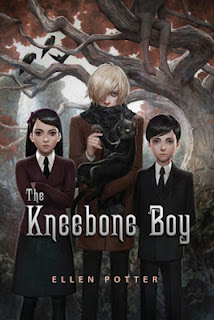 Their father is an artist, painting the portraits of lesser aristocracy and fallen royalty. He travels quite a bit but brings home the best sketches and wild stories of the people he meets.
One of the children intercepts a letter from an aunt they barely know threatening to do something if the father doesn't tell them the truth about their mother. Then their father is called away to do another portrait and he sends the three children to spend time with this aunt. But she is not expecting them and they are on their own.
Which turns out to be fine, actually. These books are always far more satisfying if the children have to find their own way. The aunt lets them stay in the "folly" or playhouse right outside Kneebone castle and it is here that they learn about the mythical Kneebone Boy.
Every generation, the Kneebone family produces a child who is horribly deformed - or so it is told. The castle is supposed to be abandoned but the Hardscrabbles know it is not and they are determined to save the Kneebone boy from isolation and deprivation.
The playhouse is huge - as big as a regular house - with gadgets and trickery galore. And there is an ominous local who spends far too much time in the surrounding woods - as do Otto, Lucia and Max.
The ending ties everything up very neatly, and if I was ten or eleven or twelve, I'd accept it without question. After all, parents do things for unfathomable reasons, right? So, read The Kneebone Boy. When you do, I'd like to know. Did you even for one second, expect it to end the way it does?

 By: Betsy Bird,
on 9/29/2011
By: Betsy Bird,
on 9/29/2011
Blog: A Fuse #8 Production (Login to Add to MyJacketFlap)
JacketFlap tags: Gail Carson Levine, Dandi Daley Mackall, Catherine Gilbert Murdock, Ellen Booraem, overweight, Ellen Potter, Josh Lieb, The Book Smugglers, book jacket nattering, Uncategorized, Add a tag
 By: James Preller,
on 4/28/2011
By: James Preller,
on 4/28/2011
Blog: James Preller's Blog (Login to Add to MyJacketFlap)
JacketFlap tags: Dana Reinhardt, april Pulley Sayre, Donna Gephart, Candace Fleming, Carol Lynch Williams, Diane Muldrow, Barry Moser, Devin Scillian, Annie Patterson, Brian Pinkney, Ann E. Burg, Around the Web, Debbie Levy, Adam Gidwitz, Andy Mulligan, Bystander, Andrea Pinkney, Mo Willems, Justina Chen Headley, Jarrett J. Krosoczka, Phyllis Reynolds Naylor, James Dashner, Margaret Mahy, Jim Murphy, Kate Messner, Loren Long, Polly Dunbar, Patricia Polacco, Julie Danneberg, Marilyn Singer, Nic Bishop, Jill S. Alexander, Margaret Stohl, Kami Garcia, Jon Muth, Preller Bystander, Laura E. Williams, Josee Massee, Margie Palatine, Michael Tunnell, New York State Reading Association, Roseann Thong, 2012 Charlotte Awards, Audrey Couloumbis, Charlotte Award Ballot, Charlotte Awards, Tricia Tusa, Eleanor Davis, Tim Bowers, Ellen Potter, Thad Krasnesky, G. Brian Karas, Geoffrey Norman, Steven Sheinkin, Vicky Alvear Shecter, Add a tag


 0 Comments on The (Re)Invention of Non-Fiction as of 1/1/1900
Add a Comment
0 Comments on The (Re)Invention of Non-Fiction as of 1/1/1900
Add a Comment
Viewing: Blog Posts Tagged with: Ellen Potter, Most Recent at Top [Help]
Results 1 - 12 of 12
By: Bianca Schulze,
on 8/6/2015
Blog: The Children's Book Review (Login to Add to MyJacketFlap)
JacketFlap tags: Ages 4-8, Fairies, Chapter Books, Author Interviews, featured, Teeth, Books for Girls, Ellen Potter, Tooth Fairy Books, Losing Baby Teeth, Piper Green and the Fairy Tree Series, Books Set in Maine, Add a tag
Blog: The Children's Book Review (Login to Add to MyJacketFlap)
JacketFlap tags: Ages 4-8, Fairies, Chapter Books, Author Interviews, featured, Teeth, Books for Girls, Ellen Potter, Tooth Fairy Books, Losing Baby Teeth, Piper Green and the Fairy Tree Series, Books Set in Maine, Add a tag
By: Bianca Schulze,
on 8/1/2015
Blog: The Children's Book Review (Login to Add to MyJacketFlap)
JacketFlap tags: Ages 0-3, Ages 4-8, Ages 9-12, Book Lists, Jennifer L. Holm, Matthew Holm, Candlewick Press, Chronicle Books, Rebecca Stead, Scholastic, featured, Wendy Lamb Books, Rick Riordan, Roaring Brook Press, Kate DiCamillo, Knopf Books for Young Readers, Amy Krouse Rosenthal, Jill McElmurry, John Rocco, Tom Lichtenheld, Antoinette Portis, Harlequin Teen, Scholastic Press, Philomel Books, Ellen Potter, Chris Van Dusen, Alice Schertle, Mac Barnett, Christian Robinson, Qin Leng, Percy Jackson & the Olympians, Teens: Young Adults, R.J. Palacio, Best Books for Kids, Erin E. Moulton, Best Kids Stories, Jessica Verdi, HMH Books for Young Readers, Hot New Releases, Drew Daywalt, Best New Kids Books, Graphix Books, Sourcebooks Fire Books, Eleanor Herman, Soho Teen Books, Alex Gino, Little Blue Truck Series, Piper Green and the Fairy Tree Series, Shannon Grogan, Tales From Deckawoo Drive Series, Add a tag
Blog: The Children's Book Review (Login to Add to MyJacketFlap)
JacketFlap tags: Ages 0-3, Ages 4-8, Ages 9-12, Book Lists, Jennifer L. Holm, Matthew Holm, Candlewick Press, Chronicle Books, Rebecca Stead, Scholastic, featured, Wendy Lamb Books, Rick Riordan, Roaring Brook Press, Kate DiCamillo, Knopf Books for Young Readers, Amy Krouse Rosenthal, Jill McElmurry, John Rocco, Tom Lichtenheld, Antoinette Portis, Harlequin Teen, Scholastic Press, Philomel Books, Ellen Potter, Chris Van Dusen, Alice Schertle, Mac Barnett, Christian Robinson, Qin Leng, Percy Jackson & the Olympians, Teens: Young Adults, R.J. Palacio, Best Books for Kids, Erin E. Moulton, Best Kids Stories, Jessica Verdi, HMH Books for Young Readers, Hot New Releases, Drew Daywalt, Best New Kids Books, Graphix Books, Sourcebooks Fire Books, Eleanor Herman, Soho Teen Books, Alex Gino, Little Blue Truck Series, Piper Green and the Fairy Tree Series, Shannon Grogan, Tales From Deckawoo Drive Series, Add a tag
For many kids, August is back-to-school month. The stories in this month's hot new release kids books will make back-to-school (and anytime) reading a breeze.
Add a Comment
By: Jerry Beck,
on 4/27/2014
Blog: Cartoon Brew (Login to Add to MyJacketFlap)
JacketFlap tags: Ellen Potter, Moonbot Studios, Bill Joyce, Ellen Coons, The Extincts, Veronica Cossanteli, Feature Film, William Joyce, Add a tag
The Oscar-winning Louisiana animation studio Moonbot recently announced that it is developing multiple feature-length film projects. It has acquired the film rights to two YA book series: the "Olivia Kidney" trilogy by Ellen Potter, which it plans to do as a live-action/animation hybrid; and "The Extincts" by Veronica Cossanteli.
Add a Comment
By: bookkm,
on 6/17/2012
Blog: Books 'n' stories (Login to Add to MyJacketFlap)
JacketFlap tags: book reviews, Ellen Potter, The Kneebone Boy, Add a tag
The Kneebone Boy by Ellen Potter tells the story of the Hardscrabble children, Otto, Lucia and Max, whose mother disappeared several years before the book begins.
The book is narrated by one of the Hardscrabbles but the narrator refuses to tell us which one. The oldest brother, Otto, has not spoken in years and wears a scarf all the time, winter, summer, day and night. He looks different from his siblings, too, having blond hair while their hair is dark. Perhaps, he is the narrator?

One of the children intercepts a letter from an aunt they barely know threatening to do something if the father doesn't tell them the truth about their mother. Then their father is called away to do another portrait and he sends the three children to spend time with this aunt. But she is not expecting them and they are on their own.
Which turns out to be fine, actually. These books are always far more satisfying if the children have to find their own way. The aunt lets them stay in the "folly" or playhouse right outside Kneebone castle and it is here that they learn about the mythical Kneebone Boy.
Every generation, the Kneebone family produces a child who is horribly deformed - or so it is told. The castle is supposed to be abandoned but the Hardscrabbles know it is not and they are determined to save the Kneebone boy from isolation and deprivation.
The playhouse is huge - as big as a regular house - with gadgets and trickery galore. And there is an ominous local who spends far too much time in the surrounding woods - as do Otto, Lucia and Max.
The ending ties everything up very neatly, and if I was ten or eleven or twelve, I'd accept it without question. After all, parents do things for unfathomable reasons, right? So, read The Kneebone Boy. When you do, I'd like to know. Did you even for one second, expect it to end the way it does?
0 Comments on The Kneebone Boy as of 1/1/1900
Add a Comment
By: Ksenia,
on 2/27/2012
Blog: MacKids Home (Login to Add to MyJacketFlap)
JacketFlap tags: humming room, Events, Middle Grade, blog tour, Ellen Potter, Add a tag
Blog: MacKids Home (Login to Add to MyJacketFlap)
JacketFlap tags: humming room, Events, Middle Grade, blog tour, Ellen Potter, Add a tag
 Ellen Potter's retelling of the classic The Secret Garden goes on sale this week: The Humming Room. To celebrate we put together a little blog tour! be sure to check out these blog tour stops for some Q&As with Ellen and guest posts written by Ellen, and find out more about Ellen Potter and the world she created in The Humming Room!
Monday 2/27 http://bunburyinthestacks.blogspot.com/
Tuesday 2/28 http://janasbooklist.blogspot.com/
Wednesday 2/29 http://www.missiontoread.com/
Thursday 3/1 http://redhousebooks.blogspot.com/
Friday 3/2 http://www.kidlitfrenzy.com/
Monday 3/5 http://www.greatimaginations.blogspot.com/
Tuesday 3/6 http://www.wordforteens.com/
Wednesday 3/7 http://vvb32reads.blogspot.com/
Thursday 3/8 http://www.thebookrat.com/
Add a Comment
By: Betsy Bird,
on 9/29/2011
Blog: A Fuse #8 Production (Login to Add to MyJacketFlap)
JacketFlap tags: Gail Carson Levine, Dandi Daley Mackall, Catherine Gilbert Murdock, Ellen Booraem, overweight, Ellen Potter, Josh Lieb, The Book Smugglers, book jacket nattering, Uncategorized, Add a tag
Since I don’t do much with YA on a regular basis I don’t read the blog of The Book Smugglers as often as I would like, even though they’re some of the best in the biz. Love their reviews. Really top notch stuff.
Anyway, they recently reviewed a book called The Girl of Fire and Thorns by Rae Carson and they got to talking about plus sized folks on covers. The initial galley for Carson’s book featured a waiflike slip of a white girl when the character is supposed to be plus sized and dark-skinned. Necessary changes were made to the final cover, but you still wouldn’t be able to tell the girth of the heroine from either of them. The Book Smugglers end their review with, “Something we haven’t talked much about, however, is this concept of slenderizing a plus-sized character for a cover. We’ve seen it before in books like Everything Beautiful. Have you noticed any of this in your reading?” Elizabeth Fama recommended a great Stacked piece on the subject from 2009 which I remember seeing some years ago that discussed this very thing.
I’ve been wondering about portrayals of overweight children in books for kids myself. With obesity rates the highest they have ever been amongst our nation’s youth, ours is a country that doesn’t know how to deal with its large children. Their portrayal in literature, therefore, is something to think about. Usually, if you’re a kid and fat in a book then you’re a villain of sorts. A Dudley Dursley or Augustus Gloop. If, by some miracle, you’re the hero of the book that’s fine, but you’d better be prepared to disappear from your own cover.
So I tried to find representation of fat children on middle grade book covers. Alas, these are the only books I was able to come up with, and as you can see they’re hardly ideal. Let’s look at what book jackets tend to do to large kids. As far as I can tell, these fall into three distinct categories: Inanimate Objects, Taking Advantage of Momentary Slimming, or Part of the Body.
Inanimate Objects
By far the most popular solution. On the YA end of things it’s almost de rigueur. On the children’s side it’s less common but not entirely unheard of.
Larger Than Life Lara by Dandi Daley Mackall
Here we had a book about a confident, well-adjusted girl who was also fat. And here we have a book cover of a dress, with no girl in sight. Yes, it refers to the plot, but still . . .

Slob by Ellen Potter
Owen, the hero of this book, is a big guy but you wouldn’t know it from looking at the cover of the book.
 11 Comments on Overweight and Invisible, last added: 9/30/2011
Display Comments
11 Comments on Overweight and Invisible, last added: 9/30/2011
Display Comments
By: James Preller,
on 4/28/2011
Blog: James Preller's Blog (Login to Add to MyJacketFlap)
JacketFlap tags: Dana Reinhardt, april Pulley Sayre, Donna Gephart, Candace Fleming, Carol Lynch Williams, Diane Muldrow, Barry Moser, Devin Scillian, Annie Patterson, Brian Pinkney, Ann E. Burg, Around the Web, Debbie Levy, Adam Gidwitz, Andy Mulligan, Bystander, Andrea Pinkney, Mo Willems, Justina Chen Headley, Jarrett J. Krosoczka, Phyllis Reynolds Naylor, James Dashner, Margaret Mahy, Jim Murphy, Kate Messner, Loren Long, Polly Dunbar, Patricia Polacco, Julie Danneberg, Marilyn Singer, Nic Bishop, Jill S. Alexander, Margaret Stohl, Kami Garcia, Jon Muth, Preller Bystander, Laura E. Williams, Josee Massee, Margie Palatine, Michael Tunnell, New York State Reading Association, Roseann Thong, 2012 Charlotte Awards, Audrey Couloumbis, Charlotte Award Ballot, Charlotte Awards, Tricia Tusa, Eleanor Davis, Tim Bowers, Ellen Potter, Thad Krasnesky, G. Brian Karas, Geoffrey Norman, Steven Sheinkin, Vicky Alvear Shecter, Add a tag
This is amazing good news. Great news, in fact. I’m happy and proud to say that my book, Bystander, is included on the ballot for the 2012 New York State Reading Association Charlotte Award.

To learn more about the award, and to download a ballot or bookmark, please click here.
The voting is broken down into four categories and includes forty books. Bystander is in the “Grades 6-8/Middle School” category. Really, it’s staggering. There are ten books in this category out of literally an infinity of titles published each year. You do the math, people.
For more background stories on Bystander — that cool inside info you can only find on the interwebs! — please click here (bully memory) and here (my brother John) and here (Nixon’s dog, Checkers) and here (the tyranny of silence).
Below please find all the books on the ballot — congratulations, authors & illustrators! I’m honored to be in your company.
-
GRADES pre K-2/PRIMARY
Bubble Trouble . . . Margaret Mahy/Polly Dunbar
City Dog, Country Frog . . . Mo Willems/Jon J Muth
Clever Jack Takes the Cake . . . Candace Fleming/G. Brian Karas
Lousy Rotten Stinkin’ Grapes . . . Margie Palatini/Barry Moser
Memoirs of a Goldfish . . . Devin Scillian/Tim Bower
Otis . . . Loren LongStars Above Us . . . Geoffrey Norman/E.B. Lewis
That Cat Can’t Stay . . . Thad Krasnesky/David Parkins
Turtle, Turtle, Watch Out! . . . April Pulley Sayre/Annie Patterson
We Planted a Tree . . . Diane Muldrow/Bob Staake
-
GRADES 3-5/INTERMEDIATE
The Can Man . . . Laura E. Williams/Craig Orback L
Emily’s Fortune . . . Phyllis Reynolds Naylor
Family Reminders . . .
Add a Comment
By: Inderjit Deogun,
on 3/24/2011
Blog: The Pen Stroke | A Publishing Blog (Login to Add to MyJacketFlap)
JacketFlap tags: Books, Kids Can Press, Children's Non-Fiction, Blue Balliett, Ellen Potter, Anne Mazer, Valerie Wyatt, Flash Point, How to Build Your Own Country, John Crossingham, Learn to Speak Music, Owlkids Books, Spilling Ink: A Young Writer's Handbook, The Danger Box, Add a tag
Blog: The Pen Stroke | A Publishing Blog (Login to Add to MyJacketFlap)
JacketFlap tags: Books, Kids Can Press, Children's Non-Fiction, Blue Balliett, Ellen Potter, Anne Mazer, Valerie Wyatt, Flash Point, How to Build Your Own Country, John Crossingham, Learn to Speak Music, Owlkids Books, Spilling Ink: A Young Writer's Handbook, The Danger Box, Add a tag
What am I reading now? The Danger Box by Blue Balliett
Non-fiction has a bad wrap. The genre has been categorized as, quite simply, boring, and rightly so. For years, the approach has left much to be desired. Alas, that has all changed.
The credit for this shift goes to a handful of innovative minds. A select few that dare to think outside the box and, by doing so, they have done what their predecessors didn’t. They made children’s non-fiction fun.
An ingenious formula that includes creativity and imagination has led throngs of young readers, and me, to their books. Of course, these innovators took advantage of colour and graphics, who wouldn’t. But, most importantly, they offer the reader the opportunity to participate. To be part of the learning process as a driver and not a passenger. That, my dear readers, deserves our recognition!
Don’t miss these exceptional titles:
How to Build Your Own Country by Valerie Wyatt | Kids Can Press

Learn to Speak Music by John Crossingham | Owlkids Books

Spilling Ink: A Young Writer’s Handbook by Anne Mazer and Ellen Potter | Flash Point

0 Comments on The (Re)Invention of Non-Fiction as of 1/1/1900
By: James Preller,
on 3/3/2011
Blog: James Preller's Blog (Login to Add to MyJacketFlap)
JacketFlap tags: Alan Gratz, Mary Downing Hahn, Julie Berry, Ellen Potter, M.E. Breen, Bystander, Alf Landon, Christopher Elliott, Mick Cochrane, Oklahoma Sequoyah Book Award, Sequoyah Book Award, Add a tag
I’m happy to report that my master plan for world domination is well under way.
Yes, I’ve got Vermont!
Yes, Kentucky too!
And now, at long last, Oklahoma is mine! All mine!
BWA-HA-HA-HAAAA!
Three states down, 47 to go. I feel like Alf Landon in the 1936 elections, staring up at the big board as the electoral vote trickled in. How’d that work out for old Alf, I wonder?

Answer: He lost to FDR, 8 electoral votes to 525.
This Alf might have fared better.
Seriously, what an honor to be nominated. It’s so great when you throw a book out into the world and something positive bounces back. (Imagine, I just griped about this the other day.)
I received an email from Christopher Elliott, which said:
Congratulations!! You have been nominated for the Oklahoma Library Association’s Sequoyah Book Award. The Sequoyah Book Award program is one of the most prestigious of the state student choice awards in the nation.
<snip>
I am pleased to notify you personally that your book “Bystander” has been nominated for the 2011-2012 Intermediate Masterlist. I am attaching a list of this year’s nominees. You have been nominated for the 2011-2012 program that will be promoted from May 2011 until the voting deadline of March 31, 2012. Votes will be counted in early April, 2012 and the winning author(s) will be notified by April 30, 2012.
The OLA Conference will be held either late March or early April 2013. If your book is selected as a winner, I look forward to contacting you to arrange for your trip to Oklahoma to accept the Sequoyah Award from Oklahoma students.
Here is a list of the Nominations for the 2011-2012 Intermediate Award. Remember the students of Oklahoma will choose the winner.
Chasing Lincoln’s Killer, James Swanson
Darkwood , M.E. Breen
Watersmeet, Ellen Abbott
The Girl Who Threw Butterflies , Mick Cochrane
Closed for the Season, Mary Downing Hahn
The Brooklyn Nine, Alan Gratz
Claudette Colvin: Twice Toward Justice , Phillip Hoose
The Amaranth Enchantment, Julie Berry
Positively Add a Comment
By: Betsy Bird,
on 6/20/2010
Blog: A Fuse #8 Production (Login to Add to MyJacketFlap)
JacketFlap tags: Uncategorized, nonfiction, Matt Phelan, Ellen Potter, Anne Mazer, 2010 reviews, 2010 nonfiction, Add a tag
 Spilling Ink: A Young Writer’s Handbook
By Anne Mazer and Ellen Potter
Illustrated by Matt Phelan
Roaring Brook Press (a division of Holtzbrinck Publishing)
$17.99
ISBN: 978-1-59643-628-2
Ages 9-12
On shelves now
I was child writer. Which is to say, I was one of those kids who wrote endless stories between the ages of nine and fourteen or so. Of these stories, I finished only one. And I remember taking a writing class over a summer once that I enjoyed, but otherwise I didn’t have a lot of direction when it came to my writing. I dabbled a bit in high school, but for the most part my creative side floundered for many years before getting a bit of a revivification in adulthood. So it’s impossible for me not to wonder how all of that might have been different had I encountered a book like Spilling Ink: A Young Writer’s Handbook as a child. As far as I can tell, there wasn’t anything like Anne Mazer and Ellen Potter’s book back in the 80s or 90s. For that matter, there hasn’t been much like it in the 2000s or 2010s! Mazer and Potter have essentially come up with a juvenile-friendly version of Anne Lamott’s Bird by Bird. I don’t invoke that standard of inspirational writing lightly when I compare it to this book, either. Though there might be the occasional detail I’d expand upon or move about in this title, for the most part Spilling Ink is the perfect book (or gift, for that matter) for any child who dabbles in putting their words in other people’s heads.
Kids may know author Anne Mazer best from her [title: The Amazing Days of Abby Hayes] series. Ellen Potter, on the other hand, is better known for the Olivia Kidney series or her individual books like SLOB. Now these two authors have joined forces to provide their young readers and incipient writers with a bit of guidance. Spilling Ink: A Young Writer’s Handbook splits into three neat and tidy sections: “Part I: Ready, Set, Go!”, “Part II: Crafting Your Story”, and “Part III: The Writer’s Brain”. Within those sections, the authors discuss everything from voice and revision to writer’s block and writing partners. The result is an exhaustive but not exhausting series of practical points of advice for kids interested in becoming that most glorious of occupations: writers.
Mazer and Potter work as well as they do together partly because their written voices meld well and partly because they consistently make good points. For example, right from the start they make it clear that in your book the main character is going to have to want something. I can’t tell you how many published children’s books I read where the characters noodle about, not wanting anything in particular while interesting things happen to them. Some adult writers could benefit from the advice in this story, I think. Another good point is made about making sure your title matches your text. You don’t want a funny title on a serious book, a
4 Comments on Review of the Day – Spilling Ink: A Young Writer’s Handbook by Anne Mazer and Ellen Potter, last added: 6/21/2010
Display Comments
Add a Comment
.jpg?picon=696) By: Gina Perry,
on 4/29/2010
By: Gina Perry,
on 4/29/2010
Blog: Picture Book Junkies (Login to Add to MyJacketFlap)
JacketFlap tags: anne mazer, spilling ink, houndsley and catina, marie-louise gay, writing, matt phelan, ellen potter, james howe, Add a tag
 A few weeks ago I was lucky enough to win a copy (hot off the presses!) of Spilling Ink by Anne Mazer and Ellen Potter. Thanks ladies! While it's a writers guide for YOUNG writers I immediately found useful and insightful advice. Quite frankly, I think I would be intimidated by an 'adult' writing book. And who doesn't love every drawing Matt Phelan does? I took this to a doctor's appointment and was REALLY disappointed that I didn't have more time in the waiting room. Once I dig deeper, I'd love to do a longer review. In the meantime, just check it out yourself!
 With writing on my mind, I found the early reader above offering me another nudge toward writing. Catina (that would be the cat character) writes every night but only desires fame from her pursuits. Turns out, she's a lousy writer and after a 3 part act, it resolves with the message that you should do what you love and happiness will follow.
 And of course I loved their little flawed friendship as well as the soft, charismatic illustrations. I think as long as your mind is open and close to good material, you'll find the inspiration you need.


3 Comments on Writing Inspiration, last added: 4/29/2010
Display Comments
Add a Comment
 By: Bruce Black,
on 3/21/2010
By: Bruce Black,
on 3/21/2010
Blog: wordswimmer (Login to Add to MyJacketFlap)
JacketFlap tags: Ellen Potter, Anne Mazer, young writers handbook, Add a tag
When two outstanding writers put their heads together and come up with a young writers handbook, it pays to listen to what they have to say whether you’re a young writer seeking advice on a story or an older writer (who has left your teen years far behind) in need of a brush-up course to remind you why you started writing in the first place.The two writers are Anne Mazer (author of over forty
0 Comments on Spilling Ink as of 1/1/1900
Add a Comment
[...] Something Strange and Deadly is supposed to be a curvy gal–it concerns me that so many covers fail to portray the characters accurately. Why do you think this is? My only guess is marketing teams think more copies will sell if the girl [...]
Ironically, once you mentioned the piece in Tablet Sunday before last, things about size and covers and fiction have all collided coincidentally in my head. I remember reading Tucker Shaw’s Flavor of the Week, and sort of marveling in my head that it was the first book where the male character was outside of the cultural norm in size, and he was in love… but the cover copped out and showed a chocolate dipped strawberry, even though a great deal of the plot hinged on him being overweight.
I was – and have been, repeatedly, disappointed…
Oh my! That is good timing. I’m just mad with myself for not reading this before I wrote my own piece.
Check out the evolution of the cover for Paula Danziger’s THE CAT ATE MY GYMSUIT.
My own beloved copy from the 70s had the top cover seen here: http://jezebel.com/359726/the-cat-ate-my-gymsuit-a-pocket-full-of-orange-pits. The current cover, I believe, is a drawing of a cat.
Interestingly, this 2008 article explains that Danziger was opposed to having her MC on the cover: http://www.printmag.com/Article/Cover_Girls.
The really depressing part is that it seems like half the time the representative object in question is going to be food. Even when that food hasn’t got much to do with the story itself. It’s like someone skims through the book’s description and decide between “Oh well, let’s just put a skinny model on the cover anyway” or “Hmm, what can I use as cover art. Obviously since this character is overweight, the ONLY POSSIBLE OPTION is ice cream.” Either way it’s marginalizing.
Interesting topic! I love the cover that my YA novel, VINTAGE VERONICA, received when it came out last year (and which is the same on the about-to-be-released paperback edition), but it is definitely in the inanimate object camp (a drawing of a dress, based on the fact that the plus-sized heroine is obsessed with vintage clothing and draws pictures of her favorite pieces).
With the exception of HUGE by Sasha Paley (which now has a cover featuring the actress from the short-lived TV show), I can’t think of a book that has dared to break this particular taboo. Carolyn Mackler’s THE EARTH, MY BUTT AND OTHER BIG ROUND THINGS had the title embroidered on the back pocket of a decidedly petite pair of jeans (a good book and a cute cover, but still…).
Even Judy Blume’s BLUBBER, I seem to recall, has never featured a truly fat girl on it (feel free to tell me I’m wrong). The one I remember best had a round-faced girl at the blackboard in a loosefitting dress with her classmates laughing at her… the current cover has a tiny whale motif that looks like in belongs on a polo shirt.
HOLES pops to mind, too. Not just because the cover doesn’t show much of Stanley (only his head, on the hardcover), but because they didn’t even attempt to make Shia Labeouf appear heavier at the beginning of the movie! I feel like it’s key to Stanley’s character that digging the holes, and suffering for it, made him fit enough and determined enough to carry Zero up the mountain.
I’m a writer and a teacher, and I once read a draft of a story to a group of fourth and fifth grade girls. The protagonist in the story (which a friendship/mystery story; the character’s weight was not part of the plot) was described as being “a little bit fat and very pretty, with wide green eyes and wavy hair”. Though the girls loved the story, they told me that I should change the description, because nobody would want to read about a fat girl. One of the most outspoken of the readers was herself, “a little bit fat”. I was trying to write about someone who looked like her–but she was emphatic about not wanting to read about a fat girl.
Another time, after reading about about the Japanese pearl divers, I tried to explain that one of the reason why the deep sea divers of Japan were often women was because women had more body fat than men, and the extra fat helped them cope with the extreme cold of deep water. The children were visibly embarrassed, and one child told me I was being sexist, to say that women were fatter than men. It was clear to me that “fat” did not mean, “more flesh” or even “extra flesh” to them. It had powerful negative connotations–it meant ugly or even obscene.
I’m not saying that publishers are right to “correct” or obscure the figures of heavier protagonists. What they are doing is part of the problem. But the prejudice against fat in this country is all pervasive, and has grown much stronger during my lifetime. I have no doubt that publishers sell more books when they don’t put fat characters on the cover.
Nice post, Betsy. I think I told you I recently had an essay on fat kids in kidlit killed. I think whenever you say that anti-chunk bias is harmful to kids, you wind up freaking people out. The “fat is bad” meme is so ingrained that merely pointing out that fat kids experience a ton of bias puts you in perceived advocacy territory.
I’m going to rework it as a reported piece and try again to place it.
Thanks, Anonymous, for your experience from the trenches. I wish I were surprised at your students’ “no one wants to read about a fat girl” feelings. While there are positive portrayals of kids who are fat in YA (tho they’re rare) and cute images of chubby cartoony kids (and badgers, lemurs and infinite other cute visual stand-ins for kids) in picture books, middle grade books seem MUCH more likely to demonize fat kids. And when fat teenagers appear in YA, they DO often — not always, but often — wind up losing weight when they gain control over their lives or get happier. Real life doesn’t tend to work that way.
Erica, as a fat devotee of vintage, I’m very much looking forward to reading Vintage Veronica! I’ve had it for a year but since I always have to prioritize explicitly Jewish books for work, I haven’t gotten around to it. (I did just read When Life Gives You OJ with my kids — no fat, but lots of Jewy — and we all really enjoyed it!)
I’m somewhat torn about this, because I actually really hate covers with pictures of people on them. So I prefer the object covers to the people ones. But if there is going to be a person on my book, I want the person to look like they’re supposed to.
The title of your blog post will most likely be the words written on my tombstone