new posts in all blogs
Viewing Blog: So Many Books, Most Recent at Top
Results 1 - 25 of 1,661

the agony and ecstasy of a reading life
Statistics for So Many Books
Number of Readers that added this blog to their MyJacketFlap: 8
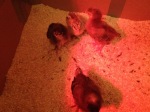
The Dashwoods – a week old!
Still trying to work out the new routine that includes the care and feeding of the Dashwoods and last night when I finally was able to sit down to blog I looked at the clock and had only about five minutes before I had to start getting ready for another commitment.
At the moment it seems like I have lots of books on the go and very little time to read them. Or rather, not as much time as I would like to read them. I find myself longing for a vacation escape to someplace where all my needs are catered to and all I have to do is sit and read. Ah, wouldn’t that be nice?
My commute book is Jane Eyre. I haven’t read it since the long ago days of college. I’m up to the night before the wedding. I am really not sure what to make of the book at the moment. The power differential in the relationship between Jane and Mr. Rochester is so skewed and even when Mr. Rochester proposes for Jane to behave as his fiance and not his employee for the month before the wedding, Jane turns him down, continues calling him sir and master. But also in doing this she manages to hold power over Rochester by denying him access to her as his future wife. Each of them is really pleased about their power over the other and relishes in making threats. It is disturbing.
I started reading Mieville’s newest, This Census-Taker, and I am not sure whether I like it. I like Mieville quite a lot. I have read Perdido Street Station and The City and The City. He is so good at world-building and creating a rich and detailed setting but This Census-Taker is scaled back, simplistic in a way. The tone feels flat and Mieville’s love of words that sends me to the dictionary is nowhere to be found. He’s trying out a stylistic thing that is interesting — the story is told (so far) from the perspective of the main character looking back on when he was a boy. He refers to his boyhood self in both first person and third person. And given the fear and violence of his childhood the fear and dissociation is realistic and understandable. But with that being the most interesting thing going on, it is hard to want to keep reading the book. It is a novella, so not so very long, but I can’t decide whether or not to keep going yet.
The Portable Veblen by Elizabeth McKenzie on the other hand, is truly delightful. The story is told in alternating chapters between Veblen and her fiance Paul. Veblen is smart and funny, loves squirrels, loves her house, is not afraid of hard work. She dropped out of college and is perfectly content working as an admin assistant. Her chapters so far focus on her engagement to Paul and her concerns that their relationship is doomed. Even the squirrels seem to be warning her. Paul is a neurologist who just took a job for a big pharmaceutical company to develop a tool and technique he invented for treating traumatic brain injuries in the field. His chapters tend to be career focused and filled with assumptions about what his future with Veblen will be like. It doesn’t take observant squirrels to see that there is trouble ahead for these two.
I am also still reading Jessa Crispin’s The Creative Tarot and enjoying it very much. It is not the kind of book to read cover to cover. But I am moving towards the end and hope to be able to write about it soon.
I started reading The Cabaret of Plants by Richard Mabey again and I like it very much but the reading is going slowly because I have so many other books on the go. I just picked up from the library a graphic novel I have been waiting my turn for for ages, Strong Female Protagonist. That will be something to enjoy on the weekend I think. And I also brought home from the library Dark Money by Jane Mayer. It is about money in American politics, particularly the money of the Koch brothers. Mayer is an award-winning journalist and while she was researching this book she was surveilled and attempts were made to discredit her. Ominous, isn’t it?
Of course I have all sorts of other books on the go. I briefly felt like my piles were getting a little smaller and then they sprang back up again even taller than before. I think I might just give up trying to manage the piles at all, it is a losing battle that only seems to cause me stress and worry. I just have to go with it and not be concerned about it. Things will either work out or they won’t and if they don’t the the worst thing that could happen is I have to return a book to the library before I get a chance to finish it. No, the worst thing would be my reading table collapses. But it hasn’t yet and it isn’t even wobbly. The books piled on it are more likely to fall off than the table is to fall down. So it’s all good!
Filed under:
Books,
In Progress 

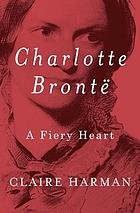 I’ve never read a biography about any of the Brontës before so when the publisher offered me the chance to read Charlotte Brontë: A Fiery Heart by Claire Harman I said, sure! This year is the two hundredth anniversary of Charlotte Brontë’s birth and that we are still reading her and talking about her books and her weird family really says something. Harman’s biography is advertised as “landmark” because it “transforms Charlotte Brontë from a tragic figure into a modern heroine.” I’ve never thought of Charlotte as being a tragic figure and I didn’t feel like the biography made her out to be a modern heroine. This is not a criticism of the biography itself, only of the book’s marketing.
Because the biography was pretty good. It didn’t spend much time at all analyzing the novels, which is good because while a little analysis is fine, I don’t read literary biographies hoping for a dose of lit crit. Of course the books are talked about, especially in relation to their autobiographical elements that somehow always seem to have much to do with Charlotte’s obsession with Monsieur Heger, her teacher and eventual employer in Belgium.
Let’s talk about that relationship a bit, shall we? Heger was married to the woman who ran the school. It appears that he really did like Charlotte more than he should. But it also seems like he managed to more or less skate along the border of propriety. He knew she liked him and he would write her notes or give her small gifts or “academic encouragement” to egg Charlotte on. But he never told her he loved her or made any overt overtures or promises. Madame Heger was too vigilant for one, and I get the impression that Charlotte was a teacher-student crush that got way out of hand because Heger did not expect Charlotte to crush on him so hard. Charlotte was borderline stalker and if she had been in modern times I could see her doing a Fatal Attraction kind of thing. Because Brontë.
You write about one Brontë you kind of have to write about them all. I knew they were not your normal sort of family but I didn’t realize just how crazy they all were. Anne I think was the most normal of them all and she was doing ok, had a good gig as a governess in a family she liked that also liked her. She even got her no good brother Branwell a job as a tutor for the boy in the family. Only Branwell had to go and have an affair with the lady of the house and Anne had to quit with the shame and humiliation.
Branwell was so full of himself and his entitlement because of Patrick his father who was also full of himself and his entitlement. Patrick is kind of like a male version of Mrs. Reed in Jane Eyre and Branwell is like John Reed through and through. And because of those two jerks, all the Brontë women were made to suffer.
Also, their closed little world at the Parsonage was not a mentally healthy situation. If Anne was the most normal, Charlotte was the second most normal. Sure she was a stalker, but she was at least functional and even had friends. Emily on the other hand, totally bananas. If you have ever wondered what sort of quiet retiring person could come up with the sick and twisted relationship that is Cathy and Heathcliff, I tell you this little story about Emily.
She was out walking one day and came upon a dog in the road. Emily liked animals and she stopped to talk to the dog. Only the dog bit her. Terrified she might have rabies but not wanting to tell anyone, she went home and cauterized the dog bite with a hot iron. Good thing women dressed so modestly back then otherwise can you imagine the dinnertime conversation when everyone got an eyeful of dog bite and iron burn? Not something one can easily explain away. Then again we are talking about the Brontës here so maybe they would have been like, Emily you are so badass! Or just made a collective whatever kind of shrug.
The biography details the trials and travails of the sisters trying to get published, goes into detail regarding Charlotte’s writing schedule and relationship with her publisher and her public. It seems she pretty much always refused to make any changes to her manuscripts. She was shy and socially awkward but her publisher treated her kindly, inviting her to London to meet the literati. In spite of his pleasantness, he paid Charlotte significantly less for her books than a man would have been paid. So what else is new, right?
Charlotte eventually did get married to Arthur Nicholls, her father’s curate. Her father was very unhappy about this because he was a mean, old selfish man who, instead of being happy for his only surviving child, was angry at her for not devoting her life to his care and feeding. But Charlotte smoothed it over by continuing to live at the Parsonage, much to her new husband’s displeasure. But that just goes to show how much Nicholls loved her, willing to live under the same roof as Patrick Brontë.
Unfortunately once Charlotte was married she pretty much stopped writing. She dedicated herself to the care of her husband and duties as a curate’s wife. And then she got pregnant and the pregnancy killed her. Her death certificate says she died from tuberculosis, but all evidence indicates that she had hyperemesis gravidarum. The cause is unknown but one theory suggests it to be an extreme reaction to pregnancy hormones resulting in a constantly upset stomach, nausea and other issues. These days she would have been able to go to the hospital like Kate Middleton did, but back then there was no help and Charlotte slowly wasted away and died. Given that she had stopped writing, I can’t help but wonder if, even had she lived, there ever would have been another book. It is too bad we never got to find out.
If you, like me, have never read a bio about Charlotte or the Brontës, this one was pretty good. Knowing a bit about their lives casts their books into a different light. But don’t just take my word for it, Jeanne and Jenny have both read and reviewed the book as well.
Filed under:
Books,
Memoir/Biography,
Nonfiction,
Reviews Tagged:
Charlotte Bronte,
Claire Harman 

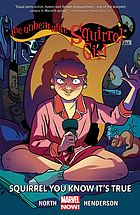 It is so hard to get any reading done with the Dashwoods! Not that they are intrusive or anything they are just so gosh darn cute I want to sit and watch them all day. So reading on the weekend, not much happened between the Dashwoods and cycling and me giving Astrid a nice spring cleaning. But I did read volume two of The Unbeatable Squirrel Girl! I must say I came very close to admitting that squirrels were kind of almost awesome. But I stopped short and veered left and laid the awesome on Squirrel Girl instead.
Volume two sees Doreen Green, aka Squirrel Girl, meeting a few new friends — Chipmunk Hunk and Koi Boy. Koi Boy is kind of weird, but Chipmunk Hunk is hilarious. He has a little puffy tail! This comic is so oddball but in such a charming and exuberant way I can’t help but like it. Squirrel Girl has such an upbeat attitude, and while she gets in the punches as good as any other superhero does, most of the time she solves problems by talking and since she is a squirrel girl she knows how to chatter and not shut up! So you could kind of say she wears her enemies down with her unceasing chit-chat.
The main story arc through volume two is the arrival of Girl Squirrel who actually turns out to be Ratatoskr, a Norse squirrel god with a unicorn horn? Ratatoskr is actually legit. S/he is a squirrel that runs up and down the world tree Yggdrasil. Apparently even world trees need squirrels!
In Squirrel Girl, Ratatoskr is bent on destroying Midgard (Earth) by stirring up trouble and playing on peoples’ insecurities causing them to get angry and go rioting and other destructive mayhem. With the help of her non-superhero roommate, Nancy, Chipmunk Hunk, Koi Boy, Lady Thor, former Thor, and Loki who shapeshifts into Cat Thor to annoy his brother, Ratatoskr is defeated and Midgard is saved.
It is all great rollicking fun and the tiny commentary at the bottom of the page adds extra entertainment as do the letters fans have sent in with photos of themselves with baby squirrels or doing Squirrel Girl cosplay.
So you can get the flavor of Squirrel Girl, here is part of a speech she is shouting through a megaphone at a crowd that Ratatoskr has sent after her:
Envy isn’t about the person you are jealous of: it’s about yourself. It’s your mind telling you exactly what you want, and you know what that is? That’s friggin’ self-knowledge, and it’s the first, most valuable thing in the universe. It’s how we tell ourselves what we need to work on in order to make ourselves the better, happier, more awesome versions of us that we deserve to be … Let’s be the change we are insecure and jealous about in the world!!
Heh. Oh and Buffy fans, there is a scene in which roommate Nancy breaks down over the fact that all her friends have super powers and she doesn’t and she moans, “I’m the Xander.” That one cracked me up!
If you have read the first volume of Squirrel Girl, get yourself the second. If you have not read Squirrel Girl and are looking for an offbeat, fun and positive comic, you’d be hard pressed to find something better.
Filed under:
Books,
Graphic Novels,
Reviews Tagged:
squirrels 

Let’s just get right to the Dashwoods, shall we? Turn up your volume so you can hear them peep.
I’ve been taking a little time to figure out who is who and I think I’ve got it. So, the little brown one with the chipmunk stripes is Marianne (Americauna). The reddish-brown one is Elinor (Rhode Island Red). The bigger black one with the white smudge on her head is Mrs. Dashwood (Australorp). The little black one with the white chin and tummy is Margaret (Barred Rock).
They eat a lot. They poop a lot. They sleep a lot. They peep peep a lot. They are cute a lot.
I am glad we were warned how fast they can fall asleep because the evening we brought them home they were all gathered round the feeder and Margaret began swaying and then took a nose dive into the food and just lay there until one of the others stepped on her and woke her up.
Mrs. Dashwood is quite protective and will charge the little scooper I use to scoop out dirty litter. She also charges the side of the box and tries to jump out. We are in the process of making the sides of the box taller. They are already noticeably larger than when we brought them home and the feathers on their wings actually look like feathers instead of fluff. This is all since Thursday.
My babies are growing up so fast!
I visit them every few hours and talk to them and traumatize them by picking each one up in turn and holding her cupped in my hands against my chest. I’ll pick up Mrs. D and she will peep like she is being murdered. I’ll hold her against me and she will calm down. I don’t hold her long, then I put her back in and she runs to the other three and tells them what happened. Then I will scoop up Elinor and she will peep like she is being murdered. I’ll hold her a little bit and put her back in the box and she will run to the other three and tell them of the horrors she just experienced. Marianne and Margaret both do the same thing. And then they forget about their trauma and wander around peeping and eating and pooping.
The cats know something is up but they have not seen the Dashwoods. They sit outside the closed door to the room where the chicks are and make upset meows, not because they want the chicks, but because they can hear me in the room talking and I am not talking to to them. When I am not in the closed room with the girls, the cats could not care less about what is behind the door.
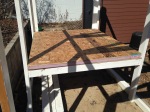
Barton Cottage has a floor
Today has been a beautiful day and Bookman and I spent part of it outdoors working on Barton Cottage which now has a floor. The pink stuff in the middle of the sandwich is insulation. On top of the plywood we will be installing linoleum for ease of cleaning.
Our next step is to put up the plywood roof before we get going on the walls. That way if it rains any time before the walls are finished, no water will get down into the wall insulation. That’s the idea anyway.
The Dashwoods are as cute as can be and I am so happy to have them. I knew they would grow fast but I didn’t realize how fast. They are still pretty fluffy but I don’t think that will last very long at all. I will do another video next week. Stay tuned…
Filed under:
chickens 

The photo is black and white because the heat lamp is red and all the photos I took this morning are red. Filtering out the red leaves no color at all. But they are still cute! Later when it is warmer I will turn the light off for a few actual color snaps.
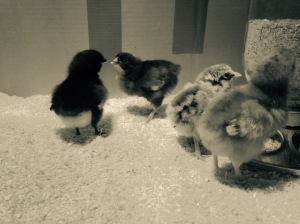
They peep a lot. They are either sleeping or eating. I watched one of them this morning fall asleep while eating and do a face plant into her food. In one word: adorable.
Waldo and Dickens aren’t sure what is going on. They have not seen what is making the noise and won’t for a long time.
More to come. And some video too where you will hopefully be able to hear them peeping!
Filed under:
chickens 

Do you ever wonder what your life would be like if you weren’t a reader? I found myself rolling it around in my brain after work today while walking to catch my train. I’ve been feeling so busy that it seemed like I could actually manage it and, dare I say, not miss reading for at least a little while. I made myself laugh because here is what I thought:
If I weren’t a reader I would certainly have lots more time because I wouldn’t be reading, I wouldn’t be blogging about books or reading other blogs about books. Wow, I’d have so much extra time to read!
Wait, what?
And it took me a few seconds to realize what I was thinking because when I thought about how much extra time I’d have to read if I wasn’t reading my brain started going over my TBR lists and wondering what books I should read first. I was also carrying a book in my bag I had just checked out from the university where I work called Green Planets and Science Fiction about the intersection of SF and ecology.
Clearly if I ever seriously decide to give up reading for a while, I will have my work cut out for me.
No post from me tomorrow night, I will be out collecting the Dashwoods and escorting them to their new home. A respite for you all before I bombard you with baby chicken photos and video. You have hereby been warned.
Filed under:
Books,
Reading 

Something I learned today: extraterrestrial law is NOT the same as extraterritorial law. The field of extraterrestrial law as such does not exist. There is space law, but it is not the same thing. So, if there is anyone out there interested in extraterrestrial law, the area is currently wide open. Make your mark!
This is what happens when you should put your reading glasses on to read a title before typing it into a search field and decide eh, the type is big enough I can read it. Silly Stef. You should know better by now.
The Middles have moved to Almost Finished and that is a good thing because there are gobs of books I want to dive into and um, I am also about to be deluged by books from the library. Maybe not deluged, more like showered. I have China Mieville’s newest, The Census-Taker waiting for me to pick up. It is a novella so shouldn’t take too long to get through. In theory. Then I am next up for The Portable Veblen by Elizabeth McKenzie. I am looking forward to this especially since I got the second volume of Squirrel Girl from the library last week. The squirrels are lively right now and I need some squirrel literature to help me feel less animosity towards them and their garden-destroying ways. I am also next up for Strong Female Protagonist by Brennan Mulligan. I have been waiting for that one a very long time.
That’s not bad. Only a few library books. A light shower. And I should be able to get back to the Richard Mabey book, The Cabaret of Plants, that I had to set aside for Herman Melville and Charlotte Brontë and Tarot Cards.
I have a feeling, however, that very soon it is going to get difficult to juggle reading and all my other goings on — the chickens, finishing the coop, gardening and cycling. Cycling is becoming a major “distraction” at the moment. I have a professional bike fitting scheduled for this coming Sunday. I just found out there is a women’s racing team here called Koochella and they are offering a clinic April 10th on bike handling skills and racing for beginners. Having enjoyed some virtual races over the winter months I am curious about the real thing. Then I have another cycling clinic on April 24th for the gravel race I registered for at the end of May. This one is informational, the how-tos of gravel riding like tires and what to wear and bring for food and how to read a cue sheet (route map) so I don’t get lost because it is not a closed course or well-marked with fans and media lining the roads. After the two clinics I will have a better idea about how much I want to try racing and how much time it might take up if I do.
So perhaps I should read as much as I can these next couple of weeks just in case reading time ends up being cut back significantly. I have a four-day weekend coming up in honor of my birthday so if I can tear myself away from cooing over the Dashwoods I will be reading. Say, maybe I could read to the Dashwoods! Do you think they’d like Jane Eyre?
Filed under:
biking,
Books,
chickens,
In Progress Tagged:
extraterrestrial law,
squirrels 

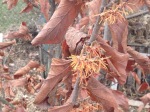
Confused witch hazel
It was a week of moderate temperatures and changeable spring weather that gave us sun and rain and wind and snow and more rain. Today was supposed to be sunny and 50F/10C but it has turned out to be damp, cloudy and 40F/4C instead. It is also Easter which I keep forgetting since I don’t celebrate it. Happy Easter to you if you do celebrate! Bookman and I went out to pick up few final items for the chicken brooder and were surprised to find the store wasn’t open. We were not the only ones pulling into the parking lot and turning around.
What need: an oven thermometer to monitor the temperature in the brooder, two small cookie sheets to have under the bedding to make cleaning easier, one extension cord so we can plug in the heat lamp because all of the outlets seem to be on the other side of the room from where the brooder is.
Is there some sort of law of extension cords that says whenever you need one you will not have a spare?
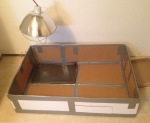
Barton Apartment
Because, maybe I’m imagining it, but we buy them and use them and then where do they go after that? They get “put away” in a place we will easily find them next time we need one. The need arises and we run around looking in all the likely places only to be disappointed. We go buy a new one. Lather. Rinse. Repeat. It’s like socks in the dryer. Where do they go? Someday I am going to discover a seething nest of extension cords in some dark recess of the house and it will be the stuff of nightmares.
The plan today was to get the few items at the store, get the brooder set up, turn on the heat lamp and monitor the temperature and adjust the light accordingly so it will all be figured out by the time we bring the chicks home Thursday night. Thursday people! I am going to have four baby chickens Thursday night after work! But wrench. So we got as far as we could. The photo is of Barton Apartment. The Dashwoods will be in their apartment for about six weeks until it is consistently warm enough outdoors, they have real bird feathers, and Barton Cottage is move-in ready.
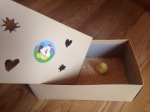
The Dashwood carriage
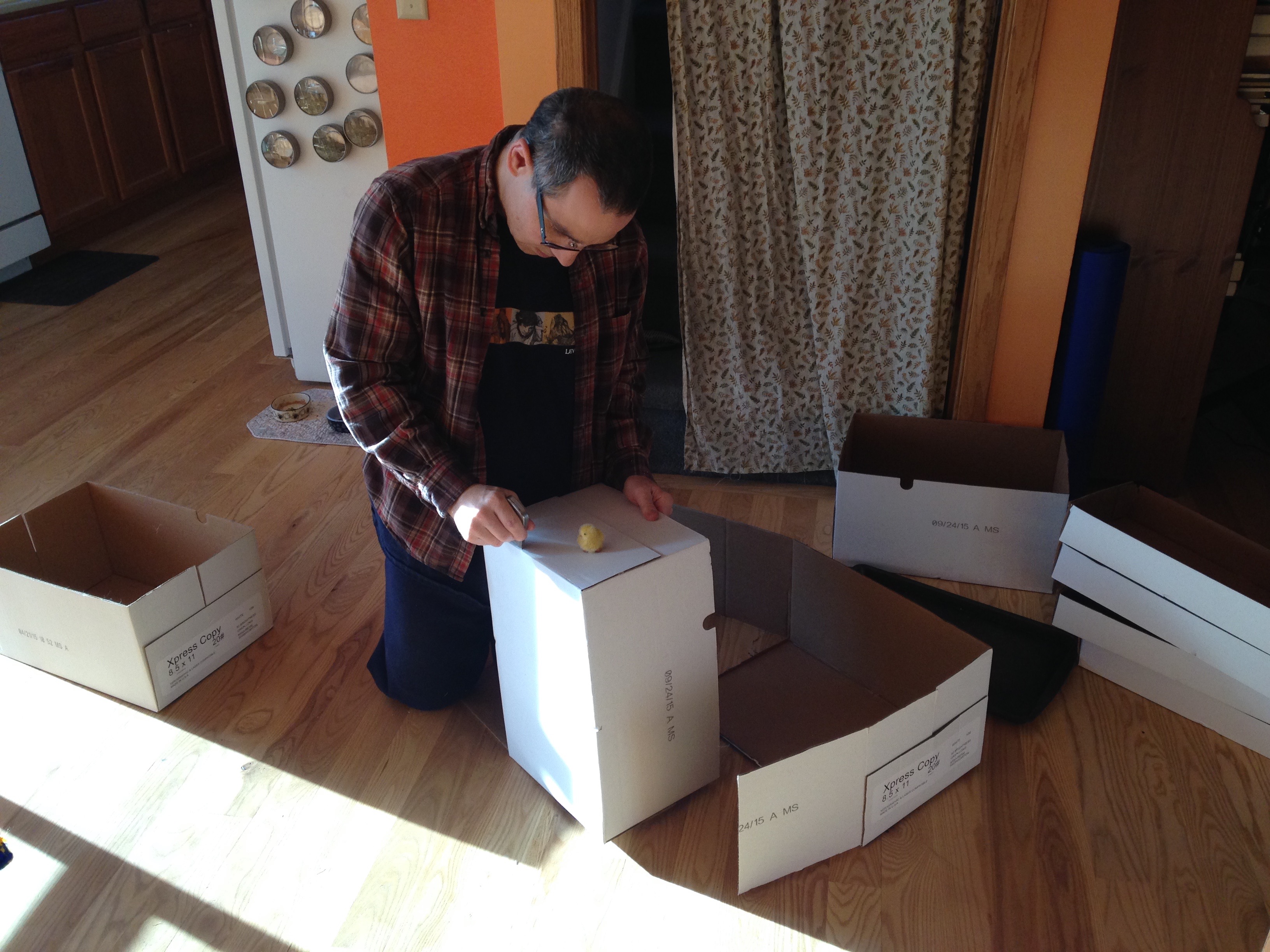
The coach is all ready for picking them up. Thank goodness we don’t need horses or footmen in livery. Bookman felt it necessary to put a chicken sticker on the box so we would not mistake it for a cat carrier. And he got fancy with cutting the holes in the top. Nothing but the best for our girls!
You know, when the Dashwoods arrive, for the first time ever in this house the girls will out number the boys. All of our animals except for Touche my red-eared slider turtle of 20 years (RIP), have been boys. Thursday night we will be five against three. Estrogen will finally triumph.
Even though the weather has been all over the place, the plants have all decided that spring is here. Melody Maple Tree is beginning to bloom. The witch hazel is blooming too. Poor thing, it is supposed to bloom in the fall but only managed it once. For some reason it has decided that it is a spring blooming witch hazel. And in autumn, it doesn’t like to let go of its leaves. It is a healthy shrub, just confused.
The leaf buds on all of the apple trees are swelling. Even the rose has swelling leaf buds. The spring
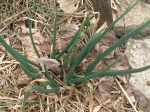
Walking onion coming up strong
bulbs are pushing their way through the winter mulch that I have not had the chance to remove yet because it has been too cold or too wet. The Egyptian walking onion has shot up, there is sorrel I can pick already. All this is happening a few weeks earlier than usual and I feel unprepared.
As I walked around the garden this afternoon I thought, briefly, oh I can plant peas and radishes and kale! Not yet. In two weeks perhaps. While the frost is well out of the ground it is still not quite warm enough to sprout seeds outdoors. It definitely won’t be long though.
I spent quite a lot of time going through the plant sale catalog this weekend marking up possibilities and dreaming. My main focus this year is to plant the green roof on the chicken coop and to get started turning the very shady area under my front yard apple trees into something that recalls a woodland. At the moment it is home to moss, violets, a very tiny patch of ramps, a tiny patch of wild ginger, a small area of alpine strawberries, and one columbine. In the middle of summer it pretty much looks like weeds.
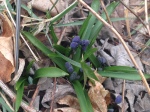
Siberian squill getting ready to bloom
I imagine a ferny glade. But I have to stop kidding myself with the ferns. I have the shade but I do not have the moisture. My soil, even after years of adding compost, is still too sandy and every experimental fern I plant is dead by the end of summer. So it is time to imagine something else. I don’t yet know what that something else is, but I am working on it. Spring ephemerals, patches of low growing plants with interesting leaves, a few bigger plants in dappled nooks. A simple path through it all. Wish me luck.
Filed under:
chickens,
gardening 

My review for Melville in Love by Michael Shelden is submitted to Library Journal and now I can get back to my own reading. I don’t feel like I can write a review of the book here, but you should know it is really good. I have a whole new picture of Melville now that I am still boggled over.
Melville fathered two children during this long-term affair with Sarah Morewood but Morewood’s husband chose not to notice that they did not look like him as did Melville’s wife. You may have heard that Melville had major financial problems, well, that’s because he bought a farm that he could not afford in order to live next door to his lover. However, Shelden presents a good argument that Moby-Dick, Pierre and Billy Budd would not be what they are if it had not been for Morewood inspiring Melville to greatness. So, look for the book when it comes out in June. It’s a good one!
How’s that for a non-review?
I get email newsletters from my favorite fountain pen store, Goulet Pens, and in a recent newsletter there was some mention about bullet journaling. I did not bother to investigate further because I assumed it meant writing a journal/diary using bullet points and what was the point of that? But today Goulet Pens posted a link on their Facebook page to a Los Angeles Times newspaper article, Why is Everyone Crazy for #bujo?. I realized this is obviously a thing so I read the article and have now been enlightened.
Have you heard of bullet journaling? It has nothing to do with keeping a diary or journaling your thoughts and feelings. It turns out to be a time and project management technique that involves using a blank journal and a pen or pencil instead of an app or a calendar or elaborate Franklin Planner. The guy who invented it has a website with a video and other step-by-step explanations on how to do it.
At first it seemed like an elaborate system but the more I followed along, the more intrigued I became. It isn’t so very elaborate after all, and once you have the basic structure down you can customize it to your needs and do whatever you want with it. The customizable bit is the most interesting part. Because you are using a blank journal (of course you can buy a “bullet journal” that has already been set up for you if you want to) you can make it your own. And the website has photos and videos of how other people do bullet journaling. Some of it is quite elaborate and intimidating and artsy and made me wonder why would you waste time drawing and doing all kinds of other stuff in a calendar/project journal? But that, it turns out, is the neat part about it.
So I’ve been wondering if I should try it. It could potentially be an efficient way to keep track of current and future events, gardening things, bookish things, work things, blog post ideas, essay ideas, things I want to look into further, to do lists, and on and on all in one place. Have any of you tried it? And if so, what do you think? Just one more bandwagon sort of thing or something truly useful?
Filed under:
Books,
Reviews Tagged:
Bullet Journaling,
Herman Melville,
Sarah Morewood 

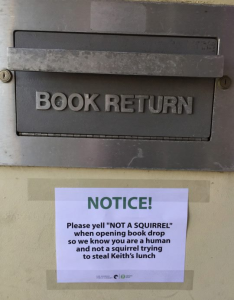
I have to write my Library Journal review tonight so I thought I would provide something for your amusement. I have been hanging on to this photo for months waiting for a good time to post it. I don’t remember where it came from, a library newsletter I think. It cracks me up, especially given my regular garden battles with squirrels. Enjoy!
Filed under:
Miscellaneus Tagged:
squirrels 

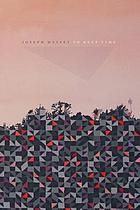 You may not know it since I don’t do a whole bunch of poetry reviews here, but I read poetry pretty regularly. My friend Cath in the Netherlands and I have a postal poetry exchange in which we choose a poem or two to send to the other every month or so. This year we decided to concentrate our poetry reading on poets we have never read before who are currently writing and who focus on nature in their poetry. I began the year with Wendell Berry and was a bit disappointed. His A Timbered Choir didn’t take flight for me. In the introduction to the book he claimed to be an amateur poet and, while there were a number of poems in the collection I did enjoy, he really isn’t the best of poets.
My next choice of poet, Joseph Massey, did not disappoint me. I don’t recall exactly how I came upon his work. I think I read about him in the Los Angeles Review of Books. He has a number of collections and since I had never read anything by him before it was difficult to choose. But when I came across a description of To Keep Time as being inspired by the landscape of Humboldt County, California, that is the one I decided to read.
What’s so special about Humboldt County? Well, when I graduated high school and decided to major in biology (I wanted to be a veterinarian) I decided to attend Humboldt State University in Arcata, California. You change a lot when you are eighteen and far away from home for the first time. Before my freshman year was out I had changed my major to English and decided I was going to teach. It meant going to a different university in Los Angeles my sophomore and following years. Nonetheless, my year at Humboldt was amazing and unforgettable.
HSU sits on a hill looking over the Pacific ocean. Stretching out behind the school are acres and acres of redwood forest. It is hands down one of the most beautiful places I have ever lived in my life. I would live there again if I could. So, poetry inspired by this landscape of ocean, redwoods, mountains, rain, fog and damp, yes please!
Massey’s poems have a haiku sensibility to them. Some are short and some are multi-parted. They are contemplative and surprising. It is the unexpectedness that I found so utterly marvelous; an image, a turn of phrase. I loved most when he would mix senses, for instance in “Microclimates”:
I squint
to hear the ocean
pierce an aperture
in sky
not wide enough
for words—
even a word—
to escape.
Also from “Microclimates”:
Bewilder-
ment persists
in this persistent
pressure gradient.
What I want to say
I can’t see to say
I can’t see to say it.
I also love the alliteration and the way he takes a word like “persists” and then changes it to “persistent.” Is there a word for that technique? I have come across it before in other poets and it is something that always gives me a little thrill.
Here is “Anchoritic”:
Listening to wind
dislodge objects
in the dark around
my room, I want
to think thinking
is enough to locate
a world, but it isn’t.
It isn’t this one.
It isn’t this world,
weather.
The word “anchoritic” is an adjective derived from the noun “anchorite.” An anchorite is a religious recluse, someone who has left the secular world to focus on their spiritual life. The poem itself is not particularly religious, but the title opens all sorts of suggestions and avenues of thought both secular and spiritual. It also suggests “anchor” as in anchored in place, but also a physical stability in the wind that is dislodging objects that contrasts beautifully with the thinking that is clearly unanchored. As you can see, the poems might be short but Massey packs in quite a lot!
I very much enjoyed To Keep Time and plan to read more of Massey’s work in the future. It is a happy occasion to discover a “new” poet.
Filed under:
Books,
Poetry,
Reviews Tagged:
Humboldt County,
Joseph Massey,
nature 

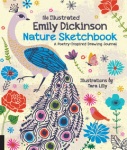 For better or worse I am a sucker for things Emily Dickinson. I love her poems so very much and she was such an interesting person — poet, gardener, baker of bread. So when offered the chance to review The Illustrated Emily Dickinson Nature Sketchbook I could not say no. Unlike past times I couldn’t say no, I was not disappointed this time around.
Just in time for National Poetry Month comes this gorgeous book that collects some of Dickinson’s poems about nature. But it isn’t just poetry. Illustrator Tara Lilly from Portland, Oregon, has created 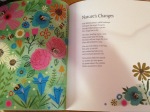 visually enchanting artwork to go along with the poems. Birds and flowers and mushrooms, butterflies and bees, I love the colors and just sat looking at them and smiling. Together with Dickinson’s poems, the art creates an uplifting and pleasant experience.
But that is not all. Perhaps inspired by the popularity of adult coloring books, The Illustrated Emily Dickinson is also a sketchbook. Most of the poems have blank pages opposite on which the reader is encouraged to create her own art while under the influence of Emily. And maybe you believe you cannot draw anything worthwhile. You don’t have to draw if you don’t want to. Maybe you just have fun swirling some colors around the page. Or, the pages are thick and could support collage if that takes you fancy.
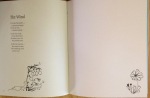 There is no need to fear your own personal creations will be somehow lacking especially up next to Lilly’s art. Her illustrations are of the simple sort that look so easy anyone can do them. And even though we all know that is a difficult thing to pull off, it is comforting to the art-challenged because you feel like you can make a go of it. In other words, the illustrations are not intimidating but heartening. You could also use the book as a writing journal or even use the poems as writing prompts and the sketch pages as your writing area.
Even if you never find the confidence to add your own art, it is still a lovely book all on its own. It would also make a great gift for anyone with an artsy bent or who just plain loves Emily Dickinson.
Filed under:
Art,
Books,
Poetry,
Reviews Tagged:
Emily Dickinson,
Tara Lilly 

Happy Spring to everyone in the northern hemisphere and Autumn to my friends in the south! I am usually so keyed to solstices and equinoxes but for some reason I totally forgot about this one and was only reminded about it during the weather forecast on the radio this morning. That kind of reveals how all over the place my brain has been of late. Work has been busy and then at home there have been lots of things to keep track of — a four-day Easter weekend, a four-day birthday weekend, chicks coming in a week and a half, a chick brooder to build, a chicken coop to finish, seeds and sprouts to keep track of, a garden to plan and a just released Friends School Plant Sale catalog to comb through to help me plan that garden. Also, books to read, a Library Journal review deadline coming up, cycling workouts, a weekly virtual cycling group ride to lead, weights to lift, core workouts and time with a foam roller for all my tired muscles. Oh, and blog posts to write. Though I didn’t do so well with that last week. This week should be better though. Maybe.
In case you haven’t been paying attention, the last two weeks have seen two new essays go up on Vocalis. Check ’em out, they are great! I’m hoping the Easter weekend will afford me time to write one of my own I have been kicking around in my head for a couple of weeks now.
Phew. Breathe.
My seed starting is going pretty well. The tomatillos are being stubborn but everything else is sprouting and growing including the peppers that were so slow to start. Last week I intended to get marigolds started but for the life of me I could not find any of the seeds I saved from last year. Where could they have gone to? I really have to make an effort to get better at organizing my end of gardening season self. I am generally so tired at that point I put everything aside to deal with in a few weeks during late fall/early winter and then it ends up I don’t do anything until spring when I am running around wondering what I did with the marigold flower heads I clipped for seeds.
Since I could not find the dried flower heads, I resorted to buying a packet of marigold seeds when Bookman and I went out today to get chicken coop hardware. We got hinges and latches for the coop and run doors. Also nails. I am paranoid about critters of both the two and four-legged sort getting into the coop and run when we are not around. As a result, you would think we were building a mini Fort Knox. We got door latches for the run door, the egg door and the cleaning door that we can put locks on. Bookman and I also spent way too much time discussing hinges — what kind, how big, how many, where and how are they to be attached, how will they open, expensive galvanized or a little cheaper zinc coated? Yes, we are totally over-building this thing. It will be a chicken coop for the ages.
The weather this weekend is sunny but a cold, much more normal temperature for this time of year (40F/4C). The week brought us sun and rain and snow. Also, my tulips are up through the mulch by several inches. The week ahead will have warm sun, rain, and possibly a day of wet, heavy snow. This is much more like typical spring in Minnesota where winter isn’t quite ready to let go but spring is ready to take over. It’s a rollercoaster. Or Forrest Gump’s box of chocolates.

Brooder building
The chicks arrive in a week and half. To that end, Bookman built us a chick brooder today. I was planning on us doing it together but he did it while I was doing some household chores. When I asked whether he wanted me to help, he grunted at me and said I didn’t have enough testosterone. The brooder is a temporary home for the chicks until they get big enough to go outside. We built it, Bookman built it, out of cardboard boxes and duct tape. Building something with duct tape is a manly job apparently, men being distinctly qualified to fix and build things with industrial strength tape.
For some reason the cats do not help Bookman build things like they help me. Perhaps they were concerned about tape and fur? Whatever the reasons, they stayed clear.
The brooder is done. Next weekend we will put in the bedding and hang the heat lamp and make it move-in ready for the babies. Just a little over a year ago we decided to get chickens. Back then it seemed like a forever time to wait and now in about ten days, the Dashwoods will be arriving and I worry if we are ready. I’ll find out soon enough.
Filed under:
chickens,
gardening 

By: Stefanie,
on 3/16/2016
Blog:
So Many Books
(
Login to Add to MyJacketFlap)
JacketFlap tags:
Books,
TBR,
Add a tag
Many book bloggers had posts up Tuesday about top ten books on their spring TBR lists or something like that. And casting around for a topic because I remain firmly in the middles, I thought, hey! TBR, I have one of those! Actually I have more than one of those. There’s the real life books such as the ones on my poor reading table that I am supposed to be reading this year but somehow am not doing a very good job of it. Then there are my many many TBR lists scattered around the virtual world. Anyway, I had to ditch the post because it involved my library TBR lists and for some reason I kept getting errors every time I tried to login. But tonight my friends, tonight you are going to get lucky! (Not that kind of lucky, get your minds out of the gutter!)
My library. They allow me to create wishlists. Last year I began using this feature far more than I probably should. But the way I see it, it is better to put an interesting book on my virtual TBR list than to buy it and have it sit around for years and years and years. My library wishlist began as just one list called “Default List.” Seriously, that is what the list is called. I never bothered to change it and now that there are 297 books on the “Default List” I am terrified to try and change the name for fear the list will go *Poof!*
Once Default began to get large and a bit unwieldy, I started creating other lists like one for poetry and one for nature and gardening books. I also created a “priority” list to help me keep track of the books I really really want to read but just can’t right now. My priority list currently has 45 books on it. See how well it works? Now, given that I read about 65 books a year, it will take me most of a year to read all those priority books and we all know that’s not going to happen. Because more books will be added and there will be books that don’t get added because new and shiny and I have to read right now and contrary to popular belief I do, on occasion, actually read a book I already own. I can conceive in some, probably not so very distant time, that I will make a move to create another list and call it something like “immediate priority.” And then when that gets too big there will be another list, “the first priority.” And it will just keep going on and on becoming more and more absurd because that’s the way I roll.
But for now, there are 45. Do you want to know what some of those 45 books are? I’ll give you ten:
- After Nature: Politics for the Anthropocene by Jedidiah Purdy. “Nature no longer exists apart from humanity. Henceforth, the world we will inhabit is the one we have made.”
- Cities I’ve Never Lived In by Sara Majka. Linked short stories.
- A Darker Shade of Magic by Victoria Schwab. Adventure, magic, parallel universes. You can almost tell me parallel universes and I am likely to bite.
- Death in the Garden by Elizabeth Ironside. A murder mystery, rare reading for me!
- Exit Wounds by Rutu Modan. A graphic novel set in modern day Tel Aviv.
- Gold Fame Citrus by Claire Vaye Watkins. This is a climate fiction novel set in California where disasters love to happen. Since I was born and raised in California I am totally allowed to be delighted about any kind of California disaster scenario, especially ones set in Los Angeles. And yes, I totally love 1970s disaster flicks! Also the one with the volcano under LA. I always knew there was something weird going on under the La Brea Tar Pits!
- Montaigne by Stefan Zweig. No explanation needed.
- Potluck Supper with Meeting to Follow by Andy Sturdevant. Essays about the midwest, including Minneapolis.
- The Traitor Baru Cormorant by Seth Dickinson. Political science fiction. Oh how I lurve political SF.
- The Mersault Investigation by Kamel Daoud. A fictional response to Camus’ The Stranger.
Essays, fiction, nonfiction, science fiction, a mystery, a graphic novel. All sorts of yummy goodness to look forward to. It’s all a priority. Obviously I am a little fuzzy on the definition of that word.
Filed under:
Books,
TBR 

I’m in one of those annoying middle times that happens now and then where I have finished a number of books close together and then find myself in the midst of many things but close to finishing nothing. That means no reviews to write and much effort spent wracking my brain to find a topic to blog about that isn’t terribly repetitive or boring.
I did start reading Jane Eyre last week. I have read it at least twice before, maybe three times, I can’t remember for sure. The last time I read it was twenty years ago. What is so wonderful is that it feels familiar enough still that I have the pleasure of anticipating certain events. It has also been long enough that I don’t remember everything. Then there is the fact of having lived twenty years (plus a few) and experiencing the story differently than I did in my early twenties. Add to this that I am still making my way through Fiery Heart, the new biography of Charlotte, in which the author points out different events in Charlotte’s life that end up being reflected in Jane Eyre. It makes for a rich reading experience.
I am racing through a book to review for Library Journal on Melville and his affair with Sarah Morewood. Both of them were married at the time. I never knew much about Melville’s biography other than that he spent time at sea and all that, but I always pictured him as a proper sort of fellow. Far from it! He was a very bold, party-loving kind of guy and during his sailing years he spread his love around among the South Seas ladies. His novels pre-Moby Dick garnered him a large and fawning fanbase of women groupies who imagined exciting and exotic romantic situations with Melville the sailor! I am having a hard time adjusting my picture of the man.
My eyeballs are also giving time to The Creative Tarot by Jess Crispin of Bookslut fame. Part of me wants to forget reading everything else and devour this book. I have a collection of tarot cards and have a tattoo of the strength card from the Rider-Waite tarot deck. The book is not about fortune-telling but about using the cards for creative inspiration. I am very much enjoying it.
There are many other books I am in the midst of right now, most of them I’ve had going for quite a while and have mentioned them numerous times. But these are my main squeezes at the moment. Very soon I get a four-day weekend for Easter and I am looking forward to spending the time reading, gardening and cycling with reading top on the list. I am very much looking forward to that. I might even be recovered from the change to Daylight Savings by then too.
Filed under:
Books,
In Progress 

It’s been one of those really busy weekends with nothing much to show for all the busy. Brunch with a friend, a women’s bike race, bike rides, a movie and popcorn, a letter to a friend, housecleaning, laundry, a few errands, sprout tending, cat tending, lost sleep because of warm weather, cats and the time change, too much coffee. I haven’t managed to read anything but a few poems and part of an interesting article about crows in Audubon Magazine. The weekend is drawing to a close and I am definitely not feeling weekend restful, could I have another please?
The weather Friday and Saturday was absolutely gorgeous. I got to go home from work Friday an hour early — yay! — and wouldn’t you know it, the buses were running late. At least I got to wait in the sunshine while reading Jane Eyre so it wasn’t all that bad.
Saturday was nice enough that I had all my trays of sprouts out on the deck. The extra warmth I had been giving the peppers and the shot of warm sun Saturday has finally got the seeds sprouting. The onions and tomatoes are doing great. The basil is just beginning to unfurl some tiny leaves. Today I was going to get some marigolds started but I just didn’t manage to get those pots filled with dirt and the seeds into them. Perhaps I can still squeeze it in before my head hits the pillow tonight.
While the early spring weather is pleasant, the fact that the temperature was 25 degrees F warmer than normal is disturbing if I think about it too much. If you haven’t had a chance to read the good and interesting article at LitHub, There is No Market Driven Solution To Our Climate Change Catastrophe, I highly recommend it.
Paul Mason writes of the “complacent calm” in the “world of suits” and says,
The focus is on scenarios for ‘what will happen,’ the climate catastrophe that awaits if we allow global temperatures to rise by more than two degrees Celsius above pre-industrial levels. But in the edge-places of the world the catastrophe is happening already. If we listened to those whose lives are being destroyed by floods, deforestation and encroaching deserts, we would better understand what is coming: the total disruption of the world.
I think many people are still under the impression that impending climate disasters are going to happen to other people somewhere else far away and not to them personally. There are going to be a lot of surprised people in the world over the course of the next 15-20 years.
The weather today was still warmer than normal but gray and damp feeling. Bookman unfortunately had to work all weekend so there was no chicken coop building. Hopefully next weekend will be conducive to getting out and putting on a roof and starting to build some walls. If not, we’ll be indoors getting the chick brooder ready. Next weekend puts us two weeks away from the arrival of the Dashwoods!
Filed under:
chickens,
gardening Tagged:
climate change 

By: Stefanie,
on 3/10/2016
Blog:
So Many Books
(
Login to Add to MyJacketFlap)
JacketFlap tags:
Books,
Reviews,
squirrels,
New Acquisitions,
SciFi/Fantasy,
Elizabeth McKenzie,
Han Kang,
Baileys Women's Prize Longlist,
Janet Todd,
Man Booker International,
Add a tag
One thing I forgot to mention in my write-up of Long Way to a Small Angry Planet yesterday was how much the book is about violence and the ways in which cultures and individuals deal with it. I mentioned Dr Chef’s species the Grum who had destroyed themselves in a war and the survivors had decided it was not worth rebuilding their society, they had ruined their right to exist in the galaxy and so the species is going extinct.
I also mentioned the captain of the ship, Ashby. As an Exodan human he is a pacifist. When humans were still on Earth and doing their best to destroy it and each other, the wealthy picked up stakes and moved to Mars, creating a colony there but only for the people who could afford it. Those left behind on a planet that was no longer hospitable to human life, made a last ditch effort to survive by building ships and launching out into the unknowns of space with no real destination. Some of them survived because they were found by one of the species of the Galactic Commons. As a result of their experiences, the Exodan humans developed a culture of pacifism that is often so extreme they refuse to even defend themselves when attacked.
All of the various species in the book have stories of violence and war in their collective histories. The Galactic Commons itself is a kind of galactic UN. How each culture came to terms with their violent past makes for an interesting examination of responses to violence. One culture goes in for communal orgies while another becomes so rule-bound that spontaneity is not heard of and would probably get you thrown into prison anyway.
Then there are the Toremi, a species whose whole existence is shaped by the continuous wars between the clans. They all believe the wars are sanctioned by the Pattern, the belief system by which they live. The violence doesn’t just exist between clans but within one’s own clan as well. It is a kind of dog-eat-dog existence and the more you kill the more respect you garner. Any offence no matter how slight, might get you killed or prompt you to kill someone else.
One of the great things about the book is that while all of this is there, it is never posted with flashing neon signs nor does the author make any intrusions and tell us what to think. We are being offered options, different ways of being and the reader gets to choose and decide for herself.
And this is why blogs are so great for talking about books – we aren’t bound to one review and done, we get extra innings.
While perusing the Baileys Prize longlist I spied The Portable Veblen by Elizabeth McKenzie. This is the book that has the tête-à-tête with the charismatic squirrel in it that I am waiting my turn for it at the library. I have moved up to 27th place. Alas I was hoping I would have that book and the next Squirrel Girl comic about the same time but it is not looking likely. I am already up to number 8 for Squirrel Girl.
Since I am on the topic of books on prize lists, The Vegetarian is on the longlist for the Man Booker International. I’m sure all the books on the list are good but I can’t imagine that any of them could be as good as Kang’s. I hope she wins!
Another unsolicited distraction arrived in my mailbox yesterday. This one is by Janet Todd. That would be the same Janet Todd who has written biographies of Jane Austen, Mary Wollstonecraft, Aphra Behn, and many others. Except this book is a novel, A Man of Genius. Because of the cover (a Venice canal) and the cover blurb rapturing on about love, obsession and “decadent glory,” I was in the process of moving it to the pile of books to get rid of when Bookman stopped me. You know who Janet Todd is don’t you? The name was familiar but I couldn’t quite place it. Then Bookman connected the dots for me and suggested I might want to not be so hasty in getting rid of it. He was right. So now it is on my poor reading table.
The book is historical fiction featuring a woman who makes a living writing cheap gothic novels. She meets and becomes the lover of Robert James, supposed poetic genius. They go to Venice. Spies, intrigue, madness, revelations ensue. Sounds like a potboiler and not my typical choice of reading but I will give it try. Just don’t know when yet. But that probably surprises no one.
Filed under:
Books,
New Acquisitions,
Reviews,
SciFi/Fantasy Tagged:
Baileys Women's Prize Longlist,
Elizabeth McKenzie,
Han Kang,
Janet Todd,
Man Booker International,
squirrels 

I have been looking forward to telling you all about The Long Way to a Small Angry Planet by Becky Chambers since I finished it a few days ago. It is one of those quiet books that you want to tell everyone to read because you loved it so very much and just did not want it to end and you want everyone else to love it as much you do. And then I find out it has made it onto the Baileys Women’s Prize Longlist and did you hear me go Squeee!? Because now for sure more people will know about this book.
The Long Way is Chambers’ debut novel. It was originally published because of a Kickstarter. Chambers found herself almost through a draft when her freelance writing work dried up. She had two options, shelve the book and return to it later or see if she could get funding to get it published. Thank goodness she got funding!
The book is one of those stories that is about everything and nothing. There is not much of a plot and hardly any action but I loved the characters so much every time I picked up the book I wanted to hang out with them and never leave.
The story takes place in the distant future. Humans have destroyed Earth, colonized Mars and headed out to the stars. But we have also gone back to Earth to try and fix the damage. As a result we have a number of different human societies with vastly different values. We’ve also met other species out there in the galaxy and become part of the Galactic Commons. The Wayfarer is a tunneling ship. They take jobs where they create tunnels through space and time to shorten the distance between areas of the galaxy to make space travel easier and faster. Basically they create stable wormholes from point A to point B.
The ship is owned and captained by the genial Ashby, a human of the Exodans, which means he is a pacifist among other things. His crew is composed of Rosemary, a clerk and new hire he brings on to do all the paperwork at which he is really bad and because of that is in jeopardy of not being able to pick up good work. Rosemary is a Martian human and running away from something. Then there are the ship’s techs, Kizzy (human) who loves fire shrimp, crazy outfits and keeps the engines running and the systems in operating order, and Jenks (human) who is the computer wizard and keeps the ship’s AI, Lovey, in tip top shape. Jenks is a small man because his Gaian mother did not believe in vaccinations and other sorts of medical interventions. Lovey, the AI, is sentient and she and Jenks are in love.
Also on the crew is Sissix. She is the pilot and an Aandrisk, a species that to humans look like person-sized lizards with feathers on their heads. Dr Chef is both the ship’s cook and doctor. He is a species called Grum, a six legged kind of insect-y looking individual. He is one of about 300 left of his kind because they had a great war and pretty much destroyed themselves. The survivors decided that as a species they no longer deserved to reproduce and so they are on the verge of going extinct.
We also have Ohan, the navigator. They are a Sianat pair, a species that is tall and furry. Long ago some of them were infected with a virus that allows them to see space and time like no other creature in the known galaxy. The culture developed so that each Sianat is deliberately infected with the virus at a certain age and at that time the infected individual goes from being singular to being a pair. Those who refuse to be infected or who partake of the cure, are heretics exiled.
Finally there is Corbin. He is the ship’s algaeist. The ship’s fuel is mostly algae and it is Corbin’s job to grow the algae and do all things algae. He is really good at his job and really bad at being a decent human being. Perpetually grumpy and uncomfortable around others, he is perfectly happy spending all his time with the algae and minimal time with the rest of crew.
The Wayfarer has been awarded a big and well-paying job by the General Commons. They are to create a new tunnel into Toremi Ka space. The Toremi Ka are a species that is perpetually at war among their various clans. There has recently been a schism and some of the Toremi Ka have made a treaty with the GC, protect us from the other clans and we will give you unlimited access to ambi, a hard to harvest and expensive fuel. It will take the Wayfarer a year to reach the spot in Tormei Ka space where they are to create the tunnel. And so we follow the crew over the course of the year as they go from place to place, making stops to visit friends and family along the way, pick up supplies, and have a few unexpected things happen. They arrive to do the tunnel, a few more things happen.
And that’s it. The whole story.
The point is not the plot, not the tunneling job. The point of the story is the journey there, the characters, their thoughts and dreams and hopes and fears, their relationships with each other. It is a story about getting along with people who have vastly different backgrounds and beliefs. There is much here about tolerance and acceptance. There is a crisis moment when someone is dying but can be saved by a medical intervention that goes against every single one of their beliefs.
It is hard to say why I loved this book so much. Maybe it is because the characters are so well developed? Maybe because I liked them all so much, even the grumpy Corbin. There was no slow part, not once did I wish the book would move along faster but many times I wished it would slow down so I could linger longer.
I know a lot of people don’t like science fiction but I think this is a science fiction book even non-SF reading people might like. And if you are an SF fan and I tell you the book has a Firefly feel to it, you might understand a little more why I loved it so much. That’s the best I can do. Read the book. It deserves more attention. It certainly had my vote for the Bailey’s prize.
Filed under:
Books,
Reviews,
SciFi/Fantasy Tagged:
Baileys Women's Prize Longlist,
Becky Chambers 

I was planning on blogging last night but I got distracted. I know, it’s mind boggling, right? After all these years of dedicated and regular blogging what could possibly distract me from the task at hand?
Why books of course!
I haven’t had anything to review from Library Journal for months and I was beginning to wonder if they were trying to quietly forget about me and that would be totally cool because I was also really enjoying not having any books to read and review on their short 2-week deadline. But then in my mailbox arrived a book from them to review. This one is called Melville in Love: The Secret Life of Herman Melville and the Muse of Moby Dick by Michael Sheldon. The title makes it sound kind of cheezy but Sheldon is a Pulitzer Price finalist in biography and the book is based on some fresh archival research. The muse in question is Sarah Morewood, a married woman with whom Melville had an affair around the time of his writing of Moby Dick. Racy! This might be interesting.
I also received an unsolicited book in the mail, The Miner by Natsume Soseki. Written in 1908, the book is a modernist classic in Japan where Soseki has the literary fame equivalent to Charles Dickens. Haruki Murakami also claims it is one of his favorite books. I have no idea when I might be able to read this book, but I put it on my reading table, the one with the pile of books that doesn’t seem to be getting any smaller.
And then I had to download some books to my Kobo because, do I need a reason? I got them all from Project Gutenberg for some classics yumminess. I had been thinking of rereading Jane Eyre and since I am reading A Fiery Heart by Claire Harman , a biography of Charlotte and her messed up family, it seemed like a good time to make sure the book was at hand. Very likely I will start reading it in the next day or two. Then I also got several “forgotten classics” by women that I culled from a list I can no longer remember from where. Today being International Women’s Day, you can possibly add them to your ereader or TBR list too:
- The Morgesons by Elizabeth Stoddard. Published in 1862, the novel follows the education and development of Cassandra Morgeson, a middle-class American girl. Supposedly it challenges the religious and social norms of the time.
- Moods by Louisa May Alcott. This was Alcott’s first novel. Published in 1864 and revised in 1882, tomboy Sylvia Yule goes on a river camping trip with her brother and his two friends both of whom fall in love with her. She marries one of them but discovers too late she chose the wrong one. What’s a girl to do?
- American Indian Stories by Zitkala-Sa. This is a collection of childhood stories, fiction and essays. Zitkala-Sa was Dakota Sioux and born on the Yankton Reservation in South Dakota. She was taken away by missionaries when she was eight and sent to a Quaker boarding school in Indiana.
- Hidden Hand by Emma Dorothy Eliza Nevitte Southworth. First serialized in the New York Ledger in 1859, then twice more after that before appearing as a book in 1888, it is the story of Capitola Black and her various adventures.
- Anne by Constance Fenimore Woolson. Woolson is the grandniece of James Fenimore Cooper. This was her first novel, published in 1880. The story deals with the emotional and spiritual conflicts that arise when the young heroine leaves her home in Mackinac Island for a future in the Northeastern U.S. It was a bestseller in its day.
How are those for distractions?
With all this, before I knew it, my blogging window had closed and I spent a few minutes puttering around and psyching myself up for a hard bike workout – forty minutes of “sweet spot” training. That translates to pedaling just below my FTP (fitness threshold power) for the whole time. It also translates to forty minutes of playing mind games with myself – you can do it, no I can’t, yes you can, I’m going to quit, no you’re not, and on and on. I made it to the end and felt better for it, but ugh, sometimes working out is more of a mental game than it is a physical one.
Anyway, books, very distracting. Tomorrow I should actually have a review of a book that I did not want to end. Isn’t that a good tease?
Filed under:
Books,
ebooks,
New Acquisitions 


We have rafters!
What a gloriously gorgeous day it has been today. To be outdoors working on the chicken coop without a jacket on of any sort and to be perfectly comfortable, even a little warm. The sun shone and the sky was a brilliant blue. There was a bit of gusty breeze but it wasn’t a cold breeze. We’ve had the door to the deck open most of the day and the cats have been happy as can be. It’s funny how in fall 58F/14C feels a little chilly but in spring it feels so very warm.
Bookman and I got the rafters up on the coop today. It went along really easy because Bookman had the brilliant idea of using two C-clamps to hold the rafter on instead of me trying to hold the rafter still while he drilled. It went so fast and easy we didn’t know what to do after that because we had expected it to be a thing. So we measured a board to attach the run door frame to and then attached that to the coop. And then we put up another board on the other side of the run for attaching hardware cloth to and then there was nothing else to do because we need hinges for the door before we build the door frame so we know if we need to make any allowances for the size of the door to fit it into its allotted space.
And we are also ready to start cutting plywood. But the plywood is under a tarp that still has a bit of snow and ice on it and we didn’t feel quite prepared to remove the tarp and start figuring it all out. That will be for the next nice weekend. It feels good to be making progress on the coop again. We still have a lot to do but all the structural framing and stuff is all done. In some ways that feels like the hardest part. Now we just have to fill it all in.
The seed starting continues apace. The onions and leeks are doing great. The tomatoes have a few tiny sprouts. The peppers still have not decided to give me any satisfaction. I think they might not be warm enough or getting enough light so I now have a lamp shining on them when the sun is not which is about half the time. Hopefully that will be enough to encourage them to get going. If not, I guess I will be buying plants in May. There is still time yet, so fingers crossed!
Today I filled paper pots and planted parsley, basil, pineapple tomatillo and cumin. I have never grown tomatillos before, I have never even tried one. Have you? I’ve seen them at the store and I have heard they make great salsa and I always like to try something new every year and these are it. The catalog description says these actually taste like pineapple. Now, I don’t expect they will, not exactly. In a blind taste test no one will be fooled. However, I expect they will be pineapple-y, a little sweet-tart and kind of fruity. Since they are an experiment we’ll see how it goes!
The weather forecast for the coming week is up and and down temperatures but always above freezing even at night. That is just crazy for this time of year. March has traditionally been one of our snowiest months and the precipitation predicted for mid week is rain, not snow. Looks like it is time to get out and start cutting back last year’s perennials and prairie grasses. Too early to remove winter mulch yet. This week might be warm but next week could be a blizzard. Not likely considering weather trends, but one just never knows.
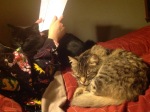
This is reading in bed
One last thing. That photo over there is what reading in bed at night is like for me. Dickens is on my lap and that’s Waldo curled up next to me. Bookman took the photo this week because he thought it was so funny. But this is not unusual, this happens every single night. If it doesn’t then there is something out of the ordinary going on. So now when I talk about reading in bed, you can fill in some of the details of what that looks like.
Filed under:
Books,
chickens,
gardening Tagged:
seed starting 

 What to make of The Vegetarian by Han Kang. I have been waiting so very long to read this book. I first heard about it around this time last year over on Three Percent. I thought it sounded amazing. It wasn’t available in the US, had not been published here. In the meantime, it began turning up on blogs of people who are not in the US and I wanted to read it more each time. Finally, in November of last year it appeared in my library catalog as being “on order.” I immediately put myself at number one on the holds queue. And I waited. And Waited. And then waited some more. Until at last the book was at the library and ready for me to pick up. Was all that waiting worth it? Oh yes.
The Vegetarian was ably translated from the Korean by Deborah Smith. It is a beautiful book about mental illness, family, beauty, responsibility, refusing to comply with social rules and family expectations. It’s tone is quiet and gentle even when some of the situations are violent. It is sometimes overwhelmingly sad and sometimes breathtakingly gorgeous. Occasionally it is mildly humorous. Most of the time it is disturbing, unsettling. This is not a comfort read.
Yeong-hye is the vegetarian in question. She is married but the relationship is not a loving one. Her husband chose her because she was convenient, submissive, and no trouble. He is trying to climb the corporate ladder and impressions are everything. Yeong-hye takes care of the house and all her husband’s needs, she doesn’t complain when he works late or needs to go out for a drink with the boss. She is a maid with benefits and her husband doesn’t once stop to consider her needs or desires because he does not care and they do not matter. Her job, her position, her life is to be there entirely for him.
One night Yeong-hye has a dream. We are not privy to what the dream is right away, though we learn about it later and it is horrific. It is this dream that makes her decide to become a vegetarian, more vegan actually since she throws out all the milk and eggs and meat in the refrigerator and refuses to cook anything other than vegetarian for her husband. This effectively upends her husband’s well-ordered world as once she refuses to eat meat, she begins refusing to do other things as well. The consequences are terrible in the true sense of the word.
The next section of the book is narrated by her brother-in-law who is an artist. He falls in love with Yeong-hye. He conceives an art project that involves painting flowers on her naked body and filming it. The flowers are vivid and alive, different than anything he has done before. Yeong-hye loves them and does not want them to wash off. There are some beautiful scenes in this section, almost transcendent moments and I got the feeling that if Yeong-hye could be perpetually covered in painted flowers that everything would be ok for her. But of course this is not the case.
The third section is narrated by Yeong-hye’s sister, In-hye. Yeong-hye has been committed to a mental institution and now refuses to eat anything. She is wasting away and medical staff keep trying to intervene but their attempts are unsuccessful. In-hye is the good sister, the one who follows all the rules. She has her own successful business, a young child, and while she is no longer married to her artist husband, she is perfectly capable of taking care of herself. The rest of the family has disowned Yeong-hye so it is In-hye who is paying the medical bills, who consults with the doctors, who visits regularly and tries desperately to make her sister well.
Gradually, In-hye begins to understand the things behind Yeong-hye’s refusal to eat, not through long heart-to-heart conversations with her sister, but through her visits and sitting silently with her and being forced to think about their childhood, their father, their lives. In-hye realizes how much anger she has inside of her and can only imagine if that is what she carries, what must her sister be holding inside? The book ends with the sisters and brought tears to my eyes, is bringing tears right now as I type this.
Most of the story is told to us through the eyes of Yeong-hye’s husband, brother-in-law, and sister. Only in a few short places early in the book does Yeong-hye speak for herself. Her silence is not just in the narrative but in her life too. She has some short dialogue in a few places but it is reported through someone else’s narrative. The others comment frequently on how quiet she is, how she won’t talk and this causes no end of frustration to all involved.
I loved The Vegetarian. It is not a lighthearted read. But it did not leave me depressed either. It manages to walk that fine line of tragedy without tipping over the edge into making you feel like you’ve been through the wringer. Instead, when I turned the last page I felt sad and stunned and sat there saying wow, wow, wow over and over. And then I spent the rest of the evening telling Bookman at random moments how good the book was.
I am very happy that Kang has a new book out, Human Acts. It is getting much praise. Hopefully I won’t have to wait an entire year before I get to read it.
Filed under:
Books,
Reviews Tagged:
Han Kang 

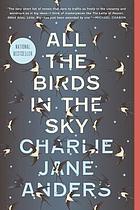 All the Birds in the Sky by Charlie Jane Anders got lots of prepublication buzz. So original and unexpected and really really good. I thought the plot synopsis sounded good and I have read a few of Anders’ pieces on i09 and really liked them so I figured, why not take a chance? I hopped on the library list and got in pretty early in the queue for a change. I am not going to fall in the with the “it’s so amazing and original” crowd because I didn’t think it was either of those. Don’t get me wrong, I really liked the book, it was an enjoyable read and the plot was a little out of the ordinary but not so far out I’d call it original.
What is the plot? It follows the lives of Laurence and Patricia from childhood to their mid-twenties. Both of them have insanely draconian parents that I found a bit hard to believe. Patricia and Laurence are both a little odd. Laurence is a super computer genius kid who builds a two-second time-travel watch he found the specs for on the internet. When he decides to go to Boston to see a rocket launch from MIT but doesn’t tell his parents, he meets the designers of the rocket who are all impressed with this little kid and who give him hope that one day he might do great things. His parents aren’t so pleased. They send him to a school where discipline in strict and rote memorization is the teaching method of choice. Laurence’s parents also decide he spends too much time indoors, and somehow are completely clueless that he is building a super computer in his closet (do they not look at their electric bill and wonder why it is so high?), so they regularly send him to outdoor adventure camps.
Patricia has an older sister who likes to terrorize small animals, chopping the heads of birds and squirrels and other creatures. She’s a demented serial killer in the making. But because she follows her parents’ rules and gets good grades in school she is the favorite child. Patricia doesn’t like rules and spends far too much time running wild in the woods behind her house. While trying to save a bird with a hurt wing from her sister, Patricia learns she can understand bird language. The bird asks her to take him to the Parliament Tree so off Patricia goes, deep into the woods. She eventually finds the Tree, the Tree speaks to her, tells her she is a protector of Nature. The birds at the tree all speak to her as well, calling her a witch. When Patricia tries to find her way back home, it is well past dark and when she finally returns her parents are furious. In order to reign her in and try to make her normal, her parents send her to the same school as Laurence.
Of course neither of them fit in. Neither of them want to. They form a friendship that is fraught with outcast angst and eventual betrayal. Eventually both end up escaping from the school, Laurence to go to a special school for smart science kids, and Patricia to run away from home to attend a school for witches. Years pass before their paths cross again.
When they do meet again their values are in conflict. As a witch it is Patricia’s work to heal people, mostly without them even knowing it. But she also casts spells and hexes on people who intentionally harm others. Laurence is now working with a group of super geniuses, funded by a rich tech guy. They are working on anti-gravity. It is science versus Nature magic with both groups believing they are doing the right thing even if it might ultimately mean destroying humanity.
And that is what the book is ultimately about, science versus nature, the rational versus the wild. Patricia and Laurence are kind of like Romeo and Juliet in way, only they get a happy ending. The ending is a sort of weird melding of science and nature that is supposed to somehow save the world. Does it? We don’t get to find out for sure though we are left with a hint that the future is bright and promising.
Other than Patricia and Laurence the characters are not very well developed, their flatness is disappointing because it causes some gaps in our understanding of Patricia and Laurence and why they think and believe the way they do. The story moves along at a good pace as it changes back and forth between Patricia and Laurence. It isn’t exactly an alternating chapter kind of telling which is actually good because that would add a forced feeling to the story. Instead the alternating viewpoints have more of a flow between them that works nicely.
I was hoping for more than I got with this book, that’s the danger of buzz. I did enjoy it however, and don’t regret reading it. I suspect a good many people will like the book quite a lot. It seems to me those who don’t consider themselves avid fantasy or scifi readers would like All the Birds as it is a little bit country and a little bit rock-n-roll but not full out either one; a comfortable read for someone who wants to “try out” the genre.
Filed under:
Books,
Reviews,
SciFi/Fantasy Tagged:
Charlie Jane Anders,
science versus nature 

Happy Leap Day! I was joking with Bookman this morning that anything we do today will have no consequences since the day doesn’t really exist. Now that I think about it though, I wonder if consequences just take longer, like they catch up with you in four years on the next Leap Day? Can you imagine gorging on chocolate and then in four years suddenly not be able to button your pants? Ha! It’s kind of funny but also not.
There is a great article at Popular Mechanics of all places about How the Humble Index Card Foresaw the Internet. Did you know the index card was invented by Carl Linnaeus? He came up with the brilliant idea while working on his taxonomies.

Waldo relaxing on top of my card cat-alog
Then during the French Revolution, French libraries began using index cards to catalog their collections. Of course Melvil Dewey then ran with the idea and used index cards to create a card catalog system that served us well for a very long time. I used to love browsing card catalogs. I am really lucky to have some old cabinets in my house. I use them for storing seed packets, knitting needles, sock yarn, fountain pen ink, hair clips and other odds and ends. I love my card catalog so much!
In 1895 two crazy Belgians set out to create their own “search engine” by using an even more detailed system than Dewey’s and millions of index cards that filled 15,ooo catalog drawers. One of the pair, Paul Otlet, wrote a book about the project in 1935 called Monde in which he envisioned all the information one day being digitized because the card database was essentially unsustainable at large scales.
And now we have the internet, a ginormous collection of databases and indices, a card catalog of unimaginable proportions. When you consider the internet as something that evolved from index cards it really boggles the mind.
I love, love, love index cards even though I hardly use them any longer. I love them so much I want to have a reason to use them but computers are so darn handy these days I go digital before I consider analog. But I keep a stash ready for when a project comes up that begs to be organized on index cards rather than my computer. One of these days there will be something and Bookman will come home to find the living room floor covered in cards and me happily shuffling them around while humming a happy song.
Filed under:
Technology Tagged:
card catalogs,
Carl Linnaeus,
index cards rock,
Melvil Dewey,
Paul Otlet 

Yesterday I came down with spring fever. The temperature got up to an unseasonable 57F/14C. The spring fever outbreak was of epidemic proportions in the city causing people to go outside without coats on! There were people out running and cycling, walking dogs and children. I walked out onto my deck with bare feet and stood in the sun, face upturned, as though I were a sunflower. It felt delicious.
I had a window open for a while for the cats and when they weren’t fighting over who got to sit in the window where there was plenty of room for both of them but neither wanted to share, their noses were plastered to the screen. Then, for no reason that I could discern, one or the other of them would go running around the house, scrabbling across the furniture and skidding around corners on the wood floors.

Fickle spring
But what a difference a day makes in more ways than one. So much restless energy let off yesterday and today, rain turning to sleet and then to snow. Waldo and Dickens were mad at me for not opening the window again. Since they didn’t pull out enough of each other’s fur yesterday they had a few more rounds today. Finally they have settled down and are curled up together sleeping as I type this.
Seed sprouting is coming along nicely. The leeks and onions are looking good. The peppers have not yet sprouted but they are getting close. They take a long time to get going which I found out too late last year. But I am getting a nice and early start this year. Today I made more newspaper pots and seeded tomatoes —pink brandywine, pink ponderosa, Cherokee purple, and Evan’s purple pear — and celery. I had no luck at all with the celery last year and since I have seeds leftover I thought I would give it another try.
While I am making newspaper pots I can’t help but notice article headlines. Of course the news is generally bad (terrorism, Syria, ISIS, climate change) or infuriating (presidential election campaigning). I was beginning to get a bit down about it all today and then I realized that all the bad stuff in the paper, I am turning it into good stuff. Pots for starting vegetables and soon herbs and flowers. And newspaper, being compostable and good for the soil, will get planted right into the ground with the vegetable plants in May. So then I couldn’t help but smile over turning bad news into sweet onions, spicy peppers and juicy tomatoes. If only my reach went beyond newspapers.
Some of you have mentioned you are interested in making your own paper pots. Here is the YouTube how-to video for the pots I use:
The pots are a really good size. You don’t need to be precise in your folding. After making a couple it gets really easy and you don’t have to think about it. A good activity while watching Netflix. Be aware though that the more you make, the inkier your hands will get so don’t plan on touching anything while you are working.
Cycling

QOM, sprint and lap jersey all at the same time
I’m still cycling indoors on Zwift. For a time last week on one of my sessions I had the women’s QOM (queen of the mountain), sprint and fastest lap jersey all at once. I had to take a screen shot to mark the occasion.
I am part of a women’s only group and Wednesday I led my first virtual group ride. The women’s group has two rides that leave at the same time, a fast ride and a slow ride. We start off together at 1.5 w/kg until a certain point in the course and then the fast group increases to 2w/kg (and then 2.5 w/kg on the second and third laps with an all out sprint to finish) while the slow group continues and does 3 laps (about 19 miles/30km) at a constant 1.5 w/kg.
I’ve ridden with the fast group the last few weeks but Tuesday night I had a hard workout and needed a slow recovery ride. No one had volunteered to lead the slow group and I asked if there was going to be a slow ride and who was leading. It turned into one of those because-I-asked-I-got-volunteered situations. So I led the slow group.
We were a pack of five and stuck together tight even on the hills (we found out later the fast group fell apart at the end of the first lap and we felt quite pleased with how well our group did). We all had a great time and they asked if I would lead again and even consider being the regular ride leader. I was so flattered, how could I say no? Hopefully it goes just as well this coming Wednesday night and wasn’t just a fluke.
The women have also started some women-only racing which is great because even though I have been doing the open racing on Zwift every Thursday night since January, it’s all men and pretty much a stupid free-for-all. The women race on Saturday afternoon every other week and so far we’ve had two races and they’ve been great with everyone following the rules and encouraging each other. In yesterday’s race I finished 14th in a field of 22 and I had a great fun time.
My goal for the next race is to really concentrate on strategy and making sure I am at the front of the pack when we cross the start line so I don’t get dropped off the back and end up racing alone and having to work twice as hard as the people up front in the pack.
I just found out there is a real life women’s gravel road race at the end of May a half hour’s drive south of the Twin Cities. And it’s free, no entry fee. It’s only 33 miles/50 km which is a totally doable distance for me without any extra training. Astrid, however, is a road bike designed for smooth narrow tires and pavement. We rode on gravel trails every week last summer but the gravel we rode on was crushed and packed and almost like pavement. The internet informs me I can get some tires for Astrid that will work better on gravel, slightly wider with a little tread. I’ll have to talk with the folks at my local bike shop and find out if it is true. I hope so!
Filed under:
biking,
gardening Tagged:
gravel,
racing,
seed starting,
Zwift 

No reviews or memes or exciting links today. I just feel like babbling a little if that’s okay with you. If it isn’t, I presume you know how to take yourself elsewhere, not that I want you to go elsewhere, but you know what I mean.
So, read any good books lately? Heh. Do you hate it when non-readers ask you that? I do. I don’t know what they are expecting me to say. If I say yes then they ask me for titles and I kind of cringe inside because I know they are not interested in reading any of the titles I might rattle off. Sometimes I try to name books I think they might like in the hope that maybe they really are looking for a book suggestion. But mostly no matter what I say I get a blank but polite stare.
Now and then the non-reader might recognize a title or author and bark out commentary like, I read that and hated it. How am I supposed to respond to that? Or they’ll say, Virginia Woolf? Are you taking a literature class or something? And I will say no and they will be all astonished and say you read Woolf for fun? And then I get embarrassed because I can see the look in their eyes which is then followed by accusations of me being a super smart genius (um no) or a big weirdo (maybe?) but either way I am clearly not normal.
Then there is the follow up question, how many books do you read in a year? When a non-reader asks you this you know anything more than one or two is going to seem like a lot so when I stammer out that I read 67 books last year the person’s eyes get big and round and then they say something like, you must read really fast. Implying of course that if I don’t read fast then I really am weird because no normal person would actually spend so much time with books.
The conversation usually ends with the other person wondering how I manage to have so much time to read when they themselves are so busy there is not a minute in their day to sit down with a book. And I know this is a veiled accusation that I am somehow lazy and spend a lot of time doing nothing because reading, to a non-reading person, is nothing. The person walks away feeling superior and I am left to be the freak I so obviously am.
This is why I love the internet and book blogs. Because you all are my tribe. Among you I am completely normal and it is the non-readers who are freaks. We can babble on and on endlessly about all the books we are reading and want to read, about being excited over so-and-so publishing a new book or going to hear a favorite author read or the treasures we found at the used bookstore or the library. It feels good to be among you and not feel embarrassed or weird or accused. It’s home.
Filed under:
Books,
Reading 

View Next 25 Posts