new posts in all blogs
Viewing Blog: The Miss Rumphius Effect, Most Recent at Top
Results 1 - 25 of 2,024

A teacher educator discusses children's literature and issues related to teaching children and their future teachers.
Statistics for The Miss Rumphius Effect
Number of Readers that added this blog to their MyJacketFlap: 34
Christmas is over, but Hanukkah is still going strong. The new year is just around the corner. I'd like to write about endings and beginnings, so a form written from two perspectives sounds like a good idea.
The somonka is a Japanese form that consists of two tanka written in tandem. The first tanka is usually a declaration of love, with the second a response to that declaration. While this form usually requires two authors, it is possible for one poet to write from both perspectives.
Writing somonka requires that we revisit the guidelines for tanka. Tanka is a form of Japanese poetry that has been practiced for more than 1000 years. Tanka are composed of 31 syllables in a 5/7/5/7/7 format. Most tanka focus on nature, seasons, the discussion of strong emotions, or a single event of some significance.
Tanka, meaning ‘short song’, is a 1300 year old Japanese form of lyric poetry. Non-rhyming, it is composed in Japanese in five phrases of 5/7/5/7/7 syllables.
In English, tanka are normally written in five lines, also without (contrived) rhyme, but in a flexible short/long/short/long/long rhythm. Due to dissimilarities between the two languages, it is preferable not to apply the thirty-one syllable standard of the Japanese poems, to tanka in English. Around twenty-one plus/minus syllables in English produces an approximate equivalent of the essentially fragmentary tanka form, and its lightness. To achieve a “perfect twenty-one”, one could write five lines in 3/5/3/5/5 syllables. If the resulting tanka sounds natural, then that’s fine. However, the syllable counting does not need to be so rigid. Though no line should be longer than seven syllables, and one should try to maintain the short/long/short/long/long rhythm, variations such as 2/4/3/5/5 or 4/6/3/6/7 or 3/6/4/5/6 syllable patterns can all make good tanka.
Here is an example, translated by one of my former colleagues at the University of Richmond. These tanka were sent back and forth between a nobleman named Mikata No Sami (Active C. 700) and his young wife, the daughter of Omi Ikuha (N.D.)
Tied up, it loosens,
untied, it's too long
my love's hair --
nowadays I can't see it --
has she combed it together?
Everyone now says
my hair is too long
and I should tie it up --
but the hair you gazed upon
I'll leave in tangles
Translated by Stephen Addiss in The Art of Haiku: Its History through Poems and Paintings by Japanese Masters (pp. 19-20)
I hope you'll join me this week in writing a somonka. Please share a link to your poem or the poem itself in the comments.
Since we wrote a sonnet variation last week, I thought I continue with this theme. In Avis Harley's book
Fly With Poetry: An ABC of Poetry, she include the bite-sized sonnet. This form follows the rhyme scheme of a "traditional sonnet," but it's not written in iambic pentameter. Instead, each line contains only ONE syllable. Here's Avis' poem.
A Bite-Sized Sonnet
House
sleeps.
Mouse
creeps
in
through
thin
flue.
Spots
cheese;
stops.
Sees
cat.
SCAT!
Poem ©Avis Harley. All rights reserved.
I hope you'll join me this week in writing a bite-sized sonnet. Please share a link to your poem or the poem itself in the comments.
Sorry I missed you all last week. I got caught up in the end of the semester and it was Friday before I realized I hadn't scheduled a post for writing. Mea culpa. I am back and have a number of stretches ready to go to see us into the New Year.
The curtal sonnet (or curtailed sonnet) was invented by Gerard Manley Hopkins. The poem Pied Beauty is a fine example of this form.
Pied Beauty
by Gerard Manley Hopkins
Glory be to God for dappled things—
For skies of couple-colour as a brinded cow;
For rose-moles all in stipple upon trout that swim;
Fresh-firecoal chestnut-falls; finches' wings;
Landscape plotted and pieced—fold, fallow, and plough;
And áll trádes, their gear and tackle and trim.
The curtal sonnet is composed of a sestet and a quintet. It is written in iambic pentameter, with the exception of the final line, which is a spondee (a foot consisting of two long (or stressed) syllables). The rhyme scheme is:
- sestet: a/b/c/a/b/c
- quintet: d/c/b/d/c or d/b/c/d/c
I hope you'll join me this week in writing a curtal sonnet. Please share a link to your poem or the poem itself in the comments.
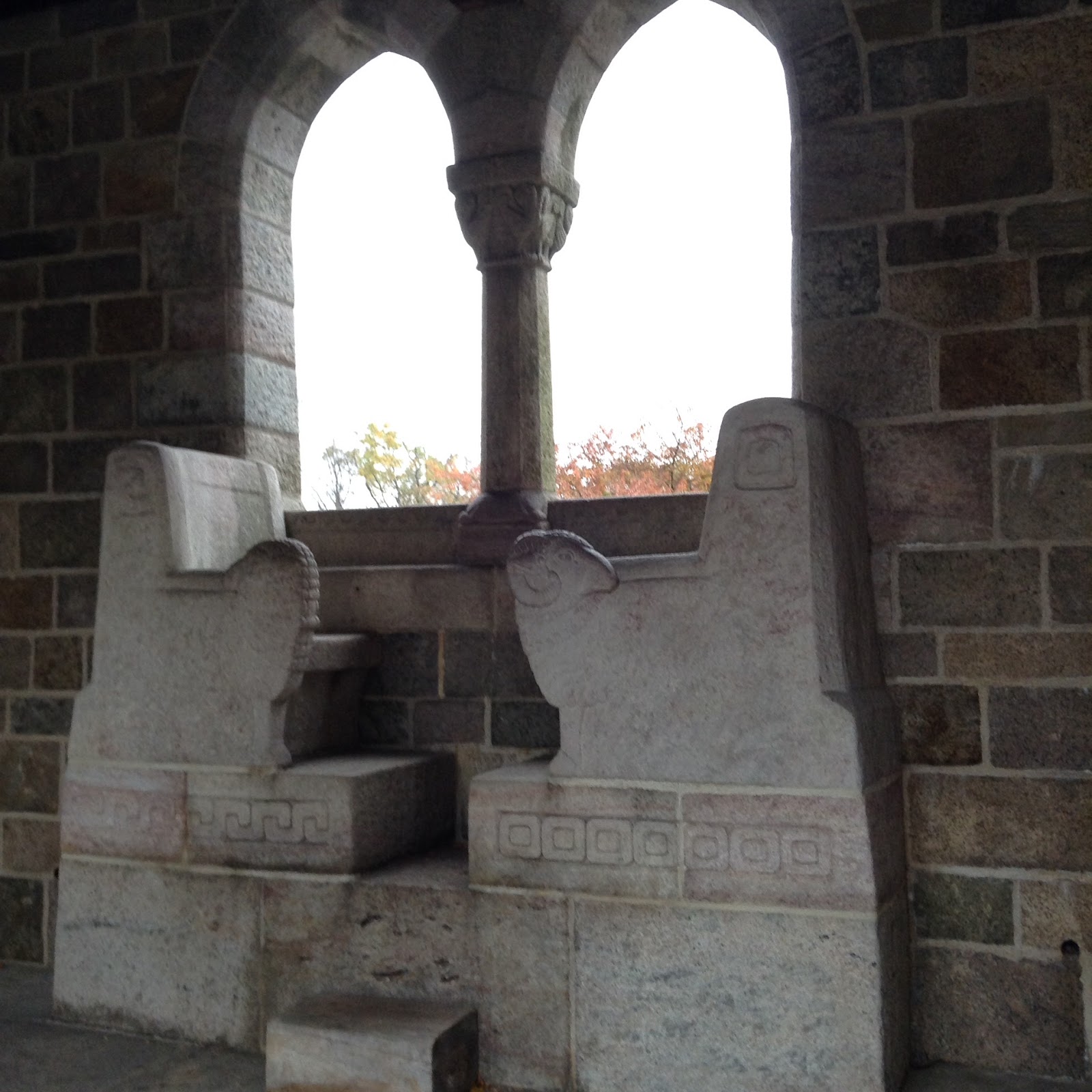
And so, another year of writing poetry with my fabulous sisters comes to an end. This year we alternated poetic forms with ekphrastic poems. This time around Andi shared photos taken at the
Glencairn Museum Cloister. This is the photo I chose.
I've never written a love poem before, as I'm not really the romantic type, but I am sentimental. Here's where this image took me.
22 Years and Counting ...You sit in the ram
I’ll sit in the ewe
together in quiet
we’ll relish the view
The peace of the valley
buried in snow
the twinkling lights
of the houses below
Up here on the hill
with the now setting sun
we sit in our chairs
as the day is undone
Communing together
we don’t say a word
but we don’t need to speak
for our hearts to be heard
With fingertips touching
we speak with our eyes
the fact that you love me
is still a surprise
You are my comfort
my home and my song
in the map of my heart
it's with you I belong
You can read the poems written by my Poetry Seven compatriots at the links below.
I do hope you'll take some time to check out all the wonderful poetic things being shared and collected today by Bridget Magee at
wee words for wee ones. Happy poetry Friday friends!
Don't fret, this isn't a sestina! Today I have a different six-word poetry challenge.
In the book
I Am Writing a Poem About . . . A Game of Poetry, Myra Cohn Livingston writes about three of the assignments she gave to students in her master class in poetry at UCLA. The third assignment Livingston gave was to write a poem that included six assigned words. Here is a description from the book's introduction.
About the last assignment--a six-word-based poem--there was some debate. Everyone agreed that hole, friend, candle, ocean, bucket, and snake presented possibilities, but a few preferred the word scarecrow to bucket, so a choice was given. Hole, friend, candle, ocean, and snake were mandatory, but one could choose either bucket or scarecrow as the sixth word.
Now, that is a challenge! Let's follow Livingston's directions and write a poem that contains the five words hole, friend, candle, ocean, and snake, as well as either bucket or scarecrow as the sixth word. I hope you'll join me in writing this week. Please share a link to your poem or the poem itself in the comments.
I'm a day late this holiday week, but I'm here and glad you are as well.
So, what do you get when you cross a terza rima and a villanelle? The answer is a poetic form called a terzanelle. A terzanelle uses the villanelle’s form of five triplets and a quatrain with the interlocking rhyme scheme of the terza rima.
Here is the line pattern and rhyme scheme.
1 a1
2 b1
3 a2
4 b2
5 c1
6 repeat line 2
7 c2
8 d1
9 repeat line 5
10 d2
11 e1
12 repeat line 8
13 e2
14 f1
15 repeat line 11
16 f2
17 repeat line 1
18 repeat line 14
19 repeat line 3
You can read more about the terzanelle at
Form and Formlessness.
I hope you'll join me this week in writing a terzanelle. Please share a link to your poem or the poem itself in the comments.
If you read the title of this exercise aloud, you will hear a quadruple rhyme. But if you examine the words themselves, you will notice that there is something special about this rhyme scheme. The sound shun is contained in ocean, the sounds of both shun and ocean in motion, and shun, ocean and motion can all be folded into emotion. Such a rhyme scheme, which incidentally was favored by the seventeenth-century poet George Herbert, is called diminishing rhyme because the rhyme words get smaller as you move from emotion to shun. But I prefer the term nesting rhymes because the words nest one inside the other like Russian wooden dolls.
Here is an example of this form from the George Herbert poem "Paradise".
I bless Thee, Lord, because I grow
Among the trees, which in a row
To Thee both fruit and order ow
Read the poem in its entirety.
So, that's it. Your challenge is to write a poem that uses diminishing rhyme. Won't you join us? Please share a link to your poem or the poem itself in the comments.
In
celebrating my blogiversary yesterday (10 years!), I went back and looked at all the poetry stretches we've done since I started posting them in August of 2007.
It's been more than two years we wrote poems in the form of macaronic verse, so it seems like a good time to revisit the form. The Handbook of Poetic Forms defines macaronic verse in this fashion.Macaronic verse is a peculiar, rare and often comic form of poetry that sometimes borders on nonsense. It is a mixture of two (or more) languages in a poem, in which the poet usually subjects one language to the grammatical laws of another to make people laugh.
The definition is a poem in a mixture of two languages, one of them preferably Latin. Usually the mixture of languages is a bit absurd. The word of one language may be terminated with common endings in the other.
So, your challenge for this week is to write a poem that uses more than one language. I hope you will join me this week in writing macaronic verse. Please share a link to your poem or the poem itself in the comments.
Today I am celebrating 10 years in the blogosphere, and more specifically, the
Kidlitosphere. It's been an amazing ride. I've found a community here that humbles, inspires, educates, and supports me in ways I never would have imagined when I started this journey.
To celebrate the big day, I've decided to share some of my favorite posts, memories, and personal experiences that have grown out the real, live human connections I've made in this digital world. So, here we go!
*****
When I started this blog, my son had just started kindergarten. He's now a sophomore in high school.
I'll admit to being a bit embarrassed about my early posts. I'm not really sure what I wanted to blog to be. I knew I wanted it to be about teaching and books and math and science and .... probably too many things in the beginning. What's interesting about reading those early posts is that some of the ideas and issues that I grappled with then, I continue to grapple with. For example, in an early post I wrote this after my first parent-teacher conference sitting on the parent side of the desk.
My biggest concern was in fact, his teacher's concern. I have a kid who hates to make mistakes, puts too much pressure on himself to get everything right, and just wants to be downright perfect.
...
I was thrilled with the fantastic report I received from William's teacher, but found myself wondering on the drive home, how do I fix this? How do I teach him it's okay to make mistakes, that everyone does, and that this is really what learning is all about? I'm not sure, but when I find out, I'll let you know.
Fast forward ten years. This week in class we focused on math talks and the "productive struggle" that's so important in math. And we talked about mistakes ... how we need to value them and how we can't fear them as kids do the hard work of learning something new.
In those first few posts I wrote about teaching, planning, historical fiction, "busy" children's books, and more. What led me down the rabbit hole, and opened up a new world on the blog was my post on January 1, 2007 highlighting the Cybils shortlist. That year, 482 books were nominated to produce a list of 45 finalists. This one post led me to the kidlitosphere, and it ultimately helped me find my tribe. My "tribe" consists of authors, teachers, librarians, poets, and a whole host of folks I never would have met were it not for this blog. My blogroll would be hundreds of links today if I actually listed every one on this blog. Now I can follow many of these folks on Twitter.
If I'd been thinking ahead, or much more creative, I would have turned this into a lengthy celebration and started weeks in advance, sharing some of the more interesting bits and bobs along the way. Ten years is a long time to do one thing. Heck, people today often don't hold a job that long! The blog has definitely morphed a bit, but it's still a place I love to hang out. Here are some of the highlights from my first year of blogging.
*****
January 7, 2007I entered
Lisa Yee's Bodacious Book Title Contest. The rules were:
1. Think of a title from a children's/middle grade/young adult book.
2. Change the FIRST LETTER of ONE of the words to make it into a whole new title.
3. Then add a sentence describing the new book.
Here's one of my entries. It seems appropriate to share so close to election day.
Original Title: Duck for President
New Title: Puck for President
Summary: Upon escaping from the pages of
A Midsummer Night's Dream, Puck finds himself in a land ruled by a ridiculous republican leader and, convinced he can do better, decides to run for President.
January 26, 2007I participated in Poetry Friday for the first time! I didn't know to link up with others at that point, but I was finding a place to share and slowly finding my way into a community that I still participate in.
January 29, 2007I posted my first thematic book list and Mary Lee Hahn of
A Year of Reading stopped by to recommend a book. I'm so glad she did, and I'm so glad we're still talking about books and poetry together.
March 5, 2007I wrote my first fib and walked through my writing/revising process. And Greg Pincus of
GottaBook stopped by! (You're shocked, right?)
April 9, 2007I wrote my first book review and was thrilled to find the author stopped by. This has happened a lot over the years, and it still makes me giddy. And that book I reviewed then is still in my teaching library and gets regular use.
May 15 - June 4, 2007I traveled to Taiwan, China, and Tibet with a group of faculty members and blogged about my adventures. Here's a link to my
summary post about what I learned.
July 16, 2007I wrote about the book
Ten Little Rabbits and the difficulty in evaluating books about other cultures. Debbie Reese of
American Indians in Children's Literature stopped by and my education began. I still read her blog and am inspired by her tireless work.
August 6, 2007I posted my very first poetry stretch. The form was the bouts-rímes. It's called the Monday Poetry Stretch now. I don't republish the poems in a new post, just hope folks will drop into the comments to read the great things people share.
September 28, 2007John Green came to campus as part of a lecture series. (This was just one year after
An Abundance of Katherines was published.) I'd been following the Vlog Brothers since he was awarded a Printz honor in January, so meeting him was great fun.
October 6, 2007I attended the very first Kidlit conference in Chicago and met all these amazing people.
October 15, 2007The kidlit community came together in an event called Blogging for a Cure, spearheaded by Jules and Eisha of
Seven Impossible Things Before Breakfast. More than 60 bloggers worked to highlight an amazing group of illustrators who created snowflakes in support of Robert's Snow 2007. I may have even purchased a few ...
And that, my friends, is just a recap of one year of blogging! I've written numerous thematic lists since then, continue to host poetry stretches, participate in Poetry Friday, still speculate on the nature of diversity in children's books, write about poetry in many varied forms, and post original poetry supported by my amazing poetry sisters. I've experienced the highest highs and some of the lowest lows with this community. I'm so very grateful to have you. Thank you for reading, commenting, and stopping in to share my little corner of the internet. I love seeing you here.
Terza rima is a tumbling, interlocking rhyme scheme that was invented by the thirteenth-century Italian poet Dante for the creation of his long poem, The Divine Comedy.
Terza rima (an Italian phrase meaning "third rhyme") consists of a series of three-line stanzas (tercets) with the rhyme scheme aba bcb cdc ded and so on. It can go on as long as the poet wishes. At the end of the poem an extra line is often added to complete the structure: yzy z.
You can read more on this form at
Poets.org.
So, with a form to guide us, we decided to write about something uplifting or hopeful. I'm not sure I managed to meet the theme head on this time, but rather think I've struck a close tangent. It's been hard to feel hope during this protracted election cycle, but I'm trying mightily to stay positive.
Here's the first draft which I wrote last night. Yes, at this point in the semester I'm working on everything at the last minute (much like my students, I imagine). It shows, but I'm glad to be here with my sisters once again.
Untitled Terza Rima(With apologies to Langston Hughes)
Our world feels broken, bruised beyond repair
the noise, the news, the chaos worse each day
but hope must be our choice and not despair
As clouds around us swell in black and gray
one look reminds us things could be much worse
so we must persevere, must not delay
to treasure all we have, this earth diverse
to fill the hearts we meet with love and trust
to turn this global meltdown in reverse
to show more kindness, fight for what is just
to raise up those who've long been trod upon
to douse hate's sparks before we all combust
Acknowledge this will be a marathon
that change requires strength that’s undeterred
that only faith and hope will move us on
to realize at last our dreams deferred
Poem ©Tricia Stohr-Hunt, 2016. All rights reserved.
You can read the poems written by my Poetry Seven compatriots at the links below. Sending hugs to Andi who's not sharing a poem today, but always with us in spirit.
I do hope you'll take some time to check out all the wonderful poetic things being shared and collected today by one of my poetry sisters,
Laura Purdie Salas. Happy poetry Friday friends!
P.S. - I'm celebrating a BIG blogiversary on Sunday, so I hope you'll stop by to join me for some virtual cake and a few fond memories.
Since it's Halloween, it seemed appropriate to suggest we write about this image.
Shapes of Fear by Maynard Dixon (1930-32)
Smithsonian American Art Museum
So, there's your challenge for the week. Please share a link to your poem or the poem itself in the comments.
The list poem was used by the Greeks and in many books of the Bible. But two of the most popular American poems, Walt Whitman’s “Song of Myself” and Allen Ginsberg’s “Howl,” are list poems. So what is a list poem?
Basically, a list poem (also known as a catalog poem) is a poem that lists things, whether names, places, actions, thoughts, images, etc. It’s a very flexible and fun form to work with.
What is it about list poems that makes them so accessible? Perhaps it's because the list is so ubiquitous in our lives. Everyone makes lists, so finding them in poetry is not unexpected and makes them seem familiar.
The list poem or catalog poem consists of a list or inventory of things. Poets started writing list poems thousands of years ago. They appear in lists of family lineage in the Bible and in the lists of heroes in the Trojan War in Homer's Iliad.
Characteristics Of A List Poem
- A list poem can be a list or inventory of items, people, places, or ideas.
- It often involves repetition.
- It can include rhyme or not.
- The list poem is usually not a random list. It is well thought out.
- The last entry in the list is usually a strong, funny, or important item or event.
Your challenge for this week is to write a list poem about fall, or Halloween, or something October-y. Please share a link to your poem or the poem itself in the comments.
**Apologies, folks. I set the schedule as I always do for 12:01. Apparently, this time around I hit PM instead of AM. I'm here and ready to go!**
*****
“I’m so glad I live in a world where there are Octobers.” (Anne of Green Gables, chapter 16).
Today I'm sharing Frost.
October
by Robert Frost
O hushed October morning mild,
Thy leaves have ripened to the fall;
Tomorrow’s wind, if it be wild,
Should waste them all.
The crows above the forest call;
Tomorrow they may form and go.
O hushed October morning mild,
Begin the hours of this day slow.
Make the day seem to us less brief.
Read the poem in its entirety.
I'm hosting Poetry Friday today, so please leave your links in the comments and I'll round you up old-school style. Happy Poetry Friday all!
*****
Michelle Heidenrich Barnes of Today's Little Ditty reveals the cover of her new publication, The Best of Today's Little Ditty 2014-2015, and shares an interview with the illustrator.
Matt Forrest of Radio, Rhythm, & Rhyme shares an original poem entitled Clematis.
Buffy Silverman of Buffy's Blog is sharing two recently published poems.
Laura Purdie Salas shares the poem Ambush from Jane Yolen's new book, THE ALLIGATOR'S SMILE AND OTHER POEMS.
The rondeau redoublé is a French poetic form composed of 25 lines with only 2 rhymes, whole repeating lines, and a hemstitch.
The lines of the first stanza reappear in order as the final lines of the next four stanzas. The hemstitch appears as a half-line at the very end of the poem. Each stanza rhymes either abab or baba.
Here's one example of the form.
When I'm first working with a new poetic form, I use a guide like this. You can
download my template if you want to try it.
Want to know more about the roundeau redoublé? Check out this comprehensive bit of background Kelly Fineman shared at
Writing and Ruminating.
I hope you'll join me this week in writing a rondeau redoublé. Please share a link to your poem or the poem itself in the comments.
The rondeau is a French poetic form that uses only two rhymes and hemstitch. Here are the basic guidelines:
- Composed of 15 lines
- Lines of 8 syllables, except the refrain, which is 4 syllables
- Refrain (hemstitch) is the first 4 syllables of the first line
- Two rhymes with three stanzas and rhyme scheme of:
- quintet - a, a, b, b, a
- quatrain - a, a, b, R
- sestet - a, a, b, b, a, R
Here's an example of a rondeau.
We Wear the Mask
by Paul Laurence Dunbar
We wear the mask that grins and lies,
It hides our cheeks and shades our eyes,—
This debt we pay to human guile;
With torn and bleeding hearts we smile
And mouth with myriad subtleties,
Why should the world be over-wise,
In counting all our tears and sighs?
Nay, let them only see us, while
We wear the mask.
We smile, but oh great Christ, our cries
To thee from tortured souls arise.
We sing, but oh the clay is vile
Beneath our feet, and long the mile,
But let the world dream otherwise,
We wear the mask!
You can learn more about the rondeau at
Shadow Poetry.
I hope you'll join me this week in writing a rondeau. Please share a link to your poem or the poem itself in the comments.
This month the poetry gang wrote poems to images selected by Kelly. The piece is by René de Saint-Marceaux and is titled
Arlequin. Kelly took the photos at the Musée des Beaux Arts in Lyon, France.
I've been experimenting the last few weeks with t
he Magic 9, a relatively new 9-line poetic form. Here's what the Poets Garret wrote about its invention.Typing too fast is often the cause of spelling mistakes and one day Abracadabra was typed as abacadaba and right away a poetry form appeared.
So the Magic 9 is a 9-line poem with a rhyme scheme of: a/b/a/c/a/d/a/b/a.
This piece creeped me out just a bit. In my brainstorming and early drafts I wrote about Zorro, the Phantom of the Opera, Batman, and a few other masked men. This is what I ended up with.
As You Wish
Masked men have always frightened me
the Dread Pirate Roberts the only exception
I can get behind a little piracy
a nom de guerre and a ship named Revenge
swashbuckling his way into infamy
all for the want of a woman
dreams of Buttercup kept him at sea
leading a life of deception
until love brought him home, set him free
You can read the poems written by my Poetry Seven compatriots at the links below. Andi's been under the weather, so she's not sharing a poem today. Here's hoping she's feeling much better now. She's with us in spirit and we'll happily welcome her back for our next poetry challenge.
I do hope you'll take some time to check out all the wonderful poetic things being shared and collected today
at Violet Nesdoly's place. Happy poetry Friday friends!
The Magic 9 is a relatively new 9-line poetic form. Here's what the Poets Garret has to say about it's inception.
Typing too fast is often the cause of spelling mistakes and one day Abracadabra was typed as abacadaba and right away a poetry form appeared.
So that's it. This week the challenge is to write a 9-line poem with a rhyme scheme of:
a. b. a. c. a. d. a. b. a.
I hope you'll join me this week in writing a Magic 9. Please share a link to your poem or the poem itself in the comments.
The haibun is is a poetic form first created by Matsuo Basho. It is a form that combines two modes of writing—prose and verse.
Here are some of the "rules" of writing haibun, as suggested by the Haiku Society of America.
Prose in Haibun
- Tells the story
- Gives information, defines the theme
- Creates a mood through tone
- Provides a background to spotlight the haiku
Haiku in Haibun- Moves the story forward
- Takes the narrative in another direction
- Adds insight or another dimension to the prose
- Resolves the conflict in an unpredictable way, or questions the resolution of the prose.
- Prose is the narrative and haiku is the revelation or the reaction.
In a haibun, the prose can come first, last, or between any number of haiku.
Haibun also have a title, something haiku generally do not.
You can read some examples and see different haibun forms at
Writing and Enjoying Haibun and
More than the Birds, Bees, and Trees: A Closer Look at Writing Haibun.
I hope you'll join me this week in writing a haibun. Please share a link to your poem or the poem itself in the comments.
Late again! I can't seem to get my act together this semester, so please forgive the late post.
The landay is an Afghan poetic form. It's described as "an oral and often anonymous scrap of song created by and for mostly illiterate people." Formally, a landay is composed of couplets, with 9 syllables in the first line and 13 in the second. Sometimes the couplets rhyme, but there is no requirement to do so.
You can learn more about the landay and read some fine examples in this Poetry Magazine feature.
I hope you'll join me this week in writing a landay. Please share a link to your poem or the poem itself in the comments.
Today I'm sharing an aptly titled poem by William Wordsworth.
September
by William Wordsworth
Departing summer hath assumed
An aspect tenderly illumed,
The gentlest look of spring;
That calls from yonder leafy shade
Unfaded, yet prepared to fade,
A timely carolling.
No faint and hesitating trill,
Such tribute as to winter chill
The lonely redbreast pays!
Clear, loud, and lively is the din,
From social warblers gathering in
Their harvest of sweet lays.
Read the poem in its entirety.
I do hope you'll take some time to check out all the wonderful poetic things being shared and collected today by Amy Ludwig VanDerwater at The Poem Farm. Happy poetry Friday friends!
*****On Tuesday I finally threw up my hands in frustration over the proliferation of "boys don't read" articles in the last few months. Here's an excerpt from the post entitled
More Boy Bashing - Here We Go Again.
Can we please give boys and young men just a bit of credit for their reading habits? If we constantly push potty and other forms of low humor on them as something they'll read, aren't we just setting the bar a tad bit low?
I was thinking about this last night as my son and I were reading a portion of
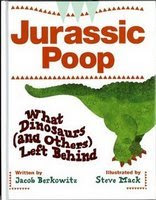
Jurassic Poop: What Dinosaurs (And Others) Left Behind, written by Jacob Berkowitz and illustrated by Steve Mack. Yes, this is a book ostensibly about poop (see that word in the title?), but it is SO MUCH MORE. The book discusses fossils, fossilization, carbon dating, history, archaeology, and the work of several different scientists. My son was drawn in more by the dinosaur connection than anything else, but since reading it he has been endlessly fascinated with the notion that you can learn about the past from things (artifacts) that are left behind, poop being one of them.
There are a number of books on low-brow topics that we hand to reluctant readers in an attempt to encourage them to read. However, the base nature of these topics and the quality of the work don't need to be mutually exclusive. (Oh, a book about poop? Must be crap!) So, in an effort to elevate some topics and/or titles perceived to be low-brow, here are some books (nonfiction all!) that will interest boys AND girls by the very nature of their FABULOUSLY INTERESTING content.
*****That list was filled with books on poop, toilets, underwear, and more. Why mention this in a book review? Because I've found a book (heck, a whole series!) that could easily be added to this list.
Gary D. Robson has written 20 books in the Who Pooped in the Park? series. Just take a look at this map to see some of the locations covered. I had no idea there was a book for Virginia! I'll be picking that one up for my outdoor education workshops soon.
You can learn more about the series at
Gary's web site.
The latest book in the series is
WHO POOPED IN CENTRAL PARK? SCAT AND TRACKS FOR KIDS. Emma, Jackson, Lily and Tony spend a day walking through Central Park, beginning at the Central Park Zoo and ending at Farmer's Gate. At the beginning of their walk they meet a worker named Lawton who tells them he can identify animals by their scat and tracks. As the kids move through the park, they stop along the way to make observations, talk to people they meet, and look at poop and tracks. It's certainly an interesting way to spend the day, and the kids are fully engaged with their explorations. Back matter includes additional information (scat and tracks) on ten of the animals observed directly or indirectly through the signs they leave behind.
While I like the story and, I was even more enamored of the informational boxes on most double-page spreads titled "The Straight Poop." These boxes, added to the text, provide readers with a wealth of information. Here's an example of what you'll find in these boxes.
Groundhogs (also called woodchucks) build long, underground tunnels with special rooms just for pooping, so you won't find much groundhog poop above the ground.
Even though this book is set in Central Park, folks in the northeast, particularly in urban areas or close to state and local parks, will find this a useful guide. Even kids who don't live in and around NYC will learn something about the myriad of animals depicted. And really, who can resist a book about poop? Certainly not me.
Since I've just been working on Welsh poetic forms, I thought I'd continue on with another Welsh form this week. The Englyn penfyr is a poetic form consisting of any number of tercets. In each stanza, the lines are composed of ten and seven syllables, with all lines sharing a rhyme pattern.
The first line has ten syllables and the seventh, eighth or ninth syllable of the first line introduces the rhyme. This rhyme is repeated on the last syllable of the second and third lines. The fourth syllable of the second line echoes the final syllable of the first through either rhyme or consonance. Here's what the pattern looks like.
x x x x x x x a x x
x x x x x x x x x a
x x x x x x x x x a
You can read more about a variety of Englyn at Wikipedia.
That's it. Easy-peasy, right? I hope you'll join me this week in writing an Englyn Penfyr. Please share a link to your poem or the poem itself in the comments.
This month the Poetry Seven crew wrote in the form of the clogyrnach (clog-IR-nach). The clogyrnach is a Welsh poetic meter that falls under the poetic form of awdl (odes). They are composed of any number of 6-line stanzas. Each stanza has 32 syllables. The first couplet is 8 syllables with an end rhyme of aa, the second couplet is 5 syllables with an end rhyme of bb, and the final couplet is is 3 syllables with an end rhyme of ba.
I had several false starts as I noodled around with this one. I'll admit I'm not a fan of this form, and I generally love form. Ultimately, it was the earthquake in Italy that I kept coming back to as a topic.
Terremoto in Amatrice
Under the olive tree we stand
among the ruins of this land
cradling hearts numb
as aftershocks come
our hearts drum
out of hand
We mourn those lost in rubble heaps
toppled homes wet by tears we weep
medieval town
broken and cast down
tarnished crown
pain so deep
Poem ©Tricia Stohr-Hunt, 2016. All rights reserved.You can read the poems written by my Poetry Seven compatriots at the links below.
I do hope you'll take some time to check out all the wonderful poetic things being shared and collected today by
Penny Parker Klostermann. Happy poetry Friday friends!
Hello all! I'm back after a bit of a hiatus and hopefully am in the swing of things now that we are in week 2 of the fall semester.
The haiku sonnet is a form developed by David Marshall, an English teacher and writer living in Chicago and blogging at Haiku Streak. Essentially, this form combines four haiku with a final two-line “couplet” consisting of seven and/or five syllable lines.
You can read some examples of David's work at Haiku Sonnet. While his poems don't rhyme (as haiku do not), I'm thinking I may attempt to include rhyme in my stretches.
So, there's your challenge. I hope you'll join me this week in writing an haiku sonnet or two. Please share a link to your poem or the poem itself in the comments.
The Espinela is a Spanish poetic form composed of 10 lines, each written in eight syllables. It is named for the poet Vicentre Espinel who created the form. Here are the guidelines writing an espinela.
The first stanza is a quatrain with the rhyme scheme a b b a.
There is a break at the end of this stanza, so line 4 should be end stopped.
The next stanza is a sestet with the rhyme scheme a c c d d c.
So, there's your challenge. I hope you'll join me this week in writing an Espinela. Please share a link to your poem or the poem itself in the comments.
View Next 25 Posts




Year’s End<br /><br />Outside my window<br />two blackbirds perch on branches.<br />Cold closes the year<br />with its white gloves, like a book<br />closing its last pages.<br /><br />They say there are seeds<br />and bulbs hidden beneath the snow.<br />My blackbirds will look<br />different in the spring, far less<br />portentous, building their nest.<br /><br />—Kate Coombs, 2016<br />all
Conversation with A Ghost<br /><br />One fourth of our lives<br />together is the new count:<br />the time you’ve gone.<br />The tick and tock of your flight<br />cannot measure my deep grief.<br /><br />This measure of grief<br />has no meaning under ground.<br />Do not weep for me.<br />You still walk all our old trails.<br />Now blaze new ones for yourself.<br /><br />©2016 Jane Yolen all