new posts in all blogs
Viewing Blog: Seize the Day, Most Recent at Top
Results 1 - 25 of 693

Herein, children's writer Molly Blaisdell raves, rants, and rambles about her craft. She also muses about juggling a job, motherhood and writing books, and there is a good dose of rallying, psyching up and inspiring for anyone who needs to seize the day.
Statistics for Seize the Day
Number of Readers that added this blog to their MyJacketFlap: 10
Hi folks,
Seize the day is moving! Please follow the link of your choice.You don't have to join Niume, but if do want to join, follow this link. If you want to just receive my blog through email, follow this link and click on my photo, then enter your email. Done. You may also follow my blog by following me on Facebook, Linkedin or Twitter.
A quote for your pocket.
Precisely one of the most gratifying results of intellectual evolution is the continuous opening up of new and greater prospects. Nikolai Tesla
Hi, folks, I've been writing a series all about a time in my twenties when I was part of religious cult. Last week I wrote a heart-breaking story from my past about G and his sad demise. This is my version of the Valley of Dry Bones from the Book of Ezekiel. I'm calling it Close to the Bone. This is the final in the series.
Toward the end of the dark days of the cult, I was failing around for purpose. A teacher from college, Dr. Van Riper, ran into me at the supermarket and demanded to know why I had three children instead of writing books for children. I had no answer. She'd told me what to do, and I'd ignored her.
I was slowly waking up in these days. God's chosen people were now looking like a bunch of uneducated country folk, plus a bunch of kids that had choked on embracing the future after college. That's when I saw the ad in the newspaper about some group called SCBWI.
Fellow-shipping outside the church was forbidden in manipulative, oblique way, but this was business so I figured God would give me a pass. I remember heading to that first meeting and feeling so welcome. There were 8 or 9 women and they were so gracious and kind. I remember the first conversation in a long time without having to say praise the Lord or how God was directing me every third word. I also remember KA. She was a real author and the leader of the SCBWI group. Her first picture book had come out but she talked to me like I was a colleague. Bam, I was in the inner circle.
I can not tell you how much KA's leadership meant to me. I tried to keep secret from the church my fraternizing with the world. KA was a Unitarian. That was something I was supposed to fear. Of course, by now, I understood that I was supposed to fear everything, and it was sort of ridiculous and tiring. KA believed in me as a creative person. She never let me feel like I was a little off with my long dresses and three kids in three years. She accepted me just as I was. It was the most Christian thing I'd ever experienced.
I remember being invited to another SCBWI member's house called DC. I had friends outside the church for the first time in almost eight years. I was hanging out with a group of women, totally normal women with varied backgrounds. It was sort of dizzying. I was supposed to have left the world behind but now I sneaking back into it. Oh, and the big problem? I loved it.
SCBWI became an island of normal in my life. Like Phoenix, I was rising from my ashes. KA tried to convince me to go to Los Angeles for the annual conference. I chickened out but her encouragement planted a seed in me. KA convinced me to volunteer for events, write letters to editors, and even submit my drawings to the SCBWI Bulletin. My first credit was as an illustrator in the Bulletin. I was so proud. I was engaged in the pursuit of liberty. I had expressed myself. I made $50. It was mind-blowing.
When Tim and I decided to move away the place we had known such tragedy, KA continued to encourage me until I left town. I have no idea if she had any idea of how lost I was, and how much I needed help to become a normal person again. She never said anything when the sorry story of my entire life was reported in the local newspaper. KA encouraged me creatively, commenting on my work and giving me suggestions, and once she sent me a card stating there would be a day when she said she knew me when. She bridged the way for me to absolutely normal. I turned into the funky person I had been before all the religious nonsense. I came to my senses.
Well, this is end of these posts and also time for big news. My blog is moving over to Niume.com. I hope you consider following me an my content there. You will receive updates of posts if you follow me on Facebook, Twitter, or tumbler.
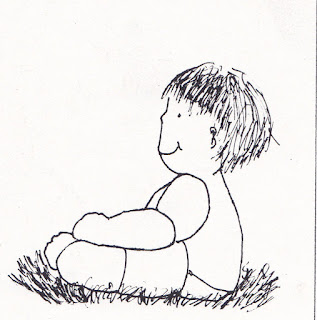
One of those early drawings. I sent to the Bulletin on a notepad paper, a big no-no. Sm bought them anyway.
A quote for your pocket:
My people, I am going to open your graves and bring you up from them; I will bring you back to the land of Israel.13 Then you, my people, will know that I am the Lord, when I open your graves and bring you up from them. 14 I will put my Spirit in you and you will live, and I will settle you in your own land. Then you will know that I the Lord have spoken, and I have done it, declares the Lord.Ezekiel 37: 12b-14
Last week I wrote a heart-breaking story from my past of lights lost, Barbara and Jan. I was part of a cult for almost eight years. There was something invincible about this cult's belief. The arrogance of believing that you cannot be wrong is like a kiln of heat for the bones. Dry, dry, bones. It leads to this kind of thinking: anyone in the Ship of Safety was free from Death, regardless of what they had done. Enter stage left, G, a close relative to my husband. G was intelligent, quick-witted, a doctor, he was also a drug addict and molester of children. He attended the cult with us sporadically.
My husband and I believed whole-heartedly that G was redeemable. With much repentance, G would receive forgiveness of sins and live an abundant life. We shared the good news with him again and again. My dear Tim believed that God would heal G's heart and set him right. G did not take the meds he needed for stability of mind. He refused them and instead chose to believe God for his healing. Tim and I supported this because the Brother had intimated many times that medicine was not God's way. On one hand we understood that G was dangerous, but we also believed that God had placed a hedge of safety around us and that God would heal G.
It was a couple of years after Barbara and Jan's death that the day of reckoning came. Tim and I continued to be part of the faithful, but the cult had almost crumbled apart by this time. People were bleeding out of the Ship of Safety except for me and Tim. We were still hoping that perhaps we could enter the INNER CIRCLE. Most people in that circle had left it. Only the Brother remained really. G had dropped off attending the cult and had returned to the narrow-minded faith communities he'd attended all his life. He'd been warped by the fear filled doctrines taught by these communities.
A stranger called Tim one day and asked if G had ever been involved in activities that hurt children. My husband began to investigate and found G was grooming a young boy for his purposes. (I am feeling sick again.) This seemed like the kind of thing you need wise counsel for. We called the Brother and explained the situation. The Brother offered his advice. Children should honor their parents. Tim should do nothing.
I remember staring at Tim and he at me. Then he called the police. The next thing that happened was G called Tim and told him he was coming to kill him: I drove away with the kids, fearing for our lives, and didn't tell Tim where I was going. When we talked to the Brother about the situation, he poured on the innuendo, implications, and insinuation. I'm not sure the Brother even knew these words. He did not have much education. He did not know that indirectly intimating something actually counts as saying the thing. He did not know that this kind of stuff is the heart and soul of being an accuser.
G was caught on a nearby campus a gun-filled trunk. He had been driving through town shooting at houses. He was arrested but soon after released. Tim confronted G. G squirmed but had to admit what he had done. He was released to his home but lost his job, his house, and faced prison time for his violent actions. We went out dinner with G one night days before he was to lose his house. It was a fun night against all odds. G was oddly happy. Tim and I were ever believing, God could redeem anything, even this new wave of sins. We were grateful to see a turn.
A day or so later Tim and I both had a terrible feeling about G. Tim went over to G's house to talk to him. He was sitting in chair where he had committed suicide. He had left neat, organized notes of madness for Tim all over the house. I thought I had been going through the motions before this day. G's death was the end of many things. There was to be no Inner Circle for us, thank God. The cult dissolved. The Brother decided to move away, and Tim and I began the slow work of figuring out how to live, how to treasure our days, and how to love one another.
I'm not posting a picture I love of Tim with our first son Jo back from those days. My hero, best friend, and love..
Next week I'm going an upbeat story. This one will be positive. It's funny, weird, tragic and miraculous and also one of the great moments of my life. It happened during these dark days.
Here is a quote for your pocket.
Last week I wrote a heart-breaking story from my past, of a light lost, Barbara. I was part of a cult for almost eight years in my twenties. This is my version of the Valley of Dry Bones from the Book of Ezekiel. I'm calling it Close to the Bone.
This week I'm going to write about one of my closest friends in the cult. She was one of the Sisters. Sister Jan. Jan and I were roommates for about two years. We shared a room in The Duplex. I had the bottom bunk. Jan had the top one. Jan loved to pray, and often times I fell asleep to her murmured prayers. My favorite Jan moment—I was a having a tough day and had gone into our room and locked the door. I was bawling. (Funny thing, I can't remember about what.) I just know I felt worthless. Jan sat on the other side of the door and spoke quietly to me. She assured me that whatever I was upset about wasn't important and that I was someone of worth who was going to do amazing things. She let me know that she would hold the true me in her heart until I was ready. She could see who I would be, so no worries about right now.
How precious is a friend like that?
So, let's wade into the deep waters. In this terrible, messed up cult, I met the love of my life, Tim, and married. He reluctantly joined the church. Jan was not so lucky in love. Remember, if you got out of the Ship of Safety, terrible things happened to you. We had to marry inside the church. The Brother assured us that we were safe in the flock, but outside, there was utter darkness. Only a very few would be saved, and all the rest of the church was lost. If you left the only true church, you could lose your salvation. Anyway, this basically set up most of us young girls for any kind of predator who was willing to go to the church. Jan married one. Days after her wedding, it was clear that she was in an abusive, hateful relationship. She left the predator and the Church. She would not be spoken of again. The Brother did not address the fact that we could be ripped to shreds inside the church as easily as in that terrible outer darkness. He did release Jan to outer darkness.
So Jan was outside the flock and in the outer darkness! She went home to her parents. (Uh, I totally noticed that inside the flock had been a horrible place for her.) I could only imagine what Jan felt as she preceded to dissolve her relationship with the predator. I didn't ask her about it because you just didn't talk to someone outside the flock. She may have dragged me into the darkness. Jan came to my house one day to talk to me. She believed she had lost her salvation because she had to leave the church and divorce. (I am feeling sick writing this.) I didn't know what to say; maybe she was right. I said nothing. I hugged her and told her I loved her.
I prayed for her salvation every day after that. I saw her a few more times. Each time she came to see me, she was more haunted than the last. I remember one day she came to visit me. I did the unthinkable. Finally, I went against all that I knew. I disobeyed. I told Jan God was happy for where she was. That he wanted her with her parents. That it was Okay with God and he wanted her to know he loved her just as much as he ever did. We both knew my words were blasphemous.
She hugged me, but we both knew outside the flock was outer darkness. I even wondered if I was in outer darkness, too, because I so wanted to see Jan happy again I told her God was happy with her. When alone, I also shouted at God for being unhappy with Jan when he should be happy.
After that, I saw Jan a few more times. Each time she'd grown more haunted, more upset.
Months later, after Barbara's death, I was praying for Jan. I had not heard from Jan in a while. My babies were asleep, and I was hanging out clothes on the line. I prayed for Jan. I remember falling to my knees praying for her. It was soon after that I learned that she had gotten out of her car and jumped off a high bridge into the turbid water below. Part of me is always flying off that bridge with her. I can feel her body as it's crushed against the water. I'm with her as water fills her lungs, and she never breathes again.
I did not go to Jan's funeral. I didn't say goodbye. Dry bones. Dry, dry bones. I think I sort of lost my mind some after this. I did my work, but I didn't think. I went through the motions of living. There was no counselling. No comforting. Everything became an endless grind of church services, diapers, cleaning house, playing with my children, prayer, even sex was part of the grind. I retreated deep inside myself. I felt sadness. I felt pain. I felt grief. I just stopped feeling anything like love, happiness, or joy after Jan's death. It would be a few years before I did again.
I'd like to say this end, but there will be more next week. If you can bear it, come back.
No doodle. Here is lovely Jan.
Here is a quote for you.
‘This is what the Sovereign Lord says: Come, breath, from the four winds and breathe into these slain, that they may live.’” Ezekiel 37: 9b
Hi, folks, this week I'm going to write my version of The Valley of Dry Bones in the first of a series called Close to the Bone.
When I was in my twenties, I joined a cult. It was a short lived thing that was all about religious propaganda to control others. This propaganda was wrapped up in a big quilt called the ABSOLUTE TRUTH. Of course, there was a booming preacher (a modern day apostle) called Brother because we would not want to be too familiar. He had a direct line to God; everyone needed to hear his message to be part of the true church. He answered to no one but God.
Under his guidance we learned important truths. Church had to be attended at least four times a week. Friends outside the Church weren't a good idea. Birth control wasn't a good idea. Sending your children to public school wasn't a good idea. God had big plans, and you needed to be in the Ship of Safety. Demonic forces were roaming around out there that would take you down...Trying to live up to this holy propaganda was sort of like having all the flesh ripped from your body and leaving you as a pile of dry bones.
So I stuck to this mess for almost eight years. I never did leave; the cult imploded around me. I wish I had left, but I was shredded instead. There is nothing noble or redeeming about my story. Toward the end, my friend Barbara was losing weight. Too much. She was probably under a hundred pounds. I'd found it all. I had gained three children and seventy pounds in three and half years. Barbara, like me, would give large chunks of her money to the church. We didn't need anything; God was on our side. I'd saved up some extra money from collecting aluminum cans (five dollars) and took the money over to her house to help her meet her rent. I also wrote a little poem about how on the other side of life we would find peace. Barbara took the money. I hugged her and said goodbye.
A few hours later, I was at church when I was told Barbara drove her car onto a train track and stopped. Beautiful Barbara was crushed by a screaming train on her way to pay the rent. I cannot not express the panic that I felt when I learned how she had died. We were God's chosen people. Weren't we? I was numb and bleeding inside. I kept saying the same old religious propaganda but my belief in the ABSOLUTE TRUTH died with Barbara. I am crying while writing this. It was 25 years ago, but part of me always lives in that moment. My friend took her life and where was I?
I had my part in it. I'd tied myself in knots trying to support an unsupportable vision of God brought to me by an uneducated self-styled apostle who I should have declared as wrong. Who knew there was so much power in just standing up and saying something is wrong? Everyone but me. Here is my message. If there is something you need to stand up for, please do. Please. Please. Please. Even if it sets the world on fire. I am standing here, handing you the torch.
Thanks for dropping by. I will continue with Close to the Bone. I hope that my story will inform yours.
Instead of a doodle I'm posting a picture of Barbara. A light lost.

Paraphrase from the book of Ezekiel 37: 2a-3:
I saw a great many bones on the floor of the valley, bones that were very dry. The Lord asked me, “Son of man, can these bones live?”
Hi, folks, This is the last in my series of Teachers Who Helped. Of course, I saved the best for last. In 1995, I moved to Kirkland, Washington. A friend of mine, Kathi Appelt, encouraged me that there was a vibrant group of writers in the Seattle area and recommended that I take a class on children's writing at the Bellevue Community College. Kathi said the teacher was considered very helpful.
I signed up for the class and met the teacher, Peggy King Anderson. (Those of my readers in the children's writing community are freaking out right now because I am dropping some names!) Peggy is a teacher like no other I have ever known. She loves her students and her subject. She taught me that my best story is in my soul, curled up inside, and that it is destined to break out its chrysalis and take flight. But the most important lessons I learned from Peggy were all about loving the journey of writing books, loving the people who write children's books, and actually letting the writing transform me, before it transforms anyone else.
Her Master Classes around her dining room table were magical. Bowls of popcorn, slices of apples, and generous heaps of conversation, I met Jolie Stekly, Meg Lippert, Allyson Schrier, Vijaya Bodach, and so many more in these classes. One thing was clear about Peggy: she nurtured excellence. Most writers entered her classes unpublished. Few stayed that way. Peggy encouraged me as a mom, as a wife, and as a student. She understood that people are complex and all the pieces of who you are inform your stories. She taught me that in the midst of storms of life that writing is my safe place. She said, "Writing is saving you."
I'm a person of faith in Christ. With Peggy's gentle critique, I learned that there was a divine spark in in my work, something wholly outside me. Each book is lit by God and is part of a great fire of goodness. Faith is something beautiful that I share with Peggy. She taught me about holiness of my work, that it is important, and that children were hungry for my words. It is my sacred duty to make my words wonderful, to draw close to the bone, and reveal the hidden truth of the worth of every individual.
Finally, Peggy's belief in each and every one of her students buoys me. Do you have any idea how powerful the faith of a learned teacher is? Her unending encouragement lit a fire of encouragement in me that I try to pass it on. Peggy is no longer teaching classes to devote time her family. (Always keeping those priorities right.) She does however continue to mentor. Check out the link to website above if you are interested.
My puny words are never going to reveal the total awesomeness of Peggy. If you read my post, and know Peggy, drop by her Facebook, and let her know what a difference she has made in your life. If not, thank the teachers who believed in you.
I hope you liked this series and will back with next week with a series I call Close to the Bone.
Here is a doodle for you.

Here is a quote for your pocket.
I am indebted to my father for living, but to my teacher for living well. Alexander the Great, (His teacher, Aristotle, who was taught by Plato, who was taught by Sophocles.)
Hi, folks, This is the last in my series of Teachers Who Helped. Of course, I saved the best for last. In 1995, I moved to Kirkland, Washington. A friend of mine, Kathi Appelt, encouraged me that there was a vibrant group of writers in the Seattle area and recommended that I take a class on children's writing at the Bellevue Community College. Kathi said the teacher was considered very helpful.
I signed up for the class and met the teacher, Peggy King Anderson. (Those of my readers in the children's writing community are freaking out right now because I am dropping some names!) Peggy is a teacher like no other I have ever known. She loves her students and her subject. She taught me that my best story is in my soul, curled up inside, and that it is destined to break out its chrysalis and take flight. But the most important lessons I learned from Peggy were all about loving the journey of writing books, loving the people who write children's books, and actually letting the writing transform me, before it transforms anyone else.
Her Master Classes around her dining room table were magical. Bowls of popcorn, slices of apples, and generous heaps of conversation, I met Holly Cupala, Jolie Stekly, Meg Lippert, Allyson Schrier, Vijaya Bodach, and so many more in these classes. One thing was clear about Peggy: she nurtured excellence. Most writers entered her classes unpublished. Few stayed that way. Peggy encouraged me as a mom, as a wife, and as a student. She understood that people are complex and all the pieces of who you are inform your stories. She taught me that in the midst of storms of life that writing is my safe place. She said, "Writing is saving you."
I'm a person of faith in Christ. With Peggy's gentle critique, I learned that there was a divine spark in in my work, something wholly outside me. Each book is lit by God and is part of a great fire of goodness. Faith is something beautiful that I share with Peggy. She taught me about holiness of my work, that it is important, and that children were hungry for my words. It is my sacred duty to make my words wonderful, to draw close to the bone, and reveal the hidden truth of the worth of every individual.
Finally, Peggy's belief in each and every one of her students buoys me. Do you have any idea how powerful the faith of a learned teacher is? Her unending encouragement lit a fire of encouragement in me that I try to pass it on. Peggy is no longer teaching classes to devote time her family. (Always keeping those priorities right.) She does however continue to mentor. Check out the link to website above if you are interested.
My puny words are never going to reveal the total awesomeness of Peggy. If you read my post, and know Peggy, drop by her Facebook, and let her know what a difference she has made in your life. If not, thank the teachers who believed in you.
I hope you liked this series and will back with next week with a series I call Close to the Bone.
Here is a doodle for you.
Here is a quote for your pocket.
I am indebted to my father for living, but to my teacher for living well. Alexander the Great, (His teacher, Aristotle, who was taught by Plato, who was taught by Sophocles.)
Hi, folks, my senior in college was a fun one for me. I switched my minor to English and took a full load of English courses. I picked classes that I thought would be a snap. My favorite was Children's Literature. My professor was Dorothy Van Riper. This class changed the course of my life.
I took this class specifically because I believed it would be an easy A. I mean I had read every book required for it more than once, and some I almost had memorized. I loved the childhood classics. How hard could this be? I've mentioned before that I was a poor student. In college, I was always the struggling one. I had a hard time with the pace of the classes. It was always too fast. I could keep up the pace for a month but then I would stumble fall behind and stand choking on the dust. I was sub-par chemistry major trying to find my way.
My experience in Dr. Van Riper's class was trans-formative. For once, I was the racehorse. It turned out , the only thing I was really well prepared for was children's literature. I didn't know this when I took this class. I was surprised when Dr. Van Riper would ask me questions (even when I didn't raise my hand.) Her class was my first and perhaps only experience in college that wasn't like school. We would argue about the meaning layered in books, we'd marvel at the marriage between text and art, and we'd discuss the future of children's books. It felt like a conversation between professionals. I couldn't wait to go to the next class. I felt like parched land that final had received a renewing rain.
About halfway through the class Dr. Van Riper invited me to her office hours. When I got there, she handed me a stack of books on children's writing: Lee Wyndham's book Writing for Children and Teenagers and several others. I had no idea why she was giving these books to me but I read them dutifully. It was like someone raised the curtain on the Wizard and I was getting a look behind it.
I continued with class. I'd write notes before I got there. Dr. Van Riper would argue with me. I would argue back. We picked apart Katherine Paterson's of OF NIGHTINGALE'S WHO WEEP and THE BRIDGE OVER TERABITHIA. We reveled in A WRINKLE IN TIME. She introduced me to the wonder of picture books again. I got a big crush on Peter Spier's work. We reveled in the magical realism of THE SECRET GARDEN. These are stand-outs of probably over a hundred books.
I'm afraid all the education majors were lost in the dust our our arguments. She would read my papers to the class. I think she read them all. She gave me stacks of extra books. It was awesome, beyond awesome. I excelled on every test. You know excelling does things to you. GOOD THINGS.
When the semester came to a close, I was freaked out when Dr. Van Riper gave me an F in her class. I stormed the gates of her office and she laughed at me. She'd given me an F because she wanted to encourage me to become a children's writer. Wow. Her insistence changed the direction of my life.
It took me a few years to get my head around the idea, but I did. And here I am at 30+ books and counting.
So teachers, you may have to give an F to get your message across. You are awesome! Teachers can see things that no test can. I celebrate their magic! I will be back next week with the last in this series.
Here is a doodle for you.
A quote for your pocket.
You cannot teach a man anything, you can only help him find it within himself. Galileo Galilei
Hi, folks! School is about to start in Texas, and that makes me think of all the wonderful teachers who have transformed my life. I had several standout college professors. Pat Flynn was one of my favorites. He taught me freshman calculus. I was the clueless one when it came to math, but Pat was a teacher within infinite patience.
I remember my first day in class, and Pat wrote something on the board in a foreign math script. He began throwing out words like integral, derivative, differential, infinitesimals, and convergence. My poor brain. I dutifully wrote down the words and definitions, but inside I knew I was in real trouble. Pat had listed office hours on his syllabus, and I headed over the very first day.
I sat down in front of him with tears in my eyes, and told him I didn't understand anything that he said. Pat slid a box of tissue to me and began to explain the problems he discussed in class. He asked me to work on a problem. I tried to do it. When I was totally flustered, he asked me if I even knew how to add and subtract. I remember blushing and answering honestly, Not really.
His eyes widened and soon he knew the terrible truth. I did not know arithmetic, algebra, geometry, or trig. When I left my rather stunned teacher, I began practicing adding and multiplying. I was in a jazzed mood. All I had to do was learn a bunch of basic math and I would be on my way to understanding calculus.
I showed up for every class. I went to every office hour. Pat found an algebra, geometry and a trig book for me. I work problems sets in each one everyday. After a while, Pat cleared off a desk in his off so I would have a place to work. After a month of grueling work, I still didn't really understand calculus. My first test had been a fat F and so had been my second one. I didn't give up though.
I kept working. Toward the end of the semester light began to dawn in my noggin. I had gained the basic tools of math, and I was finally moving forward with calculus. Pat worked problem after problem for me, again and again, while I watched. Week after week. One day toward the end of the semester, I asked him why did he put up with me because there was no way I was going to pass his class.
His eyebrow quirked up and he told me, "Oh, you are going to pass."
I jerked in surprise.
"You have showed up for every class, every office hour. You have worked every problem set. You've never skipped anything. I have never seen this kind of worth ethic in a student. I know I didn't have it when I was your age."
"But I failed the tests."
"Some things are more important than tests." Pat said.
To this day I love math. I'm fluent in the language of mathematics. Imagine if Pat had cared about the tests? I live in a world that has decided the test is the way to know how the student is doing. To me, this an epic fail. A good teacher's F student is successful. We want educated people not good statistics. We want students who love subjects and show up every day excited about learning. A good teacher makes that possible.
Hug a teacher today. Thank them for what they do. If you are a teacher, you are one of my heroes. I wish the Internet were full of stories about teachers instead of celebrities.
Here is a doodle. This is the cover art for the upcoming TEENSPublish anthology! This is a silhouette of each of the participants. Also note my book PLUMB CRAZY is on sale for my birthday month: 99 cents. Here is the Kindle link.

Here is a quote for your pocket.
Strong minds discuss ideas, average minds discuss events, weak minds discuss people. Socrates
Hi folks, school is about to start, and I am thinking about all the wonderful teachers in my life.
As a teen, I was a small town country girl with big dreams. I lived 45 minutes outside of one of the biggest cities in the United States, Houston, TX, but that drive might has been as far away as the moon. When I walked to the bus stop, I stared at a cornfield.
My favorite teacher in high school was Mrs. Baugh. She taught drama, speech, and English, my all time favorite subjects at Waller High School.
In a school world that expected me to do nothing (I was a less than stellar student), Mrs. Baugh expected everything. She always told me I was a surprise. She said she saw a tenacity in me that she'd never seen in a student before.
One of my favorite moments was when I had returned from a speech tournament with an oration that she had given me a D on. I had won first prize at the tournament, and I was waving my little speech under her nose.
"YOU failed me when I turned this in!" I said.
She looked at me over her glasses. "Whatever is in your hand does not resemble what you turned in to me. That was a first draft, but I knew you'd eventually get it figured out. You always keep at it."
What she said was true. I was a strange student. If I failed a paper (I failed many), and I was unhappy about that, I would keep working until I was satisfied. Long after we moved on in class, I would still wrestle failed papers. I could never work fast enough in school, but given time, I could do good work.
Mrs. Baugh understood this about me and encouraged me at every turn. She is the first teacher who believed in me. I am still writing today. Her belief is still with me. I also know that my need to make it better will eventually lead to my best work.
Yay, for good teachers. I hope you all have the best hear ever.
I hope you take time to appreciate the teachers in your life and the gifts they have given you. I will be back with more this month.
Here is a doodle.
Here is a quote.
One looks back with appreciation to the brilliant teachers, but with gratitude to those who touched our human feelings. The curriculum is so much necessary raw material, but warmth is the vital element for the growing plant and for the soul of the child. Carl Jung
Hi, folks. Yes, the temp is out of control now. I am hunkered down in the air conditioning. My summer publishing program for teens, TEENSPublish, has come to end. It is tough to say goodbye. We laughed, ate Skittles and wrote reams. Good times.
So talking about the heat, did you know that high temps lead to more aggression? All that energy is best channeled into your dreams and aspirations. That has been my goal this week. I haven't written many words but I have been doing the hard work of thinking about what I should do next. This is a secret, no one tells you at first. Much writing is done off the page.
Many ways exist to beat the heat. One is to find water. I went to the beach. I love to jump waves and soak in the rays. My bones feel better. My muscles feel better. My favorite sight: dolphins jumping in front of the wake of a boat. Embracing the heat is one way to beat heat exhaustion.
Think about this. The heat brings gifts. Summer rains pours down as the temps rise. Every afternoon. It's tropical here, and the rain is torrential. The feeling of pounding rain is better than any massage. My senses tingle with so much input. Creativity is bubbling.
Hence, the writing is swirling to the surface. I know last week, I was pretty down, but all the encouraging words have helped, and I am rising. Cling to hope, friends. It anchors your soul.
I will be back next week with a series I am calling School Days. These are moments in my educational journey that have changed everything.
Here is a doodle for you:
And a quote for your pocket.
Let the rain kiss you. Let the rain beat upon your head with silver liquid drops. Let the rain sing you a lullaby. Langston Hughes
Hi, folks. We have hit the high temps in of the summer. The next four weeks are going to be brutal. It is so hot outside I can feel the wall of heat pushing into the house.
I'm struggling as a creative person right now. When the temp goes up, so does the pressure in a closed system.
I am feeling the pressure, and I think I'm cracking.
I thought I could do this story thing. I thought I could be a author, but it looks like that is not in the cards for me. I got another rejection with glowing praise for my writing followed by sizzling barbs about my inability to tell a story. My plot is just not, in the publishing professional's opinion, you know, worth a hill of beans. Not news to me.
I keep hoping that I might gain wings and take to the sky in a beautiful way, but I am a ridiculous caterpillar who sprouted tiny wings that will never lift anything. Dang.
My big problem? I can't imagine not writing, but I find my publishing career has crashed. I'm sifting through the wreckage. I know I sound depressed, and you're right. I've had major depression for a while. I'm getting help, but it looks like this is the new normal. Here is the question that haunts me. Why did I ever think I could capture an audience? I've never been the star of the show. I'm a little worker bee. Not the type who receives fanfare.
The worker bee is tired. Persistence makes sense to me, but whatever I'm doing is more of an epic delusion. The doors of publishing have been closed to me for several years. I've tried to reinvent myself through self-publishing. CHICKENS DON'T TAKE OVER HALLOWEEN was a fun experience but it didn't lead me toward my goal.
So what am I seeking?
I'd like to be a place where I turn out a book a year to a group of happy fans who buy enough books that I don't have to score essays anymore. I'd like to have few (4 or 5) speaking gigs in the spring and the fall. I'd like to be paid to do the work with teens that I do. Modest goals and yet they might as well be Everest.
To end, I have a request. I rarely ask this, but all my friends who read this blog, send up prayers and thoughts that I could become untangled about my creative life.
I hope that you find creative vision. I hope you keep working under pressure despite the heat.
I will be back next week with more of my rambling.
Here is a doodle.
Cat Stevens
Yes, it is so hot. My creative juice has evaporated. I keep getting heat exhaustion and then snooze. I have heat headaches and then snooze. I have hot flashes during the heat and then, you guessed it, snooze. Thankfully, I have not internally combusted from the heat yet, but I have come close. So close.
Heat makes for short tempers. Heat makes for grumpiness. Heat drains your energy. Heat puts my brain in park. What do I do? Read. I find that no mental state ruins reading. Daydream. Nothing like kicking back with some fresh iced limeade and following the white rabbit. Nap. Napping sends invisible chills into the creative soul. Take one ASAP!
Next, heat and moisture leads to violent storms. I had a big set back a few weeks ago. My work in progress manuscript was corrupted during and electrical storm, and now I have to redo the work for a whole month. Ugh. I do not want to do this. I just want the magic to return to me. But that is wishful thinking. I must press on and do the work again. All cheering is welcome.
Last: hiding from the heat. Today I went to see Wicked at the Hobby Center in Houston. What a great show! Nothing like being blown away from an excellent re-imagining of the story of the Wizard of OZ. Expose yourself to art when the creativity is ebbing. Let art sink into you. Listen to the music, Stare at the sculptures. Fill yourself with culture. Reread a master classic as a challenge. Recharge those heat drained cells. Beat back the heat.
I hope my little wrestle with heat is helping you find your creative bones. I will be back next week with more creativity and the current heat.
Here is a doodle for you.
Here is a doodle for your pocket:
You've done it before and you can do it now. See the positive possibilities. Redirect the substantial energy of your frustration and turn it into positive, effective, unstoppable determination. Ralph Marston
Hi, folks: Yes, it is hot. You get the vision. Eggs fry on pavement. Brownies bake in cars. Heatstroke is a real problem. So how is my creativity? Except for the heat headaches, good. I have a mild one right now. Boo.
Regardless of the heat, you can be creative. Here are three little suggestions that might help you beat the heat.
Call an old friend in the hot part of the day. I had an excellent conversation with the brilliant
Chris Eboch (aka Kris Bock) today. She is a treasure for sure. Chris certainly has taught me about the value of working hard, keeping calm, and not giving up. She is facing tough times right now and with typical graciousness. I hope that we all seek to face the storms of life with graciousness. Good stuff for the creative journey.
Shut off the feeds. Did you know computers give off heat and so do angry statements? I've had to avoid the feeds for the past few days. Many people are angry. I'm the kind of person who feels it for every side. When the sides get crazy polar, I just feel crazy. I have to turn off all the voices and listen to the cool one within. Where is the common ground? On my walk this morning I found that ground once again. Love is patient. Love is kind. Love is humble. It isn't prideful. It never fails. Love somebody, folks! Love somebody that is tough for you to love. Try on someone else's shoes, not your own and see how walking goes.
Avoid the heat. It is not good to boil the brain. Creativity works much better in the AC. Take walks in the early morning. Drink lots of iced tea. Write in the hottest part of the day in a nice cool place. Ah, isn't this a lesson for all of life? Search out those still waters especially with everyone hot and bothered. That English saying: Keep calm and carry on, there is some truth there. Emotional storms are not sustainable and are rarely helpful.
I hope you take these suggestions to heart. Beat the heat.
Here is a quote for your pocket from the musical Godspell.
To see thee more clearly
Love thee more dearly
Follow thee more nearlyRobin Lamont
Hi, folks, I live in Texas and we have moved from reasonably tolerable heat to I wake at 6:30 a.m. every morning to go walking to walk in the coolest part of the day. This morning I almost threw up from the heat at 7:00 a.m. With the heat index (this a mysterious number that makes hot as hell feel hotter than hell), it felt like a 109F out there. This month I'm going to write about creativity and the current temp.
Heat zaps creative energy out of me. I want to go to some place shady and float in water. I want sno-cones. I want a arctic breeze. Heat makes me grumpy. It must be endured. So here is my plan to work around the weather. I get up early. I stay up late. I take an afternoon nap in the day. I huddle under the air conditioning. I don't linger outside after 10 a.m. unless I'm at the pool. What about my creative bones? What are they doing during this watch the weather or die time?
My creative bones give me permission. It's okay to hibernate in the heat. It's okay to not do as much as usual. It's okay to daydream. So the lesson of the current temp? Work when you can and take frequent breaks when the weather is challenging. (Heat or hard times.) Hydrate. (Read books.) Rest. (Read books.) This slower pace will help you burst with energy when seasons change. Embrace it.
I hope that you come back next week as the heat is rising, and I offer ways to keep creativity alive.
Here is a doodle for you:
Jupiter, a world far larger than Earth, is so warm that it currently radiates more internal heat than it receives from the Sun. Seth Shostackl
Hi, folks, I'm continuing my series on the heart and soul of story. This week I'm going to chat about how joy fuels the heart and soul of story. To me, joy is much deeper than a feeling of happiness, though it is that. Over the years, a state of mind has developed within me as I write and draw. It's resistant to the storms of life, like I've been surrounded by a giant levee keeps me from ever being flooded with despair for too long. The drainage is good. Flood waters recede quickly and all the buildings are sturdy and stay put in catastrophe. I might weep for a night about another rejection, but then I wake the next morning ready to work again.
Every time I learn a new skill as a writer, or overcome a plot problem, or unlock a new character trait as I am creating, I feel a surge of joy. After writing for so long, I feel like I've turned toward the true north of my creative heart. I've settled on my journey, finding confidence and hope. Where is all the joy coming from? The saver of souls for me. The world seems so unsettled these days. Fear sends folks skittering one way and then another. We are inundated by floods of information in this age of information. And yet we can find shelter in this flood. We can connect with joy and write stories that make a difference.
Here is my little recipe into that joy. Work even when you are hoping against hope. Work even if there are voices real and imagined telling you writing is a waste of time. Resist the desire to write about the "hot topics" and write about what is bright and beautiful to you. Write about what is great and strong to you. Be fearless. Open yourself up to learn from all the people in your in life, especially the people who rub you the wrong way. When you do these things, you will be surprised by joy. Truth: that joy that comes to you, that joy is your strength. Let it permeate everything you do.
I hope you come back next week as a start a new series. I am so glad you have dropped by.
Here is a doodle for you.
I love to tell the story, because I know ’tis true;
It satisfies my longings as nothing else can do. Arabella Katherine Hankey
Hi, folks. I'm continuing my Heart and Soul series. I'm so busy right now that this will be a short post. I find being grateful helps me tap into the depth of stories. It's especially helpful to be grateful when I am not feeling it. Sometime I forget to grateful and my friends help. I'm deeply grateful for those who give me perspective. Recognizing that failure contributes to my success is one of the best things of all to be grateful for.
Is it taking you a long time to complete your novel, art, etc? Writing a story is not a race. Be grateful for the time it is taking you. So be grateful for the gift of creating art. Be grateful for mistakes. Be grateful for the long and winding road to a complete work. Be grateful that you can share your story even if your work will touch one heart and that heart is yours. One heart can be a very big deal.
Gratefulness in you will infuse your story with strength and power. You will take the risks your need to. You will dig into things that you must. Gratefulness will give you the fortitude to complete your journey. I hope that you are grateful this week and let those good thoughts guide you on your way.
I will be back next week with more of this story.
Here is a doodle.
A quote for your pocket.
I am grateful for what I am and have. My thanksgiving is perpetual. It is surprising how contented one can be with nothing definite - only a sense of existence. Well, anything for variety. I am ready to try this for the next ten thousand years...Emerson
Hi, folks,
Finding the heart and soul of your story is no easy journey. Last week, I tossed the Monomyth your way. An ancient path is truly a wonderful way into your story. Learning about the theory behind story will help you understand what you are trying to do.
This week I've been crazy busy. The day job, B-fest, TEENS Publish, QueryKombat, the demise of my fridge, and now apparently, my stomach is not a happy camper, so this week is about survival and the heart and soul of story.
One reason we love books is what they make us feel. Every book has an emotional journey. An this is an important part of your story. I'm not talking about the emotional journey of your characters, but of your readers. I'm going to get science-y here. Emotion is a survival mechanism to meet survival needs. Good writing is going to throttle readers in a useful way. Lots of my writer friends have made me feel uncomfortable (Ha,ha, if you are a writer, I just think you are my friend.) They write about stuff that is foreign to my experience, but their books make me more.
Here is some serious stuff. Children's fiction is out there to help youth survive.
Children's authors know if the right book is not put in the right hands, well, that child might not survive the degradation, confusion, and hate that is trying to rip him or her apart. Noble stuff. Yes, I love you, my peeps, I love that you are trying evoke the necessary emotions to make this life a more accepting and tolerant journey.
Play the heartstrings. Let those kids know that they are not alone. Rock the boat, shake the ground, or shift the paradigm. Don't stop. I will be next week with more heart and soul of story.
Here is a doodle.
Here is a quote for your pocket.
Let every nation know, whether it wishes us well or ill, that we shall pay any price, bear any burden, meet any hardship, support any friend, oppose any foe to assure the survival and the success of liberty. John F. Kennedy
Hi, folks, this summer I am coaching TEENS Publish at Ringer Library in College Station, Texas. And in conjunction with that class, I'm going to write about the heart and soul of story over here at the blog. This week I will focus on my understanding of the monomyth, which is part of depths of story.
The monomyth also know as the hero's journey is all about a hero who goes on an adventure, and in an-end-all-the-battle crisis defeats a malevolent power. The hero returns home but as a new person, forever changed by the journey, Old things have passed away for the hero and all things have become new.
Why is mankind chasing down this hero? Why do we focus so much of ourselves on the this journey in books, films, TV shows, campfires--wherever stories are told? Life is tough and full of vast contradictions. Every generation wants to make its mark, and it also wants to make sense of their world in way no previous generation has. But a few see a troubling a pattern.
A few folks have noticed that mankind tends to make the same mistakes over and over. There is a heart's cry in these few for the madness to stop. Hence the obsession with the hero's journey. Perhaps following the ancient path of story will make us recognize our present state and try to be more. Perhaps a story will offer each person what he or she needs to change the direction of a 1000 generations of their family for better.
The choices we make are important. Learn of the choices that lead us all to higher more spiritual plane. This is work of the monomyth. This is what I understand so far on my journey. I will be back next week with more Heart and Soul.
I am glad you came by! Thanks!
Here is a doodle for you: Pug.
I hope you place this excellent quote in your back pocket.
“Not all who hesitate are lost. The psyche has many secrets in reserve. And these are not disclosed unless required.”
― Joseph Campbell, The Hero With a Thousand Faces
Hi, folks! Today is my twenty-eighth wedding anniversary with the sweetest man ever, Tim Blaisdell. He is also a blogger and writes over at THE MUSINGS OF A MEANDERING MIND. I also am in a entrant in QUERY KOMBAT. Queries are selected by judges and they go head and head in a VOICE-esque contest. Only one query moves to next level. I'm Southern Gothic Secrets and my critique partner Ellen is Mochi Monster!
What do we win? Twenty-eight agents and editor will be looking at the queries with the possibility of landing an agent or even a contract. Did you notice 28 and 28? Feels very portent-y to me!
This week I'm writing about a deep truth. We are all born to bloom. A dear friend facing who suffers from a cancer syndrome hugged me and whispered, "I want to bloom but I feel like I'm falling apart."
I hugged her back because I know what it is like to be broken on a genetic level. Some things don't need words. What we can do is focus on the splendor of now. Blooming does not come from us but creator of all things.
I grew up with a plant-loving mom, and she surrounded my life with flowers. So this week, I'm going to share about unusual blooms that I have seen in my life. I love flowers and I pay attention. I hope you will take lessons from these blooms and realize that you are stronger that you know.
A half-of a daffodil bloomed in my mother's yard once. It was the most beautiful thing. A genetic anomaly but more beautiful because of it was unique.
One time there was a sad rhody in my yard that covered with some kind of leaf disease. I had to hack away more than half of the plant. The next year the rhody bloomed with almost a hundred gorgeous blood-red blooms that took my breath away. It had never bloomed before.
Once my mom stopped the car beside the road and made me get out and look at this field of spiky plants with these gorgeous white blooms on tall spears. She told me to soak it in because these were century plants and this might not happen again in my life time.
I planted a cemetery rose in my backyard from a cutting that was about two inches long. This year rose is the size of a small car and it has hundreds of blooms.
So this week, I was blessed by this: my daylilies bloomed during the 8 inches of rain that fell on my house this week in 24 hours. The splash of color on such a dreary day uplifted my heart. Bloom during the flood!
Maybe one of these blooms speaks to you. Just like you were born to share, to be merciful, to smile, and to love, you were born to bloom. Seize every day.
I will be back next week with a new series about the Monomyth. I hope you will join me.
Here is a doodle:
Here is a quote for your pocket:
Why should I be unhappy? Every parcel of my being is in full bloom. Rumi
Hi, folks! I'm continuing my Bloom series for the month of May. There is nothing more heartening to me than a flower blooming in the crack in the sidewalk, the crevice of a mountain, or on a cliff face by the sea. Another surprise is a bloom in the desert place. There is no circumstance than can hold back a bloom. You must bloom where you are planted. This is your purpose. Life finds a way.
"Bloom where you are planted" is a quote attributed to St. Francis De Sales, the patron saint of writers. This is a little quote I whisper to myself often. It is a story of tenacity and one I am close to. Flowers that bloom in impossible places are the heart of tenacity. They put down roots in rocks. They cling to life when there is little chance of life. They bloom even if that bloom is stunted and its flower is deformed. Writers have a similar tenacity to bloom. I am no exception.
How does a writer bloom where they are planted? You may live on the backside of nowhere, i.e. suburbia. You may work a mind numbing job that is mocked on national TV. You may be over the age of 50. You may have family members with complex health issues and you care for them. You may suffer from depression during this same time.You may have received more writing rejections at this point than you considered was humanly possible. At the end of the day, it's tough to stay alive in a place like this this, much less bloom.
So how do you do it? How do you bloom? Here some of the answers: live in this moment. Don't think about the road that brought you here. Don't think of the road that will take you on. Be here and now and exist. Place your baggage down and move on. Don't refuse to forgive yourself and others. Move on with your life. Stop the foolishness. It is time to let all that stuff go. Focus of all the good you know, have known and hope to know. Believe that you will rise above the waves that wish to beat you down. Work when you are too tired. Be positive even if the waves crash over you. Be positive if you are washed out to sea and must swim back to shore. Believe that your gifts will make a place for you. Never stop trying. Do these things and you find yourself blooming in some odd places and at some odd times.
Life is tenacious. Whatever you facing, don't let it choke you. Bloom.
I'm glad you dropped by! Come back next week for the end of the Bloom series.
Here is a doodle for you. Cemetery Roses.
Here is a quote for your pocket:
Never be in a hurry; do everything quietly and in a calm spirit. Do not lose your inner peace for anything whatsoever, even if your whole world seems upset. St Francis De Sales
.
Hi folks,
This week I continue my May bloom series. Last week, guest blogger and awesome author, A. LaFaye, shared a master's class post on how to mix magic and realism. Hard to follow, but here goes.
I love May. My yard is blooming like crazy. Amaryllis, day lilies, roses, they are all so beautiful. This week I'm going to write about a few finishing touches that may connect with writers with readers. This post is about what puts the big show into your writing. The first finishing touch I will chat about is emotional connection.
One big deal about stories is they have to create an emotional connection with the reader. How is this done? You must communicate to your reader what is possible for your character. Since housecleaning is another one of my expert fields: on those first few pages of real estate, remove the clutter.What is essential? What is beautiful? What is provocative? Leave that. The rest gets moved somewhere else, tossed out, or recycled.
Now rearrange the furniture until you achieve maximum effect. This means think about how you are rolling out the story. It depends on the room, the people who will inhabit it, and the purpose of the room. This is some deep thinking for you. The best writing in the world isn't going to work if no one wants to be with you in your story. What connects with the most people? Put your comfy couch in a central place, surrounded it with useful tables, place coasters around. Maybe you should just get rid of the futon chair.
Next, do a deep cleaning. After furniture rearranging, you kick up dust. Dust the tops of the cords, the lintels, the baseboards, under the furniture. Make your writing shine. Finally add a pop of color. One color. In terms of your story, one colorful aspect to your main character on those first few pages.
I believe your story now plants a seed of welcome in your readers. You have opened the world of possibilities with your hard work. Your story begs readers to hang out and to come again. Good job! You are blooming like crazy!
I hope this is useful for you. I hope it helps you find your way! I will be back next week with more blooming posts. Ha! By the way, if you live in the College Station area and you are or know a teen who wants to write. Please join us for the second annual TEENS Publish program at the Ringer Library in College Station. We will have weekly workshops every Wednesday in June and July except July 6. The group will meet from 2:30 to 5:00. Here is a link to the flyer.
Here is a doodle.
Here is a quote for your pocket.
Laughter and tears are both responses to frustration and exhaustion. I myself prefer to laugh, since there is less cleaning up to do afterward. Kurt Vonnegut.
Did you know it takes warmth to make flowers bloom? This month's series is called Bloom. It should make you really toasty! Join me in welcoming the talented author Alexandra LaFaye as she takes over Seize the day! She is about heat up your mind with a huge dose of mixing magic and realism. Writers, get ready to bloom!
Bloom (in Frosting): Mixing Magic and Realism credit: Bigstock
Many of the rules of fiction haunt us – like spirits of drafts past or critiques gone wrong—they loom over us chanting, “show don’t tell” and the like, but as a writer and a mentor of writers, I’m not a fan of “the rules.” In fact, I would suggest that rules, grammar, and all of the conscious mind clutter that occupies our thoughts in the editing phase should take a backseat in the creation stage. Writers are often more empowered, creative, and productive if they write from their subconscious and leave all of the rules for the revision, or better yet, the editing phase.
And my topic for today is about getting our readers to move closer to their subconscious and loosen their grip on the rules of reality as they’re reading so that they can buy into a fictional world that resembles their own, but is infused with elements of fantasy—young wizards living under the stairs, angels hidden away in the potting shed, and the like. I’m not talking about magic realism here. That’s a whole other approach to writing that is very culturally grounded and often misunderstood. For more information on magic realism, this article would be a great start:
Magic Realism
What I am talking about it reality-based fantasy or stories so well-grounded in reality that a.readers are surprised to discover that the world they’re in contains elements of the fantastic and/or b. the fantastic is convincing enough to allow readers to “buy into” the otherworldly elements being portrayed.
Since I’m generally opposed to rules, I’ll have to say that for every guideline I give you here, you’ll no doubt know of at least half a dozen works that thwart the general rule and that’s the mark of great art—knowing the rules well enough to work around them or defy them all together—creating your own magic as you go. Still, these guidelines may be helpful in giving you a place to start.
And the starting line in reality-based fantasy is “A Voice in the Fog”
On a foggy night at sea a sound in the distance has a magical quality to it simply because we cannot explain it. The change in our environment puts us on edge just a little, piquing our interest, and leading us to question our surroundings—keeping an eye out for anything out of the ordinary.
This “voice in the fog” in a story is the small element that tells us something is not quite normal in the world we’ve just entered.
To illustrate my points, I’m going to use my short story “Testing, Testing 1, 2, 3...” from the anthology
Shelf Life edited by Gary Paulsen and filled with great genre-based stories by writers like Gregory Maguire, M.T. Anderson, and Jennifer Holm who are quite good at drawing readers into realistic worlds fused with fantasy and I hope my story holds its own among this talented crowd.
In “Testing,” the main character, Patrick Troy is struggling to pass standardized tests in eighth grade and in jeopardy of not being able to enter high school, so he’s only allowed to leave the house to attend school and keep up his lawn mowing job. His newest client, Mrs. Whitamore, has hired him through the mail.
As he explains, “That may seem odd, but I get a lot of weird stuff in the mail. When I hit second grade, I started getting a blank card each week. I didn't know who sent them. There was never a return address on the envelope. No postmark. Just my name. Each one was a different blind you bright color, but they never had one word on the card inside. Mrs. Whittamore's card was bright too. There was no return address. I even thought it was another blank card, but instead she asked me to mow her lawn for her every Saturday at noon.”
Here, we know something is out of the ordinary, but we’re not sure exactly what it means. This gets our “magic sense” tingling and moves us into the next element of combining fantasy and reality:
The Scully Factor (AKA Plausible Deniability)When we’re given a fantastic premise, “being hired through the mail” it should be deniable at first or at least explainable. Here, we learn that Patrick has often gotten strange things in the mail. What we learn later is that the lawn mowing request and the cards that came before it are also a test of worth (an early stage of the hero quest plot pattern that appears in most fantastic stories). But when we first encounter them they are a foreshadowing of the magic to come and an undercutting explanation for why he’d get hired through the mail.
To draw readers into the fantasy within the realism of a story like this one, writers must
Incubate Their Dragon EggsBesides their size, dragon eggs aren’t that shocking. Why they could simply be housing a fetal emu for all we know. But when the dragon hatches, it’s no longer possible to deny that something fantastic is afoot or awing. And in reality-based fantasy, writers must raise the stakes, increasing the elements of fantasy, decreasing the elements of reality until the fantasy is no longer deniable—it is the new reality of the story.
When Patrick accepts the mail-delivered job offer, he is excited to see into Mrs. Whitamore’s yard because she has nine foot hedges and is suspected of being a witch—no one sees her, she has a hidden yard, and there are odd chimes emanating from her house. When he arrives, the wind opens her screen door and ushers him through the dark house to a backyard with rings of flowers that spin right up to her back porch—all increasingly unusual things that could be explained.
Mrs. Whitamore doesn’t speak, she delivers directions on cards that are, at first look, blank, but as Patrick describes the first one, “As I got up farther, the card seemed to have gray squiggly lines that moved around like curly hair caught in the wind. Standing right in front of her, squinting, the lines darkened and stiffened into letters. I thought I needed to get my eyes checked for new glasses. That happened every spring.
The card read, ‘The butterflies need exercise.’
She smiled, her misty eyes getting all shiny.
Here we get a sense that she may be writing them with her mind or he may have eye sight issues—plausible deniability (the Scully Factor at work), but we also learn that Mrs. Whitamore is a bit more than unusual because she wants him to mow her flowers to give her butterflies exercise.
His payment that first day is a blank book. He finds this odd, especially when his watch tells him the whole job took only five minutes—but he blames the time shift on a broken watch—he often makes them stop on account of his “magnetic personality,” so reality is still in the lead, but when he returns the next week and discovers that the flowers are as tall and in full bloom as they were the week before we know for certain that magic is definitely at play.
And when she tells him that the book she gave him is as blank as the card she’s holding, Patrick realizes that the magic in his life is undeniable and he has a enchanted book that eventually teaches him how to stop time and finish the standardized tests that have dogged him all year long.
In many ways, reality-based fantasy is
Like a Layer Cake with Mythical Frosting
At the base, you have a pretty ordinary plate that may be wrapped in foil, but alone it’s as ordinary as mowing the lawn, then comes the first layer which is mostly cake and homework and standardized tests, and then there’s a layer of mythical frosting where reputed witches can hire you to mow their lawn through the mail, then you mow rings of flowers as a host of butterflies take flight—the decorations on the layer of cake that’s all lawn clippings and tests looming.
Layer by layer, the elements of reality shrink like the layers of the cake and the frosting and decorations—the magic of fantasy—take center stage and we have a kid who can stop time to give himself the room he needs to learn what he wants to know and finish the blooming test. When you look at the story as a whole the glittering magic is what resonates with us, but the emotional satisfaction of a test passed is the cake in our belly.
So, I’ve either shown you how to mix fantasy and reality or simply made you hungry for cake. Either way, I’m so grateful that you joined me on this journey and I want to offer you the opportunity for seconds or at least “cake” decorating tips. AKA What questions do you have for me about blending fantasy and reality?
After all, I have this short story, a novel about a girl who discovers her adoptive parents are shape-shifting seals (
Water Steps), a novel-in-verse about an Appalachian girl who can see the future (
Pretty Omens), and a book about a girl whose widowed father is confidently waiting for his wife’s return (
The Keening).
But don’t just take my word for it. Feel free to explore other approaches to the same fusion of reality and fantasy, here’s a good article from Fantasy Faction to get your started:
"Reality Made Fantastic" If you have questions or comments, please share them here. You can also stop by and visit me on my own blog
Wordy Wanderings Thank you once again, to you for reading, and to Molly Blaisdell for the opportunity to be a guest on her blog. Have a famtastic—hopefully, cake-filled day!
www.facebook.com/alafayeauthorwww.alafaye.com[email protected] Thank you for sharing your genius, Alexandria! This whole post warmed me up. I'm about to bloom. Readers, thank you for dropping by and I hope that you come back next week for more of the bloom series.
Finally, we already had some doodles, but here is a quote for your pocket:
She told me about rolling hills covered with cornfields and treeless miles of land without water. I dreamt of cornfields dotted with yellow rosebushes
A. LaFaye,
The Year Of The Sawdust Man
Hi, folks. Today I'm putting my writer hat aside and my creative hat too. I'm placing that reader hat on my head. Here I'm going to talk about something I don't chat about much. I love to read. I read every day of my life. I mark off the days to a book I want to read is ready to be published. My live revolves around stories, true and fiction. There is nothing that waters my life more than books.
I'm not a high brow reader. I occasionally read a book that is called literary fiction, but most of the time, I like children's books and genre fiction, most of all historical, historical romance and science fiction. I occasionally binge on non-fiction. I have had entire decades devoted to mysteries and thrillers. I never like horror. I like the classics and read one or two a year. I read a few fantasies every year too. Occasionally, I just like an author and I read every thing they have ever written.
In books, I have lived thousands of lives. I faced thousands of problems. I've inhabited the lives of so many and I am so much more this.
I feel like I've survived the Battle of Talavera in 1800s Spain, and at the same time, the intrigues of Russian noblemen is the times of Peter. The history of the Netherlands for thousands of years boils in my blood. I've seen the pyramids built and inhabited huts with my fellow slaves. I lived in the bogs of Ireland thousands of years ago struggling against my harsh gods. The stories of ages inhabit my soul.
I've felt Mr. Darcy's pride and Elizabeth Bennet's prejudice. I've been with Jane and heard Edward's mystic cries through time and space. I've survived bombings while working with my true love. I've been broken to shards and found love with someone also as broken as me. I've missed huge swaths of life, frozen with fear, and found the fortitude to love again. So many stories.
I've traveled to the far reaches of the galaxy. I've fought aliens, terra-formed planets, and discovered the ruins of ancient species. I've been sold into slavery and been rescued by an intergalactic cop. Apocalyptic nuclear winters, jungle green worlds, the harsh conditions of Mars, I've lived in a myriad of unique environments, survived, thrived and sometimes died. Like the intense electromagnetic radiation of the sun, the heart of all life. Speculative stories have transformed me.
I've sat on the bones of dead children waiting for rescue from a white mouse. I've had my memories stolen from me and forged a new life. My puppy fell out of an airplane once! Oh, one of my best friends is spider and I might be some pig. I care too much and call it love. I've opened my heart and believe that someone will come. I am stronger than I think, and I may not belong in the zoo but there is a place for me. I like your hat, I understand the price, and know stories are light in this dark, dark, world.
Books water the soul. They expand horizons and open my eyes to the distance shores. They encourage me to be more, to accept myself and others, and believe in happiness with good things beyond the bright light of last moments on Earth.
Pick up a book and read till your heart is content!
Next week a new series starts. Exciting news! A guest blogger will usher in the month of May with Bloom! Excellent author Alexandria La Faye will be here! If you don't know her books already, please check her out!!! Edith Shay! Strength of saints! Strawberry Hill! So many fab stories. www.facebook.com/alafayeauthorwww.alafaye.com, [email protected]
Here is a doodle.

Here is a quote for your pocket.
Stop being so fruitlessly busy and dream. Use your imagination. Reach out into the unknown and dream of how you can enlarge your experience and improve your mind and your soul and your world. Mary Balogh
Hi, folks! Whew, it rained buckets this week. I will have to mow my yard soon. This month I've been writing about what waters my work. I've chatted about longing, forgiveness and simple moments; all water my creative ground. Now, I'm going to talk about something that waters me like nothing else, and that is mentoring. Be the rain.
I received an email this week that just poured more buckets of water into me than any flood. It was from one of the kids I mentored in my teen writing program last year. The program is called TEENSPublish at the Ringer Library in College Station, TX. (Follow the link for the deets) She thanked me for my efforts to help her become a writer and wanted to know if mayhem was going to happen again this year. She planned to tell ALL her friends.
I said, "Of course, mayhem is happening!"
In June, I will be putting on TEENSPublish at the Ringer Library in College Station, TX. (Cost: Free!, 2:30-5:00 on Wednesdays, skip July 6)The program is for 7th-12th graders and is all about helping young writers find their voice and share it with the world. Here is the deal, doing this will help me more.
In a rut? Surround yourself will people that beginning their journey. It will transform your life.
Sometimes we don't understand our situation. We long to grow, but instead, we are stagnating. You are no longer the ground. You have become the clouds. Stagnation is about your unwillingness to share the water within. Wring out all that water on dry ground. Let what you know flow from your heart to others. So creative folk, if you want to water your work go out there and volunteer. Give something of yourself. Be the rain.
You are welcome.
I will be back next week with one more April Showers, and then a new series starts. Exciting news, a guest blogger is going to usher in the month of May with Bloom! Excellent author Alexandria La Faye will be here! If you don't know her already, please check her out!!! www.facebook.com/alafayeauthor
www.alafaye.com, [email protected]
Here is a doodle for you.
Here is a quote for your pocket:
Let the rain kiss you. Let the rain beat upon your head with silver liquid drops. Let the rain sing you a lullaby. Langston Hughes
View Next 25 Posts