



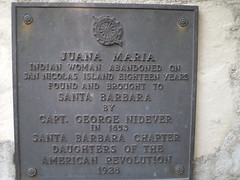
Scott O'Dell's Island of the Blue Dolphins is set on San Nicolas Island, a small island off the coast of Santa Barbara California. In the Author’s Note at the back of the book, O’Dell writes that “[t]he girl Robinson Crusoe whose story I have attempted to re-create actually lived alone upon this island from 1835 to 1853, and is known to history as The Lost Woman of San Nicolas” (p. 187). Because nobody could understand her language, her given name is not known. Named Juana Maria by the Mission priest who took her in at Santa Barbara Mission, she died six weeks after her rescue. To anthropologists, the people of the island are known as Nicoleños.
In his story, O’Dell changes Juana Maria’s status to a twelve-year old girl named Karana. As the story opens, Karana and her little brother Romo are digging roots when a ship arrives. On board is a Russian captain named Orlov who has come with forty of his (Aleut) men to hunt sea otter. Based on past experiences, Chief Chowig (Karana’s father) and Orlov have a tense discussion about what the Ghalas-at will receive in return for the otters that will be taken from the waters that abut the island. Months later when Orlov readies to leave without holding up his end of the bargain, a fight breaks out. Most of the men of Ghalas-at, including Chowig, are killed. Two years later, the survivors are rescued. After the rescue ship leaves the cove, Karana realizes Romo is not on board. She jumps ship to stay with him and wait for another rescue ship. Soon after, wild dogs kill Romo, and Karana is alone until her rescue.
Her years on the island make survival a central theme of the story. During that time, she builds several shelters, makes weapons that only men are supposed to make (according to tribal traditions), finds food, fights wild dogs, befriends a large dog that she thinks came to the island with the Russian ship and then when he dies, tames a wild dog that she thinks was fathered by the large dog. She survives an earthquake, a tsunami, and several harsh winter storms.
At the close of the story, she is leaving the island. Based on the text, she has been there at least four years. On page 162, the text reads that two years have passed since the Aleuts had been on the island. At that point, Karana stopped counting the passage of time. One spring, there is an earthquake. As she makes a new shelter, she sees a ship and at first, she hides from the two men who come ashore. She decides she wants to be with people again, and rushes down to the cove but the canoe is gone. Two years pass and a ship returns. This time, she doesn’t hide. When the ship leaves, she is on board with her dog and two caged birds.
A few words about Scott O’Dell
Born in Los Angeles, California in 1898, O’Dell died in 1989. He spent the first thirty years of his adult life working in Hollywood as a cameraman and writer. In 1920, a California newspaper misprinted Odell Gabriel Scott’s name as Scott O’Dell. Liking the misprint, Scott legally changed his name and from then on, was known as Scott O’Dell. In 1947, he became the book editor for the Los Angeles Daily News (Payment, 2006).
In addition to his writing, O’Dell spent time with his father on his orange grove ranch, where he visited ranches of Spanish families of the Pomona Valley and listened to their stories of the past. This led him to write three novels for adults, and a history of California.
In 1957, O’Dell published Country of the Sun: Southern California, An Informal History and Guide. Therein, he references Helen Hunt Jackson’s articles, published in 1882 in Century Magazine, about the mistreatment of the Cupeno Indians of California. He also references her novel, Ramona, published in 1884, saying her novel “had about the same impact as Uncle Tom’s Cabin. Overnight, the country was aroused to the plight of the Southern California Indian” (p. 52). Country of the Sun includes two pages about “The Lost Woman of San Nicolas Island”.
O’Dell developed the story into a book-length manuscript and showed it to Maud Lovelace (author of the Betsy-Tacy books). She persuaded him “that it was a book for children, and a very good one” (Scott O’Dell, n.d.). Lovelace penned the biography for O’Dell when he won the Newbery Medal for Island of the Blue Dolphins. She concludes the biography with “Scott O’Dell’s life brought him naturally a knowledge of Indians, dogs, and the ocean; and he was born with an inability to keep from writing. So he gave us the moving legend of Karana” (p. 108).
In his acceptance speech, O’Dell referenced animal cruelty and forgiveness as themes that are present in his book. He also spoke at length of Antonio Garra, a Cupeno Indian man who, just before he was executed under bogus charges, said “I ask your pardon for all my offenses, and I pardon you in return” (O’Dell, p. 103). O’Dell went on to say that this man, of a peaceful tribe, is unknown to the world because he was peaceful rather than “like Geronimo” (p. 103). Karana, he said, belonged to a tribe like Garra’s. He concluded his speech saying that Karana, before her people were killed, lived in a world where “everything lived only to be exploited” but that she “made the change from that world” to “a new and more meaningful world” because she learned that “we each must be an island secure unto ourselves” where we “transgress our limits” in a “reverence for all life” (p. 104).
Acclaim and Critiques of Island of the Blue Dolphins
Island of the Blue Dolphins received glowing reviews and went on to win the Newbery Award. It was made into a movie in 1964 and has since been made into audio recordings several times. The National Council of Teachers of English listed it on its “Books for You” in 1972, 1976, and 1988. In 1976, the Children’s Literature Association named it one of the ten best American children’s books of the past 200 years (O’Dell, 1990). It is the subject of numerous amateur videos on YouTube and there are volumes of lesson plans written for teachers. Over the years, the cover has changed several times. As of this writing, it has 734 customer reviews on Amazon.com. Thirty-three readers gave it one star, while over 600 gave it four or five stars.
In 1990, Island of the Blue Dolphins was republished, with illustrations rendered by Ted Lewin, and an introduction by Zena Sutherland. A fiftieth anniversary edition was published in 2010, with a new introduction by Lois Lowry. She showers O’Dell’s novel with praise, noting that he “masterfully” brings the reader onto the island (O’Dell, 2010). In 2010, School Library Journal blogger Elizabeth Bird listed it as one of the Top 100 Children’s Novels (Reese, 2010). In 2010, the book was listed in second place on Amazon’s list of “Bestsellers in Children’s Native American Books” (Reese, 2010).
In the academic literature, Maher (1992) writes that Island of the Blue Dolphins is a “counterwestern” that gives “voice to the oppressed, to those who lost their lands and their cultures” (p. 216). Tarr (1997) disagrees with that assessment, asserting that the reader’s uncritical familiarity with stereotypical depictions of American Indians is the reason it has fared so well. Moreover, Tarr (2002) writes that the stoic characterization of Karana and her manner of speaking without contractions are stereotypical Hollywood Indian depictions rather than one that might be called authentic. Placing the novel in a social and historical context gives depth to Tarr’s statement and also explains why it is so popular.
Island of the Blue Dolphins in a Social and Historical Context
In the years preceding the publication of Island of the Blue Dolphins, America was enjoying the heyday of Hollywood Westerns that depicted savage Indians who terrorized settlers and captured their women, and heroic White men who courted Indian maidens and bemoaned the way Indians were treated by Whites. John Ford’s Stagecoach(1939) follows a stagecoach of travelers who must be mindful of Indian attacks. Broken Arrow (1950) featured Jimmy Stewart as a man in love with an Apache girl and who, out of love and sympathy, tries to help make peace between the Apaches and the U.S. troops. In The Searchers (1956), John Wayne plays the role of a man on the search for a White girl who had been abducted by Indians.
Some of the research that went into Country of the Sun reappears in Island.Presumably, O’Dell conducted his research during the 1950s. That decade was a devastating time for several American Indian nations, a time during which their identity as sovereign nations was again under government attack. It is useful to review how they came to be known as sovereign nations.
From the moments of their arrival on the continent now called North America, Europeans encountered well-ordered nations or tribes of Indigenous peoples, each with its own territories and forms of governance. Recognition of that nationhood is evident in the treaties European heads of state made with their counterparts amongst the 500+ sovereign Indigenous nations (Deloria and DeMallie, 1999). In the treaties, lands were ceded to the United States in return for federally provided health care, housing, and education. As time passed, various entities wanted to nullify the treaties, thereby discontinuing federal funding to tribes and making available lands held by tribes. Desire for land, coupled with the rampant corruption within the Bureau of Indian Affairs that had federal oversight for the tribes, led Congress to terminate its nation-to-nation relationship with the tribes through a policy outlined in House Concurrent Resolution 108 (Wilkinson and Biggs, 1977) that led to several public laws enacted by Congress, including the California Rancheria Termination Act (Public Law 85-671). Through the Termination period (1953-1962), over one hundred bands, communities, and rancherias (California Mission Indians) in California were terminated (Nies, 1996). Given his care to include mistreatment of California Indians in the 1800s, it is curious that O’Dell does not reference any of the Terminations in Country of the Sun.
Emma Hardacre’s Lone Woman of San Nicolas Island
As noted, Island of the Blue Dolphins is based on the life of Juana Maria. At the time of his research, the resources he had available to him about Juana Maria were newspaper accounts and articles about her. Emma Hardacre’s “The Lone Woman of San Nicolas Island” was first published in Scribner’s Monthly in 1880, and then again in 1950 and 1973. Hardacre begins by noting that Robinson Crusoe is a work of fiction, whereas the story of the Lone Woman of San Nicolas Island was true. In Santa Barbara, people spoke less and less about the “widow, between twenty and thirty years of age” who leapt from the ship to be with her child who had accidentally been left behind (p. 75).
Years later, a Mission priest named Father Gonzales commissioned Thomas Jeffries to go to San Nicolas to see if she was still alive. Jeffries (p. 277):
found the remains of a curious hut, made of whales’ ribs planted in a circle, and so adjusted as to form the proper curve of a wigwam-shaped shelter. This he judged to have been formerly either the residence of the chief or a place of worship where sacrifices were offered. He had picked up several ollas, or vessels of stone, and one particularly handsome cup of clouded green serpentine.
More interesting to Jeffries was the abundance of sea otter. Soon after his return to the mainland, he returned to the island with George Nidiver and a crew of Indians on an otter hunt. For six weeks, they hunted seal and otter. Leaving the island, a sailor said he thought he saw a human figure calling to them, but the figure vanished.
On their third trip to hunt at the island, Nidiver saw a footprint and exclaimed that the woman was alive. The next day, Nidiver found a basket that contained “bone needles, thread made of sinews, shell fishhooks, ornaments, and a partially completed robe of birds’ plumage, made of small squares neatly matched and sewed together” (p. 279). In their search of the inland, they found “several circular, roofless inclosures [sic], made of woven brush. Near these shelters were poles, with dried meat hanging from elevated crosspieces” (p. 279). Not finding the woman, they determined the footprint was older than they thought, and some thought that she was probably dead. Fishing continued for several weeks. Nidiver believed she might be alive and hiding and decided to look until he found her or her remains.
A search was organized. They found the whale bone house, where “rushes were skillfully interlaced in the rib framework; an olla and old basket were near the door.” (p. 279). Climbing over slippery rocks, they found fresh footprints and followed them up a cliff. Brown, a fisherman, saw the woman in an enclosure and approached her. A pack of dogs growled at him but ran away when she uttered a cry that silenced them. She did not see Brown approaching. Hardacre reports that “the complexion of the woman was much fairer than the ordinary Indian, her personal appearance pleasing, features regular, her hair, thick and brown, falling about her shoulders in a tangled mat” (p. 280). She was anxiously watching the men below her dwelling. Brown signaled to the men that he had found her and that they should approach. When he spoke to her, she ran a few steps, then (p. 280):
instantly controlling herself, stood still, and addressed him in an unknown tongue. She seemed to be between forty and fifty years of age, in fine physical condition, erect, with a well-shaped neck and arms and unwrinkled face. She was dressed in a tunic-shaped garment made of birds’ plumage, low in the neck, sleeveless, and reaching to the ankle.
She greeted the other men and then set about preparing a meal for them that consisted of roasted roots. Through gestures, they communicated that she was to go with them. She understood immediately and put her things in pack baskets.
On board their ship, Brown wanted to preserve her feather dress, and so made her a petticoat of ticking. He gave her a man’s cotton shirt and a neckerchief. She watched Brown closely as he sewed, and showed him how she used her bone needle to puncture the cloth and then put thread through the perforations. Through gestures, she told Brown of her years on the island, how she made fire “by rapidly rubbing a pointed stick along the groove of a flat stick until a spark was struck” and that she was careful not to let it go out, covering her home fire with ashes to preserve it. She ate fish, seals’ blubber, roots, and shellfish, and she used bird skins for clothing. Her main dwelling was a large cave on the north end of the island.
On arrival in Santa Barbara, people flocked to Nidiver’s home to see her. Through gestures, she told Nidiver’s wife that dogs had eaten her baby and how she grieved its loss. She also communicated her dread of being alone, her years of hope for rescue, and at last, resignation at being alone. Nidiver was unable to find anyone amongst the Indians in the Missions who could understand her language. They learned some of her words: “A hide she called to-co (to-kay); a man, nache (nah-chey); the sky, te-gua (tay-gwah); the body, pinche (pin-oo-chey)” (p. 283). She was so gentle and modest that some believed she was not an Indian, but “a person of distinction cast away by shipwreck” (p. 283). She got weaker and weaker and when she was near death, Nidiver’s wife asked Father Sanchez to baptize her. He did so, giving her the name Juana Maria. She was buried in a walled cemetery and the mission fathers “sent her feather robes to Rome. They were made of the satiny plumage of the green cormorant, the feathers pointing downward, and so skillfully matched as to seem one continuous sheen of changeful luster” (p. 284).
Academic Resources
The academic resources on the people of San Nicolas Island were scant at that time that O’Dell wrote Island of the Blue Dolphins. Archeological studies post-1960 have generated a richer body of materials. Pre-1960, O’Dell likely drew from resources he used when writing his history of California. These included Kroeber’s handbook. He reports that her speech (language) was “thoroughly unintelligible” to Chumash Indians in the area and to Indians from Santa Catalina Island as well (p. 634). Most dwellings, Kroeber wrote, “were reared on a frame of whale ribs and jaws, either covered with sea-lion hides or wattled with brush or rushes” (p. 634). Dugout canoes “may have been burned from drift logs” (p. 634). Seals, water birds, fish, and mollusks were the primary source of food, supplemented by roots. He concludes with “whether the toloache cult or the image form of mourning anniversary had reached the island must remain in abeyance; and as to society, there is total ignorance. Ghalas-at has been given as the name of the island. This is perhaps the native or the Chumash pronunciation of Gabrielino Haras-nga” (p. 635.)
O’Dell may have read a study published in an archeological journal in 1953. Meighan and Eberhart’s study stated that “ethnographically, almost nothing is known of the tribe” and that there was a “virtual absence of trade goods, in particular glass beads” (p. 109). They reference the possessions of the woman as follows: “a well made sinew rope 25 feet long and one-half inch in diameter, thought to have been used in snaring sleeping seals” and, “sinew fishing line; bone and abalone shell fishhooks; bone needles; bone knives, and a knife made of a piece of iron hoop stuck in a rough wooden handle” (p. 112). Items found on the island include mats and skirt fragments made of eel grass, grass skirts, woven bags, woven baskets, stone knives with wooden handles, a stone drill with a wooden handle, wooden knife handles, a wooden ladle, an arrow shaft, a wooden dark foreshaft with bone bars, a drill with wooden shaft and stone point, harpoon points, a great many mortars and pestles, steatite dishes and bowls, stone beads and pendants, bird and sea-lion claws used as pendants, stone ground spoons and ladles . Meighan and Eberhart report four Nicoleno words: “tokay (hide), nahchey (man), taygway (sky), and pinoochey (body). Bird bones were used to make beads, whistles, awls, and fishhooks. Fish and shellfish were the primary source of food, including abalone, rock scallops, mussels, limpets, and sea urchins.
Clearly, these two key sources say little was known about the people of Ghalas-at and the woman at the heart of O’Dell’s novel. And yet, he was able to write a novel of 186 pages. With this survey of the source material of that time, I turn to a close read of specific passages from the story.
A Close Read of Island of the Blue Dolphins
In the following table, the left column contains a selection of material from the story. In the right column are notes specific to the information in the left column. Some of the passages are not addressed in the Discussion following the table; they are retained in the table for further research.
Text | Notes |
“I remember the day the Aleut ship came to our island” (p. 9) | “I” is Karana. On page 12, O’Dell tells us the name of the island: Ghalas-at. The Aleut’s are an Indigenous people from what came to be known as Alaska. During the time of the novel (1835), the Aleuts were enslaved by Russians and forced to hunt sea otters (Pullar, 1996). |
Karana describes Romo, her 6-year old brother: “He was small for one who had lived so many suns and moons” (p. 9) | Writers often use the cliché “many moons ago” when writing from an Indian point of view. Though it is obvious that people who do not speak English would have words in their language for sun or moon or the passage of time, the “many moons ago” idiom, inserted into the mind/mouth of any Native character obscures the diversity of language. |
When Romo sees the Aleut ship, he describes it as “a small cloud” (p. 10). | In Country of the Sun, O’Dell recounts a Cahuilla legend, “The Lost Spanish Galleon” (p. 147) that begins with Cahuilla men seeing a Spanish galleon and thinking it was a cloud. |
As Orlov comes ashore, “Half the men from our village stood at the water’s edge. The rest were concealed among the rocks at the foot of the trail, ready to attack the intruders should they prove unfriendly” (p. 12). | In Country of the Sun, when the Spanish galleon is sighted, O’Dell writes “The Cahuillas hid themselves behind rocks along the shore” and their chief “cautioned his people to remain hidden” (p. 148). |
When Captain Orlov comes ashore and begins negotiations with Karana’s father who is chief of the people at Ghalas-at, Karana is surprised that her father gives Orlov his seldom used and secret “real” name (Chowig) because “if people use your secret name it becomes worn out and loses its magic” (p. 13). | Look for: Names and their power. |
“Karana” is the protagonists’ secret name. Her common name is “Won-a-pa-lei” which means “The Girl with the Long Black Hair” (p. 13). | The translation does not make sense, given the likelihood that all the girls would have long black hair. |
The Aleuts come ashore, and Karana sees “a tall man with a yellow beard” (p. 12). | In Country of the Sun, Yuma Indians and a “bearded” Spanish captain come ashore (p. 148). |
The night Orlov arrives, her father “warned everyone in the village of Ghalas-at against visiting the camp. “The Aleuts come from a country far to the north,” he said. “Their ways are not ours nor is their language” (p. 17). | From O’Dell’s Country of the Sun: The night the Spanish came ashore, “Darkness fell and the Cahuillas went silently back to their village and held council far into the night. The older men, who had heard tales of Spanish greed and ferocity, were in favor of abandoning the village and taking the women and children into the mountains. But the younger men, proud of their heritage as warriors and jealous of it, prevailed” (p. 148). They lay plans for an attack. |
Each night, people in the tribe “counted the dead otter and thought of the beads and other things that each pelt meant” (p. 23). Karana does not like the slaughter of the otters she regards as friends she would have fun watching as they played. “It was more fun than the thought of beads to wear around my neck” (p. 23). | This is O’Dell’s first mention of beads. Presumably, the negotiations that took place when Orlov landed included beads but this was not specified. In Country of the Sun: The next morning, the Spanish gave each of the Indians “a handful of beaded trinkets” (p. 149). The beads story works because it plays on the idea that Indians are not smart enough to know that their land and resources aren’t worth more than beads. Williams’ analysis of Dutch, Manhattan, beads is excellent. |
Karana’s father sends young men “to the beach to build a canoe from a log which had drifted in from the sea” (p. 24). | Kroeber: Canoes “may have been burned from drift logs” (p. 634). |
Orlov and his men prepare to leave without paying for the otter pelts. Chowig speaks to Orlov, who signals his men to bring a black chest to the island: “Captain Orlov raised the lid and pulled out several necklaces. There was little light in the sky, yet the beads sparkled as he turned them this way and that” (p. 27) | The archeological record (Kroeber/Meighan & Eberhart) does not list sparkly beads recovered on San Nicolas Island. |
Items Karana has in a basket she carries onto the rescue ship: “three fine needles of whalebone, an awl for making holes, a good stone knife for scarping hides, two cooking pots, and a small box made from a shell with many earrings in it” (p. 42). | References to these items are in the historical record. |
Karana’s sister, Ulape, “had two boxes of earrings, for she was vainer than I, and when she put them into her basket, she drew a thin mark with blue clay across her nose and cheekbones. The mark meant that she was unmarried” (p. 42). | An assumption that Karana and her people had the same ideas of beauty (vanity) that O’Dell did. |
After she leaps off the boat and is back on shore, “The only thing that made me angry was that my beautiful skirt of yucca fibers, which I had worked on so long and carefully, was ruined” (p. 47). | An assumption that Karana and her people held the same ideas of beauty that O’Dell did. |
Romo declares that, as son of Chowig, he is now Chief of Ghalas-at. Karana replies that before he can be the chief, he must become a man: “As is the custom, therefore, I will have to whip you with a switch of nettles and then tie you to a red ant hill” (p. 51). | O’Dell’s likely source for this is Kroeber’s Handbook of the Indians of California, Volume 2. On page 672, he describes “The Ant Ordeal” that may have been part of the “Toloache Initiation” of Luiseno boys: “The boys were laid on ant hills, or put into a hole containing ants. More of the insects were shaken over them from baskets in which they had been gathered. The sting or bite of the large ant smarts intensely, and the ordeal was a severe one, and rather doubtfully ameliorated when at the conclusion the ants were whipped from the body by nettles.” |
Romo has “a strong of sea-elephant teeth which someone had left behind” (p. 50). | Meighan references sea-lion claws used as pendants. |
Karana needs weapons: “The laws of Ghalas-at forbade the making of weapons by women of the tribe, so I went out to search for any that might have been left behind” (p. 58.) | Future research |
Thinking the chest Orlov left may have an iron spearhead, Karana digs up the chest and finds it “filled with beads and bracelets and earrings of many colors” (p. 59). There are no spearheads in the chest. | Reference to beads draws on “primitive” (stupid) Indians who sold Manhattan for beads. |
Karana “wondered what would happen to me if I went against the law of our tribe which forbade the making of weapons by women—if I did not think of it at all and made those things which I must have to protect myself” (p. 61). | Future research on weaponry. |
“There was a legend among our people that the island had once been covered with tall trees. This was a long time ago, at the beginning of the world when Tumaiyowit and Mukat ruled. The two gods quarreled about many things. Tumaiyowit wished people to die. Mukat did not. Tumaiyowit angrily went down, down to another world under this world, taking his belongs with him, so people die because of him” (p. 82). | This story, from the Cupeno Indians, appears in Country of the Sun in “Revolt in the Mountains” as follows: “One of the most dramatic and current [myths of creation], as recounted by Salvador Cuevas, a Luiseno, has the world and everything in it created by the gods Tumaiyowit and Mukat. The gods quarreled and argued about their respective ages. They disagreed about many things. Tumaiyowit wished people to die. Mukat did not. Tumaiyowit went down, down to another world under this world, takig his belongings with him, so people die because he did” (p. 47). It is also in Kroeber’s Handbook, on page 692. |
Karana uses several words that she says are in her language: “Won-a-pa-lei” means “the girl with the long black hair” (p. 13) “sai-sai” is a kind of fish (p. 85) “rontu” means fox eyes (p. 105) “zalwit” means pelican (p. 107) “naip” means fish (p. 107) “gnapan” is a thick leaved plant (p. 115) “Mon-a-nee” means “Girl with the Large Eyes” (p. 160) “Rontu-Aru” means “son of Rontu” (p. 169) | None of these words are in Kroeber or Hardacre. |
Discussion
O’Dell had little to go on in creating the worldview of Karana and her people. To flesh out the story, he inserted his prior research on other California tribes, inserting their ways into the Nicoleno tribe, as though one peoples’ way of being was interchangeable with another. O’Dell wrote Island of the Blue Dolphins prior to the development of multicultural literature and the attention to specificity, so it may be appropriate not to judge him too harshly for doing it. He also drew from popular stereotypes and clichés of American Indians, including the stories in which American Indians traded their land for a string of beads. An American embrace of stereotypes and clichés led to—and guaranteed—the success of the novel.
Island of the Blue Dolphins is a lot like most books and media about American Indians that give the audience the kind of Indians that America loves to love (Shanley, 1997). O’Dell gave us both: the savage ones (the Aleuts), and the gentle ones (Karana’s people). In a spirit of generosity, it is possible to justify why his story met with such success but how do we justify an embrace of it in the present time, when we know so much more about accuracy and authenticity of representation? And why do even our leading scholars fail to step away from the book? For example, in her introduction to the illustrated version, Zena Sutherland conflated the story of Juana Maria with the fictional story of Karana. She incorrectly refers to the Lost Woman as Karana, instead of Juana Maria. She says that she was twelve years old (Juana Maria was a mother, not a child), and that Karana’s brother died on the island (Juana Maria’s child died). The real person is lost in the embrace of the fiction character, Karana. Is sentiment in the way?
Conclusion
There is a fascination, a nostalgia, and a yearning for the romantic Indian and all that “Indian” means to people who think the best life anyone could have is one of the Indian of yesteryear, living in the pristine wilderness, where the weight of the world is not on your shoulders, where you can breath clean air, and drink clean water.
This nostalgia also captures the imaginings of the perfect childhood, but neither one is—or was—real. As such, Island of the Blue Dolphins is a perfect example of a book at the center of the canon of sentiment (Stevenson, 1997). Indeed, the canon of sentiment “exists to preserve—to preserve the childhood of those adults who create that canon and to preserve the affection those adults feel for the books within it” (p. 113). A good many adults imagine the childhood O'Dell described and the survival that Karana experienced. We like to think we could survive, too, and a story like this one lets us see how that could happen.
Nonetheless, the story is lacking in its accuracy and suitability for informing children about American Indians. Will there come a time when there is a critical mass of gatekeepers rejecting works like this? I hope so. Sentiment is no excuse for ignorance.
References
Deloria, V. and DeMallie, R. J. Documents of American Indian Diplomacy. Norman: University of Oklahoma Press.
Hardacre, Emma. (1971). The Lone Woman of San Nicolas Island. The California Indians: Source Book, edited by R. F. Heizer and M. A. Whipple. Berkeley: University of California Press, 272-281.
Kroeber, A.L. (1925). Handbook of the Indians of California. Washington DC: U.S. Government Printing Office.
Lovelace, M. H. (1961). Scott O’Dell: Biographical note. The Horn Book Magazine, 37,
105-108.
105-108.
Maher, S. N. (1992). Encountering others: The meeting of cultures in Scott O’Dell’s Island of the Blue Dolphins and Sing Down the Moon. Children’s Literature in Education, 23(4), 215-227.
Meighan, C.W. and Eberhart, H. (1953). Archaeological resources of San Nicolas Island, California. American Antiquity, 19(2), 109-125.
Nies, J. (1996). Native American History. New York: Ballantine Books.
O’Dell, S. (1957). Country of the Sun: Southern California, An Informal History and Guide. New York: Thomas E. Crowell Company.
O’Dell, S. (1961). Acceptance paper. The Horn Book Magazine, 37, 99-104.
O’Dell, S. (1978). Island of the Blue Dolphins. Trumpet Club Edition. New York: Dell Publishing Co.
O’Dell, S. (1990). Island of the Blue Dolphins. With illustrations by Ted Lewin. Boston: Houghton Mifflin Company.
Payment, S. (2006). Scott O’Dell. New York: Rosen Pub. Group.
Reese, D. (2010). Bestsellers inChildren’s Native American Books.
Pullar, G. L. (1996). Alutiiq. Native America in the Twentieth Century: An Encyclopedia. New York: Garland Publishing, Inc. Edited by Mary B. Davis.
0 Comments on A critical look at O'Dell's ISLAND OF THE BLUE DOLPHINS as of 6/16/2016 10:06:00 AM
Add a Comment




Very interesting, Debbie, and a lovely presentation. A couple of thoughts: isn't "Juana Maria" almost as fictional a name as "Karana"? Most teacher's guides seem to use a similar title when discussing the true story of a fictionalized character; I don't think this can be construed as an insult. And on the subject of what might make better reading material: fiction is a great way for kids (and adults) to learn and connect with historical material. How about some fictional alternatives, suitable for 4th-5th grade? (I think this book is really meant for slightly older children, but that the book is often used in those grade levels.)
I think I did understand as a child, at least on some level, that the Aleuts were at least working under the thumb of the Russians. How it would have changed the story if I'd thought of them as "enslaved" is an interesting question.
I look forward to your more detailed writing on this book. Is this the first time you've read it?
Yes, both names are fictions. I'll revisit what I said about the use of Juana Maria. I didn't think it is insulting to use Karana instead of Juana Maria.
In a way, it is kind of like what happened when Scholastic first published the Dear America diaries. They were fictions, written by authors, but the packaging suggested that the character was a real person. In those cases, it was all fiction. In this one, there was a real person, and her name wasn't Karana. She was called Juana Maria. Using Karana instead of Juana Maria (in my view) takes readers down a slippery path in terms of knowing who Juana Maria was... Does that make sense?
One of the things I will ruminate on is that in choosing to write about her, or historical stories in general, O'Dell chose to ignore the struggles of Native people all around him. It would be interesting to know why he made that choice. Course, he wasn't really interested in Juana Maria.... from what I read, his major concern had to do with slaughter of animals. As such, she was a convenient device for him to write about how people destroy resources, and to contrast that with the Indian who, in stereotype-land, didn't destroy any resources at all.
I think I see what you're getting at with the use of Karana vs. Juana Maria in the teacher's guide, but I don't think that's clear in the presentation (just my opinion, of course).
You might be interested to know (if you didn't already) that Scott O'Dell created an award to honor the best historical fiction set in the Americas, because he thought it was important that American children know the history of the place they inhabit--surely a worthy cause, even if the way we think about this has changed over the years, and even though we no longer have a real dearth of American historical fiction (well, OK, of United States historical fiction, except for books about Latino, Asian American, and well-depicted American Indian children...). While I'm definitely not an O'Dell apologist, I want to note that his books seemed to be some of the few in my childhood (1980s) that depicted strong women of color. My Name is Not Angelica was the first book I read about slavery that made it seem real (and cruel). That doesn't mean I don't think we should read his books critically--I do; I think it's even more important to read well-written and well-known books critically--but it's interesting to examine where he was coming from. (Which was a different place later in his career than it was when he wrote Island of the Blue Dolphins, which he didn't originally intend for a children's book.)
Yes, I know about the O'Dell award.
One way to read something like his books and the award is that it deflects attention from the racism, anti-Indian attitudes, homophobia, etc. of the present. Far easier to talk about things from a long time ago than the present...
It is vitally important we know the past so, the saying goes, we don't repeat our errors. One of those errors, however, is a blind embrace of nostalgia for things that never were.
Debbie, I find that frankly bizarre. Are you saying that you are against the whole concept of historical fiction? That writers should not be encouraged to write good historical fiction or honored for doing so? That writing contemporary novels or non-fiction is somehow a more honorable or important accomplishment?
No, Wendy, I'm not saying that at all. My observation is that overall, American Indians appear more frequently in historical fiction than in fiction. And in that historical fiction, they are (more often than not) depicted inaccurately or in biased ways by people who mean well... By people who seem to be mourning an existence that went the way of that "end of the trail" notion, when in fact, that imagined existence being mourned never-was-as-imagined.
There's some historical fiction I absolutely love. Erdrich's BIRCHBARK HOUSE... Sterling's MY NAME IS SEEPEETZA...
On the subject of Prezi.. I've had serious issues with it. Every time I try to access presentations it freezes my Macbook. No matter what I do, whether it's the website or the downloadable app. It's been literally impossible for me to use it!
That is a very interesting question about the perception of the Aleuts. I am thinking not so much of our perception of the Aleuts, but Juana Maria/ Karana's. I wonder if you would feel differently about a group of people who slaughtered your entire family if you knew that they were in turn enslaved by someone else, or if you would only care that they slaughtered your entire family.