The Diamond of Darkhold by Jeanne DuPrau
Reviewed by Sheila Jones (Greenridge Chronicles)
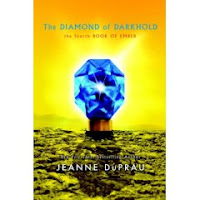
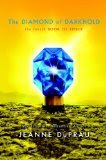 When I first picked up The Diamond of Darkhold, I knew nothing about The City of Ember , or indeed any of the other titles in Jeanne DuPrau’s Ember series. I looked at the cover (which, judging from the bland frontispiece, seemed more intent on advertising the upcoming film) and thought “Hmmm.”
Then I started the first chapter, The Vault:
“Around the middle of the twenty-first century, when it seemed that a great catastrophe was about to engulf the world, an underground city was built as a last refuge for the human race. It was called the city of Ember.”
Okay, I thought, post-apocalyptic fiction. Fun. I read on:
“When the people emerge from the city,” [the builder] said, “they will find themselves in a devastated world.”
“Unfortunately true,” said his assistant.
The Builder and his assistant cook up a plan to stock some essential “head start” articles for the people of this city, to be hidden in a vault in a hillside near to where they would emerge, when the Earth is once again safe to roam about on. Only one catch:
The people of Ember came out of their underground city somewhat later than planned. Because they were in a state of bewilderment and exhaustion when they emerged, and because trees had grown up where trees hadn’t been before, they failed to notice the door to the vault.
Oh darn. They missed the vault for the trees. But wait, someone else finds the vault. Someone who is obviously unsuitable. Someone who can’t read and has a bad temper. And thus begins
The Diamond of Darkhold.
I should start by saying that I don’t believe you need to have read the first three books in this series. It will help for some of the more obscure-and-never-explained-even-at-the-end moments, but most of what you need is in that initial chapter: apocalyptic events threaten Earth, quick-thinking and very anonymous people develop a secret underground city and stock it with food, greenhouses, clothing, and buildings, not to mention a generator to power this underground city for at least 200 years, then lead selected adults and infants down to the city, where they are to form a new society, one to survive the apocalypse. Of course, I say this because I read Darkhold first, instead of last, but there was never a moment when I thought “Ugh, I wish I’d read the others before this one.” Never.
Darkhold takes up the story several months after the people of Ember have emerged from what we are told was a malfunctioning and slowly dying city. The people of Ember are not the only people to have survived the apocalypse, though; shortly after emerging they come across a town called Sparks, with a small but determined group of inhabitants living a hardscrabble life, and the Emberites set to work to assimilate into the sometimes resentful town. Life is hard for everyone, and more so for the Emberites, not having experienced things like wind and rain and cold. Plus, they didn’t bring much with them when they left Ember, and the people of Sparks are at times ambivalent about sharing what little they have. People get sick, people die, crops fail, and there is no real medicine to speak of. Someone needs to do something, and fortunately, someone does. Someone from the city of Ember. This is the story of
The Diamond of Darkhold.
I was quite enchanted with this book. In fact, I could hardly put it down, it was so gripping. DuPrau has a clear, crisp style that details in the sparest of ways, leaving one with the feeling that the reading was like having been on a roller coaster. The action moves along briskly, never lingering, the characters are vivid, their dialogue genuine, and even the bleakest moments zip along with a sort of breathlessness. I was left with the feeling that I’d just read a book written by an old pro.
And when I’d finished it, I went immediately to the library and took out
The City of Ember .
What Other Bloggers Are Saying:
Wands and Worlds: "There's plenty of excitement and suspense and adventure. And I really liked that what they found in Ember was different than what they - and the reader - expected. Fans of the Ember series will definitely want to read it.
" (read more...)
A Patchwork of Books: "A few new characters make their way into the ever exciting mix, as do all the favorites, in what turned out to be a pretty great adventure. The beginning moved slightly slower than I typically enjoy, but being a fourth book in a series a lot of back information was given for possible newcomers to the books.
" (read more...)
HomeschoolBuzz.com "There is some action with the adventure, and the author places an emphasis on teamwork, creative thinking, and the acceptance of each other.
" (read more...)
Becky's Book Reviews: "While The People of Sparks and The Prophet of Yonwood are more about ideas and philosophies, this one is pure action and adventure." (read more...) Also see an interview with the author at Becky's Book Reviews.
More Info:
- Reading level: Ages 9-12
- Hardcover: 304 pages
- Publisher: Random House Books for Young Readers (August 26, 2008)
- Language: English
- ISBN-10: 0375855718
- ISBN-13: 978-0375855719
- Source: Review copy from publisher
Other Ember Books in the series:

 For this second day of the Jeanne Du Prau blog book tour I have got an interview for you to look at.
1. What, if any, was the inspiration for the idea of a city underground?
I grew up in the 1950s, when many people were worried that there might be a nuclear war. Some people were even building bomb shelters in their back yards. I used to read magazine articles with instructions about how to do this. All of it made a huge impression on me, and there's no doubt that it influenced my idea for Ember, which is a place built to save the human race from a terrible threat.
2. The Prophet of Yonwood takes a big step back in time from The City of Ember. Did you find it hard to make this step in the writing process or was the transition an easy one to make?
When the idea for The Prophet of Yonwood first came to me, I thought it was going to be a separate book, not connected to the Ember series. But as I started writing it, I soon realized that it was connected after all. It was a story about fear and unreasoning belief and what can happen when people see their own side as absolutely right and all others as absolutely wrong. It was a story about the origins of conflict, in other words--the kind of conflict that can lead to a disastrous war, and it was that sort of war that led to the building of Ember.
3. In the Diamond of Darkhold the diamonds that Lina and Doon find end up being crucial for the people of Sparks. Where did you get the idea for the diamonds, and do you feel that there is an environmental message here regarding solar power?
I have been interested in solar power for a long time. I'm hoping we will find a way--soon!--to use it efficiently for all our energy needs. Twenty years ago, I built a small house powered entirely by photovoltaic panels. It was a wonderful feeling to know that my lights, my refrigerator, and my computer were all being run by the sun! So of course I'd like others to share my enthusiasm.
4. At the end of The diamond of Darkhold you mention that a space ship has come from an alien world to visit Earth. This sounds intriguing and I for one would love to know what happens next. Do you plan on writing about this story in a future book?
I don't think so. I too would love to know what might happen in an encounter between human beings and people from another planet. But it isn't easy to create a convincing alien in a story. I've rarely seen it done. What I'd really like is to live long enough to be here in this world when we make contact with intelligent beings elsewhere in the universe. That would be an unimaginable thrill.
5. In writing these books were you trying to get young people to think about the future of our planet?
I did not start out, when I wrote The City of Ember, to deliver that message. But I myself am thinking about the future of our planet, and so that concern naturally shows up in what I write.
6. Do you plan out your books in advance or do you just let the story unfold as you go?
A little of both. I make a rough plan and write according to the plan until I see that it doesn't work any more, that the story has taken a new direction. Then I make another rough plan and follow that one for a while until it doesn't work anymore, either. And so on. It's a difficult and rather messy process, but I'm afraid if I outlined every step of the way and wrote exactly to the outline, my books would be less likely to come alive. And the truth is, I'm no good at outlining anyway.
7. What was your favorite book when you were twelve or so years old?
This is always a question that gives me trouble. I've never had one favorite book, not at any age. I read so much and love so many books that I can never pick just one. At twelve I was probably reading books by Agatha Christie, Charlotte Bronte, Ray Bradbury, Edgar Allen Poe, Jack London...I could go on and on.
8. Do you have a consistent writing plan that you stick to every day or are your days more fluid?
I schedule my time loosely rather than rigidly. My best working time is in the morning. I don't usually write for more than two or three hours a day, especially when I'm working on a first draft. That's the hardest kind of writing for me. When I'm revising, sometimes I work more hours. The rest of the day gets filled up with answering mail, reading, and doing all the things it takes to keep my life running more or less smoothly.
9. You must be excited about the City of Ember film that is coming out. Did you participate in the film making process at all?
Yes, the movie is exciting--I never dreamed it would happen! I haven't had a lot to do with the process, though. I don't think most authors do, unless they happen to be very, very famous. I read the filmscript and commented on it, and I have met the director and seen a few scenes from the movie. I've also had e-mail from a few people who worked as extras on the film, so I've gotten little glimpses of what that was like. But the finished movie will be almost as much of a surprise to me as to everyone else. I'm hoping it will be fabulous!
10. Did you ever think that your books would be as successful as they are? How has their success changed your life?
I did not expect this success. I'd always been a writer and had had several books of non-fiction published before The City of Ember. But Ember was my first novel, it was very hard to write, and I didn't know how it would be received at all. I had no idea that I'd be writing sequels to it, and certainly no inkling that it would be made into a movie. Because of all this, my life has indeed changed. For one thing, I've done more public speaking in the last five years than in all the rest of my life put together! I've connected with readers of all ages, all over the world. And I now get to spend my time in the place I like best--my office at home--doing the work that's more rewarding to me than anything else.
Please visit the other blogs that are participating in this tour. They are:
01 Charger,
the 160acrewoods,
A Childhood of Dreams,
A Christian Worldview of Fiction,
All About Children’s Books,
And Another Book Read,
Becky’s Book Reviews,
Book Review Maniac,
Cafe of Dreams,
Comox Valley Kids,
Dolce Bellezza,
Fireside Musings,
Homeschool Buzz,
Hyperbole,
Never Jam Today




 When I first picked up The Diamond of Darkhold, I knew nothing about The City of Ember , or indeed any of the other titles in Jeanne DuPrau’s Ember series. I looked at the cover (which, judging from the bland frontispiece, seemed more intent on advertising the upcoming film) and thought “Hmmm.”

Thanks! What a great interview! I'm learning something new at each interview.