new posts in all blogs
Viewing Blog: The Children's War, Most Recent at Top
Results 1 - 25 of 621

Essentially, a journal about books written for children and young adults about World War II.
Statistics for The Children's War
Number of Readers that added this blog to their MyJacketFlap: 2
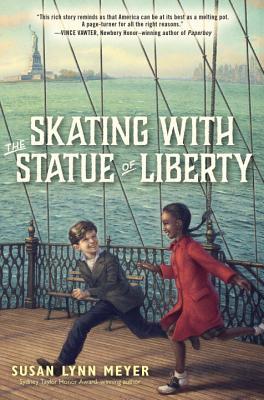
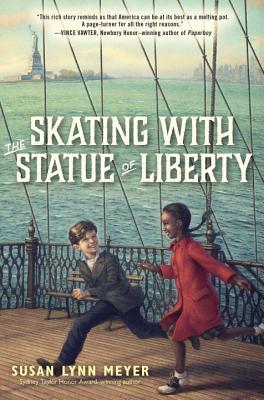
Skating with the Statue of Liberty continues the story of Gustave Becker begun in
Black Radishes. Gustave, now 12, and his family, along with his cousin Jean-Paul and his mother, all French Jews who have finally gotten American visas to leave Nazi-occupied Europe and sail to America. It's January 1942, and the ship the family is sailing must dock in Baltimore to avoid the Nazi U-boats patrolling the waters around New York City. Gustave is disappointed that the Statue of Liberty won't be his first view of America, but arriving in the US is his first taste of freedom since before WWII began.
However, life isn't all that easy for the Becker family in NYC. After staying with kind relatives, they find a small, affordable one room apartment with a shared bathroom on West 91st Street in Manhattan. His father must settle for a low-paying job a as janitor in a department store, and his mother ends up sewing decorations onto hats. Gustave begins school at Joan of Arc Junior High school, hoping the name is fortuitous for him in his new school, home and country.
School issn't too bad for Gustave, who already knows a little English, with except for his homeroom teacher, Mrs. McAdams, who believes that raising her voice at him will make Gustave understand her better. And she also decides that his name is too foreign and begins to call him Gus. He does have one African American student in his class, September Rose, but he doesn't understand why she keeps her distance. Eventually they do become friends, and face some nasty physical and verbal incidents because of it.
Gustave's English improves quickly, and he even gets an after-school job delivering laundry. He and his cousin Jean-Paul, who now lives with his mother at a relative's home in the Bronx, join a French boy scout troop run by a French priest and a French rabbi, the same rabbi who has begum preparing the two cousins for their Bar Mitzvahs. And through his friendship with September Rose, Gustave learns about the Double V campaign in which her older brother Alan and his friends are involved.
But Gustave also worries about his friend Marcel in hiding back in France. Luckily, he is able to write to his friend Nicole in Saint-Georges, France, whose father is in the French Resistance, so there is always hope that there will be good news about Marcel.
I had very mixed feelings about this novel. There is no real conflict in it, really. It is mostly about Gustave assimilation into American life. And while that is very interesting and realistic, it isn't very exciting. In fact, the whole issue around the Double V campaign, including the demonstration staged by Alan and his friends outside a department store in Harlem that refuses to hire African Americans is actually the most exciting part of the book and, I think, it should have been a story in its own right.
On the other hand, and perhaps because my dad was an immigrant, I personally liked reading about Gustave's life in America, perhaps because it is inspired on the author's father's real experiences after arriving in this country. For sure, America isn't portrayed perfect and even Gustave faces incidents of racism and anti-Semitism, but for the most part, he does make friends and has a nice support system in his family, Boy Scouts and school. I certainly appreciate his mixed feelings about which country to give his loyalty to and how that is resolved.
Themes of friendship, family, refugees, racism, hate, and acceptance make this historical fiction novel as relevant in today's world as in 1942. It is a quiet, almost gentle novel that will give young readers a real appreciation of what their family may have lived through coming to a new, unfamiliar country, finding a place in it and giving back as productive members of society.
This book is recommended for readers age 9+
This book was borrowed from the NYPL
Did the Statue of Liberty really skate in this book? Of course not, but you'll have to read to the end to find out where the title comes from.
Gustave lived on the Upper West Side of Manhattan, just as Meyer's father did. His school, Joan of Arc Junior High School on West 93rd Street, is referred to in the book as a "skyscraper school" which only means that it was built up not out because of rising property values. But it is also a real school, now landmarked and on the NY Art Deco Registry. As you can see, it is an unusual school:
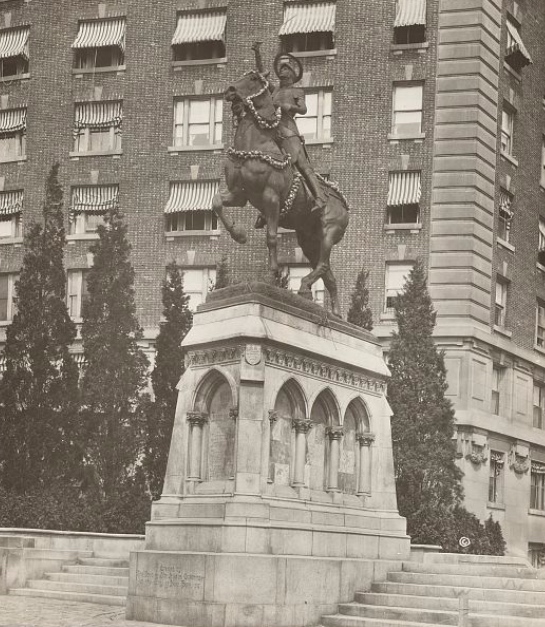
Gustave also spends a lot of time at the Joan of Arc statue in Riverside Park, at the end of West 93rd Street. It is also a famous landmark and you can read all about it at one of my favorite blogs,
Daytonian in Manhattan (he has better photos)

 |
| Elie Wiesel 1928-2016 |
I was so sad to hear of the passing of Elie Wiesel on Saturday, July 2, 2016 in Manhattan. After surviving the Holocaust, Wiesel became a witness for all those who did not survive, including his most of own family. He went on to write books and give lectures and, in 1986, he won the Noble Peace Prize that year.
Wiesel is probably most well known for his book
Night. To me, it is the book that best defines the life of Elie Wiesel and the man he became after the Holocaust, a humanitarian who spoke out against injustice, indifference, hatred, bigotry and all of the world's genocides, including those in Bosnia, Rwanda and Dafur.
You can read Elie Wiesel's obituary in the NY Times
HERE
In his honor, I am posting my review of
Night, originally posted on January 6, 2012:
"I believe that anyone who lived through an experience is duty bound to bear witness to it."
From Elie Wiesel: First Person Singular
In Night, Elie Wiesel bears witness to his experience of the Holocaust. Living what they thought was a safe existence in Sighet, Romania (Transylvania), the Wiesel family, like all the Orthodox Jewish families there, could not believe the reports of mass murder that came back to them from an eyewitness who had managed to escape the Nazis. Then the spring of 1944 arrived in Sighet, and so did the German soldiers, billeting themselves among the residents there. At first, these Nazis were polite and considerate, and people still weren’t worried because radio reports said that the Russian Army was pushing westward, in their direction.But, on the Seventh Night of Passover that year, everything changed. Jews were ordered to remain in their homes for three days, valuable were to be handed over and a yellow star was to be worn. Two ghettos were created, a small one where people stayed temporarily before being transported to camps, and a large one for longer stays. With each egregious act, the Jews of Sighet convinced themselves that it couldn’t get worse, but it did. The Wiesel family was among the last in Sighet to be transported to Auschwitz-Birkenau when the ghetto was finally liquidated. They were put into cattle cars with 80 people in each and slowly traveled for days until they finally reached Auschwitz in Poland. There, during the selection process, Elie and his father were separated from his mother and youngest sister, Tzipora. He never saw them again. Elie and his father remained in Auschwitz for three weeks, before being sent to Buna, also called Auschwitz III. There, the inmates were put to work, most of them doing factory work for the German war effort. Elie and his father remained there until January 1945, when all the inmates were forced on a death walk to a concentration camp in Germany, as the Red Army was only hours away from Buno. Elie ended up in Buchenwald Concentration Camp until April 11, 1945 when the camp was liberated.
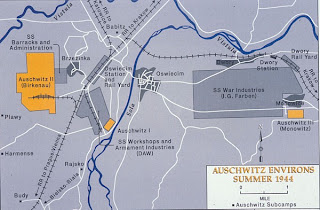 |
Map of Auschwitz - areas in orange are the three areas
where Elie Wiesel and his father were held at different times. |
Night is a book that answers Theodore Adorno’s question – how do you make poetry (art) after Auschwitz? In other words, how do you describe the indescribable? Elie Wiesel did this in simply declarative sentences, using straightforward vocabulary. And yet, he produces a picture of horrors that are almost impossible to imagine. For this reason, I think it is a benchmark for Holocaust memoir, along with Anne Frank’s The Diary of a Young Girl and Primo Levi’s If This is a Man. I have always thought the title of the book, Night, came from this passage:Never shall I forget that night, the first night in camp, which has turned my life into one long night, seven times curses and seven times sealed. (pg 34)And it does, but it also refers to a biblical passage - Genesis 1:5 defining a day as starting at nightfall (which is why Jewish holidays always start at sundown):
"God called the light Day, and the darkness he called Night. And there was evening and there was morning, one day."
In this respect, even though the book describes the inhuman treatment of Jews by Nazis, Night also carries the message of hope in its title - there will always be a tomorrow.I had read Night when I was in high school, but when Oprah Winfrey picked it for her Book Club Selection in January 2006, I reread this new and better translation, which, incidently, was done by Marion Wiesel, Mr. Wiesel’s wife. Thanks to Oprah, Night was read by 2,021,000 readers, many of whom might never have read it otherwise, according to a report in the Huffington Post It was the 3rd most popular book throughout her book club history. Interestingly enough, although Elie Wiesel was awarded the Nobel Peace Prize in 1986, to date, Nighthas never been given any individual honors.This book is recommended for readers age 14 and up.This book was purchased for my personal library
This post was originally posted in 2012, but something odd happened on Blogger and it had to be reposted.
It is 2002 and Georgie Wetherall loves two things - knowing all about England in World War II and creeping. Creeping? That is when you “streak across a row of back gardens, over fences, through hedges, across veg patches...without getting caught or recognized.” (pg13) And he especially likes leaving Miss Coverley’s garden is shambles. Georgie knows she doesn’t like him - she's always watching him. So when he has to repair her fence post as punishment for his last creeping adventure, Georgie discoveres she watches him - it seems he reminds her of someone, but who?
All this is forgotten, however, when Georgie’s class goes on a trip to Eden Camp, a former POW camp turned into a WW 2 museum of 29 huts each dedicated to one aspect of the war. Hut 5 is a realistic replica of a bombed street in London during the Blitz. The sounds and smells add to the realistic atmosphere - but wait, it is perhaps a little too realistic. In fact, Georgie suddenly finds himself transported back to wartime London.
Finding himself faced with the real deal, cold, hungry, lost and scared, Georgie wanders around until he finds a friendly searchlight crew who give him something to eat. After living through a night of bombing in a public shelter, Georgie notices four kids emerging from a bombed out pub. He and the kids start talking and they tell him he can stay with them as long as Ma approves. Ma turns out to be a 14 year-old girl who watches over orphaned kids in the pub's basement.
Ma has a job in a second hand shop owned by what she believes to be is a Jewish refugee from Germany called Rags. But when Georgie discovers a radio transmitter locked in one of the shops upstairs rooms, the kids begin to suspect that maybe Rags isn't who they think he is. And they decide to find out exactly what he is up to with that radio transmitter. Trouble is, Rags begins to suspect Ma of snooping in his stuff and decides to find out what she is up to. So, Georgie, along with Ma and the other orphans, is on a wartime adventure he never dreamt possible.
I liked this coming of age time travel story. It is told in the first person, and the author maintains the voice of a 12 year-old boy throughout, giving it an authentic quality - quick, witty, full of colloquialisms from 2002 that are questioned by the folks from 1940. I also found Georgie's reaction to his predicament refreshing. In most time travel stories, kids end up in a different time and place and seem to assimilate so easily. But for Georgie, it isn't just a jolly adventure. He worries throughout about not getting home, not seeing his parents again. As wartime London loses its romanticized aura and becomes reality, it causes Georgie to experience real reactions like throwing up more than once and even wetting himself at one point.
But it is also a story of survival, complete with a cast of orphan characters right out of Charles Dicken's London, who become Georgie's family away from family, helping him adjust and carry on. And most importantly, helping him see the reality of war.
Blitzed is a fast paced but wonderful book. The chapters are only a few pages long, but the events are exciting, making it an ideal book for a reluctant readers and certainly one that would appeal to boys as well as girls.
This book is recommended for readers age 10+
This book was purchased for my personal library
You can hear Robert Swindells speaking about Blitzed here. It is on YouTube but the embed function is disengaged.
And there really is an Eden Camp in Yorkshire, so if you happen to be in England and would have an interest in visiting (you might want to go to Yorkshire anyway, it is a wonderful place to see.) Information about visiting can be found here.

For Pete Smeaton, age 10 going on 11, moving from London to Clydebank, Scotland had its good points and its bad ones. He was sorry to leave a place he knew so well, and his two best mates Simon and Alfie. On the other hand, in Scotland, Pete has a big bedroom to himself, away from the rest of his family, including baby sister Jenny and her incessant crying. Not only that, but there's that old WWII Anderson shelter at the end of the garden, just past the bomb crater, perfect to use as his personal den. Now, if only the girl next door would stop crying - except there is no next door, not since WWII when it took a direct hit from a bomb.
But no sooner do Pete and his football-figure collection get to the shelter, then he is confronted by Dunny, who claims the shelter is his. After a brief showdown, the two boys bond over the football figures and in no time, Pete had a new best mate. Everything seems to be going well - the house comes with his dad's new job, his dad's boss, Jamie Milligan, loves old rock and rock music as much as Pete does, and he doesn't have to start a new school until after the Easter holiday. If only the girl next door would stop crying and who is the creepy old lady that is always standing at the bomb crater and doesn't seem to see or hear anyone?
Little by little, with the help of Dunny, Mr. Milligan and his mum, Pete begins to unravel the mystery of the crying girl next door. No one who has lived in this area in Clydebank seems surprised when they discover that Pete can hear her. He learns from them that her name is Beth and she lived next door during the war. On the night of the Clydebank Blitz, Beth was in the Anderson shelter when the bomb hit her side of the house and destroyed it. A box of treasured items, including her mother's wedding photo got lost in the rubble. Beth's mother was killed in the blitz and she and her father migrated to New Zealand in the 1950s.
Beth is an old woman now, and all she wants is to see the photo of her mother once more, the one in her lost box. On the anniversary of the Clydebank Blitz, the Anderson shelter becomes a portal that takes Pete back to that terrifying night. Can he help Beth find her treasure box in the past, so she can die in peace in the present?
The Blitz Next Door is a nice blending of real events with realistic fiction and fantasy. The story is told in the third person, from Pete's perspective. He is a clever, sensitive boy, good to both his sister and the girl next door, for all their crying, and brave enough to take risks to help Beth. The other characters, especially Dunny and Mr. Milligan are also well developed with definite personalities, even Jamie Milligan and Dunny's younger brother Wee Stookie are solid and believable, though Pete's mum and dad as minor characters never really evolve.
The Clydebank Blitz was, indeed, a real event, and happened over the course of two nights, March 13 and 14, 1941. A total of 560
Luftwaffe bombed the city because of its munitions factories and shipyards, 578 people were killed and many, like Beth, lost their homes.
The Blitz Next Door is a basically a contemporary story and you may wonder, as I did, if there would still be a bomb crater from WWII. I didn't find one specific to Clydebank, but there actually are still some craters in the area.
This is a story set in Scotland and there is some amount of British slang used. It won't take long to figure out that footy is soccer, that a stookie is a plaster cast, and that bally doesn't what it sounds like it should mean. It is actually a substitute for saying ?bloody" which at one time was considered to be an expletive, but isn't really, anymore.
The Blitz Next Door is a compelling story that should appeal to readers who like a mystery and time travel stirred into their contemporary adventure stories, and that explores themes about friendship, family, courage. This would pair nicely with
A Shirtful of Frogs by Shalini Boland.
This book is recommended for readers age 8+
This book was an EARC received from
NetGalley

It's 1943 and the world is in the throes of WWII. In the small rural Pennsylvania community where Annabelle, 12, and her family live, things haven't changed that much with the exception of the gold stars in people's windows indicating that they have lost a loved one in the war.
Years earlier, Toby, a gentle unkempt shell-shocked veteran from WWI, had arrived in Wolf Hallow after returning from the war, taking up residence in an old abandoned smokehouse and isolating himself from society, content to wander the woods surrounding the area to wrestle with his wartime demons. Occasionally he would gratefully accept food from Annabelle's mother.
Into this mix, comes Betty Glengarry, a 14 year old girl who is sent to her grandparents in the country because she is considered to be "incorrigible," capable of doing harm to whomever she decides is her prey. She immediately begins bullying Annabelle, and threatening to hurt her if she doesn't give Betty what she wants. And she carries out her threat, hitting Annabelle on the thigh with a tree branch, when she is only given a penny. Toby intervenes to help Annabelle and becomes Betty's next victim.
Betty insists later that she saw Toby throw the rock that hit Annabelle's best friend Ruthie causing her to lose an eye, claiming the rock's real target appeared to be an older German man who had lived in Wolf Hollow for years. But Betty knew she could capitalize on people's renewed anti-German feelings, and Toby's eccentric behavior. Annabelle knows the truth, but everyone believes Betty. After all, Betty looks like a sweet innocent girl with long blond braids and plaid dresses, while Toby looks like a “crazy” person wearing a long coat, a hat the covers most of his face, long straggly hair and always carrying three guns across his back.
Betty continues her reign of terror directed at Annabelle, her two younger brothers and Toby, until one day, she goes missing. And it doesn't take long for the community to point its collective finger at Toby, blaming him for what happens.
Wolf Hollow is a beautiful and sensitively written, multilayered novel that tackles some really weighty themes. It is narrated by a now adult Annabelle, looking back over the events of 1943, the distance giving her some understanding of what happened, yet letting the reader see how limited she was in some of her choices and her 12 year-old understanding of what was happening around her.
I liked the way the author juxtaposed Betty and Toby, both characters suffering from some form of mental illness, she from what appears to be sociopathic behavior, he from PTSD, and challenging the reader to try to understand the moral dilemma that Annabelle faces.
Lauren Wolk bravely allows the level of cruelty that Betty is capable of, without regret or guilty conscience, to evolve just as she allows Toby's odd dress and behavior to unfold in order to make a very important point about preconceived notions of who is guilty or who is innocent by how they appear. Wolf Hollow, Annabelle's grandfather explains, is named that because in the old days when everyone was farming, the men would dig a deep hole and once it was full of wolves, they would shot them to keep their community and farms safe. And the question here is just who is the wolf that is threatening Wolf Hollow now? Toby or Betty?
This is a novel that becomes darker as the tension builds and there is plenty of tension. Though this is basically a middle grade novel, I would have to caution readers that it is not for all of kids. There is some violence that just may be too disturbing to more sensitive readers.
Wolf Hollow is a morally complex novel that deals with themes of mental illness, courage, cowardice, and war, and yes, I highly recommend it.
This book is recommended for readers age 10+
This novel was an EARC, part of which was received from
NetGalley

upcoming releases we can't wait to read.
The Plot to Kill Hitler: Dietrich Bonhoeffer: Pastor, Spy, Unlikely Hero by Patricia McCormick
HarperCollins, September 13, 2016, 192 pages, age 9+
From Goodreads:
It was April 5, 1943, and the Gestapo would arrive any minute. Dietrich Bonhoeffer had been expecting this day for a long time. He had put his papers in order—and left a few notes specifically for Hitler’s men to see. Two SS agents climbed the stairs and told the boyish-looking Bonhoeffer to come with them. He calmly said good-bye to his parents, put his Bible under his arm, and left. Upstairs there was proof, in his own handwriting, that this quiet young minister was part of a conspiracy to kill Adolf Hitler.
This compelling, brilliantly researched account includes the remarkable discovery that Bonhoeffer was one of the first people to provide evidence to the Allies that Jews were being deported to death camps. It takes readers from his privileged early childhood to the studies and travel that would introduce him to peace activists around the world—eventually putting this gentle, scholarly pacifist on a deadly course to assassinate one of the most ruthless dictators in history. The Plot to Kill Hitler provides fascinating insights into what makes someone stand up for what’s right when no one else is standing with you. It is a question that every generation must answer again and again.
With black-and-white photographs, fascinating sidebars, and thoroughly researched details, this book should be essential reading.
What are you waiting for this week?
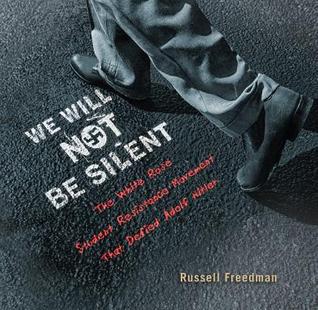
Russell Freedman has written a wonderfully succinct history of the short-lived White Rose resistance movement the formed in Nazi Germany after some friends became disillusioned with the whole National Socialist government and its leader Adolf Hitler.
Freedman highlights the White Rose's history through the lives of siblings Hans and Sophie Scholl. Hans, once a willing participant in the Hitler Youth and a natural born leader, quickly began to realize that within the youth organization and Germany as a whole, there was no place for anything other than what had been decided by those in power. Even singing folksongs from other countries around a campfire was met with severe reprimand.
Sophie, three years younger than her brother Hans, was a member of the League of German Girls, a part of the Hitler Youth. She was also enthusiastic at first, but just like Hans, became disillusioned, especially after seeing some of the treatment the Nazis imposed on people who were not party members, or on Jews.
Disillusionment led to action and soon Hans, now a student at the University of Munich, Sophie and a small group of like-minded student friends were writing and mailing their Leaflets of the White Rose, exposing what they felt was the truth about the Nazi Regime and Adolf Hitler and asking the citizens of Germany to take responsibility and fight them.
The White Rose began distributing their first leaflet in June 1942. Altogether, six different leaflets were printed and distributed all over Germany by the thousands, so many that the Gestapo began to diligently search for the members of the White Rose. On February 18, 1943, Hans and Sophie were arrested carrying a suitcase full of leaflets to be distributed and after a short trial, executed on February 23, 1943.
The story of Han and Sophie Scholl and the White Rose is an inspiring one and Freedman has presented it in a sensitive, thought-provoking manner. I think its real strength lies in the simplicity with which Freedman tells the story of the White Rose, all the while quietly letting the courage, honor, and principles of these valiant dissenters shine through. He makes clear that opposing Hitler was a dangerous business and that these young idealists were well aware of the danger they faced and died still believing they had done the right thing.
This is an excellent introduction to resistance in the Third Reich and would pair very nicely with Deborah Hopkinson's
Courage & Defiance: Stories of Spies, Saboteurs, and Survivors in World War II Denmark and/or
The Boys Who Challenged Hitler: Knud Petersen and the Churchill Club by Phillip Hoose for an interesting unit on Resistance vs. Acceptance (remembering the silence is acceptance).
We Will Not Be Silent includes copious photographs, including copies of the Leaflets of the White Rose, with some translation of their content. Back matter also includes Source Notes, a Select Bibliography of books and films.
This book is recommended for readers age 9+
This book was an EARC received from
Edelweiss/Above the Treeline
I was going through my picture books this morning trying to get them a little organized, and I came across
The Wall, which I had completely forgotten that I owned. I wish I remembered it so for Memorial Day, but I didn't so I thought I would write about it today.
On a cool, breezy day, a young boy and his father visit the Vietnam Veterans Memorial in Washington DC. The boys notices that the wall long long, shiny and shaped like a V. The names on the wall are in straight lines, the "letters march side by side, like rows of soldier."
But this isn't just a sightseeing visit. The boy and his father are looking for the boy's grandfather. As they search for his name, the boy sees different people approach the way - a wounded veteran, an elderly couple, a group of school girls - and the different mementos left by friends and family members who are still mourning the loss of the sons, brother, fathers, grandfathers Meanwhile, the boys father searches for the name of the father he lost when he was the age his son is now.
Finally, there it is - George Munoz. Son and father make a rubbing of his names, then quietly stand in front of it together, no doubt thinking about what a loss they have suffered.
Because, besides honoring the veterans who lost their lives in the Vietnam War, the wall also reminds us of what a profound loss to family and friends even a single life can be. And I think Eve Bunting has really captured that so well in this book, as well as what a truly emotional experience visiting the Wall can be, regardless of your feelings about the Vietnam War.
Ronald Himler's quiet impressionistic styled watercolor illustrations and his palette of background grays and semi-colorful foreground figures of visitors and mementos really reflect the somber mood of visiting such a meaningful visit.
I created this blog because I was interested in the impact war has on children effected by it and I think the little boy's last words really epitomize that impact:
"But I'd rather my grandpa here, taking me to the river, telling me to button my jacket because it's cold.
I'd rather have him here."
This book is recommended for readers age 5+
This book was purchased for my personal library
UPDATE:
A few years ago, I wrote that when I was too young to understand, I wore a MIA bracelet even though I was too young to understand what it was about. The name on the bracelet was James W. Grace. James was born in 1939 in Louisiana and shot down on June 14, 1969, which is, incidentally, flag day, and has been MIA since then. Eventually, my bracelet fell apart, but with the advent of the Internet, I periodically did a search for James to see if maybe he had made it home. Sadly, he is still MIA and his name has been listed on the Vietnam Memorial. Years ago, when I visited it, I did a rubbing just like the father and son in the story:
So it was time to do another search, and I was please to find a photo of James on the
Vietnam Veterans Memorial Wall of Faces
 |
| James William Grace 1939-1969 |
And just in case you are wondering what happens to all those mementos left at the wall, it is all explained in this 11 minute video, and trust me, it is well worth the tie it takes to watch.
And as always,
In Memoriam
FCP 1955-2001

Did you know that Memorial Day was originally called Decoration Day? During the Civil War, people began to decorate the graves of fallen soldiers with flowers and flags to honor them and their service. The tradition continues after the Civil War ended and the day eventually became Memorial Day.
I have to be honest and say I didn't know that Memorial Day began with the Civil War. I did know that when it became Memorial Day, it also became a day to honor those fallen soldiers of all of the wars the United States has been involved in - from the Revolutionary War to our present day conflicts, but apparently I still had things to learn.
Like me, kids probably know the true meaning of Memorial Day from school, especially since it means a day off for lots of them, and the official start of summer, with swimming, picnics, barbecues and getting together with friends and family. And that's all good.
But if you would like your kids to know and appreciate the day more, then
Let's Celebrate Memorial Day by Barbara deRobertis is an excellent place to begin. This slender book covers not just the history of Memorial Day, but explains traditions associated with it, such as why poppies are associated with it and different kinds of celebrations.
There is a section on war memorials around the country, although most are in Washington DC and if you have''t visited yet, prepare for an emotional but rewarding experience and bring tissues. There is also a section on different kinds of observances around the country, many of which have sadly been cancelled this year due to poor weather conditions. And the book acknowledges the veterans, boy and girl scouts around the country that decorate the graves of every single soldier buried in a national cemetery, so no soldier goes unrecognized on Memorial Day. And last but not least, the book reminds us that "Freedom is never free."
There are lots of photos throughout the book, large print for beginning readers, and easy to understand text. All in all, Let's Celebrate Memorial Day is an excellent book for learning about Memorial Day, for anyone who doesn't know or needs a little refresher.
Oh yes, and it reminds us to take a moment at 3:00 PM to stop what we are doing and remember our fallen heroes, and thank those presently serving in our Armed Forces.
This book is recommended for readers age 6+
This book was sent to me by the publisher.
In Memoriam
FCP 1955-2001

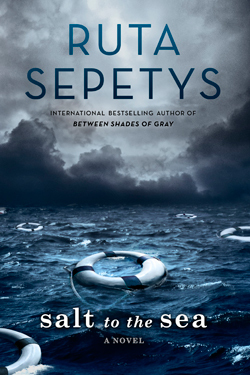
It's 1945, Germany is losing the war it had began in 1939, and now, as the Red Army approaches the East Prussian countryside, thousands of people who can are fleeing to escape the brutality that the Russians have been inflicting on Germans everywhere they go.
Among the refugees trying to reach the seaport city of Gotenhafen, where they hope to board a ship that will evacuate them out of the path of the Russians, are three young people whose paths converge en route. There is Joana, 21, a Lithuanian nurse who believes she is a murderer; Florian, a Prussian carrying questionable orders from a top Nazi official; and Emilia, 15, a traumatized young Polish girl wearing a pink hat. Also traveling with them are an elderly shoemaker, one little boy who has just witnessed his grandmother's death, a blind girl named Ingrid and Eva, a large older woman. A fourth young narrator, Alfred, is a Nazi sailor assigned to the ship
MV Wilhelm Gustloff docked in Gotenhafen.
The novel is told in first person alternating points of view by Joana, Florian, Emilia and Alfred. Each one has a history and a secret that slowly unfolds through their narration. Florian is a talented artist who was mentored as a restoration artist by a Nazi, Dr. Lange, at a museum in Königsburg under Prussian Gauleiter Erich Koch supposedly for the purpose of restoring and saving Europe's greatest art treasures. Now, feeling disillusioned and betrayed by his mentor, he is carrying information about what may have been the Nazi's greatest art plunder, information that the Nazis definitely do not want made public.
Because of her Aryan looks, Joana was repatriated to Germany as a
Volksdeutsche (one with German ancestry). Now, however, even as she works to save lives with her nursing experience, she is racked by guilt regarding a choice she made in 1941, a choice that separated her from her family and their fate in her homeland of Lithuania.
Emilia is the youngest, the most vulnerable and the most traumatized of the four narrators and has already run into the advancing Red Army twice, narrowly escaping with her life. She no long has a homeland and a family, and to make matters worse, she is traveling without any identification papers, and guarding her secret with her life - literally.
Alfred, a lowly sailor, obsessively writes love letters in his head to a girl back home describing the importance of his work in the German Navy in general and on the
MV Wilhelm Gustloff, in particular. Right from the start, Alfred is a smarmy, untrustworthy character, whose shameful secret involves his behavior towards the girl back home.
Salt to the Sea is a character-driven story about a little known maritime tragedy that resulted in the loss of over 9,000 lives, and about 5,000 of them were children. Each character moves the story forward even as they take the reader back to their past. I found this to be a compelling novel, even though it lacks a traditional plot. But I think the structure that Ruta Sepetys uses makes this a more exciting novel, and the way it is structured lets the reader learns everything they need to know straight from the narratives of the four main characters.
The scenes each narrator provides are emotionally harrowing in their detailed descriptions of fleeing refugees and the chaotic aftermath of the torpedoing of a ship. Just as she did in
Between Shades of Grey (my review), Sepetys doesn't spare the reader uncomfortable truths any more than she does her characters when it comes to the horrors of war, but she also reminders us that there are still good, caring people who will never lose their humanity.
Do pay attention to the maps at the beginning and end of the novel to get your bearings of where the refugees traveled from and to. There is lots of great back matter, including an Author's Note and information about the resources and sources Sepetys used. This is the kind of information that adds so much the a novel and why characters like the ones drawn here are so realistic and believable.
Although I wasn't too crazy about the very end of the novel, this is still one of the best novels I read this year, and I've a lot of good ones so far. I particularly loved the way each person introduces themselves to the reader: Joana tells us: Guilt is a hunter; Emilia says: Shame is a hunter; Florian begins: Fate is a hunter; and Alfred: Fear is a hunter. Right off the bat our curiosity is peaked by knowing these are conflicted characters who feel hunted, the question is why. And the answers combined with the historical setting make this a truly riveting novel.
A useful
Discussion Guide has been made available for download by the publisher, Penguin Books
This book is recommended for readers age 12+
This book was an ARC from the publisher

I am familiar with Anne Frank and also with Simon Wiesenthal, but I had no idea that Wiesenthal had spent years tracking down the Gestapo officer who arrested Anne and all the other people who had been hiding from the Nazis on the upper floors of her father's business for over 2 years. It is a fascinating story.
After having survived time in a Polish ghetto, several Nazi concentration camps and a forced march, in part because of his artistic skill was needed by the Gestapo, Simon Wiesenthal felt compelled to hunt down the Nazis responsible for the cruel and deadly treatment of Europe's Jews. It quickly became his life's work, at which he was quite successful.
Then, one night in 1958, Wiesenthal was asked to come to the Landes Theater in Linz, Austria. A performance of
The Diary of Anne Frank had been interrupted by some local teenager who claimed that Anne Frank had never existed, that her diary was a forgery, just made up to get more restitution money.
Wiesenthal's challenge to these teens - if he could find the Gestapo officer who had arrested Anne and the others in the attic fourteen years ago, would that convince them that she had indeed existed and that her story was true? Little did he know that it would take him five years to find a man who was living a mere10 minute walk from Wiesenthal's office.
The Anne Frank Case is a fascinating look at the life and work of Simon Wiesenthal, and how he tracked down Nazi criminals. Wiesenthal had a photographic memory, which helped him remember many of the names of Nazi officers involved in the Holocaust, plus excellent investigative skills. Yet, finding the arresting officer of the Franks was a long and arduous process. He frequently interviewed people from the Netherlands, including the people who were hiding the Franks, and luckily, one remembered being questioned by someone named Silvernagel. Having a place to start, Wiesenthal began searching telephone books, looking for variations of that name. But everywhere he looked led to a dead end. He thought about asking Otto Frank, but decided not to, afraid he would ask Wiesenthal to stop the search.
By the time Wiesenthal found the person he was looking for, there was just not enough evidence to prove Karl Silberbauer was guilty of the arrest despite his admission that he had done it, and so he was never brought to trial, And ironically, Otto Frank did know his name and the reason he didn't help will just knock your socks off. I know it did mine.
The hunt for Anne Frank's arresting Gestapo officer is not a something I was aware of before, so I found this to be doubly informative book - an excellent introduction to Simon Wiesenthal's life as well as his investigations. Altogether, he brought more than 1,100 criminals to justice.
Bill Farnsworth's full page realistic paintings are done in haunting dark hues, adding to the somberness of the subject.
There is a more detail biography about Wiesenthal in the back matter, complete with photographs, as well as additional resources and a glossary.
The Anne Frank Case is a picture book for older readers that will certainly appeal to anyone interested in the Holocaust and Anne Frank. It is also an excellent addition to books used for introducing the Holocaust in the classroom or home school setting.
A
Teaching Guide is available from the publisher, Holiday House.
This book is recommended for readers age 8+
This book was borrowed from the NYPL

upcoming releases we can't wait to read.
My Waiting on Wednesday pick this week is:
The Enemy Above: A Novel of World War II by Michael P. Spradlin
Scholastic, June 28, 2016, 240 pages, age 9+
From Goodreads:
The Germans are closing in. And twelve-year-old Anton knows his family can't outrun them. A web of underground caves seems like the perfect place to hide. But danger lurks above the surface. Ruthless Major Karl Von Duesen of the Gestapo has made it his mission to round up every Jew in the Ukrainian countryside. Anton knows if his community is discovered, they will be sent off to work camps...or worse.
When a surprise invasion catches them off guard, Anton makes a radical decision. He won't run any longer. And he won't hide. He will stop being hunted...and start doing some hunting of his own.
Brave Like My Brother by Marc Tyler Nobleman
Scholastic, June 28, 2016, 112 pages, age 7+
From Goodreads:
When Charlie's brother, Joe, is called up to fight in World War II, he promises to write letters to ten-year-old Charlie as often as he can. It won't make up for not being there to help Charlie out with the neighborhood bullies, but it's all Joe can do.
Life is tough for a soldier, and Joe tells Charlie all about it, from long hikes in endless rain and mud to the stray dog his company adopts. But when Joe is sent on a secret mission with the one soldier he can't stand, he will have to face risks that place their mission - and their lives - in grave danger.
Charlie knew his brother was strong, but he will discover that Joe is more of a hero than he lets on. Will Joe's letters give Charlie the strength to stand up for himself and be brave, too?
I've read other books by Marc Tyler Nobleman and really enjoyed them, so I am looking forward to his new book. Michael P. Spradlin is a new author for me, but his book sounds very interesting.
What are you looking forward to reading?

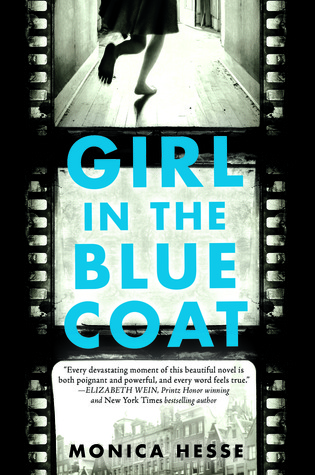
It's 1943, and Hanneke Bakker, 18, has been working as a black market runner in Nazi-occupied Amsterdam for quite a while now and she is good at what she does. Finding and delivering her customer's requests in the basket of her old bicycle allows Hanneke to keep herself and her parents safe and provided for in a city where everything is rationed. And since she looks like "the girl Hitler is dreaming of to put on his Aryan posters," Hanneke prides herself on being able to charm her way out of any impromptu Nazi searches.
As Hanneke makes the rounds, delivers her goods, she wills herself to remain distant from her customers, no matter how hard they try to befriend her. But, one day, after delivering the usual black-market tea to her recently widowed customer, Mrs. Janssen, Hanneke is asked to find something different. In fact, Mrs. Janssen has been harboring a 15 year old Jewish girl named Mirjam Roodvelt in her pantry. Mirjam had shown up at her door, pale and wearing a too small sky blue coat, after the Nazis had found and killed her family and Mrs. Janssen's husband for hiding them in his factory. But now, Mirjam has gone missing and Mrs. Janssen would like Hanneke to find her, a job she believes the young woman can do, given her black market skills.
At first reluctant to accept Mrs. Janssen's request, little by little Hanneke finds herself drawn into the mystery of Mirjam's disappearance. Visiting the Jewish
Lyceum where Mirjam went to school, Hanneke is spotted by a woman who works there. The woman turns out to be Judith, a friend of Hanneke's brother Ollie. Both are part of the Dutch resistance. And now, so is Hanneke, whether she wants to be or not.
At the same time she is looking for Mirjam, Hanneke is dealing with her own complicated war-time heartaches. Her best friend from childhood, Elsbeth, has fallen in love with and married a member of the Gestapo, putting a wedge in the friendship. And Hanneke is trying to cope with the guilt she feels over the loss of her boyfriend Bas, killed in 1940 trying to defend Holland against the Nazi invasion.
Now part of the Dutch resistance, Hanneke discovers just how much she doesn't know about what is going on around her. It turns out that Mrs. Janssen isn't the only one of her black market customers who are hiding Jews from the Nazis, and that their beautiful movie theater has been turned into a deportation center. Thinking that perhaps she can find Mirjam there, she arranges a visit with Judith to meet her cousin Mina, an acquaintance of Mirjam's.
As Hanneke begins to put together the puzzle that is Mirjam's disappearance, she begins to understand more and more what is going on around her, and how much she has missed by focusing only on Bas and Elsbeth, not even seeking closure, but allowing her to keep her eyes closed.
Does Hanneke find the girl in the blue coat? And can she come to terms with her own guilt and loss?
Girl in the Blue Coat is a complicate story, but one that you will most likely find difficult to put down.
To begin with, Hanneke is a nicely flawed character. Though her intentions may be good, she acts impulsively, and because she hasn't paid attention to what is happening around her, she often unwittingly puts herself and others in peril.
And to be truthful, the book is a little flawed as well. For instance, I never quite figured out why Hanneke decides to look for Mirjam, it just sort of happened. Was it curiosity? An attempt to assuage her guilt over Bas? An inner drive to see if she were as good at her job as she thought she was? As Hanneke uncovers the ways in which so many others try to sabotage the Nazis and save as many Jews as they can, I asked myself whether her initial motivation to find Mirjam really matters and decided it didn't. What matters is that she accepts the challenge and that is the first step towards her own healing and enlightenment.
Narrated in the first person by Hanneke, readers will find themselves completely engrossed as they accompany her on her coming-of-age journey towards self-discovery and recovery.
This book is recommended for readers age 12+
This book was an EARC received from
NetGalley

What is it like to be a black man and to want something so badly you are willing to put up with racial discrimination, willing to buck the system and prove those who think you lack the intelligence to fly a plane wrong, so very wrong? What was it like to become a Tuskegee Airman?
In a series of thirty-three poems, Carole Boston Weatherford answers these questions, writing the history of this distinguished band of brothers, the African American pilots who fought for victory on two fronts, one in Europe against Nazism and one at home against racism.
Using a composite "you" that not only addresses the Tuskegee airmen as a whole, but also and immediately invites the reader into their midst, Weatherford begins her history-in-verse, capturing the big and small personal and shared moments and events that mark this period in America.
Weatherford skillfully orchestrates this complex history, beginning with a young boy's desire to fly to becoming one of 2,000 black pilots in the 1938 newly formed Civilian Pilot Training Program - 2,000 out of a total of 400,00 - sent to Tuskegee Institute. Training is rigorous, cadets knowing that
"The eyes of your country are on you;
the hopes of your people
rest on your shoulder." (pg 10-11)
She then takes the reader along as the men learn and practice their new skills, even as they must still deal with racism and Jim Crow laws at every turn, knowing
"In this war, the enemy is you.
In 1941 and 1942, eleven black men -
if you count the three boys -
were lynched in the United States." (pg 19)
Weatherford deftly goes beyond the Tuskegee program to include the ways in which other black Americans did what they could to counter the racism of the home front, acts that give impetus to their own training. There is a poem dedicated to Dorie Miller, the Navy cook who was awarded the Navy Cross for his heroic actions during the attack on Pearl Harbor; another recounts boxer Joe Louis's victories in the ring, his benefit matches to raise money for army and navy relief funds, and his convincing the War Department to admit him and Jackie Robinson to Officer Candidate School
"along with thirteen other men
whom racist policies had barred." (pg 30)
In another poem, readers learn that singer Lena Horne refused to go on USO tours that barred black servicemen. And refusing to perform in white-only establishments, too,
"Now Lena pays her own way
to perform for the troops. When she visits Tuskegee,
she sings, perches on planes, and poses for photos.
How could you not fall for Lena?" (pg 50)
As the child of a WWII nurse, I personally love that Weatherford even offers up a poem paying homage to the Tuskegee Army Airfield Nurses, finally giving this most unsung group of military nurses some of their due: "it really takes a good nurse to KEEP 'EM FLYING." (pg 13)
This free verse history is probably one of the best books I have read about the Tuskegee Airmen, simply because there is so much meaning and information to be culled from each poem, yet they are rather sparely written, making each word used important and expressive. And it all works.
The black and white illustrations were done in collaboration with Weatherford's son, Jeffery Boston Weatherford, an artist in his own right. For
You Can Fly, Jeffery used a technique called scratchboard, which results a much more dramatic illustration than just using, for example, black and white paint/india ink or charcoal on white paper. Scratchboard results in a textured illustration and these compliment the poems so beautifully, as you can see
I have to admit I am a big fan of Carole Boston Weatherford's free verse histories. When she came to Bank Street this year, to accept the 2016 Flora Stieglitz Straus Award for nonfiction for her amazing book
Voice of Freedom: Fannie Lou Hamer: Spirit of the Civil Rights Movement, I'm afraid I may have shamelessly fangirled. So naturally, I was really looking forward to reading this new history-in-verse and let me say, it does not disappoint and I highly recommend it.
Do not miss the Epilogue or the interesting back matter that includes an Author's Note, an extensive Timeline, and a variety of Resources for Further Reading.
This book is recommended for readers age 9+
This book was sent to me by the publisher,
Atheneum BFYR
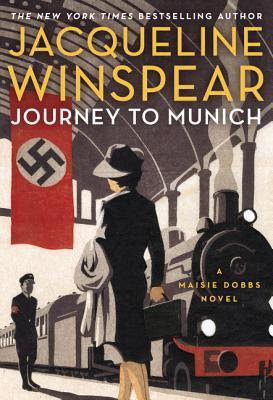 |
| I may not have loved the book, but I do love the cover |
I'm not quite as devoted a Maisie Dobbs fan as I am Maggie Hope and Flavia de Luce, but I do like to read the occasional novel. I especially like that time passes and world events are included in the novels, and that they don't take place in a vacuum.
Journey to Munich begins in early spring 1938. Maisie is still mourning the loss of her husband and has returned to England after having been gone for a long while. No sooner does she arrive back in London, than she is approached by the British Secret Service and asked to undertake a dangerous, and for Maisie, unusual assignment. She is to impersonate the daughter of a man who has been incarcerated in Dachau, the Nazi concentration camp in order to get him released.
Leon Donat, who is an engineer, had become involved in publishing academic works and while in Germany to promote them, he made a contribution to a friend's son to keep his underground journal running. Naturally, Donat was arrested for it despite being a British citizen. And Britain wants him back. So does the United States. Donat is also an inventor and had come up with a military landing craft that could be used for an invasion, but the plans are all in his head and everyone knows it is just a matter of time before another war begins.
The Nazis, with the blessing from their Führer Adolf Hitler, and not realizing how valuable he is, are willing to release Donat, but only to a family member. And his daughter Edwina Donat would be that relative, except she is in hospital suffering from consumption. So Maisie is to take her place. But before she leaves, she is asked if she will also try to find Elaine Otterburn, the woman who, a few years earlier, was supposed to pilot the plane that killed Maisie's husband who chose to fly it instead. Needless to say, there is bad blood between the two women. Still, Maisie agrees to the assignment, if only for the sake of the baby that Elaine abandoned.
Naturally, nothing goes as easily or as smoothly as one who like.
I'm sorry to say that I did not enjoy this novel as much as I have other Maisie Dobbs mysteries. I thought it would never get to the heart of the story - Maisie in Munich, encountering Nazi officials and the ensuing difficulty of getting Donat out of Dachau. Yet, ironically, she has very little trouble tracking down Elaine Otterburn even though the only information Maisie had was that she lived in Munich.
Don't get me wrong, there are some exciting episodes in
Journey to Munich, but they are a bit overwhelmed by Maisie introspection brought on, I think, by the Elaine Otterburn situation.
I felt that Maisie was out of her element as a Secret Service operative, but her talents as an investigator, as a "private inquiry agent" were just too pat here for my taste. I began to wonder whether Maisie's professional direction would change as the world heads into another war? Maybe this is the set-up for Maisie-turned-spy. Time will tell.
If you are a die-hard Maisie Dobbs fan,
Journey to Munich probably won't disappoint you. If you are the occasional reader like I am, your experience may not be as wonderful, but do give it a try. The world of Maisie Dobbs is on the threshold of a whole new era, who knows what experiences she will have.
This book is recommended for readers age 14+
This book was an EARC received from
Edelweiss/Above the Treeline
When the Nazis invaded France, it was no longer safe for young Jacques, his father, mother and grandparents to remain in Paris. There were black-booted Nazi soldiers everywhere and even walking too fast could be dangerous for the Jews who still remained there. Jacques and his parents left Paris to live in a small village and pretend they are Catholic like everyone else. His grandparents also left Paris, but Jacques doesn't know to where.
Now, it is Passover, but having a traditional Seder at home is out of the question with so many soldiers patrolling the village. There is a plan for Jacques to go with his dad through the village, and up a wooded mountain to a cabin at the summit for a secret Seder. To surprise his dad, Jacques has been secretly practicing the Four Questions that the youngest person at a Seder table asks.
When they arrive at the cabin, there is a group of strangers, all men, sitting around a table with their coat collars pulled up high to cover their heads. Though most of the traditional symbols that are such an important part of Passover are missing, an old man reads reads the
Haggadah, including the Passover story about the exodus of the Jews from bondage in Egypt to freedom in the Promised Land, likening it to the situation that Jews finds themselves in once again under the Nazis. When it comes time to ask the Four Questions, his father and the other men are surprised and pleased to see that Jacques has kept with Jewish custom and learned them in Hebrew.
At the end of the service, the men leave, never having introduced themselves to each other, but having just shared a courageous act of resistance by daring to have a Seder. Though the Seder reminded everyone that all over Europe Jews were being murdered, their only parting words to each other are "Next year in
Yerushalayim (Jerusalem), ending the story on a hopeful note.
The Secret Seder is narrated by Jacques, whose youthful perspective and determination to learn the Four Questions really points to the importance of family, tradition, and religion despite the circumstances the Jewish people found themselves in.
The watercolor illustrations by Emily Arnold McCully really reflects the mood of the story. In the village, the tone is bright and almost cheerful, except for the frightened expressions on the images of Jacques and his father. As they climb the mountain, the look of fearful apprehension remains, and the landscape around them becomes darker and darker, increasing the feeling of foreboding.
Doreen Rappaport based
The Secret Seder on real events. There are many true stories of Jews celebrating Passover and other holidays despite the danger of doing so between 1939 and 1945. I think she has really captured the fear that Jews in hiding lived with during that time, seeking to try to blend in they way Jacques and his family do by trying to act normal in the village, but she has also makes clear what an important part of their lives their religion is to Jews, especially during those dark days.
Back matter includes an author's notes about the book, information about Passover and resources for learning more about it as well as the Holocaust.
This book is recommended for readers age 7+
This book was borrowed from the NYPL

Most of us probably like to think that when a war ends the survivors go home and pick up their lives where they left off. But of course, deep down we know that isn't how it happens. Soldiers come home wounded and often suffering from PTSD, families are torn apart, children are displaced and everyone must still deal with all kinds of loss, and, as you saw in The Seagoing Cowboy, people living in ravaged countries are starving.
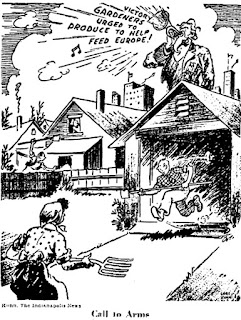
After World War II ended, Americans were asked to revive their Victory and Community Gardens in order to help meet the needs of a post-war Europe and Asia. As Henry Wallace told the National Victory Garden Conference in 1946 "...probably more persons will go hungry during the next four months than in any like period in the world's history." By then, most Victory Gardens were no longer being used so the 18,500,000 gardeners who has gardened for war were a little surprised when the call went to for them to now garden for peace. Did Americans rise to the challenge? You bet they did.
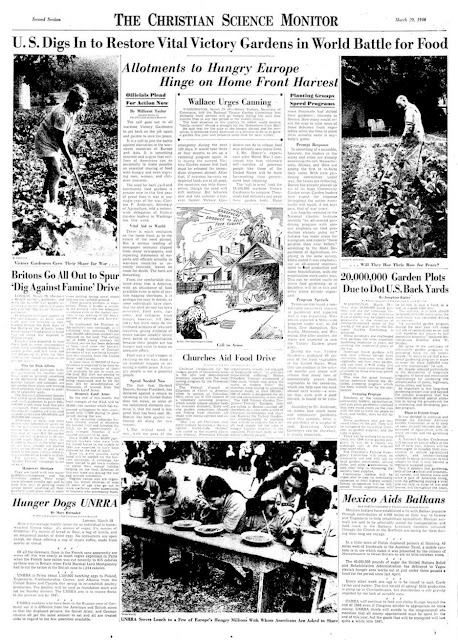 |
| The Christian Science Monitor, March 29, 1946 |
Besides asking Americans to revive their Victory Gardens, President Truman also called for the production of Emergency Flour. The idea was to conserve wheat making more of it available to Europe. What that meant was that all-purpose flour would now contain more bran and wheat germ, both of which are normally not found in flour. Because Emergency Flour didn't behave the same way all-purpose flour did when used for baking, companies began to put out recipes that were tailored to it:
I've tried these two recipes, though not with Emergency Flour, and they were OK, but my favorite, my absolute favorite is the 1946 Better Homes and Gardens recipe for Crusty Peach Cobbler. I love Peach Cobbler so much, I started canning my own peaches so I could have it year round. I found the recipe over at a blog I read called Retro Recipe Attempts and I have been using it ever since.
As you can see, it has a nice thick biscuity or crusty top layer, which I really love.
Crusty Peach Cobbler
Ingredients
6 cups fresh peaches (about 3 pounds), peeled, stoned, and thickly sliced
1/2 cup sugar
Grated zest of 2 lemons
2 tablespoons fresh lemon juice
2 teaspoons pure almond extract
Biscuit Dough
1 1/2 cups all-purpose flour
1/2 teaspoon salt
1 tablespoon baking powder
1 tablespoon sugar
1/3 cup (6 tablespoons) unsalted butter, chilled and cut into small pieces
1/2 cup milk, plus additional drops, if necessary
1 large egg
2 tablespoons sugar, for sprinkling (I don't do this, I don't like the biscuit to taste sweet)
Instructions
Preheat the oven to 400º. Arrange the fruit in a greased shallow 9-by-13-inch rectangular baking dish or 10- to 12-inch oval ceramic gratin dish. Toss with the sugar, zest, lemon juice, and almond extract.
Place the fruit in the hot oven 10 minutes while preparing the shortcake.
Combine the flour, salt, baking powder, and sugar in a medium mixing bowl. Cut in the cold butter with a fork or electric mixer until the mixture resembles coarse meal. Make a well in the center and add the milk and egg, mixing until just evenly moistened; do not over mix (I use a Danish dough whisk, one of my favorite tools, for this). Working quickly, drop the dough by large tablespoons over the hot peaches so that the edges do not touch the sides of the dish and sprinkle the top with the remaining 2 tablespoons of sugar.
Immediately return to oven and bake 25 to 30 minutes, until the topping is golden brown and firm to the touch. Cool at least 15 minutes to serve hot, or cool to room temperature and reheat to warm.
Weekend Cooking is open to anyone who has any kind of food-related post to share: Book (novel, nonfiction) reviews, cookbook reviews, movie reviews, recipes, random thoughts, gadgets, fabulous quotations, photographs. If your post is even vaguely foodie, feel free to grab the button and link up anytime over the weekend. As always Weekend Cooking is hosted by Beth Fish Reads

upcoming releases we can't wait to read.
My Waiting on Wednesday pick this week is:
The Boy at the Top of the Mountain by John Boyne
Henry Holt & Co.
June 7, 2016; 272 pages
From Goodreads:
When Pierrot becomes an orphan, he must leave his home in Paris for a new life with his aunt Beatrix, a servant in a wealthy Austrian household. But this is no ordinary time, for it is 1935 and the Second World War is fast approaching; and this is no ordinary house, for this is the Berghof, the home of Adolf Hitler.
Pierrot is quickly taken under Hitler's wing and thrown into an increasingly dangerous new world: a world of terror, secrets, and betrayal from which he may never be able to escape.
I'm always curious to read books by John Boyne. I've reviewed a few of his novels in the past, but after the controversy of The Boy in the Striped Pajamas (which I have not reviewed) I always feel hesitant on the one hand, excited on the other.
What are you looking forward to reading?
You know how on television you sometimes see ads for an organization called Heifer International? If you have ever wondered how it all began, your curiosity will find the answer in this charming picture book about one of the first "seagoing cowboys" at the end of World War II. These are the cowboys who delivered livestock to countries in desperate need to being rebuilding after the war's devastation.
By 1945, Poland had been ravaged. Its cities and farmland had been bombed badly, the people who had survived were starving and help is desperately needed. In the United States, a young man who is looking for adventure decides to sign up to become a "seagoing cowboy" along with his friend John.
Their adventure begins with a train ride to the city, where they will board their ship, the
Woodstock Victory. They arrive just as the horses and heifers are being loaded onto the ship. John is one of the young men assigned to caring for the horses on their week-long journey to Poland, while our un-named narrator cares for the heifers they were bringing over, heifers that will provide milk, cheese and butter to the hungry Polish people.
Sailing to Poland isn't an easy journey what with seasickness and a bad storm, but at last they arrive at their destination. The cowboys and their livestock are welcomed with smiles and open arms, especially by the children who want the gum and chocolate the Americans carry (and who can blame them for wanting to things after years of having nothing). And the cowboys are happy to give, but what really leaves a strong impression and saddens them most is the devastation they witness everywhere they go.
I have to be honest and say that although I have heard of Heifer International, I had never heard of seagoing cowboys, and of sending livestock to Poland and other European countries hard hit by war, so this picture book was a real eye-opener for me.
And I found
The Seagoing Cowboy to be a fascinating, reader friendly account of such a little-known part of WWII history. Although it is a work of fiction, it is made compelling because it is based on some photos that were given to Peggy Reiff Miller by her father. The photos belonged to her grandfather who had been a seagoing cowboy and they sparked her curiosity about what it was like for the men who volunteered to do this work. After lots of research and talking to some former seagoing cowboys, Peggy took their stories and wrote about the trip of a composite un-named young man and his adventures in
The Seagoing Cowboy.
Claire Ewart's full-color watercolor illustrations are bright, light and airy, reflecting the optimism of the seagoing mission while also capturing the full range of emotions felt by humans and animals alike on this voyage. I love the little smile on Queenie, the horse that John's father had donated to the program without telling his son and John and Queenie see each other on the ship for the first time.
The Seagoing Cowboy is a wonderful, uplifting story about the men who delivered more than just livestock to those in need, they delivered hope for the future, too. You can discover more about this program in Peggy's
Author's Note, along with some photographs she has chosen to share.
Be sure to download the extensive
Curriculum Guide proved by the author.
You can also discover much more information and history about the seagoing cowboys on Peggy Reiff Miller's website
HERE
This book is recommended for readers age 6+
This book was sent to me by the publisher, Br
ethren Press
Please, enjoy the book trailer:

Here is a little known harrowing story of courage and survival that could rival any novel written about WWII.
On November 8, 1943, a group of 13 Army medics, 13 Army nurses and a flight crew of 4, most in their late teens and early twenties, set off from Sicily on a plane bound for Bari, Italy to pick up some wounded British soldiers. Almost immediately, the plane ran into trouble as they flew into a cold, harsh winter storm. As the plane bucked and dove over the sea below, one of the nurses realized there were only 10 life vests for 30 people. Then the radio went out and communication was no longer possible with anyone anywhere on the ground. The plane flew in circles and began to run out of fuel. As they attempted a landing in a valley, the plane was greeted with antiaircraft artillery. When they finally crash landed, it was cold and rainy, no one was dressed for the weather or even knew where they were, and on top of that, men with rifles were running towards them shouting in a language they did not understand.
One of the men spoke a little English and told the Americans they were in Albania. Luckily for them, the Albanians were anti-Nazi guerrilla fighters, unluckily for them, the area was surrounded by German soldiers. Not knowing if they could trust these partisans, the Americans nevertheless decided to follow them through the woods, and after hiking for hours in the pouring rain, arrived at the village of Gjolen. There, they were feed some dry cornbread and sour white cheese.
Thus began the harrowing 63 day journey to reach their destination at Bari, Italy. In-between, the meds and nurses had to hike between 600 and 1,000 miles in bitter cold, snowy weather to reach the Albania coast only 60 miles away. Along the way, they were at the mercy of the partisans, some who were honest and treated them as kindly as possible under the circumstances. some not terribly trustworthy and others just scared villagers who would put them up for a night, but wanted them gone the next day. Everyone knew that If anyone in Albania was caught helping the Allies, they would be immediately killed by the Nazis and their villages burned down - and there was proof all around them that this threat was real.
Trapped Behind Nazi Lines is an exciting account of this rescue of the flight crew and the 26 medical personnel of the 807th. I have to be honest and say that given the obstacles these men and woman encountered, drawbacks like starvation, inadequate clothing, worm out shoes, I am in awe that every single one of the survived their ordeal.
Eric Braun used various sources, including books written by one of the medics and one of the nurses, to recreate a vivid, detailed account of what life was like for the two months these soldiers were caught behind enemy lines. One of the things that surprised me was that for a country occupied by Nazi soldiers, there were some British SOE agents there who were able to help the Americans escape. The other surprise was the age of the medics and nurses. I kept having to remind myself that these were really collage-age kids and not seasoned soldiers, yet they acted and reacted like more mature adults given the dangerous situations they found themselves in.
Trapped Behind Nazi Lines is a work of nonfiction that is sure to appeal to middle grade reader, and even YA readers who like history, but will also please kids looking for an action-packed story, all the more exciting because it really happened.
Back matter included lots of photographs of the Americans, a map, a timeline, select bibliography, internet sites and more.
This book is recommended for readers age 9+
This book was an EARC received from
NetGalley
upcoming releases we can wait to read.
I haven't participated in Waiting on Wednesday in a long time, but hope to be more regular from now on. This week, my pre-publication selection is:
Skating with the Statue of Liberty by Susan Lynn Meyer
Publication date: April 12, 2016
Random House
From Goodreads:
In this gripping and poignant companion to Sydney Taylor Honor Award winner Black Radishes (my review), Gustave faces racism and anti-Semitism in New York City during World War II, but ultimately finds friendship and hope.
It is January 1942, and Gustave, a twelve-year-old Jewish boy, has made it to America at last. After escaping with his family from Nazi-occupied France, after traveling through Spain and Portugal and across the Atlantic Ocean, he no longer has to worry about being captured by the Germans. But life is not easy in America, either.
Gustave feels out of place in New York. His clothes are all wrong, he can barely speak English, and he is worried about his best friend, Marcel, who is in grave danger back in France. Then there is September Rose, the most interesting girl in school, who for some reason doesn’t seem to want to be friends with him. Gustave is starting to notice that not everyone in America is treated equally, and his new country isn’t everything he’d expected. But he isn’t giving up.
Skating with the Statue of Liberty, the brilliant companion to Susan Lynn Meyer’s debut novel, Black Radishes, was inspired by her father’s stories about his first months in America. It is a gripping look at one boy’s life that is at once honest and hopeful.
I knew there was going to be a companion to Black Radishes, and I am excited to read Skating with the Statue of Liberty to see how Gustave and his family are getting on in America.
It's 1940 and it's time for the three Bateson children, Katherine, 12, Robbie and Amelie to be evacuated to Rookskill Castle in Scotland. Their father had already left for Europe, on a secret mission for MI6, but not before he makes arrangements for a new school to be set up for them and other evacuees at the castle.
Before they leave, Kat's Great-Aunt Margaret takes her aside and gives her a gift - a silver chatelaine with its three hanging charms, a scissor, a thimble and a pen. This chatelaine was a precious family heirloom that Great-Aunt Margaret always wore pinned to her belt. But with the gift came a warming - the chatelaine can keep them safe because it is magical, but there is always a price to pay for the use of magic. Logical Kat is skeptical about magic, but reluctantly accepts the chatelaine anyway.
Arriving at the castle, the children meet Lady Eleanor., who Kat notices also wears a chatelaine laden with charms and hidden from view. She tells them that Gregor, Lord Craig, who is distantly related to the Batesons, is quite ill and must be left completely along. The children are forbidden to wander the castle and the castle grounds and are to stay either in the hallway where their rooms are located or in their rooms, which will be locked every night. Eventually, they also meet the other students - Peter, an American slightly older than Kat, Isabella, Colin and Jorry.
It doesn't take long for Kat to begin to think the castle and the cold, aloof Lady Eleanor are very strange, as are the maid Marie, Cook, Hugo the driver who also helps around the castle, and Mr. Storm, their history instructor. Storm is way overly interested in historical artifacts, especially chatelaines. But when Kat begins to notices some strange goings on about the castle, and discovers a wireless in the cellar, she begins to suspect that the castle is harboring a German spy. And who are the children that seem to mysteriously come and go, and then there's Jorry's sudden disappearance, even after his parents come looking for him.
The novel occasionally flashes back to 1745 and the story of Leonora, a young girl who was married to the lord of Rookskill Castle, for the purpose producing a child. When she fails to do that, she goes to a person only referred to as the magister, who magically helps her get a child, but, of course, there is always a price to pay for using magic and she must pay the magister, a payment that brings us right back to 1940s Scotland.
The Charmed Children of Rookskill Castle is a dark and sinister tale about the forces of good and evil, and I have to confess I really loved reading it. Their are the typical tropes of creepy fantasy - weird nighttime noises, ghostlike children appearing and disappearing, a creepy, evil woman, secret passages and spells cast to confuse. To me, it felt very Gaimanesque and I mean that as compliment.
Kat is a wonderful character whose logical mind has a hard time accepting that magic might just be real. On the other hand, her logical mind also mean that she has a real talent for decoding encrypted messages, something that really comes in handy in this novel.
All the ends relating to this story are tied up by the end of the novel, but there is the hint of a possible sequel because the denouement just isn't a neat and clean as it could be and leaves room for a lot of speculation about Kat's future.
Let me just mention here, for those who may not know this, but Adolf Hitler and the men he surrounded himself with had a serious interest in the occult.
I found this to be an original, spine tingly story, even though at times, I know I figured out things before a young readers might. Readers who have already zipped through the Harry Potter books and want more will probably also enjoy
The Charmed Children of Rookskill Castle. I know I did.
This book is recommended for readers age 10+
This book was an ARC received from the publisher
OK, I really loved this novel and it's great fantasy, so I have no problem with willingly suspending any disbelief to enjoy a good story. But when I read that Kat's father told her to keep calm and carry on, I did feel I needed to remind readers that that was a slogan that was never used in WWII. The slogan was designed for a very special purpose, which you can read all about in my post
Keep Calm and (fill in the blank) The fact that Kat's father used the slogan - I chalk up to coincidence. Keep calm became a kind of mantra for Kat and one she often needed.


It's only June, but the summer of 1939 does not look very promising as far as Frankie Baum, 11, is concerned. Her sister and best friend Joan, "the just-barely-older of the two," is getting to spend the summer at Aunt Dottie's farm in New Jersey, where Frankie is sure she will be having the best summer ever, while she's stuck at home in Hagerstown, MD with older sister Elizabeth, called Princess by their parents.
And ever worse, Frankie is expected to work in her father's newly purchased restaurant, a long neglected Alpine-style relict of years ago, now with only weeks to get it cleaned up and running again to become his dream of "An Eating Place of Wide Renown." Opening day is planned for July 5th. Sure enough, at the restaurant, Frankie is sent to the kitchen to work, a dirty, messy job, while Princess gets to work the cash register.
Frankie is vaguely aware of war talk among the townspeople, of anti-German feelings that are beginning to brew, but she has never really considered her family to be German, even though her father's parents immigrated from Germany. But when Hermann Baum is approached by the cigar smoking president of the Chamber of Commerce, Mr. Sullen Waterford Price, and refuses to let himself be bullied into becoming at
paid member of the chamber, he makes a formidable enemy, one all too aware of his German roots.
Price is also running for mayor of Hagerstown, so when Hermann also refuses to put his election poster in his front window, Price begins looking for just the dirty information he needs to start spreading rumors that Hermann Baum is quite possibly a spy and Nazi sympathizer.
To make matters even more complicated, Hermann decides to throw his own pre-opening day Fourth of July party for friends, family and even his African American staff and their families. Hermann has always treated his kitchen staff fairly, despite living in a state where Jim Crow is in effect. That, coupled with the German flyer that has mysteriously fallen into the hands of Mr. Price, are all that is needed for a boycott of Hermann's party.
Frankie has overheard quite a bit while working in the kitchen, and decides to do some investigating of her own about what is going on. But she also finds herself doubting her father's innocence. When no one shows up at her father's party, she goes to the town's celebration to try and find out what is going on. When Hermann shows up looking for her, he collapses. And the Baum family's life is changed forever.
A Tiny Piece of Sky is a wonderful coming of age story. Frankie's character develops slowly over the course of the novel as she encounters different people and situations. The story is told in the third person by an omniscient narrator in a rather conversational style, and who seems to be right in the thick of things, more aware of what is going on in the world than Frankie is. To get some of Frankie and even Joan's mindset, there are also first person letters they write to each other, which tend to create more mystery about Hermann Baum's heritage than information.
The story takes place over June, July and August 1939. There aren't many pre-World War II home front stories for young readers, making this all that much more interesting. Stout looks at both racism and xenophobia through the lens of Frankie's summer.
Frankie hasn't really paid attention to the racism and discrimination towards the African American community in Hagerstown, until she starts working in the restaurant. But the character of Mr. Stannum, the restaurant's new manager, opens her eyes when she witnesses the way he treats the black kitchen staff with such cruelty and contempt, even refusing to allow them to use the bathroom he uses.
You also don't find many books for young readers that are about the kind of treatment that German Americans experienced in the 1930s and 1940s as the possibility of war with Germany became more of a possibility. Most people don't realize they were also discriminated against. though to a far lesser extent than Japanese Americans. What makes this an interesting theme here is that Stout shows how easily people can change their attitudes towards of friends and even fathers when doubt begins to take hold. For that reason, A Tiny Piece of Sky is not just good historical fiction, but also resonates so loudly in today's world.
The other part of what makes
A Tiny Piece of Sky such an interesting, realistic novel is that much of the material comes from Shawn Stout's own family and the restaurant they owned in Hagerstown, which she writes about in her Author's Note at the end of the novel. Be sure to read it when you read this excellent novel.
Teachers can find an extensive Teaching Guide for A Tiny Piece of Sky
HERE
This book is recommended for readers age 9+
This book was borrowed from the NYPL
 |
Used with permission: the original menu from Shawn Stout's grandparent's restaurant.
Click to enlarge and check out the prices listed. |

It's the early 1950s and office boy Trevor Roberts just wants to be a full-fledged reporter for his hometown paper, the
Lowestoft Journal, but so far, he only get reporting jobs once in a blue moon, and usually not very interesting. One March morning, Trevor is sent out to see if Mr. Friston's tortoise has woken up from his winter hibernation. Little did Trevor know that that would be the beginning of a long friendship and a wonderful article for the newspaper.
Slowly, over a series of weekends, Trevor peddles out to the two converted railroad cars that Henry Frisson's lives in and hears the story of how he acquired his tortoise, whom he named Ali Pasha, during World War I. Told in a series of flashbacks and using his saved wartime memorabilia, including his diary, Henry recalls wanting to see the world as a boy, and joining the Royal Navy hoping to realize his dreams. But shortly after, WWI breaks out and Henry's ship,
HMS Implacable, heads straight for Gallipoli. There, Henry finds himself on shore and in the trenches, charged with the duty of removing wounded and dead soldiers from the battlefield, ironically in the company of the Turkish soldiers they were fighting with.
It is in the midst of fighting one day that Henry is knocked down into a shallow crater by a shell blast, followed by a hard object hitting his head. It turned out to be a tortoise whom Henry befriends while waiting for the fighting to end. Henry decides to rescue the tortoise and sneaks it on to the
HMS Implacable, hiding it in his battleship station, the Number Two Gun turret. Because Henry found his tortoise on the Gallipoli Peninsula, which was part of the Ottoman Empire then, he decides to name it Ali Pasha, after one of its rulers.
From Gallipoli, the
HMS Implacable heads to the Suez Canal, and eventually back to England. And Ali Pasha go home with Henry, where the two lived out their days together.
I always know that when I pick up a Micheal Foreman book, I am going to like the story and the artwork equally and
The Tortoise and the Soldier is no exception. Here is a wonderful, lifelong story that begins on the battlefield of one of the worst campaigns in WWI and continues of over 70 years.
And though the center of the story is about Henry and Ali Pasha, there is a lot of story relating to Henry's family, his school days, his brothers fighting in Europe, and mostly centrally, his relationship with the other sailors assigned to Number Two Gun turret. Foreman subtly shows the reader how important it is to be able to not just get along with those who live in such close proximity to one, but also how much better it is if you really like each other and work together. As Henry tells Trevor, his shipmates would bring Ali Pasha treats from their own meals in the hope that he would bring them luck.
Perhaps the best message a young reader can take away from this story, is that the enemy, in this case the soldiers from Turkey, are really at bottom no different from Henry and his mates, a important discovery he makes during a short cease fire to collect the dead.
This is a very pleasant story, one told for the most part with a light touch, but make no mistake about it, Foreman doesn't sugar-coat what happens in war, on the sea and in the battle field. Recognizing oneself in the enemy, and realizing how deadly war is are both good reasons for kids to read this book. But so is the enduring friendship between man and tortoise.
The Tortoise and the Soldier is historical fiction based on the lives of the real Henry Friston and Ali Pasha. Foreman includes information, photos and other artifacts about both man and tortoise, as well as his own personal story knowing Henry during WWII. But it is Foreman's own watercolor illustrations that really enhance and give depth to the tale he is telling:
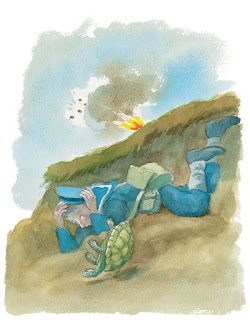 |
| Henry meets Ali Pasha |
This is a wonderful story that is sure to appeal to many middle grade readers.
This book is recommended for readers age 9+
This book was borrowed from the NYPL

View Next 25 Posts