new posts in all blogs
Viewing Blog: Unabridged - Charlesbridge Publishing Company, Most Recent at Top
Results 26 - 50 of 192

Charlesbridge publishes high-quality books for children, with a goal of creating lifelong readers and lifelong learners. Our books encourage reading and discovery in the classroom, library, and home. We believe that books for children should offer accurate information, promote a positive worldview, and embrace a child's innate sense of wonder and fun. To this end, we continually strive to seek new voices, new visions, and new directions in children's literature.
Statistics for Unabridged - Charlesbridge Publishing Company
Number of Readers that added this blog to their MyJacketFlap: 50
 As a young reader, my tastes often tended toward the macabre, fantastical, and horrifying—I probably started reading Stephen King before I should have. Books were an opportunity to keep myself up at night—even after the lights were off and the books were closed, I’d lay in bed awake, my mind replaying over and over a slideshow of the startling images I’d just absorbed. Though I was also a sucker for classics like Charlotte’s Web, The Outsiders, and Mrs. Brisby and the Rats of NIMH, it was always the scary stories that I tore through the quickest. And the scariest stories, to me, were always the ones that seemed the most real. Or the ones that were, in fact, based on real events. For me, a terrifying event—an out-of-control factory fire, an earthquake hitting a city, a terrorist attack—inherently contained more horror than any fictional story featuring vampires, zombies, haunted houses, or masked madmen with a knife ever could.
I was in sixth grade when undersea explorer Bob Ballard discovered the wreckage of the ship Titanic two-and-a-half miles below the surface of the North Atlantic in 1984. My English teacher passed around the new issue of National Geographic, which featured on its cover a ghostly blue image of the ship in its watery grave, taken directly above it by a roving remote-controlled deep-sea film camera called Alvin. Then she passed out a photocopy of an article that gave an overview of the Titanictragedy: that it was the biggest and most luxurious passenger ship ever built and was proclaimed to be “unsinkable”; that it hit an iceberg on its maiden voyage from Southampton, UK, to New York City in 1912 and sank, taking 1,500 passengers with it into the freezing water; that, though it carried a total of 2,224 passengers and crew, it only held enough lifeboats for 1,178; that its list of passengers included some of the richest people in the world; and that the majority of those lost on the ship were the third-class passengers, mostly immigrants, who were stuck below decks without a fighting chance to access the limited number of lifeboats on the main deck.
Paging through the National Geographic—with its full-color photographs of the wreckage two-and-a-half miles below the surface, its timelines of the tragedy, its diagrams and drawings of the gash in the hull the iceberg had made—I was transfixed by the sheer horror of what all those passengers—those who lived and those who died—must have gone through on the night of April 14, 1912.
I became obsessed with the story, and started tracking down any books out there that told it. I scoured my local library, uncovering a few titles—The Story of the Titanic As Told by Its Survivors, by Jack Winocour from 1960, The Odyssey of C.H. Lightoller by Patrick Stenson from 1984, and, of course, Walter Lord’s classic from 1955, A Night to Remember—and read them with eyes wide and a chill running down my back. The stories collected in the pages of these books were horrifying, even more so for being true. These were real people, lucky enough to have secured a place on Titanic’s maiden voyage across the Atlantic, and, four days after departing Southampton, unlucky enough to be fighting for their lives amid the wailing of people drowning, the horrible creaking and groaning of the massive ocean liner as it surrendered to the sea, and the dark, earsplitting chaos that would only subside after the ship had disappeared under the water and almost 1,200 lives had been snuffed out.
Tales of terror from our history have always drawn me in, whether they took place during the Civil War that gave rise to countless battlefield horrors, the Gilded Age that produced the Titanic, or the Great Depression that birthed dust storms on the Great Plains that suffocated thousands and turned the sky black. So when I was approached by Hilary Poole, the editor and creator of the Horrors of History series for Charlesbridge, about writing a book for young readers about the Galveston hurricane of 1900, it seemed like the perfect project for me to take on. Even though I was a little nervous about writing for a young audience for the first time, I was excited at the prospect of researching and writing about an event that had been largely forgotten—much like Titanichad mostly disappeared into the mists of history until Bob Ballard’s amazing discovery reignited interest in the story of the doomed ocean liner. I wanted to bring this horrific bit of history to life for the hungry young readers I know are out there, since I once was one.
The hurricane of 1900 remains the deadliest in American history, and it changed the trajectory of the island city of Galveston forever. For my book City of the Dead, I plumbed survivor accounts, newspaper articles, historical records, and local archives to bring to life various Galvestonians’ experiences during this storm that hit on September 8, 1900, and killed 6,000 to 8,000 people, nearly one quarter of the city’s population. I discovered amazing stories of survival, heartbreaking accounts of bravery and sacrifice, and jaw-dropping details of the merciless violence of Mother Nature at her worst.
 I was particularly gratified to be able to write about the Sisters of Charity orphanage, which sat just a little ways from the beach. The story of the child survivors is truly astounding, and City of the Dead represents the first time their accounts have been dramatized in an historical novel.
City of the Deadis dedicated to the people of Galveston who suffered this tragedy. It is my hope that it will ignite in young readers not only an interest in exploring the frightful and awe-inspiring stories of death and survival in Galveston in 1900, but also a desire to start their own searches into the countless amazing and spine-tingling true tales from our country’s past.
Posted by T. Neill Anderson, author of City of the Dead, the first book in the Horrors of History series. This is his first book for young readers, and one that he wishes was around to enlighten (and terrify) him when he was a kid. T. Neill Anderson lives and writes in Brooklyn, New York.
The Horrors of History series commemorates horrific, life-changing events in our nation's past. Each novel combines thorough research, first-hand accounts, and fictionalized characters and scenes to make history accessible to young readers. The results are gripping tales of devastation and bravery, made all the more intriguing by their foundation in real-life events. Stay tuned for the February 2014 release of Ocean of Fire: The Burning of Columbia, 1865, which details life in the South at the end of the American Civil War through the retelling of the fire that swept through Columbia, South Carolina, after the city surrendered to General Sherman’s Union troops.
Author Anna McQuinn shares LOLA AT THE LIBRARY and other stories with the children of Chicago. Read about her visits to the Chicago Public Library, Lurie Children's Hospital, and ALA on
her blog.
 There used to be birds big enough to eat you, I tell my audience. Oh, yes. You. In one gulp.
Kids love this, the little frisson of danger and at the same time the inviolable safety of many, many years blocking them off from the savagery. It’s the draw of prehistory, what makes it so fun. Everybody loves T. rex. Nobody wants to be eaten by one.
Everybody loves terror birds too.
Imagine a really big, carnivorous ostrich. A bird as tall as a basketball hoop, with a beak as heavy and sharp as an axe. These birds didn’t fly. They didn’t need to. They ran down anything they wanted to eat, and they ate it. Terror birds ruled South America for millions of years.
Then they were gone. Now all we have are bones.
But bones tell a story.
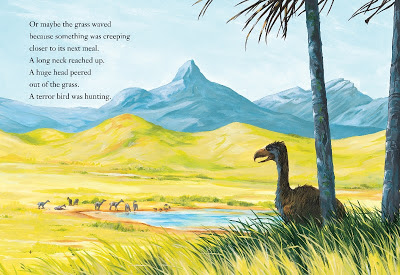 |
| Interior spread from Ancient Animals: Terror Bird |
I have plans for my next several lives. First I’m going to be a set designer; I love they way a good set is a cradle and a launch pad for theatrical magic. Then I’m going to be a marine biologist, so I can study dolphins and get paid for swimming. After that, I’ll be a paleontologist. I’ll pry the past loose from its rocky bed, bone by bone, tooth by tooth. I’ll blow the dust off chips and scraps of ancient creatures and put them back together. I’ll rewrite the lost story of life.
No, wait. Maybe I’ll just write nonfiction for children. Then I’ll get to do all of it in one narrow lifetime.
This is one of the things I love about my job—I get to find out everything. For past books, I’ve researched the Elizabethan theater, the American flag, how vipers locate prey, how much a blue whale’s tongue weighs, and what Abraham Lincoln said to his wife when she suggested that he run for president. Now I get to find out about terror birds, the top predators of ancient South America, ruthless avian rulers of an island continent. I also get to discover the vital role of a top predator in an ecosystem, how a hunter like a terror bird makes life possible for the species it devours.
Then I can turn my attention to saber-toothed cats, cunning predators who competed with our own ancestors for food. I learn how paleontologists deduce facts of behavior from bits of bone. (How do we know the saber-toothed cat was an ambush hunter? Its short bobtail, like a bobcat’s today. Cats who chase have long tails, to counterbalance the body on a turn. Cats who ambush have short ones.) I learn about pack or pride behavior, its gains (aid in raising young, access to mates, cooperative hunting to bring down large prey) and its costs (competition for food in a limited territory).
And then I put this fascinating research together with something I already know—how hungry young readers are for facts. For truth. For nonfiction.
“Is this true?” my five-year-old daughter asks insistently. “Is this a true book?” She doesn’t know the boundaries quite yet, doesn’t automatically understand that dragons and talking monkeys make a book fictional, that dinosaurs and saber-toothed tigers make it real. But she wants to know, and she wants books to tell her: what’s real and what’s a dream, what could once have eaten her and what never will.
Kids want to know, just like I do—how a giant flightless bird hunted, whether a cat with giant teeth purred or roared. (No to the first, yes to the second.) And they want books written in their own language and at their own level to tell them. Even the shape of an early reader says who it is made for. The small trim size and the compact format declare that these are books for a single young reader to treasure. The expanse of a picture book, made for sharing, is gone. Early readers are books for a child to read on her own, to hold and pore over and cherish. Language and art work together to open up a world of information. A single reader’s mind acts as a key.
I’ve written picture books and novels, poetry and prose, fiction and fantasy and “true books.” Out of all of those, nonfiction early readers are the hardest. I once did nineteen drafts of a single manuscript. First the facts must be found, selected, organized, and then the language must be agonized over. Can I make that sentence clearer? Did I just start with a prepositional phrase? That word has three syllables—can I find one with two, or one? Keep the concepts complex; keep the language simple; keep the clauses short. On every page. On every line.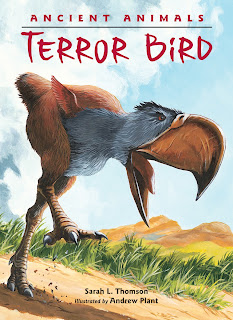
But the challenge is worth it, when I visit classrooms and see the kids' eyes light up and their hands shoot into the air. They know, you see. They know about science, about animals, about prehistory. They come armed with facts and dying to share them, enthusiastic beyond measure for books that show them the astonishing truth of their world.
Terror birds. Saber-toothed cats. Other wonderful creatures of prehistory. These animals have vanished, but their bones can still tell us their stories. We need scientists to interpret this dusty, ancient language, and we also need writers to share information about these creatures with the rest of us. Then we need readers to gobble up that information and ask for more. Maybe some of my readers, hungry for “true books,” will become scientists one day, digging up more facts, knitting together more theories, sharing what they find out, teaching us more.
I don’t need more lives after all. I just need readers who will take what I offer them into their own futures. They will be the ones to create, learn, and discover more than my own life would ever be able to hold.
 I lived for over a decade in Somerville, the next town up from Cambridge, in Boston, Massachusetts. There was no "T"--as we called the subway--in Davis Square when I moved there, and for the first couple of years I rode a bus to Harvard to catch the train to downtown Boston. I remember hiding behind a book while I studied the world around me. In each ride I could count Greeks, Irish, Polish, Portuguese, and Italians sharing with me the early morning and whatever temperature was in season. I thought I would miss that when I moved to San Francisco; not the weather, mind you, but the fact that there were restaurants, street celebrations, and friends from all over the world that gave daily meaning to the word multiculturalism.
How far from reality that thought was! What I encountered in California was equally diverse, but this time within the Latino culture. Just a few weeks ago in celebration of spring, some forty friends descended to our house and at some point we formed a circle to acknowledge friendship and humor in the passing of time. In that circle there were at least fifteen different representations of the word "Latino," not only from the country of origin but also from ethnicity, language, and cultural evolution.
Not even our friends from the same country, Mexico, have the same first language or culture. Some of the fifty indigenous languages that are still alive in Mexico have crossed the border and fortunately survive in the realm of intimate everyday life. All of us had one language in common, English, and many two, when adding Spanish. A few three, counting the regional first languages we were born in, but the great evidence was how the mix of Latinos within the Latino community have evolved. My Salvadorian friend Vicky has married José from Mexico. Victor from Honduras has married Emilia from Panama. And my Cuban friend Diana is about to get married to a Venezuelan. I could of course continue mentioning the even larger mix that I see in the third generation. Latinos are expanding their horizons, as did all other immigrants before.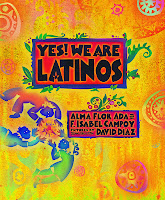
When Alma Flor proposed the idea of writing our latest book, Yes! We Are Latinos, I immediately understood the importance of a gallery of portraits that would reflect the reality that surrounds us. Co-authorship is something we have been practicing for two decades. "It doubles the thought, the passion, and the craft," we tell people who ask how does “it” work. This particular book has been both a challenge and a pleasure. Alma Flor had hundreds of students in her doctoral program at the University of San Francisco who brought their roots to class to expose, dissect, study, comprehend, and embrace the identity hidden in their names. Many were Latinos. We joined them in a project in Teotitlán del Valle, near Oaxaca, during a summer that resulted in a profound experience for all of us. The seeds of those conversations, encounters, and friendships grew in the form of words that make up Yes! We Are Latinos.One topic that kept coming into conversations among friends and students was the need that we all felt to share the journey, to tell each other where we came from, and how that came to be. The history of our individual immigration became the question of the social and political circumstances that motivated some and forced others to leave their countries of origin to come to the United States. In the case of Alma Flor and myself, we both are first generation immigrants. Others in our circles are second, third, or too far back to remember. We realized that it was common to many of us the need to know more about each other’s history, and I agreed with Alma Flor that we needed to leave a record of all of this, to provide knowledge of the past, and a foundation for this new social group called Latinos to continue on the path towards a broader identity. In the words of the last profile in the book, our character named Román puts into words our sentiment: And, looking at these walls inside the tower,written by Frederico VigilI realize the strength of my heritage,the contradictions of our history,the battles won and lostwithin our hearts.We have been mixing for centuries.Mixing our blood, and our faiths.Mixing traditions, music, and dance.Mixing our languages, our literatures.Mixing us into a greater reality,a larger identity.One that now calls us Latino.Yes! We are Latinos. Pienso en sus palabras, las de Frederico Vigily mirando estas paredesme doy cuenta de la fuerza de mi herencia,las contradicciones de nuestra historia,las batallas perdidas y ganadasdentro del corazón.Hemos estado cruzando nuestras vidas durante siglos.Mezclado nuestra sangre y nuestra fe.Mezclando tradiciones, música y baile.Mezclando nuestras lenguas y nuestra literatura.Una mezcla hacia una realidad más amplia,una identidad mayor.Una que ahora nos llama latina, latino. ¡Sí! ¡Somos latinos!Posted by F. Isabel Campoy, co-author of Yes! We Are Latinos, which releases August 1, 2013.
Headed to ALA at the end of the month? Mark your calendars! On Sunday, June 30th at 1:00 PM, Isabel and Alma Flor Ada, along with author Judy Goldman and Teresa Mlawer, translator and expert on Spanish and bilingual titles, will discuss the trends and needs in the Spanish/Bilingual and Latino Interest marketplace. Click here to learn more about this special ALA Book Buzz program.
 This past March I sat around a table with a group of women, discussing my latest picture book, A Path of Stars, the story of the relationship between a young Cambodian American girl named Dara and her grandmother, a survivor of the "Killing Fields." The group happened to be inmates at the local women's prison, participants in a wonderful reading and writing program led by author Monica Wood (When We Were the Kennedys); I was the visiting author-illustrator.
Going around the circle, each participant--mostly white women raised in Maine--shared a response to the book. No one said, "I really liked this opportunity to learn about another culture," though I'm sure they did absorb new information. Instead, what I heard again and again was, "I really loved this book because it reminded me of my relationship with my grandmother."
In the course of the conversation, we discovered another connection between the characters in my book and the women. Like Dara's grandmother, they were survivors.
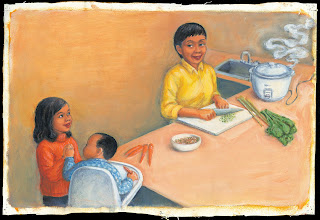 |
| A scene from A Path of Stars; Dara and her grandmother |
So often, "multicultural" books are relegated to the purpose of examining differences, such as during Black History Month. What if books with diverse characters and cultures--like the ones in the previous post--were seen as being about, and necessary to, all of us?
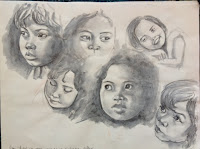 |
| Face research for Dara in A Path of Stars |
In 1998, I traveled with a black South African friend to southern Africa, as preparation for illustrating a nonfiction book, Africa is Not a Country by Margy Burns Knight and Mark Melnicove. I wasn't planning to do any specific research so much as to look for some sense of connection, some insight that would inform my attempts to portray the diverse range of African cultures, none of which I belonged to and all of which I knew little about. I expected the countries I would be visiting--Swaziland and Zimbabwe as well as South Africa--would be the most culturally different of anything I'd ever seen, the equivalent of traveling to the moon.That wasn't my experience. As I shopped open air markets in Capetown, walked the dusty paths of my friend's hometown neighborhood of Dube in Soweto, and bought food from street vendors in Durban, instead of a sense of curiosity at the exotic, my response was recognition. Despite the different colors of the landscape and the different customs of people's lives, I kept seeing things that seemed somehow familiar. It took me days to realize that I was reminded of the neighborhoods I'd grown up in in 1960s South Korea, of the ways in which daily life--from brushing teeth to bathing to baby care--was communal and took place in plain sight in the streets and alleyways. In the streets of southern Africa, I saw my own story. This was the insight that I brought back with me from my trip, the touchstone I held onto as I went through the lengthy process of research, consulting, collaboration, and critique, to create accurate and respectful images. It taught me that after all the essential work, there's another aspect to authentic representation that can't be found in the data. If we are to truly connect across all our differences, we have to let our hearts respond, and we have to trust those responses as true expressions of our common humanity. I don't leap over differences to get to commonalities. As I'm researching and creating, I'm focused on the particular details of what defines human uniqueness, in groups and in individuals. The details of difference matter, and have meaning. I keep remembering how little I know, what blinders I'm wearing, that I often can't even imagine what questions to ask. I assume I will make many mistakes. I seek lots of input from primary source experts, people with lived experience, to help me see what I can't see.But the North Star towards which I am navigating is the core belonging of each of us to one human community. In the images we communicate of "other people"--through the words and pictures we create as writers and illustrators, and the books we share with children as educators and parents--the sweet spot is lively, particular human being. To see, and reach for, our own selves reflected there. Anything less is not enough for our children. Ultimately, authentic diversity isn't about getting it "right." It's about getting each other. Posted by Anne Sibley O'Brien, author and illustrator of several books for young readers, including A Path of Stars. Anne blogged for Unabridged about the process of creating A Path of Stars here.
Meet Anne during Children's Book Week!
In partnership with Primary Source and Charlesbridge, Anne Sibley O'Brien will be discussing race, ethnicity, and diversity in children's books.
Her program, entitled "From the Heart: Illustrating Across Race and Culture," will take place on Tuesday, May 14th from 4:00 PM to 6:00 PM at the Watertown Public Library, 123 Main Street, Watertown, MA.
at 85 Main Street, Watertown, MA (two doors down). Free and open to the public!
For more information about this event, please click here.
In light of the recent events in Boston, and here in Watertown, Massachusetts, we have heard from many teachers, librarians, and parents looking for books that will help open a line of communication with children about how to deal with these tragic events. While Charlesbridge does publish books that help young children learn to discuss loss, they don't touch upon the themes of the recent events and why someone would cause so much pain.
However, one thing that Charlesbridge does very well is publish books about community, humanity, and the beauty in diversity. We want to share these books with you here.
Please share your suggestions in the comments. Perhaps we can build a huge book list and through books we can build a bridge to a better world.
Global Baby GirlsFrom Peru to China, from Russia to Mali, this board book features captivating photographs of baby girls to share a simple, yet powerful message: no matter where they are born, baby girls can grow up to change the world. I'm in Love with a Big Blue Frog A huge hit for Peter, Paul and Mary in 1967, this song has been a favorite in classrooms, camps, and at sing-alongs ever since. Not only do children delight in the playful tune, but adults also embrace its lyrics, which gently send a message of tolerance in the most light-hearted, humorous way. Camille's TeamCamille loves to build sand forts at the beach. But it's hard to build a big fort alone. Camille and her friends make a plan. They find that they can get more done--and have more fun--when they work together.
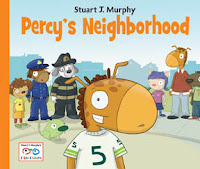 Percy's NeighborhoodPercy helps his dad hang signs for the Neighborhood Fun Run. Along the way, Percy meets the community helpers who make See and Learn City a better place to live, work, and play. Percy is excited to tell the gang about the new friends he met in the neighborhood. Kenya's SongKenya’s homework is to pick her favorite song and share it with her class. Sounds simple, but for Kenya, it’s anything but. With all that beautiful music in the world, how can she possibly choose? Over the Rainbow
Leading into the song's familiar chorus is a lesser-known verse describing the world as a "hopeless jumble," portrayed in Puybaret's acrylic paintings as a rain-soaked, windblown cityscape. Giving a nod to the film, the setting shifts to a farm, where a rainbow appears at a girl's window to lead her to "a place behind the sun, just a step beyond the rain." When she returns to her barnlike home, the creatures and celestial objects from her magical journey remain, turning the wistful tenor of the closing lines ("Why, oh, why can't I?") into a statement of defiance that speaks to the power of imagination. Grammy-winner Judy Collins sings the title track and two other songs on an accompanying CD.
--
Publishers WeeklyI Am Different!This clever picture book presents sixteen visual puzzles. On every page, readers must pick out the one item that is different from the rest--a different color, a different shape, reversed from left to right, or just asleep when others are awake!
The phrase "Can you find me?" is shown in a different language on every page.
Children from Australia to ZimbabweCelebrate the many faces of children around the world.
Vibrant color photographs portray positive images of children that help foster a sense of global citizenship. With an abundance of information about cultures, languages, and environment, this fascinating journey around the world will inspire both young and old alike. Readers will also discover Xanadu, an ideal imaginary land described and illustrated by elementary school children.
Children of the U.S.A. Celebrate the diversity of the United States!
There is no typical American child. Children may share similar activities and pastimes, but they represent a variety of ethnic, cultural, and religious backgrounds. Striking photographs showcase fifty-one cities -- one from each state, as well as our nation's capital, Washington, D.C. The photos and facts feature common activities and interests, as well as varied foods, languages, entertainment, sports, and other examples of daily life throughout the country.
Faith Families around the world celebrate faith in many different ways—through praying, singing, learning, helping, caring, and more. With stunning photographs from many cultures and religious traditions,
Faith celebrates the ways in which people worship around the globe.
Be My NeighborAround the world, children live in community with others, sharing homes, resources, and experiences with their neighbors. This book celebrates what it means to be a neighbor the whole world over -- from Vietnam to the United States, Austria to Kenya and everywhere in between.
With
Words of Wisdom from Mr. Fred Rogers.
To Be a KidUnquestionably, to be a kid is the most exciting thing to be. Filled with beautiful photographs,
To Be a Kid celebrates kids as they play and learn, as they spend time with their friends and family, and as they discover their environment and the world. Kids, no matter where they are from, share this same wonderful adventure and at the heart of it a kid is just a kid.
Somos un arco iris/We Are a RainbowWe Are a Rainbow helps young readers begin building the cultural bridges of common human understanding through simple comparisons of culture from breakfast foods to legends. Colorful cut-paper art and gentle language deliver this universal message eloquently.
The ABC Book of American HomesHouses in trees, houses on water, houses with wheels! America is a country of diverse people who live in all types of homes--homes made of wood, metal, glass, even snow! In the desert, on a farm, or by the beach, American houses have only one thing in common--they provide shelter and comfort to those who live in them. No matter the size, shape, or location, they are places to call home.
Candy ShopWhen an act of bigotry scars the sidewalk in front of the candy shop and frightens the store owner, Daniel knows he must do something to fight back. A tender story of a young boy's courage in the face of prejudice.
Different Just Like MeThis celebration of a world of difference is sure to make every reader appreciate the distinctive qualities in themselves and everyone around them.
Don't Say Ain'tIn the 1950s, Dana struggles to live in two worlds—her Harlem neighborhood and the advanced school she attends—while staying true to herself. Irene Smalls and Colin Bootman team up in this heart-warming story of friendship, integration, opportunity, and hard choices.
The Flag We LoveThis spirited tribute to Old Glory will inspire readers, young and old, to take a new look at the greatest emblem of the United States of America. With patriotic verse and historical facts,
The Flag We Love explores how our flag has become an enduring part of our nation's proud history and heritage. From its earliest designs to its role in peace-time and war, the Star-Spangled Banner will take on a whole new meaning for all readers.
Hats Off To Hair!Hair is our most versatile feature and kids everywhere have created their own unique styles. Exquisite paintings of kids from many cultures show us the beauty, splendor, and wonder of our hairstyles.
Magic TrashMagic Trash offers strong themes of working together, the power of art, and the importance of inspiring community--especially kids--to affect action. The Heidelberg Project is internationally recognized for providing arts education to children and adults and for the ongoing development of several houses on Heidelberg Street. Not only does the Heidelberg Project prove that when a community works together it can rebuild itself, but it also addresses the issues of recycling, environmentalism, and community on a global level.
A Path of StarsDara's grandmother, Lok Yeay, is full of stories about her life growing up in Cambodia, before she immigrated to the United States. Lok Yeay tells her granddaughter of the fruits and plants that grew there, and how her family would sit in their yard and watch the stars that glowed like fireflies. Lok Yeay tells Dara about her brother, Lok Ta, who is still in Cambodia, and how one day she will return with Dara and Dara's family to visit the place she still considers home. But when a phone call disrupts Lok Yeay's dream to see her brother again, Dara becomes determined to bring her grandmother back to a place of happiness. Priscilla and the HollyhocksPriscilla is only four years old when her mother is sold to another master. All Priscilla has to remember her mother by are the hollyhocks she planted by the cow pond. At age ten, Priscilla is sold to a Cherokee family and continues her life as a slave. She keeps hope for a better life alive by planting hollyhocks wherever she goes. At last, her forced march along the Trail of Tears brings a chance encounter that leads to her freedom.
A story of how love overcomes hate.
Subway RideA fantastical journey introduces young readers to subway travel. Five children pay the fare, pass through the gates, and zip through the tunnels of subway stations in ten cities around the globe. The trip around the world underscores how travel and cultural connections create community.
The Searcher and Old TreeBeloved author-illustrator David McPhail crafts a simple, yet powerful, allegory about the safety of home and the strength of unconditional love.
This Is AmericaWhat is America? It's the special places that remind us of important events. It's the people who have dedicated themselves to improving our country. And most of all, it's the ideals and beliefs that we share. Informative text and bold scratchboard illustrations pay homage to our country's past and present.
The Ugly VegetablesThe neighbors' gardens look so much prettier and so much more inviting to the young gardener than the garden of "black-purple-green vines, fuzzy wrinkled leaves, prickly stems, and a few little yellow flowers" that she and her mother grow. Nevertheless, mother assures her that "these are better than flowers." Come harvest time, everyone agrees as those ugly Chinese vegetables become the tastiest, most aromatic soup they have ever known. As the neighborhood comes together to share flowers and ugly vegetable soup, the young gardener learns that regardless of appearances, everything has its own beauty and purpose.
Yum! Yuck!At a busy street market, kids eating ice cream exclaim, "Yum!" in English, "Geshmak!" in Yiddish, and "Nam-nam!" in Danish. But disaster strikes when a little dog overturns a spice cart, showering pepper on everyone's ice cream. Will the kids end up crying, "Hai hai," or cheering, "¡Yupi!"? energetic art and a lift-the-flap feature make exploring languages fun.
You See a CircusA young acrobat shows his friends around the big top, but all is not as it seems. His uncle, the strongman, always manages to lose their wrestling matches. The scary-looking tattooed man is a regular Joe who likes to pull funny practical jokes. And the daring trapeze artists make their son do homework just like everyday parents! Lively watercolors capture the excitement of the circus and the coziness of home.
After GandhiIn 1908 Mohandas Gandhi spoke to a crowd of 3,000. Together they protested against an unjust law without guns or rioting. Peacefully they made a difference. Gandhi’s words and deeds influenced countless others to work toward the goals of freedom and justice through peaceful methods.
Bamboo People
"Perkins seamlessly blends cultural, political, religious, and philosophical context into her story, which is distinguished by humor, astute insights into human nature, and memorable characters."
--
Publishers WeeklyCamel Rider War has broken out in the Middle East and all foreigners are fleeing. Instead of escaping with his neighbors, Adam sneaks off to save his dog, which has been left behind. Lost in the desert, Adam meets Walid, an abused camel boy who is on the run. Together they struggle to survive the elements and elude the revengeful master from whom Walid has fled. Cultural and language barriers are wide, but with ingenuity and determination the two boys bridge their differences, helping each other to survive and learn what true friendship is.
Candy Bomber
After World War II the United States and Britain airlifted food and supplies into Russian-blockaded West Berlin. US Air Force Lieutenant Gail S. Halvorsen knew the children of the city were suffering. To lift their spirits, he began dropping chocolate and gum by parachute.
Michael O. Tunnell tells an inspiring tale of candy and courage, illustrated with Lt. Halvorsen's personal photographs, as well as letters and drawings from the children of Berlin to their beloved "Uncle Wiggly Wings."
Flying the Dragon"A quiet, beautifully moving portrayal of a multicultural family."
--Kirkus Review
Hopscotch chalk colors driveways and sidewalks, thrashers are singing lustily, kites high-flying gustily. The world is bursting with life, song, and hope after winter's torpor. April, appropriately designatedPoetry Month, beckons each creature to join the creative process. Writing poetry often occurs first as a response to such beauty and exuberance, and some people think of it only that way, but poetry's an appropriate expression for life in all its guises. It captures the comedic irritation of spring winds and Russian-immigrant tumbleweeds in... AH, SPRING! Wind herds tumbleweeds/ down the Southwest interstate/ at posted speed./ Oncoming car grills grin/ through Russian thistle whiskers.Poetry exposes the underbelly of war in the last stanzas of...
*CODE TALKER [he] meets two other camouflaged survivors/ helps the famished men set snares/ for chickens they'd heard scratching/ in the brush.// He had passed the hens - - -/ themselves once famished in this war - - -/ as they plumped themselves/ on maggots feasting/ upon fallen-soldier flesh.
Although many authors begin in childhood, I came to writing--beyond thank-you notes, letters, and school papers--with graying hair. Writing this blog couldn't have been imagined, much less happened, in my youth. Writing would have kept me inside. I was an outside kid playing ball, flying kites, and exploring along the local creek.
My fondest childhood hours were spent at the end of our block in a large vacant lot where things grew WILD. Up in the cherry tree, I was a bird viewing the world below. Lying on the ground, I imagined what life was like for beetles and crickets with grasses tall as trees towering above. I puzzled why ants walked single-file like second graders returning to class.
I'd heard that God punished the snake for its role in Eden by depriving it of legs. I, however, couldn't see how the garter snake was disadvantaged as it slithered with a grace unequaled by footed creatures. Nor was it bothered by skinned knees, stubbed toes or broken bones from falling. I amassed my observations and kept them to myself. I certainly didn't write about them. Nor could I have predicted, many years later, being so touched by an intact snake skeleton that I'd write...
*SNAKE SPEAKS Among the dunes/ beneath a ponderosa pine/ articulated skeleton of snake// speaks to me/in supple syllables/ of vertebrae/ and curved ribs/ fine as needles// till I can hear/ it slither-stitch/ its shifting shape/ across the sand/ in search of prey.
After my dad died, we moved to an older neighborhood without a vacant lot. As the oldest of three children I took on more family responsibility. Life progressed with its hormonal changes, work at the corner drugstore, college, teaching, and marriage--all in cities. I had assumed life's traditional roles and forgotten the vacant lot until many years later when my husband and I settled on ranch land in New Mexico among red rock mesas and miles of space.
I learned to recognize our new neighbors as much by sound as by sight: the whhipp whhipp whhipp of ravens flying overhead, the descending co coo coo coooo of the romantic roadrunner. In October my pulse responded to the warbling call of gray waves of sandhill cranes lapping their way across the sky along an invisible path first marked millions of years ago.
Among the neighbors I was getting to know was a black widow spider, the first one I'd ever seen, her telltale red hourglass on a body sleek as polished jet. She lived, not in the neat orb of garden spiders, but in a ragtag web littered with gray exoskeletons hanging about like ghosts of her previous meals.
In those days before PCs were common and Google was a verb, I took notes, wrote down questions, and went to the bookmobile to learn that the tiny brown spider that awkwardly approached my black widow wasn't just a meal, but was her mate plucking the lines of her web like a harp to announce his intentions, that the marble-size silk ball she turned and tended was her egg sac. I watched spiderlings hatch one by one by one by one and sail off in the breeze on strands of silk like kite tails that delivered hundreds of young to new homes.
I had reconnected to my vacant lot, responding to nature with the awe and wonder of a child. Only now my vacant lot was 60 acres and I didn't have to grow up.
But I did feel the need to capture these experiences in a tangible way after I'd all but lost them for those many years. I also wanted to share my findings and excitement with children who don't have the advantage of exploring undeveloped places. "A Dangerous Lady," about the black widow spider, was my first article. It appeared in Cricket magazine. I continued to write.
Poetry crept into my writing along with the rhythms and sensuousness of the seasons. I watched extravaganzas of horizontal lightning on onyx nights, accepted the extremes of drought and floods, and attended to the details of a land many call barren. I started to read poetry and took classes. I began writing with much more awareness of my writing tools.
In addition to sounds, pattern, repetition, rhythm, and rhyme, I consider point of view, shape, and poetic form. I try to listen for what a poem needs. Capturing emotional truth often means not always or in all ways telling exactly what happened. In the following excerpt I chose first person to enhance the poignancy of
*THE WATCH MAN The way I know it's my birthday is when Mom tells me to stay home from school to wait for him. . . . I take the small box he pushes into my hand. Open it he commands. It's a watch. It's always a watch. Thanks I say. You're thirteen now, he notes. Be good. Be good startles me. It's the most interest he's ever expressed in what I do. It's the last time I see my dad.
 Rather than using a strict traditional form or even free verse, I felt the prose poem format suited the emotional bleakness in "The Watch Man."
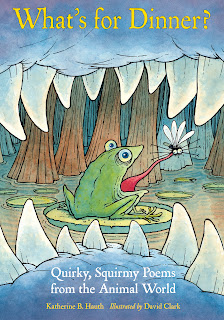
I no longer separate poetry from nature. Even the worst disasters call me to dip into the well of poetic choices for adequate expression. So did gross aspects of eating and being eaten seek to become 29 children's poems about the food chain in What's for Dinner? Quirky, Squirmy Poems from the Animal World.A dose of humor helps make distasteful facts more palatable.
When I hear children or adults giggle or say, "I didn't know that," I know I've succeeded in communicating my fascination with nature's facts and idiosyncrasies.
As a children's writer, there's a special satisfaction when my words are paired with complementary art such as David Clark's illustrations for the cover and poems in this book:
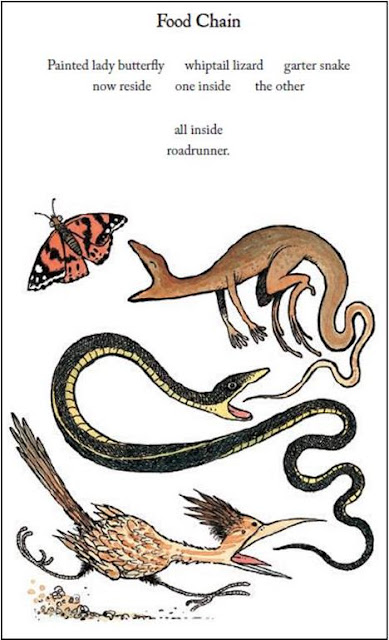

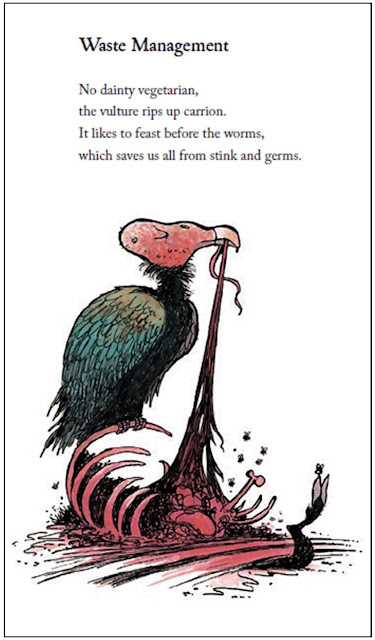
For me, a silver-haired eight year old, what it means to be a poet is to be childlike, in the sense of seeing with unbiased eyes and heart, and to write honestly in the best language possible for the subject and for my audience.
------------------------------------------------
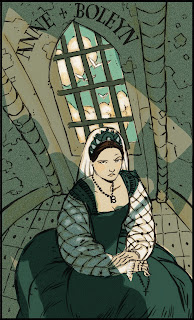 Strange stuff, this 21st century. Lurking around my eternal resting place, the Tower of London, I encounter all sorts of oddities. First of all, people do not run from this place anymore, but instead, they seem to flock to it! And what’s more—they pay money to do so! They all seem intrigued by the stories and tales of the people murdered and imprisoned here. If only they knew . . .
I appear to be quite the topic of conversation around here. And rightfully so! I was imprisoned here, wrongfully, at the hand of my husband, King Henry VIII. He said I betrayed him, that I ran around with other men! Ha! The real truth is that I did not bear him a son and, anxious to try anew with someone else, he threw me in the Tower like a common criminal, ended my life by beheading me here. How kind of him to wait until I was true and dead to engage himself to Jane Seymour—a whole day he waited! Well, let me say—Jane may have bore him the son he always wanted, but it was I who gave birth to Elizabeth, the greatest queen of England.
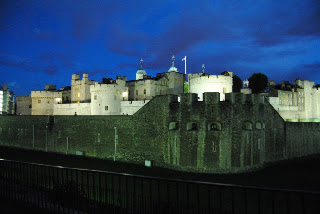 |
| The Tower of London |
And what’s more, there is a dreadful display right at the site of the scaffold where many were executed—myself included. I suppose I should feel . . . honored? After all, the literature I see tossed in the rubbish bins calls this disdainful monstrosity a “memorial site.” A glass pillow sits there, as though the act of losing one’s head is a relaxing experience. Quite the contrary!
 |
| Scaffold site at the Tower of London |
Aside from the changes in the Tower, I’ve also heard news of a book about me, Bad Girls. I have several problems with it: first of all, I am not bad! I was wronged! Secondly, I am not a girl! I am a Queen! (And it would do you well to remember that.) Third of all, I do not appreciate being lumped together with the likes of some of those women. Surely I did nothing to deserve being bound together in literary eternity with Mary Tudor!
 To the authors of this . . . strangebook:
Ms. Yolen, I appreciate your tendency to argue on my behalf. Quite the queen, you’d make.
Ms. Stemple, since when is being manipulative a crime? However, you seem to me someone who would have gotten the better of my late husband, and for that I must admire you somewhat.
And to the illustrator, Ms. Guay . . . a fine job you’ve done. It’s quite astounding how well you managed to capture my essence—have we met?
Posted by Queen Anne Boleyn, the woman who lost her head for love. Bad Girl from circa 1500-1536.
You, old woman, scribe with the strange name, write this down. Write it truly. I know well you scribblers often lie. The heiroglyphs of my life make wounds. Even the letters my Roman husbands used can cut deep. But remember this: you cannot judge me. You are but a writer. I am the queen. Only I can judge.
You sneer at me, oh I know. I have had your words translated. You think to laugh at my brother-marriage. Well know this: in Egypt we royals kept the blood lines pure by marrying ourselves. But I was the oldest. My brother schemed with crafty men. He had to die. There was no shame in ordering it. You cannot judge. I am the queen.
You laughed at me marrying the old Roman men. Well, know this: they held great power. It is no shame to marry that way, to keep the power lines strong. Only power can hold on to power, only power can breed more power. You cannot judge. I am the queen.
You thought the style of my life was an excess of feasts and festivals, of great barges and beautiful clothing, dazzling jewels. That I had servants and slave. Of course I did. There was no shame in it. The poor expect it. They lived through me. I was their mornings, I was their evenings. You cannot judge. I am the queen.
And in the end when all was lost, you pitied me. I did not want your pity. I did not want their pity. A queen who encourages pity is a queen who is lost. Lost to her kingdom, lost to her people, lost to history. The asp was my choice, the poison my salvation, death my new life. You cannot judge.
Only I can judge. After all, in death as in life, I am the queen.
Posted by Cleopatra, The Queen of Denial. Bad Girl from 69-30 BCE.
When’s the last time you played Red Rover or Leap Frog—or bobbed for apples or went on a scavenger hunt? If you’re a teacher, a parent with young children, or a grandparent, you probably get some pretty good play opportunities. But for those who no longer—or haven’t ever—come in contact with children, the concept of “play” may have become completely foreign.
That’s truly sad, because play is a key factor for enjoying good health—both physical and mental—as well as a long life. Numerous studies have documented these benefits for adults who play games:
- More creativity
- More laughter (which improves heart rate and lung capacity)
- Reduced blood pressure
- Decreased depression
- Longer lifespan
Children get those same benefits, plus they learn vital skills such as:- Social skills and interaction
- Ethics
- Self-control
- Following rules and instructions
But scientific studies aside, the best reason for playing games is that it’s fun! In a world where drudgery and tragedy are too often our constant companions, the interjection of an occasional dose of fun is as essential as air.
"What do most Nobel Laureates, innovative entrepreneurs, artists and performers, well-adjusted children, happy couples and families, and the most successfully adapted mammals have in common? They play enthusiastically throughout their lives."
~ Stuart Brown, The National Institute for Play
Preserving the Past for the Future
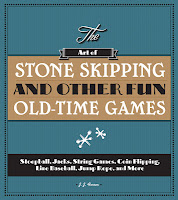 Did I write The Art of Stone Skipping and Other Fun Old-Time Games for adults? Well, maybe. I mean, if we don’t pass on the ridiculous fun of balloon and egg tosses and the hilarity of crab walking and sack races to the next generation, who will? Mostly I wrote this book because I can’t stand to think that technology might wipe out activities that have survived since the beginning of time. I love Pac-Man as much as anyone but, frankly, it pales in comparison to the rollicking adventure of Capture the Flag, and when electricity and batteries are not to be had, a shadow puppet by candlelight will always be a bored child’s best friend.
My research also fueled a fascination with how connected we are, globally speaking, through the games with which we grew up. Keep-Away, which goes by at least four other names in various regions of the U.S., is played in Africa under the name “Mbube, Mbube” (the Zulu word for lion), and in almost every other country in the world. That beloved game has been around since the 17th century and I saw it being played at an apartment complex just last week. How many things can boast that kind of longevity?!
I’ve been a poetry missionary for many years because I believe so strongly in all it has to offer us; after researching this book, I’m adding playfulness to my list of Life Essentials. Whether it’s physical play that gets us up and moving, or mental play that keeps our synapses sharp, there’s plenty of proof that “those who play get more out of their day!"But don’t take my word for it: listen to thepresentation below by Dr. Stuart Brown, founder of the National Institute for Play, who says, “play is as important to humans as vitamins or sleep.” Dr. Brown gave this presentation as a TEDTalk in March 2009.Or just watch my very favorite YouTube video, which shows that a little bit of creativity and a playful attitude can turn even the bleakest situation into a good time!Posted by J. J. Ferrer, author of The Art of Stone Skipping and Other Fun Old-Time Games.
My new book Snow School was inspired by my love of cats, especially wild cats. There are none more fascinating than snow leopards. These wild cats are so rare there are believed to be as few as 3,500 left in the entire world.
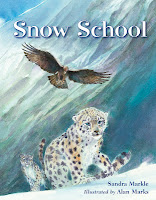 As always, when I want to learn more about a wild animal I go exploring. That’s how I came to spend a winter in Antarctica, the experience that inspired me to write A Mother’s Journey, a story about what female emperor penguins do while the males hatch out the eggs.
Sometimes, though, I just can’t get to the places I need to go to explore firsthand. Then I track down experts who have been able to go to those places and studied the wild animals I want to write about. That was the case with Snow School. I had the pleasure of interviewing Dr. Tom McCarthy who has spent many years climbing the high, rugged mountains of Pakistan in order to learn about the life and behavior of snow leopards.
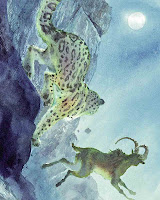
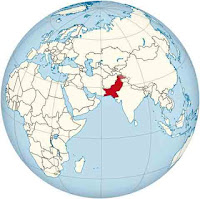 To see where snow leopards live and where the story of Snow School takes place, go online to find out about Pakistan (in red on the globe to the left). Also search for information about the Hindu Kush Mountains, the setting for the story. This habitat is one of the harshest on earth and requires the cats to be able to chase fast prey downhill over very rocky terrain.
 |
| From Snow School |
Even during his many years studying snow leopards Dr. McCarthy shared that he only had a chance to watch a few downhill chases as snow leopards caught prey. He said, “Once, I was lucky enough to see a mother have two cubs with her while she hunted.”
Dr. McCarthy guessed these cubs were in training. Snow leopard cubs spend two years with their mothers learning to survive on their own. That inspired me to wonder what lessons snow leopard cubs need to learn in order to be successful in the extreme conditions of their home habitat.
 |
| Dr. Tom McCarthy with a snow leopard cub (photo courtesy of Panthera Snow Leopard Trust) |
|
|
|
|
|
|
|
|
|
|
|
|
|
|
|
|
|
|
|
|
|
|
|
|
|
|
|
|
|
|
|
|
|
|
|
|
|
|
|
|
|
|
|
|
|
|
|
|
|
|
|
|
|
|
|
|
|
|
|
|
|
|
|
|
|
|
|
|
|
|
|
|
|
|
|
|
|
|
|
|
|
|
|
|
|
|
|
|
|
|
|
|
|
|
|
|
|
|
|
|
|
|
|
|
|
|
|
|
|
|
|
|
|
|
|
|
|
|
|
|
|
|
|
|
|
|
|
|
|
|
|
|
|
|
|
|
|
|
|
|
|
|
|
|
|
|
|
|
|
|
|
|
|
|
|
|
|
|
|
|
|
|
|
|
|
|
|
|
|
|
|
|
|
|
|
|
|
|
|
For one thing, as soon as they’re big enough, snow leopard cubs travel with their mother. That way they get a close look at the features of their environment. And they learn the shortest, safest routes to take.
 |
| Fr0m Snow School |
To get a feel for what the snow leopard cubs are learning, go to your local park or playground with a parent or adult partner. Take along a pencil and a notepad. Draw a map of the area. Use symbols to mark any key landmarks, like fountains or statues, big trees, or benches. Next, study the map with your partner and plan the fastest, safest path to use to travel across the mapped area. Then use a watch to time how long it takes you to run across the area following your chosen path. Afterwards, revisit the map and decide if another way might be easier and safer. Time test your new route.
 |
| From Snow School |
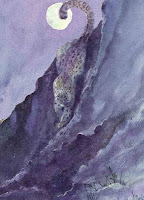
The snow leopard’s habitat is really a high desert with very steep terrain. When these cats hunt, they have to chase down prey animals, like ibex, capable of running down steep, rocky slopes without falling. And they have to pounce at just the right moment to stop their prey without going over a cliff.
Snow leopards do have some natural built-in advantages. One is a very long tail. Dr. McCarthy reports that a snow leopard’s tail is all muscle and that it’s heavy. He said, “It must even be heavy for the snow leopard. In snow, I’d see a mark where a cat would start to drag its tail after every two or three steps. So holding up its long tail must be tiring.”
Having such a long tail is worth the effort, though, when the snow leopard starts to run. It swings its tail back and forth and that helps it stay balanced while twisting and turning. To get a feel for how its tail helps a snow leopard stay balanced, try this: stand on one foot with your hands at your sides. Then repeat standing on one foot, but this time stretch out your arms and move them forward and backward.
 |
| From Snow School |
Snow leopards also have big feet that act like snowshoes, helping them walk on top of fluffy snow. In fact, Dr. McCarthy reported a snow leopard’s feet leave very round footprints because their feet are about as wide as they are long (about four to five inches in both directions.) Measure the length and width of one of your feet. How much longer is your foot that it is wide? And, just for fun, figure out how much longer your foot is than a snow leopard’s.
These cats also have a lot of fur around their toes and the pads of their feet to shield them from the ice and snow. Like housecats, snow leopards have retractable claws. They put these out to help them climb and to stop themselves from skidding.
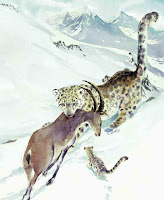
Dr. McCarthy reported that once a snow leopard catches prey it needs a safe place to eat—safer than on a steep mountainside. Dr. McCarthy said, “I’ve watched a snow leopard drag a big goat that weighs as much, if not slightly more, than the cat does. And it dragged its prey uphill.”
 |
| From Snow School |
Imagine pulling something that weighs as much as you do. Now, imagine doing it the way a snow leopard does. This cat bites to grab its prey. Then it drags this weight between its legs. This is another behavior snow leopard cubs learn by being copycats, doing what their mother does.
From an early age, the cubs learn the smell of what’s good to hunt because their mother brings home prey. See if you’ve learned to identify your food by its scent. Have an adult partner blindfold you. Then have your partner hold each of the following five food items, one at a time, under your nose for you to sniff. Test your scent IQ on the following: peanut butter, orange juice, mustard, cheese, and ketchup.You might be surprised to learn that snow leopards usually only get a chance to catch big prey about once a week. So when it is successful, the cat is likely to stay by its prey and eat as much as 25 pounds of meat a day for two to three days. How much is that? Weigh a plate. Then put the food you’re going to eat for dinner on that plate and weigh it again. Subtract the weight of the plate to see how much your meal weighs. How many of those meals would you have to eat to equal what a snow leopard eats when food is available?
Can you guess what snow leopards do after such big meals? You’re right! They sleep. Like lions, tigers, and housecats, snow leopards sleep most of the day to save their energy for hunting.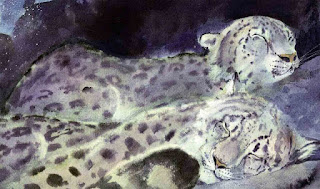 |
| From Snow School |
I hope you enjoy reading Snow School. For more activities and to explore more of my books visit my blog Write On! Sandra Markle.Posted by Sandra Markle, author of Snow School.All illustrations copyright 2013 by Alan Marks from Snow School.
 My new book, Too Hot? Too Cold? Keeping BodyTemperature Just Right (February 2013), grew out of many years researching animals and learning how each one has adapted in its own way to the weather and temperature of its habitat. Some animals migrate or hibernate; others grow thick coats of fur in winter and shed it in summer; some, such as those that live in the desert, restrict their activities to night, when the air is cooler. I began to realize that there were many parallels between animals and the way people adjust to variations in temperature in the places where they live. We may not grow thick fur to keep warm, but we do put on heavy coats and jackets when it is cold outside.
  |
| Caroline Arnold, age 10, with her brothers | |
|
I grew up in Minnesota where winters are cold and summers are hot. When I was ten, my mother took a photo in front of our house of me and my brothers all bundled up in our snowsuits and mittens on a snowy February day. She wrote on the back of the photo that the temperature that day was minus fourteen degrees Fahrenheit! I have fond memories of sledding and ice skating on cold winter days in Minneapolis. In summer, when temperatures soared into the nineties, my brothers and I stayed cool by swimming in the lake not far from our house.
I now live in Los Angeles, California, where the seasonal variations are not so extreme. Even so, there are clear differences between winter and summer. On warm summer days, I often see lizards sunning themselves in my driveway. On cool winter days, the lizards hide among the rocks. In spring and fall, I enjoy watching birds as they migrate through southern California on their way to and from their summer homes farther north.
As I worked on the book, I tried to think of activities that would help readers understand the concepts I was describing. It is one thing to read about an idea, and another to experience it. Here are three simple activities you can do that are related to information presented in Too Hot? Too Cold?
Getting Heat From the Sun
Dark colors are good for absorbing the sun’s heat. That’s why vultures will hold out their dark wings on cold mornings to catch the sun’s rays. Light colors reflect the sun and help keep an animal cool. The addax, an antelope that lives on the Arabian Peninsula, has a light-colored summer coat to help protect it from the desert sun.
Activity: Hot Rocks
In this activity you can test how well dark and light colors absorb the sun’s heat.
You will need: Two rocks (about the size of your fist), white paint, black paint, a paintbrush
Paint one rock white and the other rock black. Put both rocks in the sun and wait for one hour. Then feel the rocks. Which rock feels warmer?
The white rock reflects the sun’s rays and stays cool. The black rock soaks up the sun’s rays and becomes warm. To stay cool on a hot day, would you wear a dark shirt or a light one?
Migrating to Keep Warm or Cool
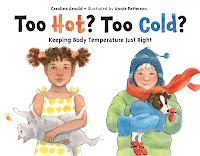 Some animals leave their homes, or migrate, when the weather gets too cold or too hot. Many birds migrate. Some of them fly thousands of miles between their winter and summer homes. Strong wings make them good flyers.
Activity: Wingspan Measuring Tape
Have you ever wondered what kind of bird would you be, if you could fly? A bird flies with its arms, which are covered with feathers. Stretch out your arms as if you were flying. Here's how you can make a measuring tape to find out your wingspan...
You will need: heavy paper (such as cardstock), scissors, tape, a pencil, and a bird guidebook.
Cut the paper in 1.5 inch strips. A paper cutter works well if you have one. Or, use your scissors. You will have eleven strips, each eleven inches long.
Connect the ends of the strips with tape. (Strapping tape is best, but any tape will do.) You will have now a strip 121 inches long. Look in the bird guidebook to find the wingspans of various birds. Then, start at one end and use a yardstick or measuring tape to mark the tape with the width of each bird's wingspan. Here are some of wingspans on my tape: emperor penguin, 32 inches; peregrine falcon, 3.5 feet; red-tailed hawk, 4.5 feet; flamingo, 5 feet; turkey vulture, 6 feet; golden eagle, 7 feet; bald eagle, 8 feet; California condor, 9.5 feet. You can add the wingspans of any birds you like.
Ask two people to hold the ends of your tape. Then you can measure your wingspan. When you are not using the tape, it folds up like an accordion.
Keeping Warm Through Thick and Thin
Large objects gain and lose heat more slowly than small objects. Animals with large bodies warm up and cool down more slowly than smaller animals. They have less surface area in relation to their size than smaller animals do. For example, a crocodile’s huge body helps it retain body heat longer than a smaller reptile could. This lets it remain active even after the sun has gone down.
Activity: Cooling Thermometers
This experiment is a simple demonstration comparing the length of time it takes for objects of two different sizes to cool down in your refrigerator.
You will need: 2 household thermometers, 4 washcloths, rubber bands, paper and pencil, a clock.
Look at the thermometers and write down the room temperature. Wrap one thermometer in one washcloth and fasten it with rubber bands. Wrap the other thermometer in three washcloths and fasten with rubber bands. Put both thermometers in a refrigerator for five minutes. Then take them out, unwrap them, and look at the temperature on each thermometer. Which one cooled off the most?
These activities can be done at home or at school. I enjoy doing the wingspan activity during my presentation when I do author visits at schools. Third graders are almost always red tailed hawks. Two students together, fingertip to fingertip, have the wingspan of one bald eagle!
During a recent school visit, a second-grader asked where I got the idea for my latest book The House That George Built. While answering her question I realized this story began in the same way as most of my picture books—when I accidentally stumbled upon a fascinating, little-known piece of history which literally gave me goosebumps. In the case of George, inspiration struck when a proud dad was telling me about the White House model his daughter made for a school project. He mentioned George Washington designed and built the President’s House, yet he was the only president who never lived there. Really?! (Cue goosebumps.)
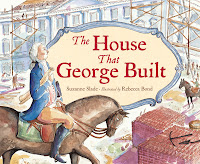
Immediately a title came to mind, The House That George Built. But before I could consider writing this story, I had to do research to determine if there was enough "good-stuff" to make a picture book (unofficial author term which means relatively unknown, yet captivating facts which lend themselves to a complete story arc with a satisfying ending). So I hurried down to my local library where I checked out The President's House, a two-volume set of colossal books filled with detailed White House history by noted historian and author, William Seale. One thousand, two hundred and twenty four pages later, I knew there was plenty of "good-stuff" for a story. Now I had to figure out the best way to tell it.
Considering the book title idea, my first thought was to share George’s story using an adaptation of "The House That Jack Built" nursery rhyme. From my research I knew George was intricately involved in the entire building process—from selecting the house design and plot of land where it would be built, to deciding the best roofing material—so I was concerned a revision of that tightly structured rhyming piece wouldn’t provide enough room for all the interesting facts I’d found. After some consideration, I decided the nursery rhyme adaption would be a fun, unique way to provide basic information about the main building elements of the house (brick, stone, wood), and by adding some lively prose paragraphs, I could share all the details of George’s huge building project.
But the research and writing of this book was just the beginning of my adventures with George. The illustration process was incredibly exciting as I watched the talented, award-winning artist Rebecca Bond bring history to life with her detailed, historically accurate sketches, which later turned into breathtaking, watercolor masterpieces.
 |
| Early sketch by Rebecca Bond from The House That George Built |
 |
| A final spread by Rebecca Bond from The House That George Built |
Then came something I’d been waiting my entire writing career to do—I’d always wanted to dedicate a book to my parents, but for one reason or another none of my previous books felt right. But George was perfect! First, my parents names are George and Martha (for real), and they’d created a wonderful home for our family. So after many years, I finally dedicated a book to my parents.
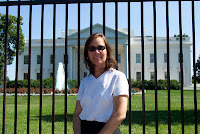 |
| Suzanne Slade visits the White House |
Later, I had the opportunity to visit to the White House. What a thrill to personally see the magnificent home I’d studied for years. I’d be lying if I didn’t say my heart skipped a beat the first time I spied that gorgeous white stone exterior, which I’d learned turned white when it was first painted with a stone sealer made of ground-up rice. As I admired the stately two-story design, I remembered the original plans called for three stories, but without enough stone to cover three floors George had modified the plans to two. I smiled when I looked up at the massive roof, recalling that the first roof of impressive heavy slate rock leaked every time it rained.
While working on The House That George Built, I was constantly amazed by the fascinating history I discovered about the President's House (which was renamed the White House by Theodore Roosevelt in 1901), and I hope readers enjoy learning about America's most famous home as much as I did!
When I was a child living in Poland, I had a favorite book of poetry called Sto Bajek (100 Tales Sto By′ek ) by Jan Brzechwa (Yon Bzheh′va.) He was Poland’s equivalent of Dr. Seuss with his unleashed imagination, impeccable meter, wonderful rhythms, and playful language. He wrote of talking trees and whining vegetables, fish mathematicians and arguing coat sleeves. The humor was preposterous and sure to bring on giggles, and the sounds and wordplay were pure joy. I could not get enough of his poems.
I could read and write before I turned six, and I attribute this to the many hours I spent listening to these verses, hearing the sounds, reciting them, looking at the words, and with my family’s help, putting the puzzle together.
At age seven I immigrated to the United States, and upon arrival my Aunt and Uncle gave me a big book of Mother Goose. Now I had the challenge of learning to speak and write in a whole new language, but results came quickly with this wonderful treasury of quirky old rhymes to inspire and teach me. Little did I know that someday I would extend many of them into picture books.
I always dreamed of becoming a children’s book author and illustrator, but I had no idea that the majority of my titles would be Mother Goose rhymes. It all started over twenty years ago, when my first publisher asked me to write and illustrate something well-known. We decided that nursery rhymes lent themselves well to extension. And so I came up with a story for The Itsy Bitsy Spider, starting with the original verse and then adding new verses to create a simple but not insignificant plot.
To my delight, the book was an instant hit with early educators. Preschool and kindergarten teachers from across the nation, who I met at conferences or who wrote to me, said the book was helpful in teaching children to read. Here are the reasons they cited: Children recognize the title and that piques their interest to look inside the book. Knowing the first verse gives them confidence to learn the rest of the verses. The repetition of the first line in each stanza (The itsy bitsy spider climbed up the...waterspout, kitchen wall, rocking chair...), the predictability of the rhyming sounds, and the added benefit of singing the verses accelerates learning.
Sadly, some teachers also told me that a percentage of their students were not familiar with nursery rhymes. They encouraged me to extend more of these verses into picture books and suggested their favorites: Twinkle, Twinkle Little Star, Baa Baa Black Sheep, Row Row Row Your Boat and many others. I was happy to oblige. :-)
In creating these extensions, though I add my own twist, I strive to match not only the meter (which is critical), but also the essence of the original rhyme. In Twinkle Twinkle Little Star, I tried to maintain the wonder of a child gazing at the night sky, wishing on a star. In Baa Baa Black Sheep, the focus was on asking the sheep for something: "Have you any wool?" (I had kittens asking for milk, a horse asking for hay, etc.) In Row, Row, Row Your Boat, I continued the adventure of merrily rowing a boat down the stream, though not always so gently.
 Usually I leave the first verse intact. Only once did I make a change and that was in Froggie Went A-Courtin’, which has the line: "with a sword and pistol by his side." I changed it to: "with a rose and chocolates by his side." I thought Froggie stood a much better chance of finding love with flowers and sweets than with deadly weapons. :-)
When I visit schools, I start my presentation by singing one or two of my books to the children. Usually we sing the first verse together and then I sing the rest. Sometimes they are quite surprised by the new verses and try to sing along with me, repeating the traditional one. They are especially surprised by my book Shoo Fly in which I used the original verse as a refrain, but changed it a bit (after the first time).
Original verse/first refrain:
Shoo fly don’t bother me,
Shoo fly don’t bother me,
Shoo fly! Don’t bother me--
I belong to somebody.
Two other refrains:
Shoo fly don’t bother me!
Go fly to Tennessee.
Leave on the count of three--
Can’t you see you’re bugging me?
Shoo fly don’t bother me!
Go spread your wings and flee
Across the great blue sea,
All the way to Waikiki.
"Look how many different “E” sounds I had to come up with: flee, three, Tennessee, Waikiki..." I tell the children. And then I ask them to think of some other words that rhyme with "me."
The sounds of words, and especially rhyming words, certainly enchanted me as a child and instilled in me a love of language. I am honored and gratified to have my books used in classrooms, and I hope the words I conjure up and the pictures I paint bring joy to my wonderful little readers.
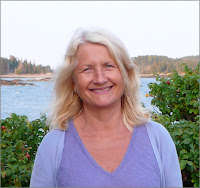 To learn more about Iza Trapani and her books, please visit her at www.izatrapani.com and check out her blog, In and Out of My Studio.
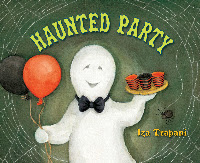 Click here for a list of Iza's books, including Haunted Party, the perfect read for a fun Halloween treat!
When we think about the issue of bullying, images of older children and young adults come to mind. Those are the examples that we see in the news: children ganging up on one another, hazing situations that turn into serious incidents of physical and psychological harassment, cyber-bulling, and more.
However, bullying takes place at all ages, even with very young children. It can take the form of anything from relatively minor name-calling to very serious aggressive actions. It can occur in person or hidden in notes and other communications. It can be first-hand, with one person directly bullying another, or indirect through gossip and talking with third parties.
Addressing bulling at an early age is critical. Young children need to learn to recognize bullying and they need to develop strategies for stopping it. They also need to learn how to protect themselves if they are being bullied, and ways to empathize with and support others who are being bullied. Finally, they need to better understand the reasons behind bullying and how to address them.
That’s what inspired me to write Freda Stops a Bully. I want to give young children a chance to witness a bullying incident and to consider the roles of everyone involved: the victim, the person doing the bullying, and any bystanders who see the bullying taking place. Most importantly, I want to provide some strategies for young children to use to stop people who are bullying them.
When Freda wears her bright pink shoes to school, a boy named Max taunts her. “Funny Feet! Funny Feet!” yells Max. His friends all laugh. But Freda doesn’t think it’s funny. She puts her shoes way in the back of her closet and plans to never wear them again. That doesn’t stop Max. “Hi, Funny Feet!” he hollers. “Where are your funny shoes?”
Through advice from adults, including her mom and her teacher, Miss Cathy, and suggestions from her supportive friends, Percy and Emma, Freda tries a number of strategies, including not listening, walking away, and getting help. When none of those works, she finally turns to Max and shouts, “Stop it!” Max and his friends are surprised. “I was just trying to be funny,” said Max. Freda explains that she didn’t think it was funny at all.
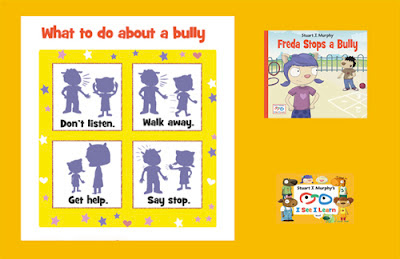 |
| Click here to download the "A Closer Look" poster! |
The story ends with Max wearing purple gym shoes with stars on them. He walks right up to Freda and says, “Funny Feet! That’s me!”
This wasn’t an easy book to write. First, I had to find an example of bullying that wasn’t too scary for young children, yet at the same time was strong enough so they would recognize that it was hurtful. I made sure that the person doing the teasing was never labeled as a “bully,” a designation that might become permanent and self-fulfilling. I provided some examples of peer support and adult intervention, and some reasons that people bully others. Bullying is complex!
Teachers, librarians, parents, and other caregivers can help young children to better understand bullying and what to do about it by reading my book and others that deal with this topic. After reading the books, they can encourage a discussion of the key ideas that are presented in the story. The strategies that can be used to stop bullying can be posted on a classroom wall, the refrigerator door, or other places where children will see them again and again.
Short plays and puppet shows can be created around bullying. This is a good way to reinforce all the elements involved in the process. Children can be encouraged to draw pictures about bullying and then to discuss them with others. These, too, can be posted for ongoing reference.
The important thing is to find ways to stop bullying whenever and wherever it occurs. Let’s agree to work together to stop bullying -- right now!
Posted by Stuart J. Murphy
________________________________________
Freda Stops a Bully is part of Stuart J. Murphy’s I See I Learn® Series.
The series includes sixteen children’s books that are organized in four domains: Social, Emotional, Health and safety, and Cognitive Skills. Dealing with Bullying is categorized as an Emotional Skill.
Websites that may be helpful in dealing with bullying include:
Day 14
Today was an exciting day—I was finally able to experience what it is like to be present when an editor has decided to acquire a book! This afternoon, Julie came over to my desk and asked me if I would like to try my hand at creating a book proposal. Not only that, but I also had to fill out a terms sheet and put the correct monetary figures into an Excel graph to see what the overall investments and returns would likely be estimated with the book being the type that it is. A book proposal form is pretty basic—at least the ones at Charlesbridge are. On it, I typed in the name of the book, the names of the author and illustrator, and year the book will likely come out. Also on the proposal is a description of the book, the editor’s vision for the book, the editor’s reason for publishing, and more nitty-gritty information like what kind of book it is, who it’s for and how it will be formatted, what the competition is likely to be, the reasons for why it’s marketable, and what the author’s history is. For all of this, it was my job to look at past book proposals for books similar to the one being acquired, and once I had an idea of what should be said, take a go at doing it myself.
Initially, looking at the form and the spaces where paragraphs written by me would have to go (knowing that what I wrote would be seen by not just Julie, but also Yolanda and various others (including the publisher)), I was terrified. The book being acquired is similar in length and structure to Grin and Bear It. Grin and Bear It appeared to have a fairly enthusiastic description that was to the point. I tried my best to mimic the enthusiasm (not difficult since the book is quite good—believe me—I’ve read it), but later on, found out I had to be more careful with my character and subject placement in a sentence as it can make the book appear that one character is the focus when really another character is the main one in the story. Also I learned to be more specific and to remove more umbrella-like statements. For the paragraph about the vision of the book, I looked to Julie’s emails for guidance. Seeing what she’d written as far as critiques or praises about the book helped me to form a couple statements I thought pretty well summed up her ideas. I did the same for the section titled “Reason for Publishing.”
When it came to the more technical items on the list, I opened up Google for some research. The book being acquired is a book about two friends and their adventures together. I looked up books using Amazon, Barnes & Noble, and other book websites, trying to find books that would fit the same market as this new novel. I found four titles I thought might be comparable. I then wrote brief plot synopsis of each book, and put down the publisher and year of publication. In “Selling Points” I once again looked to Grin and Bear It. Later, I learned that there must be a thoughtful order to the points (I know—no-brainer but I’m new at this), so if an author is well known, it is good to mention his or her name in the first bullet-point. If the author is not as well known, the name mentioning can be left to the last bullet if at all. I learned to ignore the role of the parents and to focus on the kids. I also learned not to mention the story’s moral as that can sound didactic. As Harold Underdown says in his book, The Complete Idiot’s Guide to Publishing Children’s Books, an author should be subtle about the “moral” of his or her book. If there is a lesson to be learned, it can be taught through the actions taken by the characters in the book. It is very rare when a publisher wants an author to just spell out the moral.
As for the terms sheet and graph, these mostly required guidance from the term sheet for Grin and Bear It. It’s so strange to know how much authors are paid, what their payments rely upon after the initial payment, and what percent of each book sold (depending on if it is hardcover or softcover) goes to the author. I felt like I was doing a lot of guessing, but since Julie was looking it over, I didn’t feel too pressured.
Overall, it was an extraordinarily fascination lesson, and beyond that, I am so excited that I got to be here to find out that a book was being acquired!
Today I also was able to conduct an informational interview with Karen. It was great learning about her path to Charlesbridge, her thoughts on what makes a valuable editor, and her recommendations for when I begin to apply for jobs in publishing. She also looked over my questions that I will be taking to New York, and helped me to organize them into “themed” lists. I was so grateful for her help.
Day 15
Today I received Julie’s edits on the book proposal form and terms sheet. After doing those, I had a meeting with Connie, who is the Managing Editor at Charlesbridge. Essentially she is the one who keeps the wheels, nuts, and bolts well-oiled so that production goes smoothly and on-schedule. It’s tough to keep four lists of books organized when editors, designers, and marketers are in the process of working on multiple lists at a time. It would be impossible to remember what books are being copy-edited, what books are with illustrators, what books have been signed off on, what books have jacket sketches, etc. without a calendar. Connie works to keep the schedule up-to-date, and runs the production meetings every other week. She also deals with reprints, accepts or rejects proofs and ozalids, acts as a liaison between departments, preps eBooks, and creates/edits forms. She was kind enough to do an informational interview with me, and I found her work fascinating.
Day 16
I’m headed to the Big Apple! And I’m meeting with all sorts of publishing folks for informational interviews! I brought my resumé in and Karen kindly looked it over and edited it for me. As it turns out, Karen is the resumé pro, and if I may say so, my resumé now looks pretty swanky and awesome. After she so kindly turned my resumé into a professional work of art, I worked on slush. It was hard to concentrate though with thoughts of going to New York flipping around in my head.
Today we also had an editorial meeting but it was later in the day. One of the other interns, Paige, was able to come since it was in the afternoon, and so it was interesting to hear about her work in customer service where she also interns.
At the end of the day, we also had a team meeting where we got to watch videos for Pip Pig Returns and Little Pig Joins the Band. The two books are being marketed together and the DVD features them being read aloud Reading Rainbow style. It was fun to watch.
Day 17
I feel I should mention the New York trip as it was just as much a part of this interning process as being at Charlesbridge. My trip was exciting and surprising. When I wasn’t interviewing, I was able to take advantage of seeing the city for the first time, and that meant seeing Broadway, taking in Times Square at night, going to the Met, and taking a ferry past the Statue of Liberty and Ellis Island. While I enjoyed these ventures, however, the interviews were the most inspiring part of the trip. While in New York I was able to interview with employees from Roaring Brook, Putnam, and Workman. I also got to sit down briefly with Harold Underdown, a past Editorial Director of Charlesbridge, which was equally exciting. Most of the people I met with were editors of some kind (either associate or assistant), though one person worked in International Marketing. I learned a great deal from my interviews and have so many more ideas running through my mind now about what to expect, what the process will be like, what others’ experiences have been, and more. I was able to talk about some of my favorite books such as Water for Elephants, Mudbound, Millions of Cats, and Al Capone Does My Shirts with people who had actually helped out/are helping out now with those projects. I also got to talk about a recently published manuscript of which I’ve only read the beginning, with the editorial assistant who helped work on the book. It was incredible hearing about the process and what she got to do throughout to bring the book to publication. All in all, I am so grateful to every person who agreed to meet with me and who patiently sat for and answered my questions.
As for what I did today, First thing in the morning, I had my informational interview with Julie. Although she’s been my mentor and guide for the past two months, it was great to be able to sit down with her and ask the questions I haven’t had the chance to ask before. Learning about her work and having her explain the total book publishing process in more depth was so incredibly interesting and helpful. I was also able to ask her advice on some things.
After the meeting, I got caught up on slush (there was a lot of it over the weekend). One of the manuscripts was from a child, and since Charlesbridge doesn’t publish youth submissions, I wrote her an encouraging letter and sent along a list of publishers that would be able to help her. It was cool reading her story though—hearing what kind of stories a kid wants to read is the best way to know what should be published, I think.
Today I also worked on verifying facts for a manuscript in the process of being published. Fact-checking is such an integral part of writing and editing—I find it exciting, but then again, I’m a history minor.
Day 18
Today’s task was officially the coolest thing Julie’s allowed me to do during my internship. Today I was given the job of writing flap copies for three soon-to-be-published manuscripts. For those unaware of what a flap copy is, a flap copy is what is written on the inside flaps of the books when you open it up to read a short plot synopsis. It’s also what’s at the back of the book to tell you a short paragraph about the author and possibly the illustrator. I can’t tell you how excited I was— how incredible it felt to be given such a task. Over and over in my head I couldn’t help thinking about how when the book was published, if Julie and Yolanda liked what I’d written, the only other writing inside the book aside from the story would be what is written by me on the inside flaps. It’s a fantastic feeling. Since my last day is tomorrow, I probably won’t know until the books come out a year from now, just how much of my flap copy attempts made it into the final books, but I’m going to let myself dream for now that I’ve done an incredible job—a job worthy of going inside the books.
In order to write effective flap copies, I looked at other books the author had written, reading those as well as their own flap copies to get a feel for how it should sound. This method was especially helpful with Saint Saëns: Danse Macabre, as this is the author’s eighth book in the musical series, and her writing is easy to get excited about. If you’re ever looking for enlightening and creative picture books about famous composers, I highly recommend the series by Anna Harwell Celenza. I was wowed by her ability to combine fact with story-telling to weave a book that can level with a child while still being informative. As someone who has sang in many choirs, I also loved reading more about the composers whose pieces I’ve sang, and enjoyed getting to know them on an almost personal level. It has actually changed the way I see those composers— and and in a good way.
For the other two novels, I looked at similar styles of books and tried to gauge what were the most important factors of their flap copies. I noticed that many middle grade novels use quotes to suck the reader in and make them want to continue reading. After reading the two pieces for which I was to write the flap collies, I scoured the pages for the quotes I’d found most impactful and eye-catching. For all three books, I also did some research on the authors to try and put together a draft of the information in the “About the Author” sections.
The most challenging part of the day took place when it came time for me to write the flap copy for the third book given to me. This was a book that asked me to step out of my comfort zone as it was one I would not normally have picked up at a library. This book was much darker than my typical reading list. As I read it, I found myself dealing with a churning stomach. While the writing was well done, and the topic fascinating, I was entirely sucked in by the circumstances within the book and the highly unpleasant topic. As one point I went to Julie’s office and had a discussion with her about the book. I wanted to get her advice on who I should be looking to target in the flap copy. How should I go about promoting a book I didn’t like? Julie could tell I was upset by the book and she was kind enough to ask if I wanted to stop. I told her no. Even though I didn’t like the book, I felt it was important to have the experience. I realized as I was talking to her that this likely wouldn’t be the last time I’d have to work on a book I didn’t enjoy, and Julie confirmed that. Part of being an editor is putting personal feelings aside, recognizing that not everyone is going to agree with you, and you need to think about the other readers out there. I finished the book and wrote the flap copy. Interestingly enough, I think it turned out fairly decent.
Day 19
Sadly, today was my last day at Charlesbridge. I cannot express how mind-blowing this internship has been, nor can I contain my enthusiasm for what I have learned and been able to accomplish. It has been a truly wonderful and unique experience in which I have made measurable growth, and I feel undyingly grateful to every single employee at Charlesbridge as absolutely everyone here has been so kind, welcoming, and patient. I have had the most unforgettable internship experience, and am so thankful.
As for what I did on my last day of work, things were pretty mellow. I revised a rejection letter, worked on slush, and attempted to remove my folder from the computer (I say ‘attempted’ because I was not successful. Figuring out Macs is a skill I have not yet fully mastered). During work, Julie also sat down with Page and I and went over Charlesbridge’s book acquisition contract. Learning about the legality of acquisition was both important and interesting. I’m glad I was able to learn about contracts before leaving.
After work, Julie kindly took me to dinner where we feasted on some delicious appetizers and chatted about outside-work things. It was a wonderful way to end my time at Charlesbridge. Next week I will be able to bring my parents in so they can see where I’ve been working, as they are coming here to Boston for a visit. When I bring them in, I will be able to say my final goodbyes which I am dreading… hopefully no waterworks will be present.
Final Thoughts…
Well, this is it. For those who have been following my blog, thank you. I am ever as much a hopeful writer as a hopeful someday-editor. I hope the next time I am on a publisher’s website, it will be as an employee, and then another adventure will begin.
The five cousins (ages ranging from six to fourteen) crowded onto the hammock in my brother’s backyard, pretending they were in a rowboat in a terrible storm. They shifted their weight trying to make the hammock sway perilously close to tipping over. They squealed and shrieked with delight, and the youngest yelled, “Watch out for the salami! Here comes the salami!” It took several minutes for the adults to figure out she was trying to say “tsunami.” My sister had the same idea I had: great Facebook status update. We took dozens of photos of the kids on smartphones, digital cameras, and iPads. Every moment from that lovely afternoon recorded.
 |
Quentin and Archie Roosevelt were honorary members of the White House Police Force. |
Now, it’s one thing to be forced to sit still while the summer party paparazzi get their cameras out, but imagine living in this kind of fishbowl every day of the year. That’s how many of our presidents’ offspring described their experience as residents of the White House. But for every photo opportunity and “aw-shucks-isn’t-that-kid-cute” White House Kid fluff piece in the news, there are thousands of “salami” moments missing from the historical record. It’s this “hidden” history that I sought to capture in
White House Kids. Often photographed, but also just as often forgotten or at least relegated to the footnotes, these children experienced history firsthand. They did their homework where some of the nation’s most important documents
were signed. They rode their bikes down the same stairs where their fathers and mothers were introduced at large gala events. Dressed up and told to behave, they tried not to fidget while their parents spoke, waved, shook hands, etc. Any mistake or normal childhood/adolescent/teen indiscretion, a potential news story the following day—a non-fluff-piece story mom and dad would
not be happy to read. (Just ask George and Laura.) The next time your kids complain because you’re reading their text messages and Facebook comments, remind them that they should be lucky they don’t live in the White House.
 |
Alice Roosevelt was one of nine White House kids to get married at the White House. She cut the cake with a sword. |
I had a lot of empathy for these kids as I learned about their lives during and after their time at the White House. Tad Lincoln lost his brother at the White House. And then his father. Chelsea Clinton got made fun of on national TV because of her looks. She was a fourteen-year-old girl for God’s sake! The Garfield children spent more time in the White House watching their father die than watching him lead the country. Years later, Jesse Grant fondly recalled stargazing on the White House roof with the country’s most famous war general and president—whom Jesse simply called “Dad.” And then there was Teddy’s brood. They didn’t move into the White House so much as invade it. They brought dozens of animals, explored every nook and cranny of their new home, discovered that the cookie sheets from the White House kitchen made great sleds for sliding down the back staircase, and played pranks on the staff. Of all the White House kids, these are the ones I would have wanted for childhood friends. Alice would have been my first crush—though she never would have even noticed me. Quentin would have invited me to join his White House Gang, and together we’d have stuffed Algonquin the pony in the White House elevator. I would have gladly helped him try to fix the full-length portrait of First Lady Lucy Hayes, which he rammed into with his wagon. But, most of all, I would have wanted to be there for all the “salami” moments that weren’t captured. These young lives were spent in the spotlight and the shadows at the same time, and for every wonderful moment I learned about while writing this book, I know there are dozens more lost to time.
 |
| Jesse Grant hanging with the president and first lady. |
This video was created by fifteen-year-old Aidan Weaver.
Posted By: Joe Rhatigan Joe Rhatigan has authored more than twenty books for children and adults, including Bizarre History, Bizarre Crimes, Don't Unravel When You Travel, and Out-of-This-World Astronomy. He has also produced several best-selling books and series, including 100 Places You Gotta See Before You're 12!, The Boo Boo Book, and the My Very Favorite Art Book series. Joe has been a poet, a teacher, marketing manager, and a newspaper boy. He lives in Asheville, North Carolina, with his wife and three children.
Day 2
Today, my first job was to finish up reading the online submissions I’d been given to look over, and to finish the letters. One of the submissions required a different kind of rejection letter because the book had already been published overseas, and Charlesbridge isn’t currently looking to publish foreign titles. Because of those reasons, the book wasn’t a good fit, and was declined. I found this sequence of decisions and reasoning fascinating. The other story I had left to read was an almost 200 page chapter book. I really enjoyed it, so instead of submitting a letter of rejection, I typed up a one page, bulleted paper of the things I liked about it, and why I thought it would be a good choice for Charlesbridge. Some points I looked for and found in the text were educational, historical references, strong characters, and a really interesting plot.
Shortly after finishing those two things, Julie called me into her office to teach me how to file a CIP application. CIP applications, or Catalogue in Publication, is an application which goes to the Library of Congress to register a book that is being published. When the book is printed, the Library of Congress will receive a copy of it. They literally have a copy of every book published by a professional publishing company, in the United States. In the CIP data application, it was my job to input the author’s name, the name of the editor, where it was being published, by whom, what its ISBN number was, what kind of book it was (including its projected audience), etc. After that, I had to open up the book’s file, check to make sure its title page and publication information were correct, and then transfer that into a notepad document and put in commands for the Library’s computers such as for “Title Page” or for the end of the title page, for “Table of Contents,” and or to go around each chapter, with the final chapter of the book ending in . I’m so nervous I messed up and forgot one of the commands or screwed up part of the application on one of the applications. If the information is not correct when it comes back from the Library, someone will have to request a change and do it all over again.
After showing me how to do this, Julie was kind enough to ask me to lunch with Susan and Whitney. Susan is an art director, and Whitney is a design assistant. The four of us went to a delicious (though admittedly expensive) burger place, and I got to listen to how they each found their place at Charlesbridge. It was fascinating. I also asked Julie about graduate school which is a topic I’ve been worrying over for a while now. There are a few schools here in Massachusetts that offer graduate degrees in Publishing or even Children’s Literature. I’ve been agonizing over whether or not I should be taking the GRE and attending graduate school once I graduate in the Spring. After fifteen years of school and working hard to stay on the honor roll, graduate school isn’t my favorite choice of things to do after I graduate. Julie says that while going to graduate school would help me look at children’s literature more critically, it is not necessarily a requirement for publishing jobs. I certainly hope this is true for me when I get there, but if not, I’ll go back to school in a couple years and earn my Masters.
After lunch, I got to work on the CIP applications, which I did until 5. In all honesty, it’s not the most entertaining job as it’s pretty repetitive, but I don’t mind it at all because I think it’s probably the coolest work an intern could be doing—to help authors (even if they don’t know it’s happening) to have their books filed within the Library of Congress. Seriously—does that not sound like the most amazing thing ever?
Day 3
My first job this morning was to finish up the CIP applications, and after that, Julie gave me a draft for a middle-grade novel they're publishing in the fall. I don’t want to give too much away, but to everyone back home, the book takes place in Idaho! Right in our very own Old Penitentiary! The book is about the youngest inmate in history—a ten-year-old boy known as Prisoner 88—arrested for murder. When I told the staff that my high school actually had our Halloween dances there, they were tickled. They asked if I’d give them some pictures, so hopefully mom and dad will be able to go and take some for them to see. Reading that book was so nice because it was like taking a trip back to somewhere familiar. Don’t get me wrong—I love this city so far, and I’m enjoying the meeting new people and doing new things—but I appreciate home, and it’s nice to read about a character who lived where I live. Even similarities such as being able to say we’ve both seen the sagebrush-covered hills, is cool.
When I finished the book (it’s a chapter book so it took a couple hours), I got to sit in on a meeting with Julie, Susan, and Whitney. They were having a discussion about potential covers for the book and proposed designs for the title page. It’s truly remarkable how much time is put into deciding not only which cover illustration is best, but what typeface, and where the author’s name should be positioned on the cover. The coolest part for me was when Julie asked what I thought of the cover proposals, and which one I liked best. Everyone actually really liked what I had to say, and my reasons for why I picked the one I did. In fact, my comments even inspired everyone to discuss those same factors within another one of the covers, which had been the frontrunner at first, but had since been pushed back a bit in favor of another option. In the end, Julie, Susan, and Whitney decided on the cover which was discussed more after my comment, and it was basically the coolest thing ever to have been a part of that decision-making process! They also liked what I had to say about the title page which was awesome. Before this week, never in a million years did I think I would have had the chance to observe and contribute to a discussion with the people whose job it is to create the book you see in bookstores and online.
After this, Julie brought me a draft of another book they’re publishing next spring, called Eat Your Science Homework. It’s a sequel to one of their already published non-fiction books, Eat Your Math Homework. She asked me to read the previously published book carefully, and determine in what ways the new book was or was not consistent with the first. Were the page layouts the same? Did it have the same feel to it? Was the science understandable? I did my best, but didn’t get all the way through. Hopefully on Monday I’ll have the chance to finish it and hear what Julie had to say about my comments. I wish I could convey here how incredible it felt to have pages in my hand of a book being published, and be able to write comments on sticky notes and put them on those pages. The feeling is so great it’s hard to describe.
Day 4
Today, Julie had plenty of work for me to do. I was able to revise the rejection letters I wrote, and she gave me a lot of good critiques to use in future writing. She also loved my first reader's report which was awesome to hear, and I only had to revise a few things on it before it went to Yolanda, the Editorial Director. After this, I finished up reading and commenting on the upcoming sequel to Eat Your Math Homework, and got that turned in. I know I said it in the last post, but it truly is an amazing thing to be asked to critique and add suggestions to an upcoming book. I don't know how helpful I will be, but it's still fantastic to be asked. Following this, I read a poetry anthology submitted through an agent, and as I thought it was a good fit for Charlesbridge, I submitted it to Julie with a one page bulleted document detailing my reasons. There were many for why I liked this particular anthology, but namely, I liked that it was geared towards a child’s audience, that it was entertaining, and that was also educational without being too advanced or preachy.
Later this afternoon, Julie had me look over the second set of proofs for a book that will be out in the coming spring, called Here Come the Humpbacks. For all those with children who adore Finding Nemo, and stories about ocean creatures, this whale of a tale is about a mother whale leading her baby to their feeding grounds. The story is really sweet and it’s got the most beautiful pictures, as well as great science facts. All the artwork has officially been checked and approved, but Julie wanted me to check the writing on each page and make sure no words had been dropped in the printing process. Even though it's pretty easy to go between the originals and the new copies, it's so stressful and I find myself double and triple checking each page because if I don't catch something, I don't want Julie signing off thinking I've done my job and have it be all my fault that there is a mistake.
Finishing this, I worked on the slush pile until the end of the day. Right now, I'm working through the manuscripts sent in in October, and I hope I'll be able to get caught up through July by the time my internship is finished. As there are two other editorial interns, I think we’ll have it done in no time.
The slush pile is very interesting. For those who don't know what a slush pile is, it's a pile of unsolicited manuscripts— in other words, manuscripts sent in by authors without agents. Most manuscripts are only a few pages since they're kids' books, but there have been some chapter books. Some authors send in illustrations (typically not very good, though some are pretty cute) to go with their stories, and others send supplemental "gifts." Whitney said there was one that came with a giant chocolate dachshund. I opened one today that had a fake one dollar bill in it. I pinned it up on the wall of my cubicle to stand as my first bribe (kidding). A lot of the books are very strange. Today I read one about a fly who wouldn't be killed, and another about a girl who had juice on her face and turned into a superhero. People come up with some strange things. Julie says she once got one that was about animals a person had killed. Why someone would think this to be good literature for children, I’m not sure. Some manuscripts in the slush pile are actually pretty good in my opinion. I put two in the "Yes" pile today, and a few in the "Maybe" pile. Most went into the recycling pile, however. Before these go out to actually be recycled, Julie will look over some of them to make sure we’re on the same page. I’ve found it isn’t easy to do the slush pile, because even though I genuinely enjoy reading the submissions (even the awful ones), it’s tough to read someone’s cover letter, listen to their hopes and ideas, and then have to throw those away when the story attached is sub-par. For those reading this who’ve ever aspired to be writers, I’m obviously new at this, but these are some pointers I’d offer from my few days of experience:
1. Have several readers look over your submission before sending it in. If you’re going to pay for postage, you might as well make sure what you’re sending in doesn’t have silly typos.
2. Ask your readers to critique you, and listen to their suggestions. If your reader doesn’t understand something, chances are, the editor here won’t either, and it’s too much effort to sit and decipher what you’re trying to say with so many other submissions to get through.
3. Give your characters names, and show the action, don’t tell it.
Day 5
Today I worked a lot on slush, but I also got to attend another Editorial meeting which is my favorite part of the week. It's so fascinating to listen to these women who are my mentors while I’m here, discussing the decisions they are making within publishing. After the meeting, Whitney let me join her discussion with Susan about the art in a book coming out in the spring, about Winston Churchill and his dog. I have not had a chance to read it yet, but as a dog-lover, I approve.
I never knew there was so much to illustrating. It seems so simple to readers— someone wrote a book, someone drew some illustrations, the illustrations were put in, and TA DA! Book! I’m quickly learning that is not at all how it works. In reality, books can go through several sets of proofs from printers, and the design staff works to ensure that the finished product is as close to the original as possible. That means pouring over first proofs, checking to make sure colors are the same, and the contrast is right. Is there enough yellow or red? Do the colors blur, or is the clarity in the original accurately depicted? Sometimes they have to use Photoshop to fix small errors, or "flop" an illustration so that what was on the right is now on the left and visa-versa. Whitney also taught me some publishing lingo: "Leading" is the space between lines of text, and "Kerning" is the space between words. Sometimes there can be too big or too small of a space, and you can see that if you look at a page and un-focus your eyes. If you don't see lines going across, the leading is probably off.
Towards the end of the day, Julie gave me another interesting job, which was to read along with the book, A Pirate’s Life for Me!, as I listened to the recording. The book is getting reprinted soon, and some of the softcover copies will include CDs in the back which not only tell the story, but contain several musical tracks about pirates. I am 21 years old, and I actually really enjoyed the songs.
Day 6
Today, I spent a lot of time doing slush, but I also attended a team meeting which went over the publication schedule for the next two years. The meeting was eye-opening, and a good lesson for me, as I too stick to a schedule that helps me plan out the Coyote issues. Publishing a book takes so much work, thought, and time. It is truly a long and arduous process. From what I gathered at the meeting, it sounds like most books take two years before being published. The calendar we looked at went out to two years in the future.
Throughout the morning, I also worked on small tasks such as writing rejection letters for Yolanda, Julie, and even Susan. They all have to approve the letters of course, so that what is being said is representative of their feelings, but after attending that team meeting, I definitely learned why they use interns for the job of writing some of the letters—they are all up to their eyeballs in work.
At lunch, Julie was kind enough to walk over to the Stop and Shop with me, and I got some lunch foods to keep in the refrigerator at work. It was really sweet of her to walk over with me—I don’t think anyone else in the program has as nice of a boss.
At the end of the day, I typed up a menu for the sound recording for a book that is being reprinted soon.
Day 7
We have a new Editorial Assistant! Her name is Karen. This morning, while Yolanda showed Karen around and introduced her, I got my directions from Julie and began proofreading the second set of proofs of a book coming out called I Love Our Earth (the bilingual edition). My job was to look between the first and second set of proofs to make sure that the errors Julie had found on the first set had been fixed in the second. Most of the changes had to do with italicizing certain words while making others Roman. A few of the changes were fixing comma errors and realigning the text on a page so that it was right-justified instead of centered.
The editorial meeting was rescheduled for today, and at the meeting, I learned so much. After Yolanda talked about her projects and mentioned something she felt good about last week, Julie put up four different layouts of part of one of her books. Each layout had a different font. One had a font that looked like Times New Roman at the top, with what could have been Kristen ITC in the “Side bars” below. Another was all Kristen ITC, the third was Kristen ITC on the bottom with what could have been a relative to Monotype Corsiva on the top. The fourth was all Monotype Corsiva (if that’s what the other font was). Julie’s dilemma was that she didn’t especially love any of the choices, and was having a hard time making a decision about which typeface would best suit the illustrator’s elegant style, but still convey the character’s voice, as the book is meant to look like it was made by a child. Each of us got to take a turn and say our thoughts on which versions we thought were working, and which were not, as well as why we liked one over another. In the end, we didn’t have an answer for which one to choose, but Julie was able to go back to the designer and ask for more contrast, which was thought to be something that might fix the problem.
Also at the meeting, I got to learn a little bit about how books are made/used to be made prior to digital printing. I learned that books are made with pages in multiples of 16, because when pages are printed, they are made in stacks of 8 long sheets, which, when folded over, create the 16. This folded over section is called a signature, and when you look at a book from the top, you can see each signature folded into the spine. Yolanda also showed us film that is as big as an X-ray, which used to be used for printing picture books. The way it worked was that you would have four pieces of film—each would be responsible for a color (Cyan, Magenta, Yellow, or Black)—and each print would be made into a metal plate which would have the color put on it. Then, since the prints all work to overlap, they create blends of colors from the three listed preciously, as the paper is stamped by the plates. If you look through a nifty tool called a Loupe, you can actually see the tiny dots of color in every illustration, created in the printing process. Fascinating, right?
After the meeting, I worked on reading manuscripts submitted to an editor who is no longer working at Charlesbridge. I sorted them into “No” piles and “Maybe/Yes” piles, in order to prepare to write the letters and reader’s reports. This kept my busy until the end of the day. Before I left, though, Julie gave me a paper with all the “official” editing marks on it so I can study them and better understand her marks when I get back an edited rejection letter, reader’s report, or submission. I studied it on the bus all the way back to the dorm. It is my goal to have all of the marks memorized, as well as all the hints in my edition of Grammar Girl’s Quick and Dirty Tips for Better Writing, before the end of the summer.
Day 8
Today I worked all day on writing letters of rejection, and writing reader’s reports for the submissions I read yesterday. I ended up liking a few of the submissions, but there were some I was not a fan of. Many of the pieces involved anthropomorphism, which means giving animals humanlike qualities. I’ve seen this work in a variety of cases—look at the Warriors series, Clifford, or the Spot the Dog books. Even The Jungle Book or Wishbone would be good examples. Knowing how to write anthropomorphism successfully is an art in my opinion. How do you make an animal say something or do something he/she wouldn’t normally and realistically do, without appearing childish or cheesy? This is a skill I am nowhere close to mastering, so I understand when I see it not working out for authors whose submissions I read.
At lunch I went to lunch with another one of the interns, and it was really cool to talk to someone who is in a similar situation as me. Both of us will be seniors next year, and both of us are in love with the field of book publishing. Hopefully one day both of us will have fulfilled our dreams.
Day 9
Today we had two meetings. One to go over the publication schedule for the books which will be coming out within the next two years, and one to discuss communication within Charlesbridge, and what can be done so that all departments feel included and represented in production. We also watched an interesting short video on calligraphy and how fonts are created. Aside from our meetings, I mostly worked on shush, did a brief filing project for Karen, and worked to track down facts for Prisoner 88. At lunch, a bunch of us went out to celebrate Karen’s first week of work. I sat with Yolanda and Alyssa and got to bombard them with questions about publishing and how they got into the editorial field. Thankfully they’re both patient, nice people, and I learned so much. I feel a lot more focused now in knowing what I want to do for a career someday, and I have a better idea of the things I need to learn before I start applying for jobs.
Day 1
My first day of work was incredible!
 This morning I managed to get to the Charlesbridge building, and only got lost once. My supervisor, Julie, who is an associate editor, is really friendly. She showed me the cubicle I'll be working in while I’m here (I get my own cubicle!), and then pulled a bunch of their children's books for me to read while people started arriving for the day. I only got part way through one book before she came out and took me around the office and introduced me to the staff at Charlesbridge. I got to meet everyone, from those in sales and marketing, to those in art and design. As the only literature I’ve ever read/seen, which deals with publishing, is A School Story and The Proposal, I’ve always wondered if the publishing world is predominantly male or female. At Charlesbridge, there are primarily women. Julie says that in some house in New York, many of the higher positions are held by men, but there are still a lot of women regardless.The office turned out to be bigger than it looked on the outside, so it actually took us quite a while to meet everyone.
After I met all the employees, Julie invited me to sit in on an editorial meeting with her and the two other editors, Alyssa and Yolanda. Yolanda is the editorial director, so she started the meeting. The meeting was so fascinating for me, particularly because I've always wondered what publishers think before they publish a book. What problems do they encounter in the publication process? What is it like working with the writers and illustrators? What kinds of projects are they involved in and what connection do they feel to the pieces they spend so much time on? Do they work on one book at a time or multiples? It felt surreal to be allowed to sit in on such a fascinating meeting.

Later in the afternoon, Julie gave me five online submissions which were sent in by agents on behalf of their subsequent authors. My job was to look at the five pieces and determine whether or not they fit in with Charlesbridge's style, and were publishable. If I didn’t think so, I was instructed to look at previous examples of letters of rejection, and, in similar style, write these letters myself. I felt like I'd been knighted. This was such a greater responsibility than I ever expected. I was thrilled and nervous all at once. What if I liked all the pieces, proving I could not distinguish between great and mediocre literature? Wasn't I supposed to be fetching coffee and organizing filing cabinets? Instead, I found myself in the position of reading pieces submitted by actual authors, and putting in my two cents worth to recommend publishing or rejecting. Of the five, I liked two. The other three were brilliant, but not good fits for the company, in my opinion. I typed up one page of bulleted points explaining why I liked the pieces I did, and for the other three, I wrote letters. If Julie agrees with my views on the pieces and approves of my letters, the letters will be sent off through Yolanda.
All in all, a memorable first day for the girl from Idaho.
MAINE ISLAND ARTIST EXPLORES IMPACT OF GLOBAL WARMING
IN ILLUSTRATIONS FOR NEW CHILDREN'S BOOK and USM EXHIBIT
When Boston children's book publisher Charlesbridge Publishing called to ask Peaks Island, Maine, illustrator Jamie Hogan to illustrate another book for them, she didn't know how much it would focus her attention on global warming. Taking up her pastels to depict writer Caroline Arnold's text about the effect of warming on the world's animals made her reconsider her responsibilities as an artist and a citizen.
“It changed my radar,” she said.
Hogan's first task in illustrating A Warmer World: From Polar Bears to Butterflies, How Climate Change Affects Wildlife (Ages 8-13) was to draw the golden toad, a creature that used to inhabit the cloud forests of Costa Rica. When the weather became too warm in the region, the pools where its eggs hatched dried up and the species was lost.
"I have never drawn dinosaurs, but here I had to depict a similar animal lost to us forever," said Jamie Hogan. "I found photos of them in my clipping file. Just in recent decades, the last golden toad vanished. I was oblivious, as was most of the world. Things are disappearing in our lifetimes.”
The golden toad is just one of several species spotlighted in A Warmer World, a thought-provoking and informative account of how global climate change has affected wildlife over the past several decades. Species by species, acclaimed nonfiction children's author Caroline Arnold describes how warmer weather alters ecosystems, forcing animals to adapt or risk extinction.
Charlesbridge Publishing suggested the book could be laid out like a nature journal, with the text appearing on torn pieces of notebook paper.
"I hunted down various notebooks and tags. Each animal is labeled with an actual tag collaged over the drawing. Somehow the journal theme helped me see myself as more involved in the reporting of global warming, as if I were in the field taking down these notes or drawing beside the author Caroline Arnold in Costa Rica or on the polar icecap. I wanted kids to pick up a tactile sense of participation, too—that they, too, could study these effects, and their attention could lead to change."
Instead of a traditional marketing approach, Jamie considered how a young reader or classroom teacher would feel after reading the book. Would they want to do something to prevent further warming? All the websites she reviewed advocated reusing and recycling, crucially important tasks. She thought readers might also want to voice their concern for the featured animals and for global warming. Hogan created a website to support the book (www.awarmerworld.com), which allows young citizens to send electronic postcards that say they are "worried about a warmer world" and provides links to Congresspersons' email addresses.
"Some see global warming as no more than a fluctuation in our environment and suggest that kids need not care about the effects, but it’s their world. Improving our stewardship of the planet can only help.”
Jamie Hogan and her fellow Peaks Islanders live almost on a small planet of their own. Trash must be carted off island, and many things are reused, repaired, and even incorporated into artwork by the island's many creators. People walk, bike, and share rides every day to keep car use low on the island.
"Surrounded by a bay full of creatures we see (the brief bobbing head of a seal) and those that we do not makes us aware we are part of the environment, not distanced from it. When you take the ferry to town, you recognize we are simply all on the same boat."
A Warmer World: From Polar Bears to Butterflies, How Climate Change Affects Wildlife may help young readers become young citizens who see humans and animals as "all on the same boat."
Illustrations from A Warmer World will be included in “Tell Me a Story: A World of Wonders,” an exhibit of children’s book illustrations by Maine artists at the Atrium Gallery, University of Southern Maine, Lewiston-Auburn College from June 22 - August 3, 2012.
http://usm.maine.edu/atriumgallery
Images
DOWNLOAD the book jacket
http://dl.dropbox.com/u/23528178/WarmerWorldJacket.jpg
DOWNLOAD an illustration of the Golden Toad
http://dl.dropbox.com/u/23528178/WarmerWorldToad.tif
DOWNLOAD a photo of Jamie Hogan
http://dl.dropbox.com/u/23528178/Jamiehoganphoto.jpg
About the Book
A WARMER WORLD:
From Polar Bears to Butterflies,
How Climate Change Affects Wildlife
By Caroline Arnold
Illustrated by Jamie Hogan
Published by Charlesbridge Publishing
• National Science Teacher Association (NSTA) Recommends
• A Junior Library Guild Selection
“Caroline Arnold’s book is ideal for young readers learning about climate change for the first time. The book is filled with concrete examples of the effects of climate… This is a thought–provoking book with extremely rich illustrations. I would recommend this book to the young reader. In addition to the beautifully colored pages, a glossary is included along with a few websites and books that contain additional information for those interested. This book would make a great addition to the elementary teacher's library.”—NSTA Recommends
“Hogan handsomely portrays the animals using charcoal pencil and pastel. Arnold doesn’t sugarcoat the potential effects of climate change, plainly stating that the “loss in biodiversity could be devastating.”—Publishers Weekly
“With clear explanations and bright, handsome collage artwork, this picture book packs in a lot about the effects of global warming on particular animals and the connections between them. …The visual details bring the concepts close, from images of a butterfly in flight or the final view of an arctic fox with a factory belching black smoke in the background. A glossary and suggested resources conclude.”—Booklist
About the Illustrator
Jamie Hogan grew up in the White Mountains of New Hampshire and graduated from Rhode Island School of Design with a BFA in Illustration. She began her freelance career in Boston, with work appearing frequently in the Boston Globe. Her illustrations have been included in American Illustration, PRINT Magazine, Graphis, and the Society of Illustrators.
Jamie and her husband, illustrator Marty Braun, moved to Maine in 1992. She illustrated Rickshaw Girl by Mitali Perkins, which was both a Maine Lupine Honor Book in 2007 and the winner of the Jane Addams Peace Association Honor Award in 2008. She has taught illustration at Maine College of Art in Portland since 2003.
Illustrations from A Warmer World will be included in “Tell Me a Story: A World of Wonders,” an exhibit of children’s book illustrations by Maine artists at the Atrium Gallery, University of Southern Maine, Lewiston-Auburn College from June 22 - August 3, 2012.
Contact Jamie Hogan
(207) 766-9726
Website:
http://www.hoganbraun.com/J_home.html
Blog:
http://jamiepeeps.blogspot.com/
“That’s one small step for (a) man; one giant leap for mankind.” These words, spoken by Neil Armstrong on July 20, 1969 as he stepped onto the surface of the moon, quickly became the iconic phrase that summed up the entire Apollo 11 mission. It was a pivotal moment in U.S. History - one that served to remind people that anything is possible.
It’s a message that bears repeating. Anything ispossible. But first you have to take that “one small step.” It’s something I’ve always had trouble with. That first step. I must confess that I’m not the most confident person in the world. I was that shy, nerdy girl in school who liked to read and keep to herself, who never wanted to try anything new and was always the last picked in gym class. It wasn’t until I went away to college that I suddenly felt that urge to do something different.
The spark came in the way of a flyer that I saw on the cafeteria table. It was an advertisement that read, “Come join the circus!” And then the three magic words: “No experience necessary.” I was intrigued. I was curious. And I was…a wimp. There was no way I was walking into the unknown by myself. I mentioned the circus to a few people in my classes, but no one seemed interested in going with me. Until one day, a girl in my communications class leaned over and said “I heard you talking about that circus a couple of weeks ago. I’m thinking about going to check out their practice tonight. Want to come with me?” YES!!!
 Okay, so I needed a little nudge with that first step, but I got there. Over the next few years I learned to walk a tightwire, juggle, eat fire, and ride a unicycle. But most importantly, I learned to believe in myself. And one day, when my boyfriend (and future husband) said to me “Hey, you know all of that writing you do? Maybe you should try to sell some of it,” the idea didn’t seem quite so absurd. So, with another little nudge, I began to submit. And submit. And submit. The rejections piled up. The acceptances came slowly. Just a poem here and there for magazines, but it was all I needed to keep me going.
Much like landing on the moon, it took many years (and many small steps) for me to achieve my ultimate goal: a book contract. The dream has become a reality. The fact that the manuscript began simply as a challenge to myself to see if I could pull off the “terse verse” style, makes its publication even more incredible. Anything really is possible.
It’s no longer a message that needs to be repeated to me. And I don’t need that nudge anymore. I am finally able to take those small steps all by myself. Although these days, those steps are taken in skates. Because last year, all on my own, that shy, nerdy girl who was afraid to try anything new…went and joined a roller derby team. Told you anything was possible!
Posted by Linda McReynolds, author of Eight Days Gone, which releases on July 1st. Linda has published many poems in children's magazines, but Eight Days Gone is her first children's book. She lives in Montgomery, Illinois.
Get your justice on!
Bill the Boy Wonder is now available. Don't see THE DARK KNIGHT RISES without reading the full story behind the legend of Batman.
Bill the Boy Wonder: The Secret Co-Creator of Batman
by
Marc Tyler Nobleman
Illustrated by
Ty Templeton
"When a man loves cats, I am his friend and comrade, without further introduction." Mark Twain
Few people in history loved cats as much as Mark Twain. And if he were alive today, he'd probably be delighted to discover that June is "Adopt-a-Cat Month." While a boy growing up in Hannibal, MO, and known by his given name, Samuel Clemens, he watched his mother adopt cats in June...July...August, as well as the remaining 9 months of the year. While the Clemens family were of modest means, they were rich in cats. Any neglected, homeless, hungry feline would find food and shelter with Jane Clemens. "Some people scorn a cat and think it not an essential; but the Clemens tribe are not of these," Sam would write later.
When Sam became the world-famous author Mark Twain, he filled his fanciful Connecticut mansion with enough cats to delight his daughters and provide inspiration for his pen. Then, as an old man grieving over the death of his wife, he adopted his daughter's black cat, Bambino, as solace for his grief and loneliness. From his guardianship of Clara's cat, Mark Twain would learn how much he meant to his fans and readers.
It was this last story about Mark Twain that intrigued me. I started to consider it as a subject for a children's story, exploring the concepts of loss, grief, friendship, and consolation. I had been asked by my editor at Charlesbridge (Randi Rivers) if I would consider writing another children's story about a famous person and their pet. Picasso and Minou had been released and it was time to think of a follow-up story.
As a cat enthusiast myself, it was easy to list several people who could fit this topic. But Mark Twain seemed to be the ideal candidate. He was my favorite author as a child and I continued to study his life and writings through high school and college.
At first I thought of a story about young Sam Clemens, who lived in Hannibal, Missouri with all those cats. Did he really give patent medicine to one of his mother's darlings, providing the basis for the "Peter and the Painkiller" episode in The Adventures of Tom Sawyer? But a quick search through cyberspace uncovered the Bambino chapter in Mark Twain's life.
In November 1904, a few months after the death of his wife, Olivia, Mark Twain moved into a townhouse on New York City's bustling 5th Avenue. With him were his youngest daughter Jean, their housekeeper Katy Leary, and "Bambino," a black cat that belonged to Mark Twain's older daughter, Clara. But Clara was away in a sanitarium, trying to recover her health and strength after the death of her mother. Until Clara was strong enough to return to her family, Twain would care for Bambino.
 |
Photo of Bambino by Mark Twain's daughter, Jean Clemens
from the archives of the Mark Twain Papers, University of California, Berkeley. |
Shut up in his townhouse, Twain cut himself off from society, especially the press. For years he had been one of the leading celebrities of the time and the darling of the media. Anything he did or said could generate a news story and "Sam" loved being in the limelight. But in the Fall/Winter of 1904-1905, he remained secluded inside 21 Fifth Avenue and refused to see anyone.
Then in the Spring of 1904, Bambino disappeared! It was assumed that he jumped out of one an open window during spring cleaning, when rooms were routinely "aired out." Where he went and why is the subject of speculation. However, we do know that Mark Twain placed an ad in all the New York newspapers offering a reward for Bambino's safe return. Immediately the story of Mark Twain's missing cat was picked up by newspapers all over the country. For three days in April 1905 it was the human interest story everyone followed.
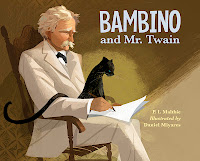 And while he waited for Bambino's return, Twain became the target of what amounted to something of a flash mob event. Fans young and old brought their cats and kittens to their favorite author to comfort him until Bambino's return. Now Mark Twain was willing to meet the world and thank his admirers for their concern. And when Bambino did return home, there was a change in Mark Twain. He would soon adopt the white "summer suit" as his signature attire and return to his public platform.
Did Bambino's mysterious disappearance and re-appearance really cause Mark Twain to re-connect with his public? I would like to think so. The good wishes of so many of his admirers had to lift his depression enough so he could return to the world again.
If animals could speak the dog would be a a blundering outspoken fellow, but the cat would have the rare grace of never saying a word too much." - Mark Twain
In 2002the Maine Humanities Council, through their New Mainers Book Project, commissioned me to create a picture book about a Cambodian American family.
The task was a daunting one. "Who am I to undertake this," I wrote in my journal at the beginning of the process, "to presume the ability to know, to understand, to represent?" I knew that I couldn't create such a story myself, but I thought that if I immersed myself in the experience of Cambodian Americans and listened long enough, perhaps a story might come throughme.
I read stacks of books detailing the Cambodian experience, nearly all survivor accounts. I learned from a specialist in torture and genocide about how trauma is repressed yet lodges as "shards of memory," evident in "a silence, a gap, an absence," and how that memory is often retrieved by the third generation. I looked at Cambodian art, listened to Khmer music, watched Cambodian dance.
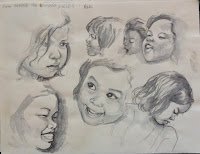 |
| Sketches of Dara from A Path of Stars |
And finally, I sat in the living room of my friends Veasna and Peng Kem as they graciously shared their own memories. They talked of their beautiful homeland, of the roses and hibiscus, the coconuts and mango trees, of favorite recipes and games, of family star-watching and the star stories elders would share.
Veasna remembered her own escape from the war, lost in a bamboo forest, fearing wolves and other wild animals, saying to herself, "I'm going to die here." She recalled praying to Buddha and to her ancestors for help. "Your parents are the ones you respect the most," she told me, "the ones who gave birth to you and took care of you since you were 'red' (a baby). They mean more to you, more than the big ocean. The spirit of my parents protected me."
Having gathering all of this, I waited. And waited some more. And finally one day, an image came, of a girl in a garden picking a tomato and a single yellow rose.
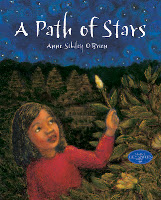 Ten years later, A Path of Stars(Charlesbridge) has just been released. In words and oil paintings, it tells the story of young Dara and her beloved grandmother, Lok Yeay, who escaped from Cambodia with the only two survivors of her family, one of whom would grow up to be Dara’s mother. Lok Yeay passes on to her granddaughter stories of the beauty of Cambodia and her survival and flight from her homeland, but when a loss triggers her traumatic history, Dara must use what she’s been given to help her grandmother heal. To my knowledge, it’s the only available fiction picture book about the Cambodian American experience.
The book's release has created wonderful chances to connect with Maine's Cambodian community, which numbers about 2000, including Portland's Cambodian Dance Troupe. Taught by a classical dance performer trained in Phnom Penh, the troupe includes sixteen girls, ages 4 to 20. Some are 2nd-generation Cambodian Americans whose parents escaped the Khmer Rouge; others were born in Cambodia and adopted by American families.
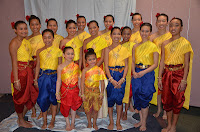 |
| Portland's Cambodian Dance Troupe |
When I met with the girls in February, one of the ideas that struck me is that their identity is a relatively new one. Communities of Cambodian Americans, such as ours here in Maine, began taking root in the U.S. in the late 1970's. The oldest American-born Cambodians--in any significant numbers--are in their 30s. What it means to be Cambodian American is being defined now, in all its variety, by these young people, creating a brand-new, unique piece of the American mosaic. I look forward to the day when books about the Cambodian-American experience will be written and illustrated by the people who are living that story.
The book is also creating opportunities to connect the wider community to their Cambodian neighbors. In April I shared A Path of Stars with 3rd-5th graders in Westbrook, Maine, and Framingham, Massachusetts. The students then created Happy New Year cards with a drawing of a lotus and greeting in Khmer, which were mailed to local Cambodian temples.
 |
| Happy New Year cards |
This spring I'm helping to develop a project, "New Neighbors," to promote reading projects with children's books like A Path of Stars. Such books can spark conversations in which differences of language and culture, race and religion, can be explored through the lens of what we have in common--grandparents, family stories, immigrant journeys, special foods, love of the natural world. The "I'm Your Neighbor" website, currently under construction, will contain a list of recommended books and an evolving list of engagement materials for educators, librarians, and community organizations who seek to build bridges. (Sign up at www.ImYourNeighborBooks.org to receive email notification of the project launch.)
Anne Sibley O’Brien (AnneSibleyOBrien.com) has illustrated thirty-one books for children, fourteen of which she also wrote. The Legend of Hong Kil Dong: The Robin Hood of Korea won the Aesop Award, the Asian/Pacific American Award for Literature, and was named to Booklist’s “Top 10 Graphic Novels for Youth.” After Gandhi: One Hundred Years of Nonviolent Resistance, which she co-wrote with her son, Perry O’Brien, won the Maine Literary Book Award and was named an IRA Teacher’s Choice. She blogs about race, culture and children’s books at “Coloring Between the Lines” (www.coloringbetween.blogspot.com).
April is Poetry Month! Two renowned authors, Jane Yolen and J. Patrick Lewis (current Children's Poet Laureate), teamed up to celebrate poetry by interviewing each other about their experiences as poets. Even better, they've done it in rhyme...
Jane Yolen:So you say you're a poet,
So how do we know it?
Do you wear special clothes when you rhyme?
So, like how do you show it?
Do you go with the flow? It
can't mean that you rhyme
all the time.
J. Patrick Lewis:I rhyme for a nickle, I rhyme for a dime,
A penny, a quarter--it's strange.
I rhyme when I go to the grocery store.
I rhyme when I'm looking for change.
But I won't if I don't really feel like rhyming.
Sometimes words like playing around
On the horn in my mind or the drum on the page.
I sit back enjoying the . . . noise.
Jane:As for me, I've been rhyming before I could talk,
with a goo . . . and a gaa . . . and a waa.
I rhymed for my daddy, my uncles and aunts,
and especially rhymed for my Ma.
I began with real verse in rhymed couplets for school
when I was in first grade, I'm told.
(Though I must admit that I'm growing a bit,
Getting better as I have grown old.)
I did a long poem, all in rhyme, at thirteen,
an assignment about New York State.
A great rhyme for Otis, who made elevators,
and I did not turn it in late.
I won a Scholastic award for my verse
and the poetry prizes in college.
I sold my first poem to a real publication
before I'd amassed enough knowledge.
So--over to Pat, catch us up with your verse.
Do you think you're now better or now getting worse?
(To keep rhyming this way can be seen as a curse
Or a-musing.)
Pat:How can you write sonnets or epics if, Lordie,
You don't meet Ms. Prosody till you turn forty?!
Where was she hiding? My Pied Piper teacher
In third grade? In eighth grade? Dark mystical creature
To juggle me the noun and swivel me the verb,
To give me a special hat, Do Not Disturb:
The Boy in the Corner May Turn Out To Be
A Man of Outlandish Whimsicality.
Nowhere, I tell you, my wee muse had flown,
So I had to stumble ahead on my own.
My ear is improving, I'm glad to report.
I'm learning by doing this indoor sport.
Who knows? If I practice both day and night,
By flashlight and candle, I may get it right.
Both:So the word from the experts, is just keep on moving.
The more that you do it, the more you're improving.
And whether you've rhymed from your childhood or dotage,
If you work at your poems, then you're sure to get quot-age.

Stay tuned for the upcoming release of Jane and Pat's next poetry collaboration,
Last Laughs: Animal Epitaphs, due out July 2012.
View Next 25 Posts


 As a young reader, my tastes often tended toward the macabre, fantastical, and horrifying—I probably started reading Stephen King before I should have. Books were an opportunity to keep myself up at night—even after the lights were off and the books were closed, I’d lay in bed awake, my mind replaying over and over a slideshow of the startling images I’d just absorbed. Though I was also a sucker for classics like Charlotte’s Web, The Outsiders, and Mrs. Brisby and the Rats of NIMH, it was always the scary stories that I tore through the quickest. And the scariest stories, to me, were always the ones that seemed the most real. Or the ones that were, in fact, based on real events. For me, a terrifying event—an out-of-control factory fire, an earthquake hitting a city, a terrorist attack—inherently contained more horror than any fictional story featuring vampires, zombies, haunted houses, or masked madmen with a knife ever could.
 I was particularly gratified to be able to write about the Sisters of Charity orphanage, which sat just a little ways from the beach. The story of the child survivors is truly astounding, and City of the Dead represents the first time their accounts have been dramatized in an historical novel.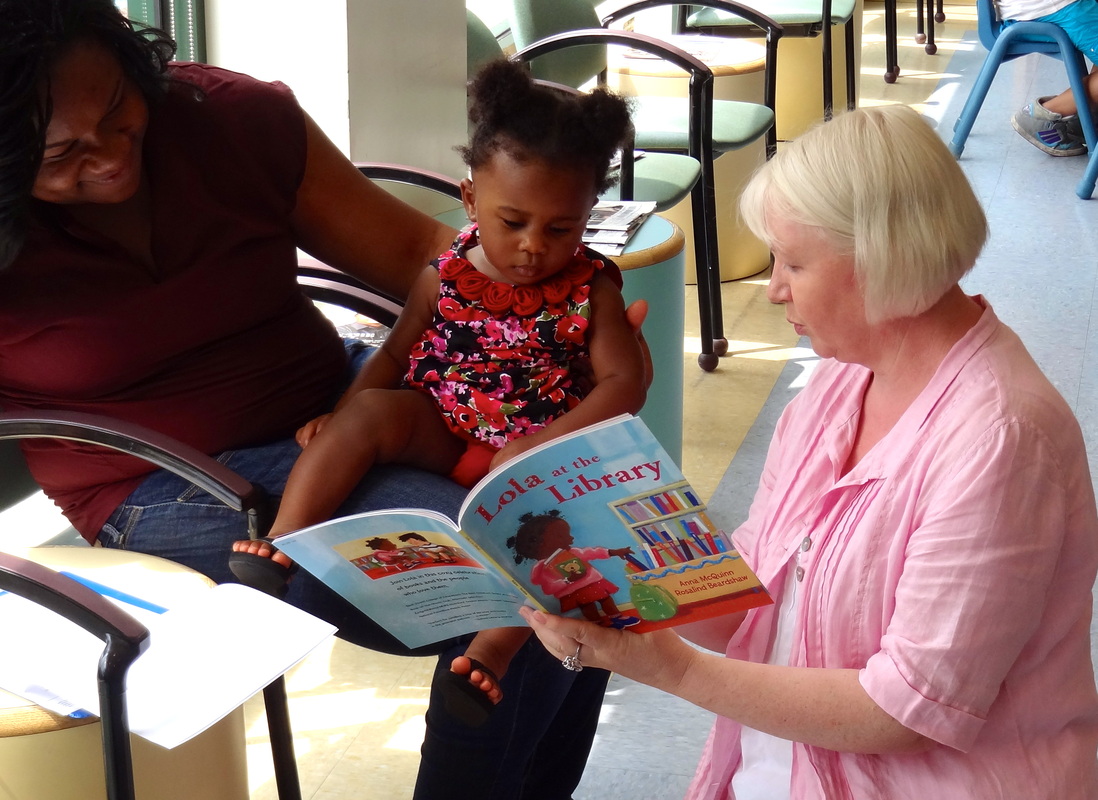


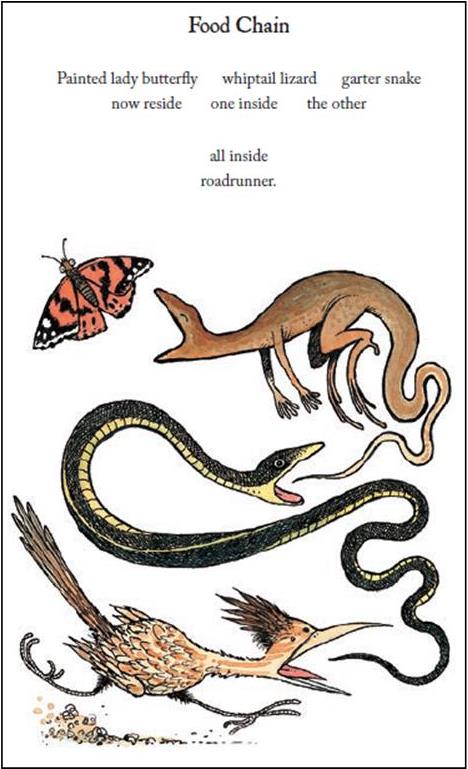


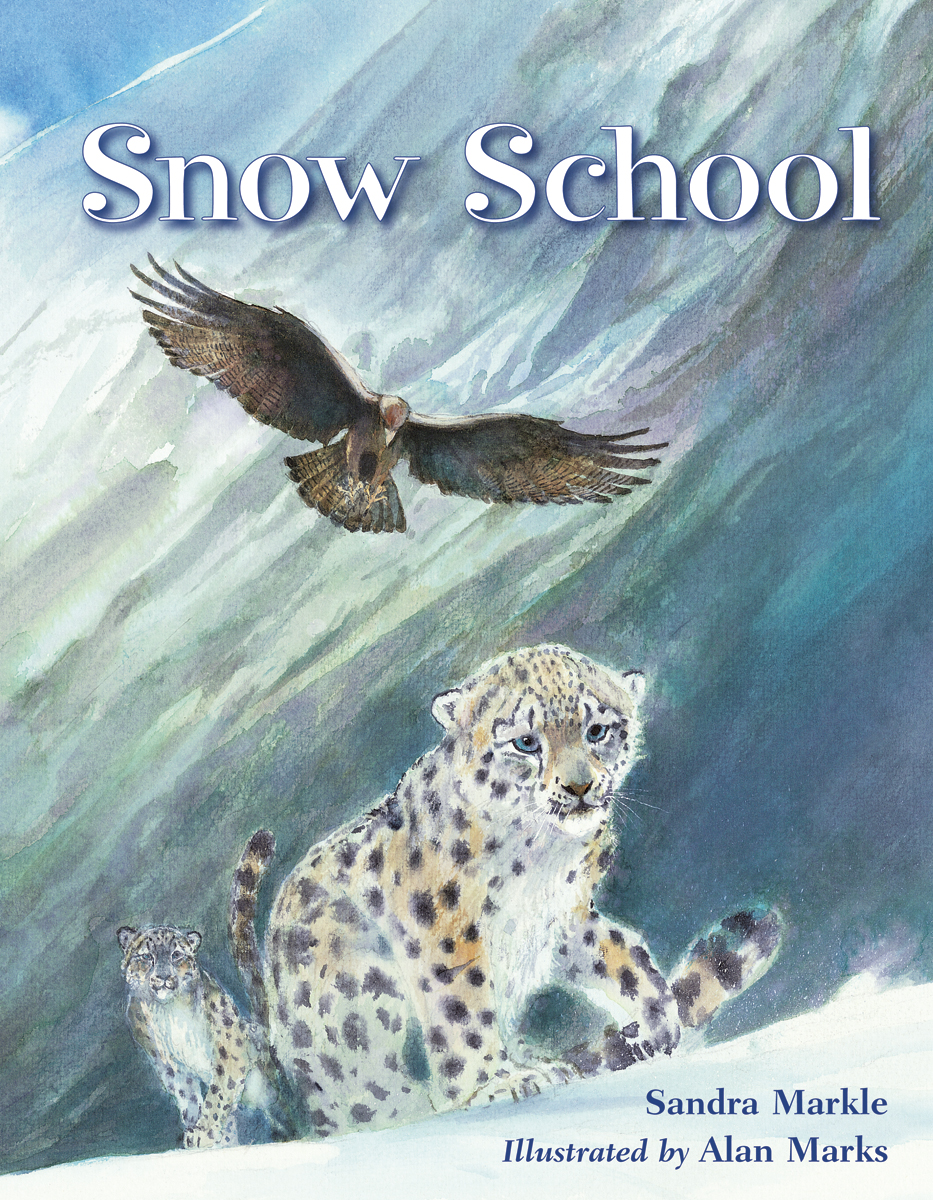


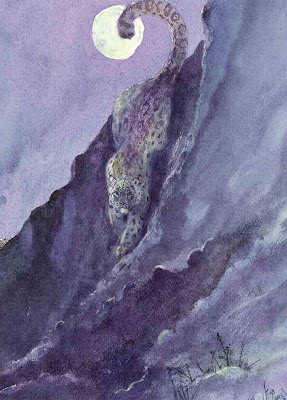







Great story Suzanne! Both how you researched the book and the story. There are no better stories than those that are part of history!
Sounds like a great book, Suzanne! Hooray for goosebumps and the places they take us.
What a fascinating story!!! I wrote a children's book. How do I get someone to illustrate it? Where can I send it for submission?
Email me at : [email protected]