new posts in all blogs
Viewing Blog: Fresh Eyes: A Bookseller's Journal, Most Recent at Top
Results 1 - 25 of 316

Envisioning New Bridges Between Authors & Readers
Statistics for Fresh Eyes: A Bookseller's Journal
Number of Readers that added this blog to their MyJacketFlap: 2
Where are you spending your summer vacation? For David Enyeart of Common Good Books, St. Paul, Minn., this year's destination is directly connected to his choice of "mountain read."
 |
David Enyeart's summer reading getaway spot in Montana.
|
"I am eagerly anticipating a galley of All the Wrong Places: A Life Lost and Found by Philip Connors," he said. "I'll be reading it on vacation in a decommissioned fire lookout in the mountains of Montana, and I'm going there in large part because I read and loved Connors's previous book, Fire Season: Field Notes from a Wilderness Lookout. That first book tells of his time honing his writing craft while working as a firespotter in New Mexico. In his new memoir, Connors looks back a bit farther, to the period when he'd lost his way in the wake of his brother's suicide at 22 and was struggling (and failing) to connect with people, work and his new home."
It's hard to top a decommissioned fire lookout in the mountains of Montana as a reading venue, so let's backtrack momentarily to where we left off last week and share three personal favorites from Emily Crowe of the Odyssey Bookshop, South Hadley, Mass., beginning with The Hawley Book of the Dead by Chrysler Szarlan.
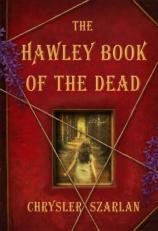 "Full disclosure: this book is the debut novel from my co-worker," Crowe admitted. "But even if I didn't work with Chrysler, I would have thought that The Hawley Book of the Dead was fun from start to finish. Filled with 'real magicalism,' including a mysterious falconer, a prognosticating length of twine, and names brimming with double entendre, this debut novel is an uncanny blend of The Night Circus meets The Crucible.
"David Mitchell's The Bone Clocks was like nothing I've ever read before. I'm told that if you loved Cloud Atlas, then there's an excellent chance that you'll love this one, too, so now it's time for me to read some David Mitchell backlist. The character of Holly Sykes is one of the great females of 21st-century literature so far. I don't read very much short fiction, as I prefer to really sink my teeth into a book and get absorbed by its world. However, if all short stories were as good as Eric-Emmanuel Schmitt's Invisible Loves, I would have to change my reading habits. These stories are exquisite, elegant, and enchanting--perfect little gems of literature that are full of philosophy and quiet moments of epiphany."
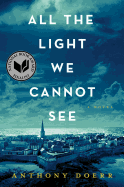 Two booksellers praised Anthony Doerr's All the Light We Cannot See. Sarah Pishko of Prince Books, Norfolk, Va., said the author's "writing is beautiful and very evocative about a girl amidst the backdrop of World War II." And Lynne Reed of Misty Valley Books, Chester, Vt., called it a "lyrical story of how war affects two young people from opposing sides."
"Why would you choose light reading, when your vacation is the only time you have to really get into a wonderful book?' Reed asked. "I'm always looking for that one (or two) book that is different." Her other selection was I'm Having So Much Fun Here Without You by Courtney Maum, a "love story in reverse between a British artist husband who tries to woo back his wonderful French lawyer wife (and their child) after an affair. It could be a trite book but it's not, and I couldn't put it down, wondering if he'd get her back... you'll root for both of them! A great summer read."
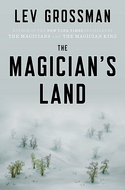 Matt Norcross of McLean & Eakin Bookstore, Petoskey, Mich., said his "great escape this summer has been Lev Grossman's The Magician's Land. It's not fair, you see; I've been pre-wired to love this series. At age eight, I was given the complete Chronicles of Narnia on tape and literally wore out the cassettes that gave me the adventures of Peter, Susan, Edmund and Lucy. Lev's series has brilliantly brought back the wonder I felt on those late nights listening to Lewis, but this story is definitely not for little boys and girls. Like the previous two novels, The Magician's Land packs enough twists, turns and surprises to fill several books, but it's greatest feat lies in how the story is brought to an end. This is one of the most satisfying ends to a series I have ever read, and although that in and of itself is deserving of high praise, the fact that it can make you feel the excitement and wonder of childhood makes it truly magical. Happy late nights!"
The final words this week go to Matt's wife, Jessilynn. In McLean & Eakin's e-newsletter, she observed that "it's been more of a 'reading day summer' than a 'beach day summer,' but we are confident that more beach days are on the way in August.... June and July flew by so quickly, that it almost feels like they were both a week shorter this year! Everything has been so fast and furious that we are worried there hasn't been enough focus on fun, relaxing, and lightening up for the summer. Here's to a lazy August, full of beach days, beach reads, and most of all s.l.o.w.i.n.g. down and relaxing in the sun." --Published by Shelf Awareness, issue #2310.
Hey booksellers! What are you reading on your vacation this summer? In response to last week's Brief History of Beach Reads column, Ellen Stimson, author of Mud Season and the upcoming Good Grief! (Countryman Press, October), suggested: "Now we need a wrap-up of our actual private summer reading. What do booksellers read on the beach?"
So... I asked.
"Every July I drag out my favorite bookish T-shirt with the New Yorker cartoon of a law officer addressing a man reading in a beach chair: 'I'm sorry sir, but Dostoyevsky is not considered summer reading. I'll have to ask you to come with me,' " said Cheryl Krocker McKeon of Book Passage, San Francisco, Calif.
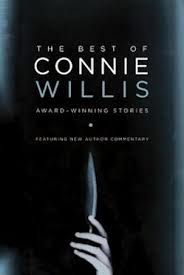 "As a bookseller I often deprive myself of popular titles because these books don't 'need' me, so this summer I think I'll read Gone Girl and Unbroken," she added. "And for sheer fun I'll bring The Best of Connie Willis, because the stories are surprising and thought-provoking, funny and profound, and include the author's afterword to each story, so it's like a bonus of having her as a travel companion! Oh, and Travels with Charley, finally; since I won't see the whole USA I can enjoy 1960 America with Steinbeck and his poodle. I think I am going to run out of vacation hours."
Noting that "a 'beach vacation' sounds nice, but I'm going to be more on the 'days off' end of the spectrum this year," Jeff McCord of Bound to Be Read Books, Atlanta, Ga., said his "vacation is being lived vicariously through the wonderful stories our customers tell me about their vacations (including trips to London, Germany, Sweden, a month-long driving tour of New England, etc.... awesome!).
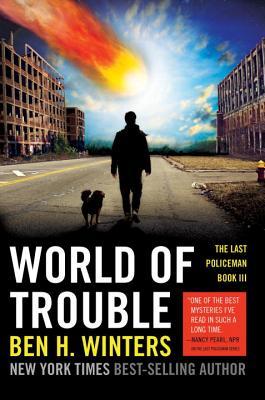 "I waited to start the Last Policeman trilogy by Ben Winters until the third book was about to be released July 15, and it has been a great summer read. I started last month with The Last Policeman, a murder mystery set in pre-apocalyptic New Hampshire. I'm finished now with book two, Countdown City, and was waiting on my staff to finish the ARC of the third book, World of Trouble, but since it was released last week, I have my own copy now--as do several of our customers who have also jumped on board. It's a great series, with an Edgar Award to recommend it as well. Can't wait to finish it!"
 Anne Holman of the King's English Bookshop, Salt Lake City, Utah, observed that "summer is my time to catch up on the books that all the other booksellers loved and I, somehow, just didn't get to for whatever reason. So my stack for that 'project' includes Atonement, The Shadow of the Wind, A Visit from the Goon Squad and Olive Kitteridge. I don't often read anything twice; too many books, too little time. But The Rosie Project just makes me happy. Open it to any page and read a paragraph and you will laugh out loud, I guarantee. It's not deep; there are no hidden messages to decipher and discuss endlessly. It's simply an invitation to inhabit someone else's life (Don Tillman) who is so different from me and yet not, that it gives me great hope for the human race (and also cocktails)."
Planning for an upcoming vacation, Connie Brooks of Battenkill Books, Cambridge, N.Y., said her "new book" will be The Book of Life by Deborah Harkness: "Anyone who has been reading this wonderful trilogy knows that the third book is highly anticipated. I have two customers--a mother and a daughter--they bought one copy of The Book of Life--and they are both trying to read it at the same time--they keep stealing it back from one another. The Book of Life is my kind of beach read--a large tome that will utterly transport me out of myself!
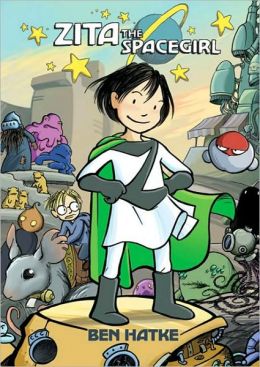 "I will also be reading The Shadow of the Wind. This is our Book Club pick for next month, and while it might not fit the classic 'beach read' definition, it is summer reading perfection. Dark, atmospheric, scary and erotic--what better for when you actually have time to completely give yourself over to a novel. And, finally, since I have a six-year-old, we have another trilogy ahead of us this summer: the graphic novels Zita the Spacegirl, Legends of Zita the Spacegirl and The Return of Zita the Spacegirl by Ben Hatke. I will also be adding in The Outermost House by Henry Beston. Now in a 75th-anniversary edition, this is considered a classic nature book, and since we will be in Cape Cod soon, it is perfect."
Emily Crowe of the Odyssey Bookshop, South Hadley, Mass., just returned from her two-week beach vacation "where I spent a lot of time reading. In fact, I spend almost as much time planning my vacation reading as I do planning the vacation. I 'test drive' the first 50 pages to make sure the book is worthy of inclusion in my suitcase. My husband and I take about a dozen physical books between us and I also load up my e-reader with e-galleys. My beach reading reflects my general reading; it's just more concentrated. I was lucky this trip; everything was good, but some of it was outstanding."
More about Emily's favorite vacation reads coming in next week's column, along with warm weather contributions from several other booksellers. As always, you are more than welcome to join the conversation if you'd like to divulge your private beach reads for 2014. --Published by Shelf Awareness, issue #2304.
First, sincere congratulations to CNN as the 2014 award winner (in a very competitive field) for most egregious use of a summer reading pun: "Whatever your definition of 'beach book'--romance, mystery, gripping true-life-tale--you'll find a shore thing here."
As I dutifully pored over all the summer reads recommendation lists released during the past couple of months, I began having sun-addled visions of beach reads from the distant past (sometimes called "hammock reads," I soon learned). After some seasonally appropriate leisurely research in the archives of the New York Times, I now offer for your summer reading pleasure an ever-so-brief history of the American beach read:
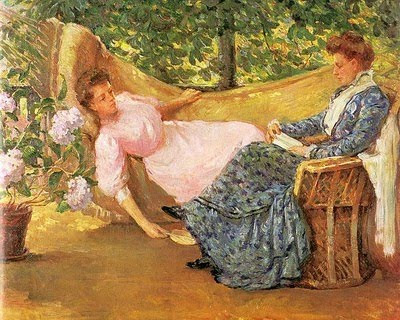 1890s: "During the Summer days a table was placed in the doorway and here were displayed a selection of the paper-covered books for 'Summer reading.' For some reason lighter books were considered more suitable to the hot weather."
1897: "The reader of to-day whose knowledge of books goes back twenty years must often have been surprised with the change that has come over books intended for Summer reading.... Society and civilization may take hope from the improved quality of the Summer books.... It truly seems as if all the world were writing novels. With bad ones plentiful enough, how good the best ones are!"
1900: "But if there is one season in which the printed book might be regarded as a questionable intruder it is when the pageant of Summer has attained its full splendor and the most attractive pages of the great book of nature lie open before us.... When he would for a brief period escape the spell of the printed page, break its chain, and rise to a rarer atmosphere, lo, the whole world seems leagued against him, and from a hundred throats he hears the cry, 'Books for Summer Reading!' "
1907: "What I'm trying to discover is whether any one reads in Summer, or whether the bulk of vacation literature is really an unopened contingent.... It isn't necessary to read a book in order to be happy with it. On a steamer or in a hammock you simply have to have the book in your lap or close at hand, with the paper-cutter and pencil."
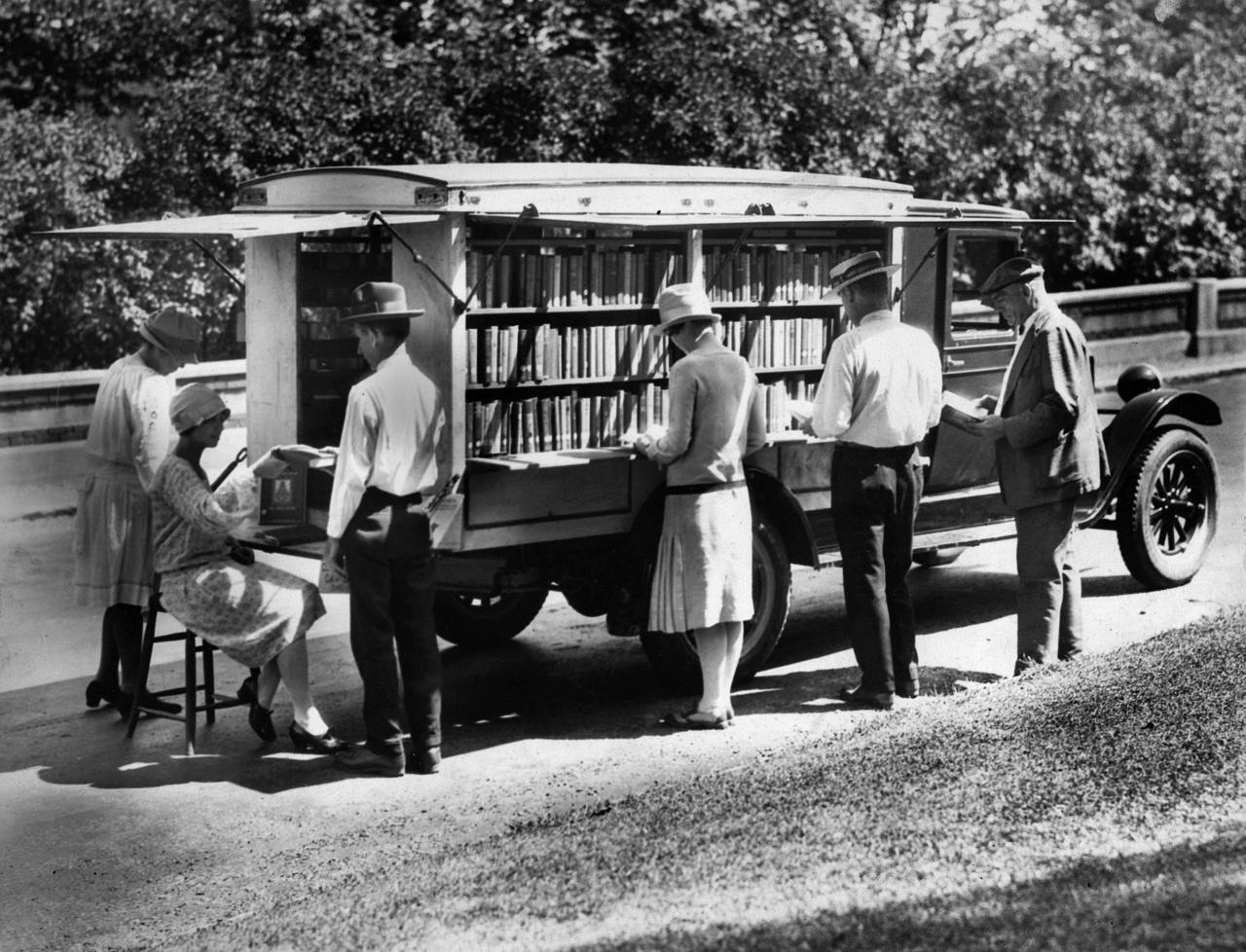 |
| Cincinnati Public Library bookmobile, 1927 |
1920: "It made us wonder just how Summer Reading has progressed in a world where excitement has been the rule and where nothing has remained as it was.... Gone are the days when the unambitious reader would lie in the grass in a semi-coma and meander blankly through a volume of trashy lovemaking and trashier thrillers."
1928: "What do people read in the summer?... They read, in other words, whatever the tastes and piety of earlier generations of Summer residents have stored for them on the hotel shelves."
1950: "There is, however, one error which is disastrously popular--namely, the assumption that only 'light' books, by which is meant trivial or foolish or badly written books--are suitable for summer. Nothing is actually harder to read than that which is not worth reading, and there is nothing more likely to produce boredom than a too desperate attempt to escape it."
1953: "When an unwished beach picnic is suggested, for example, the necessity of reading a light romantic novel will not stand up as an excuse for not attending. On the other hand, the casual display of the somewhat weightier book will prove at once that even on vacation the thirst for knowledge rises superior to such casual pleasures as picnics."
1968: "There is nothing like the library of a summer house to reverse the tides of literary improvement.... It is wonderful junk--never weeded out, like other junk, because summer people just can't throw any book away, however transient its subject or purple its prose." (William Zinsser)
1971: "The reviewers must have reasoned that as we, book lovers all, packed to head off for vacation, we agonized about how to pack our limited baggage space with the most rewarding material available. Hence 'suggestions for summer reading.' " (Russell Baker)
1985: "A feeling seems to have arisen that summer is the time for light reading. I don't know where anyone got that idea. The truth about summer is this. There are an enormous number of hours in it--slow hours--and yet, before you know it, somehow it is over.... Summer is the time for heavy reading, reading that works up a sweat. I wouldn't be surprised if there were scientific studies showing that the sun's heat melts eye-glaze." (Roy Blount, Jr.)
 2014: "For me, being a reader, in summer or at any other time, isn't a 'lifestyle choice.' Rather, I made the choice--if that's what it was--so long ago, it has taken on an inescapable character in my mind.... The beach is one of the few places pathological readers can pass undetected among their civilian cousins." (Zadie Smith in O, The Oprah Magazine)
And, finally, these history-transcending words of summer reading perspective from George R.R. Martin: "Winter is coming." --Published by Shelf Awareness, issue #2299.
Last month, I asked if you'd ever wondered how someone completely outside the book trade might envision the shape of bookstores to come, a question prompted by the Economist's "Reinvent the Bookshop" challenge to four leading architecture and design firms.
 I was particularly intrigued by feedback I received from relatively new booksellers, whose task is as much invention as reinvention. Karen Bakshoian of Letterpress Books, Portland, Maine, which opened last fall, did not mince words: "I truly despise this idea.... 'They' are removing all the personal interaction between bookseller and customer, taking away the joy of sharing wonderful titles, and all of the fun as well. I have been a bookseller for a whole eight months now, but the best task of each day is working with my customers. They quickly become regulars. They tell their friends and family members what a super bookstore is now right in their neighborhood. They share the books with their friends. They join the book club. Isn't that cool?"
As someone who regularly interacts with new and prospective booksellers on design issues through the Bookstore Training and Consulting Group of Paz & Associates, Donna Paz Kaufman has a vested, as well as personal, interest in the topic of bookstore reinvention. In the comments section for the Economist's article, she had written: "As a designer of bookstores in the U.S. and in various places around the globe for 22 years, it seems to me that the architects miss one important point: people come to bookstores because they want a break from technology. A curated selection, beautiful displays that cater to the reading lifestyle, a comfortable setting, friendly staff, and a business that recirculates its profits in the local community matter. If people want technology, they tap those resources at home or on the road. The bookstore is a comfortable, peaceful escape from a fast-paced life."
I asked her to expand on this observation. "I was so curious about the article and was so disappointed when I finished it," she said. "Seemed they went over the edge when it came to modern design and technology. In another life, I think I was or still want to be an urban planner because the whole idea of how we live speaks so much about whom we are, what we seek, and what brings us contentment and comfort. Looking at bookstores today, I think we need more that is authentic and human to balance out the number of screens and machines in our lives."
 She cited Melissa DeMotte's vision for her new bookshop, the Well~Read Moose in Coeur D'Alene, Idaho, as an example: "Her store is all about human connection.... cafe with indie coffee roaster and Northwest regional wines, a seating area specifically designed as a quiet nook for book groups, Melissa's mother's rocking chair she used when Melissa and her sister were babies, and a play area for kids. We're excited about Melissa and her store since she came from the corporate world and is so full of life and love. She symbolizes all that we love about the people drawn to this business and we still need way more of them to fill in all of the gaps around the country without bookstores."
 |
| DeMotte |
DeMotte, who told me she considered some of the "Reinvent the Bookshop" ideas to be "quite creative," has received a lot of positive feedback regarding the layout in the Well~Read Moose's 2,700 square feet. "People say they like the flow and that they can 'find new things around every corner,' " she said. "We did quite a bit of research on the local demographics. After Borders closed, we didn't have a bookstore with all new books. This just seemed 'wrong' for a wonderful community like Coeur d'Alene. Our vision was to create a warm and inviting space to browse, meet friends and try new things--a new book/author/genre, a new brewed coffee, a new wine, etc. We will host our own book clubs as well as reserve spaces for outside clubs to meet. We have a nice seating area for up to 10 people to gather comfortably, sip some wine and chat about their books. We have had many, many people thank us for opening. They are happy to have an indie bookstore and vow to support it. What more could I ask for?"
 Non-booksellers also weighed in on the bookshop reinvention issue. Maureen Mills, who worked in small press/academic publishing for more than 30 years, praised her local booksellers, Mary Adams and Janice Holmes of the Annapolis Bookstore, Annapolis, Md.: "I know you hear this over and over--but it is a truly special place run by two very special ladies."
Mills stressed the importance of interconnection over reinvention: "Extend the connection between bookshop and customer to online in a way customers can connect from home, not just to a Web page to order books, but to be able to browse the store, as if you were there (yes, I'm being daring here)."
She also wished there was a better way to "grab and extend the idea of online webinars/seminars/courses, with synchronous book readings connecting groups at bookstores across the country. I'm especially fond of this idea because I can see these functioning in a way that helps people understand the many unique 'hometown' cultures that exist across the country. All this maintained by and promoted through the special personal touch of an independent bookstore. There's a nice challenge."
And challenges, as we know, are nothing new for indie booksellers. --Published by Shelf Awareness, issue #2294.
'Having a great time! Wish you were here!" That's the summer postcard I would have sent out last week from the "All About the Books" event held in the Henry A. Wallace Center at the FDR Library and Home, Hyde Park, N.Y. The New England Independent Booksellers Association and New Atlantic Independent Booksellers Association teamed up to host the gathering, with Bookazine underwriting, as it has since All About the Books launched in 2009.
"Hyde Park was an experiment in including NAIBA members and more New York-based authors and I'm glad we did it," said NEIBA executive director Steve Fischer. "As we have done all along, we try to create a balance of fiction and nonfiction, male, female, large publishers and smaller, indie publishers, two children's book authors--one picture book and one YA. Somehow it all works. It isn't anything you can make happen, but when it does it's an amazing two hours."
Mary Beth Thomas, v-p of sales at HarperCollins, agreed: "This is the second event I've gone to and I just see them as a great opportunity to hear from a variety of authors, most of whom I'm not that familiar with, and to learn about their upcoming books. They each have their own way of handling a 5-10 minute presentation, but all the ones I've heard have been funny, or inspiring or scary, or in some cases all three! It's a great way to generate enthusiasm among the booksellers in a more intimate setting than the regional and national shows. Also a great opportunity to connect with booksellers. The venue was lovely as well."
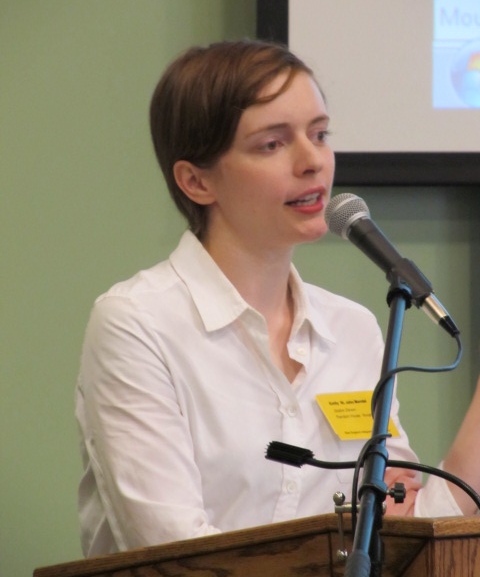 |
| Mandel |
The morning program featured authors Peter Ackerman (The Lonely Typewriter, David R. Godine), Emily St. John Mandel (Station Eleven, Knopf), Justin Martin (Rebel Souls, Da Capo), Cammie McGovern (Say What You Will, HarperCollins Children's), Brian Morton (Florence Gordon, Houghton Mifflin Harcourt), Brent Ridge & Josh Kilmer-Purcell (The Beekman 1802 Heirloom Vegetable Cookbook, Rodale), Bill Roorbach (The Remedy for Love, Algonquin), Joanna Scott (De Potter's Grand Tour, FSG), Gail Sheehy (Daring: My Passages, Morrow) and Annie Weatherwax (All We Had, Scribner).
The time limit sparked entertaining, concentrated storytelling, with the writers talking about their new books and expressing a little indie bookseller love. For example: "First, I want to thank all of you," said Mandel, noting that her first three novels had been Indie Next picks. Morton observed: "I want to take a moment to talk about what you do.... It's been so inspiring over the years to see indie bookstores not only survive but thrive." Citing the critical importance of locavore and shop local movements to their world, cookbook authors Ridge and Kilmer-Purcell said they are "always so encouraged when we go to your bookstores because we see that that's what is making you successful also." And Scott noted: "You keep the blood flowing in our literary culture."
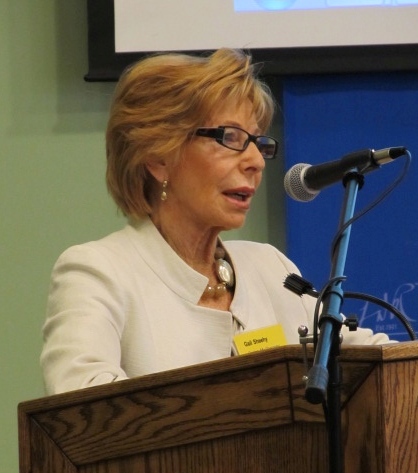 |
| Sheehy |
Perhaps the loudest applause was for Sheehy, who said she was "thrilled to be here today as a foot soldier in the war of independence against Amazon."
The afternoon education session, "Increasing Sales on Your Website," featured NEIBA president Suzanna Hermans, co-owner Oblong Books & Music stores in Millerton and Rhinebeck, N.Y.; Andrew Getman of Politics & Prose Bookstore, Washington, D.C.; and Neil Strandberg of the American Booksellers Association.
With the surge of social media options, store websites have sometimes taken a back seat, but, Strandberg said, "You need an online presence and I think a homepage is still a useful thing to have. That you cannot be found digitally just does not make sense anymore."
"You have some concept of who you are as a personality, so your website has to represent the story you're telling," Getman observed. Displaying a bookshop site that was highlight its Amazon/Hachette-themed display, he said: "She has this fabulous display, but what's wrong with this picture is you can't click it. You can't buy locally.... Make it a destination people don't get flustered by."
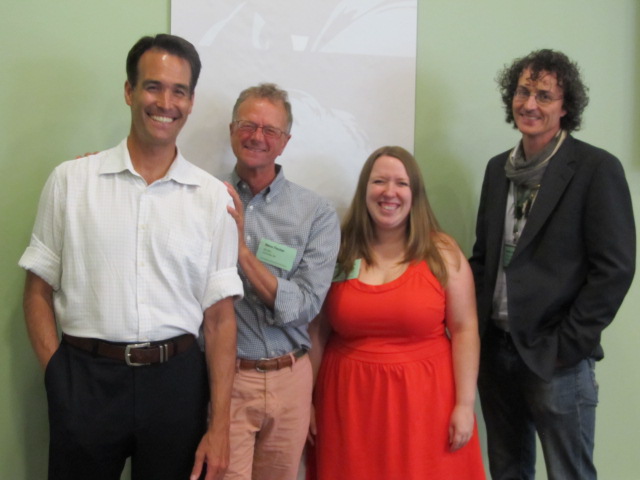 |
Neil Strandberg, Steve Fischer, Suzanna Hermans & Andrew Getman
|
Hermans discussed Oblong's "custom content" on its website, including autographed books and the Oblong Insider subscription service for YA titles: "We make sure we have a pre-order link on our website a month before an event," which also allows visiting authors to link to it in advance. "Custom content is really important to me," she added. "That's where the money is.... It's a little bit of a time suck, but it's worth it."
"Are there genres or types of books you are less competitive with?" asked Strandberg, suggesting bookstore websites "present things you won't find on the Amazon homepage. If you've got something that's unique to you, you're more likely to generate sales that a large retailer wouldn't."
Some of the advice was basic, yet often overlooked: Place all social media links at the top of the homepage and use "buy buttons" rather than click-throughs for featured titles. "You don't have to put everything on the website," Getman cautioned, adding that social media platforms are ideal places to showcase event photos and other "ephemerals" that might draw visitors back to the online store.
And then it was over, this very good day for books.
"It was wonderful to host both NEIBA and NAIBA groups in the Hudson Valley," said Hermans. "As a store that spans both territories, it was great to get everyone together in the same room to share ideas. I hope we can collaborate again in the future." --Published by Shelf Awareness, issue #2289.
Outside perspective can be intriguing, if only to spark further conversation. In his 1888 novel Looking Backward, this is what Edward Bellamy imagined retail stores would look like in the year 2000: "All our stores are sample stores, except as to a few classes of articles. The goods, with these exceptions, are all at the great central warehouse of the city, to which they are shipped directly from the producers. We order from the sample and the printed statement of texture, make, and qualities. The orders are sent to the warehouse, and the goods distributed from there."
Last December, in a piece headlined "Are You Ready for the Store of the Future?" Mark Startup of the Retail Council of Canada's MyStore division told Profit magazine: "It's taking large retailers a long time to figure out all this technology. Independents can change the store environment almost on a dime."
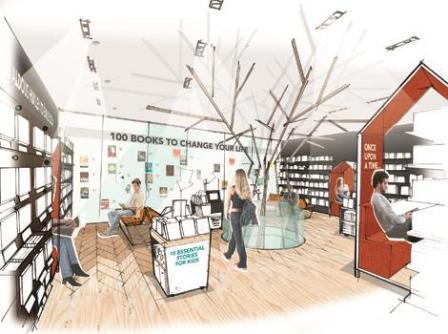 Have you ever wondered how someone completely outside the book trade might envision the shape of bookstores to come? The recent media blitz regarding Foyles' shiny new flagship "Bookshop of the Future" in London inspired Intelligent Life, the Economist's culture magazine, to challenge four leading architecture and design practices to "Reinvent the Bookshop."
Gensler, 20.20, Burdifilek and Coffey Architects were each given the same brief: working with a £100,000 (US$169,836) budget, design "a general-interest bookshop, selling fiction, nonfiction and e-books, in store and online, on a typical European high-street site, with two floors of 1,000 square feet each." Check out the full article for complete details, but here's just a sampling from their designs:
tl;dr (short for "too long; didn't read"): At Gensler's bookshop, "you don't have to enter the store to shop from it: the glass facade is a touchscreen that can be tapped on to download e-books from QR codes," Intelligent Life reported. A vending wall swings onto the pavement, offering a changing selection of paperbacks. To save floorspace, there is no checkout counter; payments can be taken instantly by booksellers with a card reader. Gensler's Owain Roberts said they did not focus on fixtures and fittings, which he called "incidental to the activities taking place," because the retail model is changing so fast that "the days when a fit-out would last five years are long gone."
The Art of Storytelling: Jon Lee, 20.20's creative director, agreed: "People won't go into a shop because the ceiling's beautiful. They'll go in because the experience is relevant to their lifestyle. It's what you do in a space that's really important." This "reinvented bookshop" has a café "with a twist: a Yo! Sushi-style conveyor belt delivering short reads and reviews to consume with your coffee" to act as a draw to the back of the shop, Intelligent Life wrote. Mobile "mid-floor units" carry screens to advertise events, as well as books that fit a frequently changed theme. A staircase and tree lure patrons upstairs. All books are displayed face-out, with just one title on the front of a drawer and the rest of the author's work inside.
ILB (Intelligent Life Books): "If you just concentrate on books, you're rolling the dice," said Burdifilek's creative director Diego Burdi. ILB "is more of a gallery, showcasing particular books alongside related merchandise.... It's like a concierge service: everything in one place. My frustration [at the moment] is that I buy the book, then I have to go to another store to buy the product. It's a luxury to see and touch the product. That's what the Internet doesn't give you." ILB incorporates a glass roof to highlight the selling space upstairs as well as entice customers to the downstairs. A digital kinetic screen on the back wall spans both levels, lighting up at night like a movie screen.
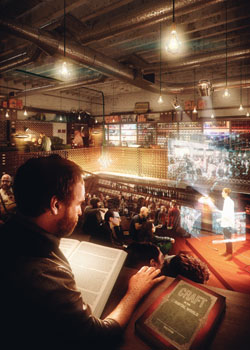 Craftword: "Can you save the bookshop? Is there any point?" asked Phil Coffey of Coffey Architects "cheerfully" (as Intelligent Life described his tone). Believing that digitization will make print books redundant, Coffey said that what can be saved is the cult of the book as a beautiful object. Intelligent Life noted that Craftword "celebrates the arcane arts of printing and bookbinding" and is the "antithesis of an e-book emporium: niche, retro, social, inky, bibulous, but with only a few books to buy off the shelf. The idea is that you make your own, with the help of floating robots--choosing the paper, ink, font, leather, even gold leaf--on antique presses and binders."
"Design on its own will not save the bookshop," Gensler's Owain Roberts observed. "If you leave the model as it is and redecorate, nothing's going to change. The solution needs to be much more fundamental: informed, strategic and daring."
Agree? Disagree? How would you "reinvent the bookshop"? Maybe you already are. --Published by Shelf Awarenesss, Issue #2285.
I recognize the symptoms. My annual bout of late spring future shock is an aftereffect of BookExpo America, attacking an immune system thoroughly weakened by conversations regarding the "foreseeable future" of the book world; ritual harvesting of ARCs (books from the future); and enhanced anxiety about a potential Cyborgian literary dystopia (see McSweeney's "The Future of Books," year 2070).
 |
| Scalzi and Preston |
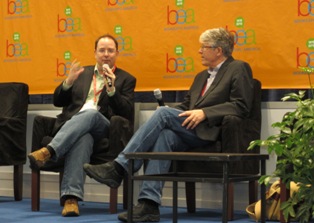
This year my future shock began even earlier than usual, during a BEA presentation called "Where Near-future Techno-thrillers and Sci-fi Meet." When the conversation turned to "envisioning" things to come, Douglas Preston said it is "impossible to predict the future," and John Scalzi added: "We expected rocket cars and got the Internet and cell phones."
The symptoms returned this week when Amazon unveiled the Fire Phone. After noting its features in her New York Times piece, Claire Cain Miller deftly played the unforeseeable future card: "Amazon must be thinking: What if, say, a contact lens could do all that? The Fire is Amazon's stepping stone to the future, and for now that just happens to be in the form of a phone."
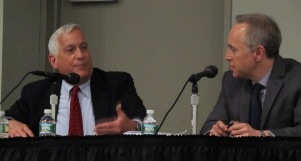
Scary though it may be, we love to think about the future, even though rocket cars so often turn out to be cell phones. During BEA, Jacob Weisberg of the Slate Group interviewed Walter Isaacson about his upcoming book The Innovators: How a Group of Inventors, Hackers, Geniuses and Geeks Created the Digital Revolution (Oct.), which explores the past to explain where the present came from to those of us living now... in a future. My prediction: I will read this book.
"When you and I were first going on the Internet, we probably did it with training wheels," Isaacson said, citing those ubiquitous AOL startup CDs from a couple of decades ago. Cue the nostalgic, infuriating sound of dial-up, a neo-ancient siren song luring us to the Information Superhighway.
 |
| Isaacson and Weisberg |
Isaacson said the future has traditionally been made by innovators and "the secret of innovation is putting together the right team." Calling his book "a series of lessons in collaboration," he added that the best innovation requires "a diverse set of people working in proximity," where they can bump into each other, work as teams, even "finish each other's sentences.... You need to have that primordial stew that brings people together."
Who leads this team? "If there were one simple answer, we wouldn't have a 500-page book," Isaacson quipped. "Almost every great innovator in this book was somebody who knew how to collaborate." He also emphasized the importance of merging creative with technological: "Joining the liberal arts with technology; that is the great theme of this book."
How does this affect the future of the book business? Isaacson observed that unlike the music and magazine trades, "the publishing industry is quite healthy," and stressed the continuing importance of the organized "team effort" that traditional publishing still represents in nurturing a writer, bringing out the best book possible and getting it to readers.
He utilized an additional team effort while writing The Innovators: "I realized that the Internet was invented for collaborative creativity," so he posted chapters from early drafts on Medium, where the public commented and added margin notes. "I got 18,000 comments," he said. "The good news is a lot of it you can ignore," but many of the contributions, including substantial input from Stewart Brand, improved the final book.
Even that term "final book" may be considered illusory now. Isaacson said he could imagine a "next phase of the publishing industry" in which "we could take this book and say, 'How do we make an enhanced book from that?'... I would like it to be a wikified book in which I get to play curator." He quickly added he saw no conflict between print and electronic books. "I think we've reached the equilibrium," Isaacson observed, adding that when we consider all the things a print book can still do better than a digital one, "it's amazing what a wonderful technology paper is."
Regarding the Amazon vs. Hachette controversy, he said Amazon "has done a lot of innovation and that's good," but expressed concern that profit appears to be increasingly the motivation for Bezos's moves: "I think he is in danger of losing that sense of putting the customer first.... It's also about the perception that publishing and selling a book is not the same as selling a button-down oxford shirt."
BEA future shock. Weeks later, I'm still slightly dazed, stumbling along in the muddled present, and still no rocket car in sight. Perhaps I'll cede the final words on the subject to an author both Isaacson and I rank among our favorites. From Walker Percy's Lancelot: "To live in the past and future is easy. To live in the present is like threading a needle."
--Published by Shelf Awareness, issue #2279.
"I have come to think that soccer lends itself to great writing because it thrives in the imagination, like so much of life. Great writers put themselves into the possibilities of the sport--pondering." --George Vecsey, Eight World Cups: My Journey Through the Beauty and Dark Side of Soccer
 The World Cup began yesterday and I must write about it. I don't mean I've been assigned to; I feel compelled. My connection to the beautiful game dates back nearly half a century to when I played in high school and college, as well as in summer leagues on teams that included Italian and Polish marble mill workers. In 1966, our high school coach took a few of us to Yankee Stadium, where we joined nearly 42,000 fans to watch the incomparable Brazilian legend Pelé and his Santos team beat Inter Milan of Italy 4-1 in an exhibition game.
American fans have taken some heat recently for their dubious "soccer snobbery" and "elaborate affectation," but I think my soccer street cred is still intact. I've loyally rooted for England (my team of choice and of ancestral heritage) since they won in 1966, though I never worry about using the terms soccer, game, field or uniform instead of football, match, pitch or kit; and I don't wear a team scarf.
Thus, from my little corner of the world's most popular sport, I offer a decidedly bookish, American take on the beautiful game. Here's what I've noticed lately:
 There's a World Cup window display at the Book Nook, Ludlow, Vt.; and Powell's Books, Portland Ore., is having a 30% off sale on soccer titles.
Three Percent's World Cup of Literature is underway, pitting "representative books from all 32 World Cup qualifying countries against one another in a single-elimination tournament."
You can also back your favorite country's writers in the Penguin Cup. On being named to England's team, Fever Pitch author Nick Hornby commented: "My proudest moment in football and literature. I worry about this team, though. I know for a fact that Zadie has no left foot, and I'm worried that Austen won't give me the protection I need if their left winger has pace. Christie is prolific, though."
"For whom did Arthur Conan Doyle play football in the late 1880s?" This was one of the questions in the Guardian's football in fiction quiz.
"What if writing was like World Cup soccer?" asked Merritt Tierce in an Electric Literature piece headlined "Writers' World Cup."
"The run-up to every World Cup in recent memory has brought a deluge of books," the New York Times noted. "What began as a trickle after the new year has grown to the point where bookcases are groaning under the weight."
BBC offered a "book lover's guide to Brazil," featuring some of the host country's "eloquent and original literary voices."
 In writing about Alex Bellos's revised and updated edition of Futebol: The Brazilian Way of Life, Jon Michaud in the New Yorker noted that an entire chapter is devoted to Aldyr Garcia Schlee, the designer of Brazil's signature uniform who "went on to become a journalist, university professor and novelist."
Ah, England. British player Frank Lampard, who has written several Frankie's Magic Football children's books, was asked whether he would write another one if England wins. "I have already written Frankie and the World Cup Carnival, but I would be happy to write another one IF we actually won it!"
Reality check: The Seminary Co-op Bookstores in Chicago linked to an Economist article recommending three new books about the host country and pointing out that "holding the World Cup in Brazil, football's spiritual home, sparked many fantasies of samba-infused spectacle. Those illusions were shattered last June when protests swept across the country during a warm-up tournament; a year on the discontent still simmers."
Writing for ESPN FC, Nick Hornby observed that the "smell of money around this World Cup is more unpleasant and more distracting than it has ever been.... Perhaps we are foolish, naive and self-deluding, those of us for whom the World Cup is an event that results in the glorious suspension of ordinary life for the best part of a month... But in an odd sort of way, everything that is so despicable about the contemporary game is a tribute to its power and continuing appeal."
Why did I feel compelled to add my thoughts to the World Cup frenzy? Maybe it's as simple as the recollection of a precise moment during the Summer of Love in 1967, and the sound of the ball when I caught it just right with my instep on a corner kick and sent it arcing toward the crowded goal area, as if tossing chum into a pool of sharks. One of my teammates executed a perfectly timed leap above the roiling surface to meet the ball, and just a flick of his head sent it to the upper right corner of the goal, beyond the outstretched arms of a desperate keeper. Then the celebration erupted with almost unbridled joy and (for just an instant, in Hornby's "odd sort of way") with love... for the beautiful game. --Published by Shelf Awareness, issue #2274.
I'm not sure when it first occurred to me that I was hooked. Perhaps on Friday, as I saw a line of people gathering at the Melville House Books booth to meet Mariusz Szczygiel and get a signed copy of Gottland: Mostly True Stories from Half of Czechoslovakia (translated by Antonia Lloyd-Jones). Or maybe it was Wednesday, during the panel "Case Studies: Successful Insight from Translators and Editors," when moderator Esther Allen cited a 2003 New York Times article headlined "America Yawns at Foreign Fiction." She then pointed out that Karl Ove Knausgaard's My Struggle: Book Three (translated by Don Bartlett), was the featured review in that day's edition of the Times.
"There's been a big change in the last 10 years," Allen said. Panelist and Penguin editor John Siciliano added that Entertainment Weekly had recently featured two stories on Swiss author Joël Dicker's The Truth About the Harry Quebert Affair (translated by Sam Taylor). "That was just astonishing to me."
Probably it was both of these moments, and many more, that drew me again and again to BookExpo America's Global Market Forum: Books in Translation events. What I loved about this year's program was that discussions weren't limited to: "What can we do?" They often focused on: "What do we do next and better?" And while Americans may not be reading enough books in translation (though I only heard the old 3% figure a couple of times, which is a record), they appear to be reading more each year.
"It's definitely a different time. It's kind of eerie," said translator Anthony Shugaar, who noted there is still a resistance to stories that do not fit preconceived notions of a country or culture. "It's definitely a huge change, but it's amazing how much baggage we're still carrying along."
Maria Campbell, owner of an international literary scouting agency, praised foreign publishers for becoming savvier: "How international books are presented to the American market has gotten better.... I think that the actual mechanisms have improved dramatically." She also said "publishers and readers are more adventurous" in seeking out fiction. "I sense even more since 2008... the financial crisis here was the beginning of 'let's look around and see what's out there.' " She added that 9/11 played an early role, as did websites like Words Without Borders.
"We also need a greater recognition of translators," Campbell noted. In fact, translators were at the forefront of many discussions. "It's not about the words; it's about what you get from the words," said Shugaar. Marcos Giralt Torrente, author of The End of Love (translated by Katherine Silver), said authors "need time for writing. We need time to find the right word. Maybe hours, maybe days.... We need translators who have time, too. They need to be paid... You can be poorly translated by a good translator who doesn't have time.... I feel very lucky because I've worked with three stars of translation.... What you ask of a translator is to recognize your own voice. I could recognize my voice. None of them betrayed my voice. None of them betrayed my style."
 |
|
Editor Sal Robinson, translator Antonia Lloyd-Jones and author Mariusz Szczygiel with publishers Dennis Johnson and Valerie Merians at Melville House booth
|
"Making Translation Work: The Author, the Translator & the Editor" featured panelists representing two publishers--Melville House, with translator Lloyd-Jones, editor Sal Robinson and author Szczygiel; and Europa Editions, with publisher Michael Reynolds and Marco Malvaldi, author of Three Card Monte and Game for Five (translated by Howard Curtis).
Lloyd-Jones offered a step-by-step explanation of how she puts together a presentation folder and said: "I've seen a lot of change in my career." Noting that she began when translators names were often not even included on a book, she spoke of the "professionalization of translators" and efforts to improve the business by translators themselves. "We have some good organizations.... I'm now mentoring younger translators in Britain."
Robinson observed that, "as an editor, you're a reader first. You ask yourself, Is this something I would pick up?" She also noted that translated genre fiction can have certain advantages when reaching out to an English-speaking readership: "Crime novels can sometimes tell you something about a society you can't get in another novel."
"Discoverability is the real challenge for the industry at the moment," said Reynolds, adding that a translated work "is very complex and takes a lot of effort and a lot of energy. So you have to choose the right author.... If there is an obstacle, it may be in the publishing industry itself rather than among readers."
Malvaldi noted that "something common in the country where you write can be new and uncommon in the country where it is published," a point Ann Goldstein, translator and member of the New Yorker's editorial staff, explored later in her presentation "How to Edit a Translation." For an editor, one of the key tasks is to consider obscure or unfamiliar references and decide how much help a reader needs, since translators would naturally be more familiar with the nuances of a particular language and culture. "The main thing is that you're dealing with two authors. The translator is also an author," she said.
"It's an immersion into another culture and a reading of signifiers," translator Allison Markin Powell, founder of the website Japanese Literature in English, told BEA's Books in Translation program coordinator Ruediger Wischenbart during the final event of the show. "I do try to gear toward a general reader.... I work within trade publishing. I'm looking for work an American audience might want to read."
And that, as it happens, is what we all had in common at Global Forum: the search for our next great read.
--Published by Shelf Awareness, issue #2269.
"I'm walkin' here! I'm walkin' here!" --Ratso Rizzo (Dustin Hoffman) in Midnight Cowboy
Next week, those of us attending BookExpo America will become temporary commuters in a city that recently garnered exceptional marks for public transit and walking. According to 24/7 Wall Street, New York City, "where more than 10% of residents walked to work, had a Walk Score of 87.6, the highest in the nation."
We aren't required to hoof it out to the convention and back each day, thanks to the numerous Big Apple transport choices, including BEA shuttle buses, taxis and mass transit (though the still-truncated 7 train subway line and the often jam-packed, unpredictable 34th St. crosstown bus are barely useful). However we choose to get there, we most definitely will be walking while attending the show. And walking. And walking.
If you've observed BEA attendees before in their unnatural habitat (aka the Javits Center), you may have noticed a wide range of of walking styles negotiating their way through the bookish throngs. Since Sibley hasn't yet published a field guide to identify all of these varieties, I tried to assemble a sampling here to illustrate just a few of the walkers you're likely to encounter--or become--during your #BEA14 pilgrimage:
 Stampeders: This can happen any time the herd is spooked by news of a celebrity booth signing or hot galley giveaway, but it is most pronounced during the opening moments of the show when the crowd speedwalks en masse from the first Book & Author Breakfast at the Special Events Hall to the main Exhibit Hall upstairs. Beware the frenzied escalator climber!
Salmon: It is one of nature's miracles, and actually quite inspiring, to witness the instinctive determination with which a person will sometimes attempt to walk against the prevailing current in an overcrowded publisher's aisle.
Broken Field Runners: Like football running backs, they dart left and right, move quickly to any open space, sometimes lower a shoulder and plunge through the onrushing line, always focused on the goal, however imperceptible and unimportant that may seem to those left reeling in their wake. Note: Tackling is now discouraged by show organizers.
Striders: They mean business. They move neither left nor right, but assume anyone in their path will step aside, and always keep their eyes trained upon something or someone really, really important waiting out there on the horizon. They are on a critical mission and you, my friend, are not part of it.
Grazers: In bookstores we call them browsers, but at BEA, grazing is perhaps a more appropriate designation for those who stroll casually from booth to booth, sampling the wares as if plucking leaves from trees.
Statues: If an object in motion tends to stay in motion, BEA walkers at rest tend to stay at rest, especially if they have rooted themselves to a spot directly in the line of traffic flow. They appear to be frozen mid-step, about to walk on, and yet... they don't, completely oblivious to the cresting waves of irritated colleagues breaking around them.
Predators & Prey: If you observe closely, you can often predict when an unwary attendee walking past a booth is about to be captured by the exhibitor. A similar drama develops when an attendee stalks a booth, waiting for just the right moment to corner a particular exhibitor who's been chatting with one person after another.
Hunters & Gatherers: Their walk is distinguished by a steady pace and a kind of sixth sense for where the best stuff--ARCs and pens and posters and bookmarks and more--is being distributed at any given moment. They are also exceptionally patient, willing to wait in seemingly endless lines at booth signings.
Pack Horses: Sooner or later, this is the fate for many of us, as we trudge back to our hotels laden with colorful, even sparkly, ARC-filled tote bags that belie the pain of our aching arms and shoulders.
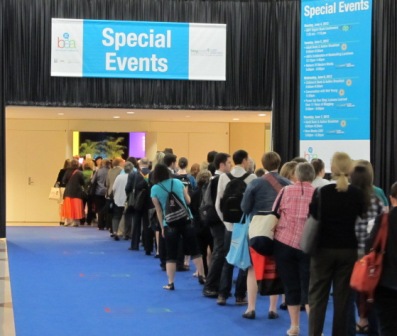 Cattle: Well, you've seen BEA's Autographing Area. Wait, shuffle, wait, shuffle, wait.
Saunterers: You don't encounter them often, but when you do, they are sight to behold. To stroll at BEA is to go completely against the grain. They seem to be unaffected by the madness around them. You wonder why they are there at all, and sometimes, however briefly, you envy their calm detachment.
The Walking Dead: Best observed on the final afternoon of BEA, waiting for shuttle buses back to their hotels.
Soon we'll all be walkin' the BEA walk, but make sure to reserve a little extra time and shoe leather to explore the not-so-mean streets beyond the Javits Center. "If it's a beautiful day, I love taking walks," said quintessential New Yorker Pete Hamill: "The walks are always aimless." Sound advice. --Published by Shelf Awareness, issue #2258.
As another BookExpo America approaches, my thoughts have turned to celebrities. Not author celebrities, but celebrity celebrities (who, for BEA purposes, often mean celebrity authors). This year's BEA Book & Author Breakfasts include a generous helping of speakers whom you might be forgiven for considering celebrities first and authors second, including Neil Patrick Harris, Anjelica Huston, Jason Segel, Alan Cumming, Martin Short and Lena Dunham.
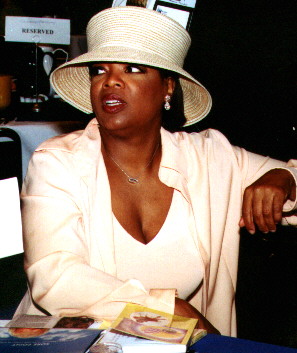
I'm not complaining, having watched booksellers, myself included, stalk celebrities in our own quiet way for a long time, including a pair of occasions when I witnessed Oprah Winfrey being engulfed by an adoring, bookish entourage. The first occurred in 1993 at the ABA convention in Miami, where I happened to attend a lush, downtown rooftop garden launch party for Oprah's soon-to-be-canceled memoir. Shielded by bodyguards, she moved across the floor within what was quite literally the eye of a party storm as the book crowd swirled around her.
 |
| photo: outcrybookreview.com |
And in Chicago eight years later, the scene was repeated when she attended a BEA Author Breakfast where her friend Quincy Jones was speaking. Afterward, she left for a quick tour of the trade show. Her passage through the corridors from banquet room to convention floor became a procession, with Oprah leading and booksellers trailing in her wake.
On their home turf, most booksellers are generally more circumspect. The first unwritten rule at the bookstore where I worked for many years was that if you spotted a celebrity in the stacks, you left them alone and respected their anonymity unless they broke the ice first. The second rule was that it didn't count as a genuine sighting without credit card name confirmation.
Auntie's Bookstore, Spokane, Wash., sums up the "celebrity browsing" dynamic nicely: "Over the years, we've learned to expect a bit of celebrity here at Auntie's, and not just our own! Many community figures, actors, singers, artists and other performers are also avid readers. We don't stalk our visitors while they're here, but once in a while we feel comfortable requesting that we be allowed to take a photo."
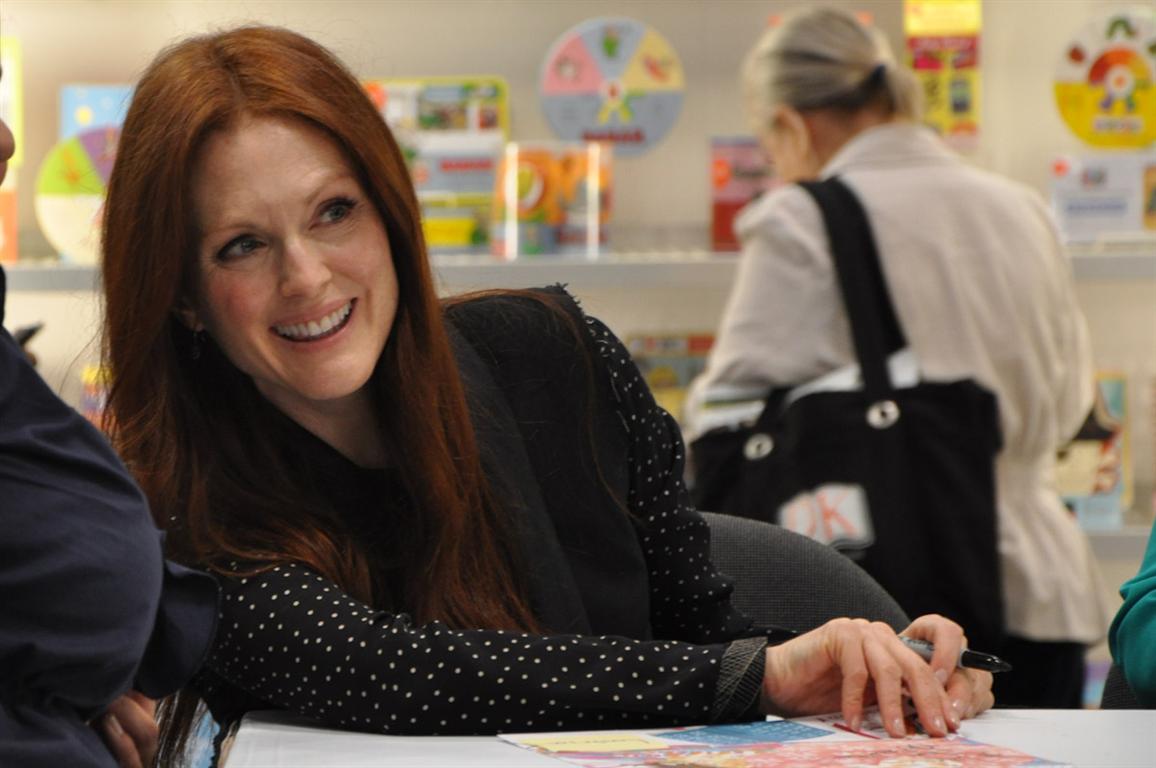
I've noticed recently that the gossip media tends to be inordinately thrilled when it catches celebrities in bookstores:
 |
| Julianne Moore, BEA 2013 |
Generally, indie booksellers are content to practice a bookish version of catch-and-release when it comes to celebrity sightings. It's not that we don't care. No one could deny the buzz that sweeps through a bookshop when a celeb is on premises, so we're not completely jaded when it comes to celebrity encounters.
I remember a great conversation I had several years ago at BEA in Chicago during a Farrar, Straus & Giroux dinner with Paul Yamazaki, head book buyer at City Lights, San Francisco, Calif., and Billy Corgan, the Smashing Pumpkins lead singer who was about to publish a collection of poems. We discussed books and places to eat; just three dudes talking poetry and the best bratwurst vendors on the streets of Chicago.
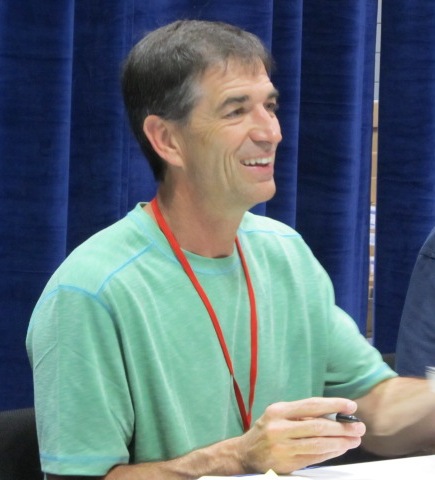 |
| John Stockton at BEA 2013 |
I'll even confess that last year at BEA, I made two special, somewhat star-struck pilgrimages to hover briefly around the signing tables of National Basketball Association legends Kareem Abdul Jabbar and John Stockton.
My all-time favorite celebrity-turned-author moment involved Bill Murray's appearance at a BEA Author Breakfast panel in Los Angeles 15 years ago for his book A Cinderella Story. After confessing that he "became a writer back in 1999. I had approximately, uh, the rest of the month to finish it," he offered a little Murrayish retail perspective for the indie booksellers in attendance: "I've never gone to the Internet and sat down and read anything, but I've never gone to the Internet and shoplifted, either."
Ultimately, I can only hope my strategy for dealing with celebrities in the book world falls well short of stalker territory and more in line with that sense we often get while on vacation of not wanting to be mistaken for a tourist. Pretend like you belong and it's all part of your everyday routine. Maybe you'll at least fool yourself.
--Published by Shelf Awareness, issue #2253.
Do you know what the first rule of Mother's Day is at Hallmark? "Don't make fun of your mom."
Dad? It's always open season on him. Even Mother's Day isn't a safe paternal harbor (please refer to Exhibit A--this great card featured by Chapter2Books, Hudson, Wis.). Tina Neidlein, a Hallmark greeting card writer, told Bloomberg Businessweek: "On Father's Day, you can say, 'Dad, all you want is a sandwich!' or 'Dad, you nap a lot.' But if you make fun of your mother, she's going to cry. And you can't even make fun of that."
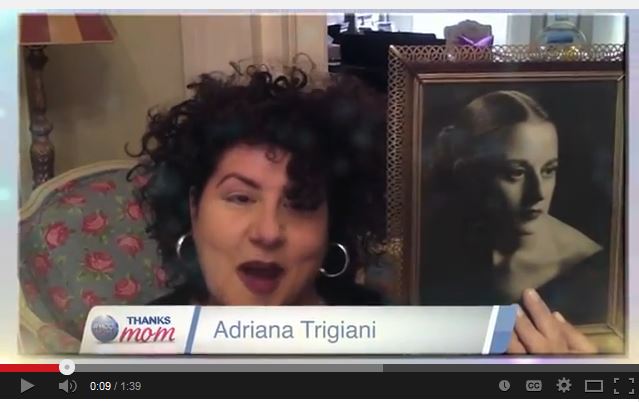 Just to be safe, we'll opt for the "be grateful" strategy, as in "Thanks Mom for Being My First Storyteller." The new video from HarperCollins features several authors--Veronica Roth, Soman Chainani, Lauren Oliver, Ann Patchett, Dan Gutman, Rita Williams-Garcia, Adriana Trigiani and more--expressing their bookish Mother's Day gratitude.
Books. That's the ticket. While the don't-make-fun-of-mom edict is probably based more on Hallmark's penchant for sentimental typecasting than scientific research, it did remind me that indie booksellers have long made a point of breaking away from traditional (i.e., cliché) merchandising options in their Mother's Day displays. For example, this year the Book Nook, Ludlow, Vt., showcases Sheryl Sandberg's Lean In: Women, Work, & the Will to Lead and Elizabeth Warren's A Fighting Chance on its Mother's Day table. And then there are the delightfully entomological sentiments expressed on the cover of a greeting card featured by Greenlight Bookstore, Brooklyn, N.Y. ("Eating her young meant fewer Mother's Day cards to open")
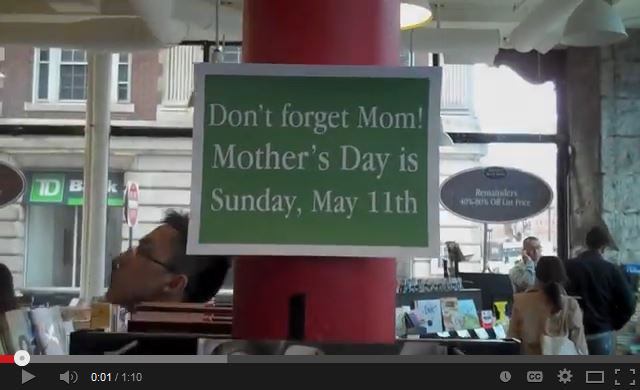 Harvard Book Store, Cambridge, Mass., created a video of personal staff picks for their mothers, with a nice range of choices: A Fighting Chance, Sibley Birds, A Platter of Figs, Journey, Ethics for the New Millennium, Beatrix Potter's Gardening Life, The Girl with a Clock for a Heart and Flour, Too: Indispensable Recipes for the Cafe's Most Loved Sweets & Savories.
"Mother's Day is a very booky holiday," the New York Times observed. "A book isn't too much, it doesn't have to be prominently displayed, it doesn't demand a conversation about how calories-don't-count-because-whatever and it doesn't wilt--or it goes nicely with more traditional gifts, which do do some of those things. Mother's Day is a fun time to give a book she will love to a friend, too: maybe a friend whose spouse and children don't 'get it' quite as well as you do."
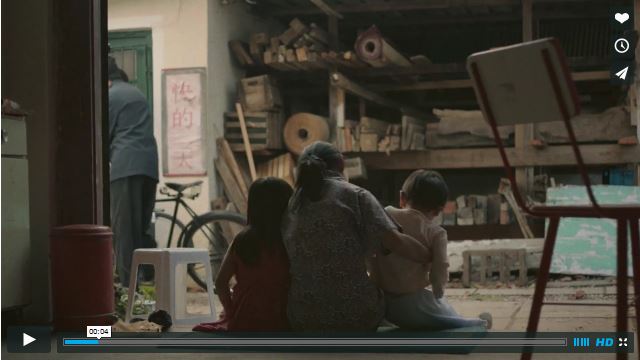 Last year, Kobo released a Mother's Day video featuring moms from many countries reading with their children, ending with: "She gave you the gift of reading. On Mother's Day, give it back."
Once upon a time (let's call it the early 1950s), when I was three or four years old, a fierce thunderstorm hit our town. Through the haze of memory, I can still feel the intensity of that storm, but I mostly remember the shelter my younger brother and I found on my mother's lap while she read us a story to take our minds off what she called "God bowling in the sky."
I was reminded of that moment when I recently encountered a lovely and very bookish e-newsletter column by Nancy Page, owner of Island Books, Mercer Island, Wash.: "With our youngest, Lewis, leaving home in the fall to attend college in the Midwest, this Mother's Day takes on a special meaning and gives me pause to reflect. The school-age years have been full, as I watched our children forge their own friendships and become the young adults that they are, but it was the early years when we hunkered down on the couch and read piles of books for hours at a time, completely absorbed in stories, that hold the fondest memories. I liked to read aloud and my kids loved to listen--a match made in heaven."
Page then chronicles a title-rich reading life with her children before concluding: "So maybe I could have done this mothering thing differently and my children would be practical scientists or mathematicians in the making, but instead they are exactly as they always have been and really in my opinion, should be, the sorts who love stories, bookseller's children. I am forever grateful for those years spent reading to them. So if you are at home with little ones, I suggest you make time to read. Read a lot to them. Punctuate your days with books, piles of books on the couch. You will never regret it. Happy Mother's Day." --Published by Shelf Awareness, issue #2248.
How could you pass up an invitation like this one? "Parapalooza! with Tim Federle and his Are You There God, It's Me, Margarita. Enjoy a cocktail while authors read, with meaning, feeling and enthusiasm, a single favorite hand-picked paragraph from their book." 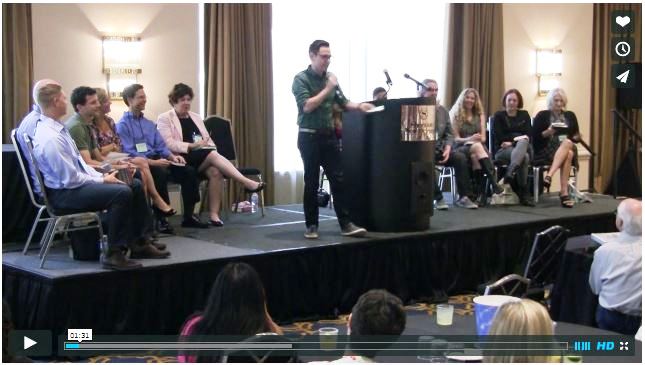
Well, I didn't pass it up and had a front row seat for last fall's Southern Independent Booksellers Alliance trade show debut of Parapalooza! in New Orleans. Emceed with humor and enthusiasm by Federle (Tequila Mockingbird: Cocktails with a Literary Twist & the Nate Foster series of children's books), the program featured a wide-ranging baker's dozen of alternately serious or funny, but always fascinating, literary voices
So I was pleased to learn that Federle will return to host and emcee the second edition of Parapalooza! during SIBA's Fall Discovery Show this year in Norfolk, Va. His next book is Hickory, Daiquiri, Dock: Cocktails with a Nursery Rhyme Twist (Running Press).
 Parapalooza! is a great concept, putting writers in the position of highlighting passages from their own new works. That Margaritas were the beverage of choice for last fall's event may have heightened the audience's appreciation quotient measurably (Even our host opened with: "My name is Tim Federle and I'm drunk already!"). Having the opportunity to experience a wide range of narrative styles and reading voices in such a condensed format (especially at the end of a long show day), turned out to be a marvelous, word-drenched twist on Happy Hour.
 |
| Lisa Patton |
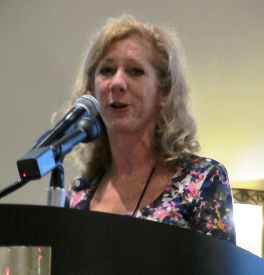
Lisa Patton, who read an amusing passage featuring three characters from her novel Southern as a Second Language, told me she chose her paragraph "because it showed the humorous side of my novel and I wanted the audience to get a sense of the comedy that is so important to me in all my books. Plus, I felt it would allow me to be animated while reading. I really enjoyed Parapalooza!, but if truth be told, I may have cheated a little and read several lines of dialogue, which are technically paragraphs in and of themselves."
 |
| Danny Ellis |
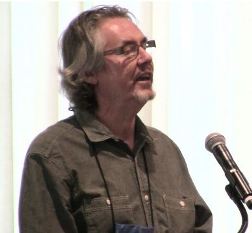
One of my favorite moments occurred when singer-songwriter Danny Ellis chose not to read a paragraph, but to perform, a cappella, "Tommy Bonner," a song about one of the characters in his memoir, The Boy at the Gate (see it at the 13-minute mark on the Parapalooza! video). "Wow! So that happened," Federle said afterward. "Anything can happen with these paragraphs."
But Parapalooza! is more than just authors and Margaritas. SIBA created the concept "around the impulse readers have to share a favorite paragraph from their favorite books" and it has become an ongoing project for the organization, which encourages the reading public to participate by sending links to short videos of them reading a paragraph from one of their favorite books. The only requirement is that, like the author event, paragraphs be "read with enthusiasm and feeling." Videos and links can be sent to [email protected], and will be archived on the Parapalooza! Youtube channel and on the website.
"We invite one and all to submit their own Parapalooza! video for the website," said Wanda Jewell, SIBA's executive director.
A couple of things came to mind when I started thinking about Parapalooza! this week. The first was a memory from more than a decade ago, when I was at an event where Elizabeth Cox read from her story collection Bargains in the Real World. As she was being introduced, I noticed her marking up a page with a pen. She later said she had been rewriting a paragraph in her already published book before reading it. That image of writer as eternal reviser, even of "finished" sentences and paragraphs, stayed with me.
The second was a question: What paragraph would I choose to read for a Parapalooza! video? It's hard enough for an author to select a passage from a single book, so how do we readers possibly narrow down a lifetime of book encounters to such a pinpoint?
Quite suddenly, however, I recalled a surprisingly appropriate choice: a paragraph that nests deep within Michael Ondaatje's The English Patient, when Hana is reading Kim to her patient, who says: "Read him slowly, dear girl, you must read Kipling slowly. Watch carefully where the commas fall so you can discover the natural pauses. He is a writer who used pen and ink. He looked up from the page a lot, I believe, stared through his window and listened to birds, as most writers who are alone do. Some do not know the names of birds, though he did. Your eye is too quick and North American. Think about the speed of his pen. What an appalling, barnacled old first paragraph it is otherwise."
--Published by Shelf Awareness, issue #2243.
"Well, God give them wisdom that have it; and those/ that are fools, let them use their talents," Feste says in Twelfth Night. He is, I confess, a role model, though I've generally found more practical applications in my life for foolery than wisdom. That said, a belated Happy Birthday wish goes out to William Shakespeare, who turned an ever-wise and ever-foolish 450 years old Wednesday.
Although World Book Night was originally scheduled on April 23 precisely because it is the Bard's birthday, so much WBN news is being made that Will sometimes gets lost in the wings. So it seems only fair to give him--yes, I'm going to say it--his hour upon the stage.
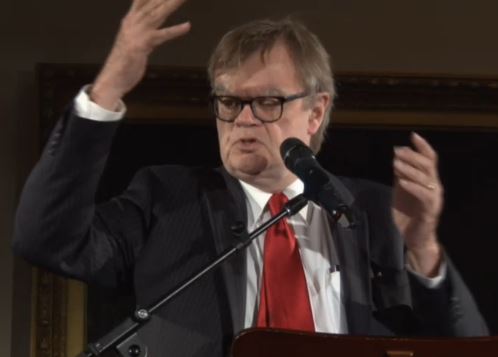 |
| Garrison Keillor at the World Book Night kick-off at the New York Public Library. |
As Garrison Keillor, author and proprietor of Common Good Books, St. Paul, Minn., observed on the Writer's Almanac this week, Shakespeare "created some of the most unforgettable characters ever written for the stage, and was a master of the language of various social classes. According to the Oxford English Dictionary, he coined 3,000 new words, and he has contributed more phrases and sayings to the English language than any other individual."
Or, as @MelvilleHouse nicely summed it up: "How to celebrate Shakespeare's birthday? Perhaps by living our entire lives within the language he more or less created. Thanks, buddy."
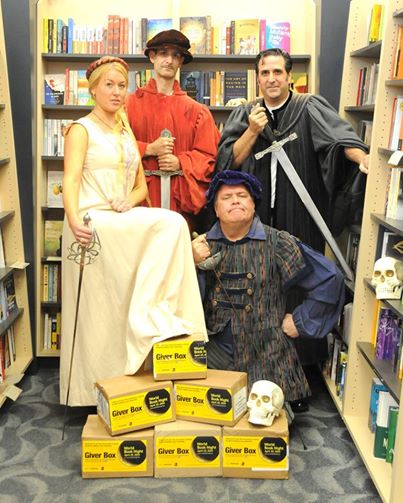
Shakespeare was, as might be expected for a birthday boy, more ubiquitous than usual during this year's World Book Night festivities. Those attending the WBN launch event at Skylight Books in Los Angeles Tuesday night were among the first to receive a free copy of Dover's Shakespeare's Complete Sonnets in a special WBN edition. On Wednesday, Weller Book Works, Salt Lake City, Utah, proclaimed: "Today's #WBN2014 (World Book Night), #Shakespeare450th, & the anniversary of Sam Weller's birth. There's no better day to read a book!" Books Inc. in Alameda, Calif., agreed: "World Book Night? Shakespeare's 450th bday? Booksellers at Books Inc. Alameda? Yes, yes, and yes. Come down and join the fun!"
 |
|
Books Inc. in Alameda, Calif., brought the Bard into Book Night. The players: (l.-r.) Adrienne Reiter, Tom Galleguillos, Nick Petrulakis; (kneeling) Gene Kahane.
|
In Louisville, Ky., Carmichael's Bookstore welcomed "our friends at Kentucky Shakespeare for an early celebration of World Book Night," with performers reading sonnets and "even grac[ing] us with a performance or two in honor of the Bard."
The California Shakespeare Ensemble in Pasadena, Calif., "which has been partnering with Pasadena LEARNS to 'facilitate' the John Muir High School after school Drama Club," worked on Shakespeare's Sonnets Wednesday with students as part of their WBN celebration, Hometown Pasadena reported.
Innisfree Poetry Bookstore Cafe, Boulder, Colo., featured members of the Shakespeare Oratorio Society presenting " 'Venus and Mars,' an exploration of the complicated and ever-changing relationships between women and men as seen in Shakepeare's plays."
I stopped by Northshire Bookstore, Saratoga Springs, N.Y., Wednesday night for their "William Shakespeare Birthday Celebration for World Book Night," featuring Skidmore College students and actors from Saratoga Shakespeare reading sonnets. The audience received copies the WBN Dover edition to keep and share. Even the Bard himself, looking surprisingly spry for a 450-year-old, was in attendance.

In New York City, copies of the Complete Sonnets were placed on theater seats during Wednesday's performances of Rodgers + Hammerstein's Cinderella, Matilda the Musical, Newsies and The Lion King. Broadway World noted that "curtain speeches and letters in the books will encourage audience members to give their book to someone who may not be a regular reader."
In addition, the Broadway League is teaming with WBN U.S. to distribute free copies of sonnets at national Family First Nights events for students and families, Kids' Night on Broadway programs throughout the country, and to students participating in the Broadway League's high school internship program.
"We are thrilled to be partnering with the Broadway League and all the great work they do," said WBN U.S. executive director Carl Lennertz. "Obviously, we share a love for the words and work of William Shakespeare, and the Broadway League is committed to increasing awareness of the arts as we are of reading, so this is a wonderfully natural fit. Theater and books bring joy and light into many lives."
I've had the good fortune to see a few magnificent productions in recent years, including Shakespeare's Globe and Mark Rylance's Measure for Measure at St. Ann's Warehouse in Brooklyn (2005), as well as Twelfth Night and Richard III last fall at the Belasco Theatre; and the Royal Shakespeare Company's As You Like It in a stunning replica of its Stratford-upon-Avon Theatre, constructed within the Park Avenue Armory (2011).
What I also love, however, is the way Shakespeare's words feel so at home wherever they are spoken, even when we don't know we're speaking them: "a fool's paradise," "dead as a doornail," "come what may," "forever and a day," "love is blind," "night owl," "wild goose chase," "into thin air."
Sustaining this tradition, World Book Night has become great international street theater for book and word people. Shakespeare would approve. In fact, at the WBN kickoff celebration in New York City Tuesday, he was even seen wearing a book giver badge. Happy birthday, Will, and many happy returns to the stage.
--Published by Shelf Awareness, issue #2237.
Pick a poem, any poem. Well, not just any poem; pick one you have lived with a while. Now, read the poem aloud. How does it sound? Record your voice reading that poem. Add complementary video. Imagine dozens of people doing the same thing.
 As it happens, you don't have to imagine this because for the past five years, California's DIESEL, A Bookstore has been releasing a new videopoem daily during Poetry Month. While booksellers are usually the featured readers, DIESEL occasionally invites a guest. Last year, even I got in on the videopoem action with my signature monotone rendition of Gary Snyder's "Hay for the Horses."
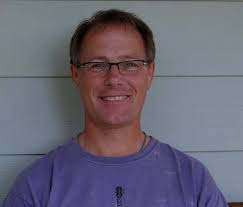
DIESEL's co-owner John Evans told me the bookstore has "always had an extra special emphasis on poetry and art. We believe they are essential parts of great local independent neighborhood bookstores like ours. I am a poet and have an M.A. in Poetics (of all things) and so want poetry to be widely, easily available and visible at our stores. We have cultivated poetry reading, and writing, at our stores from the beginning."
That said, technology is no stranger to DIESEL's mission either. "We've embraced technologies, but insisted that they further good aesthetics," Evans observed. "We created a website in 1991 and, I must say, it was beautiful. It's a challenge, as platforms change--sales gets integrated into what was originally a communications tool--to keep the aesthetics going. It's a welcome challenge. My partner, Alison Reid, has said that a good slogan for DIESEL is 'if you bought an ugly book, you didn't buy it at DIESEL.' "
 |
| Evans |
When they decided to produce more book-related videos about five years ago, "we just started naturally also reading from them and then thought, What about a whole month of reading poems for National Poetry Month?" Evans recalled. "Most of us were absolutely excited by it, and some were a little more tentative. After all, hard as it may be to believe, not all booksellers regularly read poetry. But all booksellers have read, and loved, some poetry. Since we try to open things wide, we encouraged people to just read whatever poems they wanted. We were startled by the results the very first year. Several of us--me, Jon Stich and Grant Outerbridge (both very artistic booksellers)--decided to shoot some video to match with the read poems for those who didn't want to be filmed reading and out of a curiosity as to what we could come up with."
During the first year, DIESEL mixed videos of booksellers reading with some videopoems before deciding the video versions were generally more interesting. "Since then, Jon has shot most of the video and added the audio clips," Evans noted. "Pretty much all of our booksellers have contributed readings each year."
Positive feedback has come from customers, friends, publishers, other booksellers and authors, "all praising us for our commitment, for specific poem choices and for particularly effective readings," he said. "Some people look forward to the one-per-day reveal, while others listen to them in groups and a few wait until the month is over and then binge on them. It's a great annual ritual: for each of us; for all of us at the store; and for all of the other readers, of poetry or not, who enjoy getting words in their purest forms."
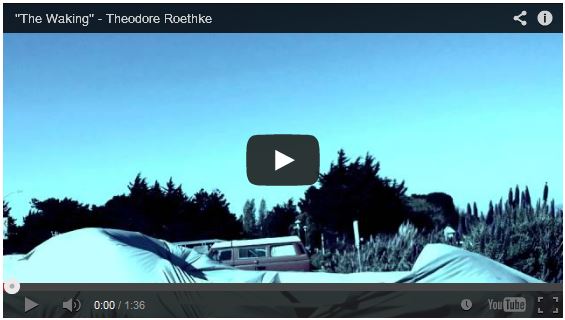 Evans cited two of his all-time favorite videopoems, which "come to mind every year, largely because of their combination of great reading and eerily perfect video." One is William Butler Yeats's "Lake of Innisfree," read by Nell Arnold, and the other Kay Ryan's "The Material," read by Colin Waters. He also praised Brad Johnson, "who does our blog and is a poet himself and a great reader of poetry. He floored me with his reading voice--like a young Orson Welles! I love to hear him read, but particularly love the first videopoem of his that I saw/heard: 'Sentences' by Lyn Hejinian. My favorite so far this year? Herb Bivins, who works in the Larkspur store, "beautifully reads one of my favorite poems--'The Waking,' by Theodore Roethke--and Jon intuitively marries it to an amazingly appropriate scene. The wind and Herb's breathing, and wonderfully timbred voice, bring forth so much of the incantatory magic of this poem, it just leaves me smiling." The Roethke videopoem is my favorite thus far this year as well.
"One further thing which I've really only full appreciated this fifth year: I really enjoy the sounds of my co-workers voices transposed into this intimate register of reading poems which they care about and so, care for," Evans observed. "This is not the voice of the bookseller with our enthusiasm for books and expert helpfulness, but the voice of close readers of beautiful writing and the imaginations conjoined there. It's such a pleasure to know and hear my fellow booksellers in this way."
--Published by Shelf Awareness, issue #2232.
First, a confession: I did not know what a clerihew was until I learned that Ice Cube Press would be publishing The Lost Clerihews of Paul Ingram July 1 (shipping June 15). On the other hand, I did know that the author is a legendary bookseller at Prairie Lights Bookstore in Iowa City, where he has worked since 1989. Whenever a list of great indie handsellers appears, he is inevitably on it.
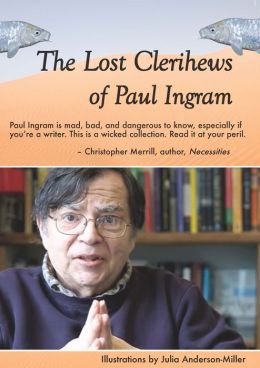 From Ingram's introduction to his collection, I soon discovered the clerihew was first devised by English author Edmund Clerihew Bentley and follows the rhyme scheme AABB, with the first line including "the name of a well-known or ill-known person." Since Bentley's death in 1956, and despite its adoption by poets like W.H. Auden and Anthony Hecht, "the form has seldom been in use."
Until now, that is. Ingram's mischievous creations have been found at last ("And how did they become lost? Many reasons. They are tiny and often find themselves on napkins, old receipts, sugar packets and matchbook covers."), and readers will soon enjoy the pleasure of their company.
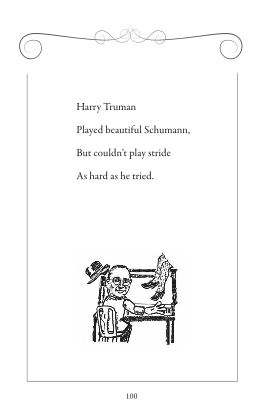
Igor Stravinsky
Couldn't convince me
He knew one damn thing
About the rite of spring.
Ingram said he had doubts when he initially toyed with the form 20 years ago: "I believed I just wasn't clerihew material. I just wasn't that clever. But I do all the buying for the bookstore and had hundreds of names going through my head, so once I'd figured out how to do a couple, I figured how to do a lot of them." Although he estimated he has composed as many as 400 ("not 400 good; not 400 publishable"), Ingram noted that "there are plenty that I did not include in this collection because they are pointedly offensive."
Does the clerihew perhaps allow him to vent a little? "I feel I'm generally a way, way too respectful person, but I don't always necessarily feel that way," he replied. "It's just what came out; they come out kind of naughty. I think most of what I have in there now is just this side of printable."
 In his blurb for the collection, Richard Howorth, co-owner of Square Books, Oxford, Miss., called Ingram "an extraordinary bookseller who has not only found the lost clerihews; he has elevated the entire form. This book forever shall reside in our guest bedroom so that visitors will either know or wonder what sort of people we are."
How Ingram's clerihews evolved into a book is one of those great tales of the right people converging in the right place at the right time.
"The book's genesis was mostly through Bruce J. Miller, who encouraged me to go listen to Paul tell me some of them," said Steve Semken, founder and CEO of Ice Cube Press. "I listened to Paul recite clerihews and laughed and loved how clever they were. At first they seemed merely funny, but then, when I realized the point of a clerihew is also to make biographical points about the person, I thought, What could be better than laughing and learning all at once?"
Miller, co-owner of Miller Trade Book Marketing, added: "It's been an exciting time. For me the publication of Lost Clerihews represents the fulfillment of my long held wish to help bring Paul's work to a national audience. I asked him from time to time if he had thought about publishing his wonderful clerihews, and this time I was able to help make it happen."
The book is illustrated by Miller's wife, Julia Anderson-Miller, an accomplished artist who has known Ingram since 1987. "When I was asked if I had the time to illustrate The Lost Clerihews, I was so happy!" she recalled. "What an education and variety of inspired situations those clerihews provided for my creative juices. I was only planning to do 12 or 24, but ended up doing 134. And I still do not want to stop--but the book is finished.
"I did not want to illustrate verbatim, so it was fun to wander off a wee bit. I needed research, because I did not know who some of these people were, and I also needed to get the realism of gesture, face or interesting facts. I looked forward to solving difficult clerihews to put into pen and ink. I love a challenge."
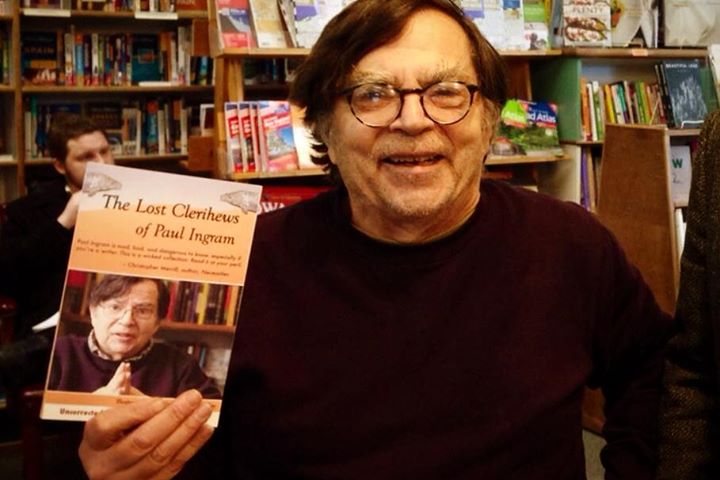 "Having an illustrated clerihew book is 'how it's done,' " Semken observed. "Auden's was illustrated, as was E. Clerihew Bentley's clerihew book. This really is a valuable part of the book, I think."
The Lost Clerihews of Paul Ingram will include a foreword by Elizabeth McCracken and has already drawn accolades from a range of word enthusiasts, including Jane Hamilton, Daniel Menaker, Roz Chast, Elizabeth Crane, Christopher Merrill and Amelia Gray; as well as booksellers like Howorth and Anne Holman of the King's English Bookshop, Salt Lake City, Utah.
And what does the future hold for the clerihew? "I would be absolutely delighted to see great clerihews popping out all over," Ingram said. "I'd love to be part of making that happen. I have also discovered, for example, that just about all of them fit in a tweet."
Semken may have summed up the Team Clerihew project best when he said: "That Paul works at Prairie Lights in Iowa City, and it was through a Midwest sales rep telling me, an independent press in the Midwest, about the idea--I really think all these parts working together prove that real partnerships exist in the book industry, that we all need each other." --Published by Shelf Awareness, issue #2227.
As you read this, Nan Sorensen, administrative coordinator at the New England Independent Booksellers Association, is either preparing to head over to Boston's Fenway Park or is already there, psyched for the home opener of her beloved World Champion Red Sox. Nan is one of the most passionate Sox fans in the book business and I wondered about her game prep because baseball is, after all, a sport of rituals.
 "I always wear a Red Sox T-shirt, but most important is I will have a soft ice cream before I enter Fenway," she said. "Regardless of temperature, I always do. Usually I wear shorts and a Fenway Park (I love Fenway as much as I love the Red Sox) T-shirt, but in the heat of the summer I sometimes get brave and wear my pink Dustin Pedroia T-shirt." Would she dare bring a book to a game? "No book. I buy a program at my first game of year. There is always too much going on at Fenway to have a book."
The Red Sox season officially began earlier this week in Baltimore, and even ESPN couldn’t resist a bookish lead in reporting on the game: "No need for Grady Sizemore to embellish his story. It's already just a couple of ticks shy of Roy Hobbs as it is. No need for Jackie Bradley Jr. to embellish his story, either. These days, it seems like Stephen King is ghostwriting it."
Baseball remains the sport that lies closest to our literary souls. Even an impromptu starting lineup card of authors is an all-star team: Roger Angell, W.P. Kinsella, Don DeLillo, Bernard Malamud, George Plimpton, Donald Hall, David Halberstam, Thomas Boswell, Roger Kahn. Creating that list off the top of my head should spark another great baseball tradition: the "rhubarb." What about Stewart O'Nan and Stephen King and David James Duncan and Chad Harbach? Or old school legends like Ring Lardner? Since it's also opening week for Poetry Month, how about Lawrence Ferlinghetti's "Baseball Canto" or John Updike's "Baseball"?
In other words, books and baseball make a good team:
- The Baltimore Orioles are sporting a patch on their uniforms honoring the late Tom Clancy.
- April 23 marks the 100th anniversary of the first professional baseball game at what is now Wrigley Field, home of the Chicago Cubs. "Only florists and chocolatiers love anniversaries more than book publishers do," the Tribune noted.
- Derek Jeter, who will have his own imprint at Simon & Schuster by this time next year, began his Yankee career farewell tour in Houston this week.
- MLB Network unveiled its new opening sequence, which takes "a page straight out of another American tradition: comic books."
 For Nan, however, it's all about the Sox. The team was honored this week at the White House by President Obama, who named Mike Napoli to the newly-created (as of April Fool's Day) President's Council on Beards. Even press secretary Jay Carney "bearded up" for the occasion to celebrate the barbigerous champs--as, by the way, had Nan last season (and we have the photographic evidence), putting on her game face when it mattered.
She did confess, however, that when she was growing up in New Jersey, she was a Yankee fan: "I loved Joe Pepitone!" Later, while working for the publisher David R. Godine, "we used to go to Opening Day at Fenway. George Gibson and Andre Dubus II would buy a big block of tickets and we'd take the afternoon off. That was my introduction to the Red Sox. Now I love Dustin Pedroia and Big Papi (David Ortiz) and Shane Victorino."
There are far too many Red Sox fans among NEIBA members to list, but Nan said that "standouts include Mark Lamphier of Harvard Book Store, Cambridge; and Dawn Rennert of the Concord Bookshop." She also gave high marks to Random House district sales manager Lesley Vasilio, "with whom I go to the games, though sadly not for Friday's game." I couldn't resist asking if there are any Yankee fans hiding out among NEIBA members, and she cited Michael Herrmann of Gibson's Bookstore, Concord, N.H., adding that "he doesn't hide it."
 |
| The columnist psyched up for opening day, Little League edition, circa 1959. |
Although I'm not a Red Sox fan, I do have genuine Sox street cred. My parents spent their 1949 honeymoon in Boston and saw a few games. Since I was born almost exactly nine months later, you could say I was conceived in the shadow of Fenway Park. And I certainly spent uncounted hours of my youth consumed with becoming a "real ballplayer," as my father, who worshiped Ted Williams, called the good ones.
There may be some lingering effects, so I completely understand Nan's emotions yesterday, when she told me: "Today is like the day before leaving on vacation. Ready to burst with excitement! Glad the gates open early so I can get out of the house and head over. For the past few years I've gone to all the games with Lesley, but could only manage to get the one ticket for this. Going to feel weird, but I'm sure I'll find a few people to cheer with; and sing 'Sweet Caroline' with--one of my favorite parts of the game!"
And is there a connection between baseball and booksellers? "Baseball players, like booksellers, 'fight' everyday for the good of the 'team,' " she replied. Play ball!
--Published by Shelf Awareness, issue #2222.
"Though this be March Madness, yet there is method in't," Polonius almost said in Hamlet. For the record, the poor guy not only didn't make it out of the play alive, he was also defeated in the second round of 2012's Shakespeare Character March Madness Tourney by King Lear ("O, that way March Madness lies; let me shun that").
 Yes, ladies and gentlemen, 'tis the season of March Madness and there are brackets, brackets wherever we turn--online, on refrigerators, on bulletin boards, on everything. It's been a long time since bracket fever afflicted only obsessed NCAA college basketball tournament fans.
"Bracketology--the practice of parsing people, places, and things into discrete one-on-one matchups to determine which of the two is superior or preferable--works because it is simple. What could be simpler then breaking down a choice into either/or, black or white, this one or that one?" wrote Mark Reiter, co-editor (with Richard Sandomir) of the 2007 book The Enlightened Bracketologist: The Final Four of Everything.
Ben Yagoda, who contributed a "sins against the language" bracket to the book ("I put the phrase in quotation marks to indicate it should be taken with a measure of irony."), observed more recently: "I think we can all agree that March Madness has jumped the shark."
"When did filling out a March Madness bracket become popular?" asked Smithsonian magazine recently, noting that "NCAA bracket madness has also spawned a social phenomenon: The Wire, proclaiming March the 'bracket-iest month of the year,' is rolling out competing brackets each week in a 'tournament of everything.' Even the federal government is getting in on the madness, betting that a bracket will make the Affordable Care Act relevant to millennials. It's hard to turn anywhere on the Internet without running into a bracket of some kind."
The book world is not exempt, of course. Inkwood Books, Tampa, Fla., has its own Staff Pick Madness. Early in the month, Weller Book Works, Salt Lake City, Utah, advised: "Looking for your own March Madness? Check out Tournament of Books sponsored by The Morning News. Bracketed book bouts."
Launched in 2005, the ToB has inspired many variations on a theme, including the Tournament of Sidekicks from Half Price Books, Out of Print's Book Madness, the Piglet Tournament of Cookbooks, Game of Thrones March Madness Bracket, io9's SciFi Versus Fantasy Madness, Picture Book Bracketology, Bracketology for Female Book Characters, and even a Quidditch World Cup bracket challenge contest. The Medina County District Library featured Book Madness, challenging readers "to pick the top winners as the Best Books of 2013 go head-to-head with the Books That Stand the Test of Time."
 March Madness also erupts annually in the sidelines department for the lucky few college bookstores whose teams win and progress through each round. Right after the University of Dayton was awarded an NCAA tournament berth last week, the bookstore "reported having between two and three hundred online orders for 2014 March Madness t-shirts." (Sideline sales for the sidelines?) And with the Flyers still in the mix, staff member Taylor Seidl said the retail outlook remained upbeat: "As long as we keep winning we have orders coming in for Sweet 16... Elite Eight." Same story at the University of Virginia bookstore, where executive director John Kates said, "In the thirty years I've been here... I've never seen anything like it."
Speaking of the Elite Eight, there was an unfortunate digital retail slipup on Wednesday when the University of Arizona's bookstore had to issue a public apology for accidentally displaying a page featuring T-shirts that heralded the team's advancement to the next round before they had even played their Sweet Sixteen game against San Diego State last night. They won anyway.
And just so you know, in Las Vegas March Madness means "busy hotels, Bud Lite and bustling books," but not our kind of books.
The endgame of NCAA tournament bracketology is almost always defeat and befuddlement. What began March 16 on Selection Sunday with unsullied brackets and 68 optimistic college basketball teams simply cannot resist the tidal pull of a cresting Shakespearean wave ("The ides of March Madness have come."/ "Yes, Caesar--but not gone."). Maybe it has something to do with March itself, that most confusing of months.
Or, as Polonius sort of put it (anticipating, perhaps, Orchestral March Madness, Tuition Madne$$, Public Media Madness, Mensa Bracket Challenge Champion and even March Madness Meta-Bracket: Which Tournament Is the Best?): "A happiness that often March Madness hits on, which reason and sanity could not so prosperously be delivered of." --Published by Shelf Awareness, issue #2217.
Every year, UNESCO celebrates those who give life to poetry as one of the highest forms of linguistic and cultural expression. Poetry is a song of freedom, enabling us to affirm our identity through creation. Poetry is also the song of our deepest feelings; in the words of the Brazilian poet and diplomat João Cabral de Melo Neto, "even unintentionally, every word that comes from emotion is poetry." Through its words and its rhythm, poetry gives shape to our dreams of peace, justice and dignity, and gives us the strength and desire to mobilize to make them real.
Friday was World Poetry Day, which was established by UNESCO in 1999 and is observed annually on March 21. One of its main objectives is "to support linguistic diversity through poetic expression and to offer endangered languages the opportunity to be heard within their communities."
The festivities are also meant to "encourage a return to the oral tradition of poetry recitals, to promote the teaching of poetry, to restore a dialogue between poetry and the other arts such as theatre, dance, music and painting, and to support small publishers and create an attractive image of poetry in the media, so that the art of poetry will no longer be considered an outdated form of art, but one which enables society as a whole to regain and assert its identity."
Here's a global sampling of World Poetry Day celebrations:
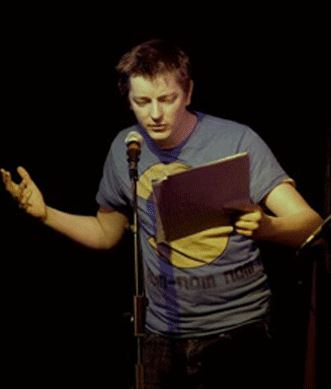 |
| Harry Man |
At the 53rd Struga Poetry Evenings festival in Macedonia this week, British poet Harry Man won the Bridges of Struga award for his debut collection, Lift, while Korean author Ko Un was honored with the prestigious Golden Wreath award.
In Ghana, "they are taking the word art to a whole new dimension by spicing the shows up with the best performance spoken-word artists in the country." World Poetry Day celebrations include spoken-word workshops; flash mob and street performances; a national senior high school poetry slam championship; and a final concert, all sponsored by Goethe Institut and G3 Channels, in conjunction with the Ghana National Theatre, Talk-Fact3, Writers Project Ghana, IUB and Inkfluent.
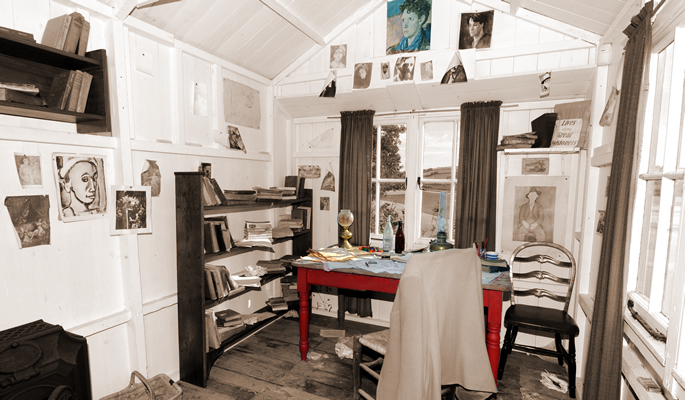 A replica of the iconic writing shed used by Dylan Thomas will make its first appearance Saturday in Carmarthen, Wales. During the centennial year of his birth, Thomas's shed, a "bespoke replica [that] even has the curled pictures on the walls and the view over the estuary," is touring the U.K.
"It's Poetry Day! Get Poeting!" is the sound advice offered by the blog for English at the Colegio Público de Espiñeira Aldan in Spain.
The Slovenia Times noted that to "mark World Poetry Day, the Slovenian Writers' Association will hold a poetry and musical evening at the Ljubljana Town Hall's atrium. Poems will also be read in front of the headquarters of Maribor University. Meanwhile, the Iriu Institute has selected poems by several Slovenian and foreign poets which will be served with coffee at selected coffee shops in Ljubljana and Celje."
In Manitoba, Canada, Brandon University is commemorating the day with an hour-long "Celebration of Dead Poets and Their Poetry," during which participants will perform their favorite works from great poets of the past.
 |
| Tulasi Diwasa |
Nepali poet Tulasi Diwasa is one of more than 50 poets from around the world invited to the World Poetry Festival in New Delhi, India. The festival was organized to celebrate World Poetry Day as well as the 150th birth anniversary of Swami Vivekananda.
On the Caribbean island of St. Maarten/St. Martin, "Cross-Generations: A Gathering of Soualiga's Poets" will be held in the Philipsburg Jubilee Library's hall. Lysanne Charles, president of Foundation 5 Square Miles St. Martin and coordinator of the event, said the island "has a long history of poets and in the last 30 years or so published poets. Cross-Generations celebrates the vibrancy of this and pays homage to the older poets and our publishing outlet House of Nehesi Publishers.... It is important that we acknowledge the word of the written and spoken word on the island and the ability it has to transform things."
Tonight, the Beyond Baroque Literary Arts Center in Venice, Calif., will host La Poesia Festival World Poetry Day, featuring several poets and inviting people to "bring original poetry in Spanish/bilingual to share."
And Illinois Wesleyan University in Bloomington has asked "readers of all ages and backgrounds" to participate in Virgilpalooza, a marathon reading of Virgil's epic poem The Aeneid.
In his aptly titled poem "World Poetry Day," Polish author Tadeusz Rozewicz writes:
around noon the phone rang
"today is poetry day"
said Maria
"I can't hear you!"
"today is World Poetry Day, o poet!"
it's been established by Unesco"
Even Ionesco couldn't have thought up
something like this! this is something (something)!
Something indeed. Happy World Poetry Day. Now, go out there and get poeting!
--Published by Shelf Awareness, issue #2212.
"Time: 1985 or thereabouts. Place: Shakespeare & Company Booksellers (as I remember it) in Manhattan." A New York Times "Metropolitan Diary" entry last week opened with that CSI: Bookstore intro, then shared a brief but amusing tale involving a few classic ingredients of the crime thriller: suspect, witness and potential theft, with a devilishly clever comeuppance at the end.
The witness recalls seeing "an unmistakable tall, reedlike figure with a jutting jaw and blondish hair, wearing a floppy knit hat that could not disguise him." She recognizes the celebrity and begins stalking him through the aisles until, quite suddenly, she's astonished to catch him in a criminal act: "He doesn't seem to notice me as he stops and pulls a book off the shelf. He examines it. Then, he quickly snaps it shut, slips it under his oversize coat and strolls away."
 Still in shock, the witness continues to trail her suspect until his "pace, slow at first, begins to quicken as he approaches the cashier through the front exit. Wait! What do I do? Do I rat him out? I am stunned into silence."
In a dramatic plot twist, the suspect "magically flips the book out from its hiding place onto the counter along with a $20 bill. He then flashes a conspiratorial wink at me and my gaping jaw. Peter O'Toole then exits the stage, leaving this sole audience member both amused and amazed."
I love that story. It brought to mind any number of incidents from my bookselling days, including the time a new manager at the store where I worked thought he had the goods on an elderly customer who seemed to frequently walk out with unpaid books. The case was quickly solved, however, once clues were assembled and he was informed, Inspector Lestrade-like, that the suspect was actually the co-owner's mother.
As sometimes happens, the Peter O'Toole story tempted me not only to stroll along my own guilt-lined memory lane, but down the Internet rabbit hole as well, where I found a gem from the June 6, 1968, NYT:
 "A film about shoplifting that included an episode about a woman slipping a vacuum cleaner under her skirt and walking out of a store evoked horrified laughter yesterday at the American Booksellers Association convention. The audience was told afterward that unexplained shortages in bookstores probably run from 2.4% to 4% of total business handled....
"After the shoplifting film, Hubert Belmont, a Washington book consultant who was a shop manager for 15 years, told the booksellers: 'Now that we have all decided to close our stores we will still go on with the program. However, we will no longer wonder why some of our friends walk away peculiarly when they are leaving the store with encyclopedias between their legs.' "
I should mention (call it a confession, just to keep with the theme) that bookstore shoplifting is a subject that has long intrigued and even haunted me, for a few reasons:
- I often feel irrationally guilty when I'm browsing in a bookstore I haven't visited before.
- I wouldn't snitch on another customer I saw shoplifting and I feel a little guilty about that, too.
- When I was a bookseller, I never once caught anyone stealing, even when I was sure they had; even when they set off the security alarm while leaving. I was a master of the slightly delayed leap into action, hoping one of my colleagues would beat me to the door and the confrontation.
- I knew I would be lousy at the chase-and-apprehend nature of catching shoplifters, so I didn't try.
- The standard rule that you could never let suspected shoplifters out of your sight for an instant (lest they dump the goods and increase the dangers of litigation) reinforced my natural inclination to inaction.
Maybe I should have been more vigilant. Certainly I was no Paul Constant, who wrote in the Stranger: "In my eight years working at an independent bookstore, I lost count of how many shoplifters I chased through the streets of Seattle while shouting 'Drop the book!' I chased them down crowded pedestrian plazas in the afternoon, I chased them through alleys at night, I even chased one into a train tunnel."
 Jerry Seinfeld was willing to rat out his own Uncle Leo for shoplifting books at Brentano's:
Jerry: Leo, I saw you steal.
Leo: Oh, they don’t care. We all do it.
Jerry: Who, criminals?
Leo: Senior citizens. No big deal.
When I was a bookseller, I just couldn't take the pressure of being an anti-shoplifting enforcer, and now I'm an oblivious bookstore customer, avoiding any temptation to snitch. Oblivious... and maybe just a little guilty.
--Published by Shelf Awareness, issue #2207.
We've all experienced serendipitous moments while traveling, when our plans suddenly evolve into something unexpected, profound and beautiful. Recently, Northshire Bookstore co-founders Ed and Barbara Morrow were in just such a situation during their two-month stay in Granada, Nicaragua.
 |
| Ed and Barbara Morrow with indie bookseller Troy Fuss, owner of Lucha Libro Books in Granada, Nicaragua |
In February, the Morrows discovered their visit happened to coincide with the city's 10th annual Festival Internacional de Poesía (International Poetry Festival), "a week of activities and festivities, all centered around poetry--punctuated by live music," Barbara recalled. "It is held mostly outdoors in the central square of Granada, surrounded by the beautiful San Francisco cathedral, local vendors selling artisanal wares and the lovely square itself consisting of cafés, shops and restaurants, catering to locals and tourists alike.
"The festival celebrates poets from around the world, many from Latin American countries, and this year's North American honoree was Rita Dove, Pulitzer Prize winner and former Poet Laureate. It was thrilling hearing her read her poems (in English, and then deftly translated into Spanish) at the beginning of the festival; she was regal, profound and accessible."
One night, during a celebration of women poets, Dove "spoke eloquently about the abuses faced by women around the globe, and said that in a perfect world there wouldn't be the need for women's poetry and men's poetry," Barbara added.
A bookseller at heart, she mentioned two books in particular that had helped prepare her for the trip. One was Gioconda Belli's memoir, The Country Under My Skin: A Memoir of Love and War, "and lo and behold, she was here for the festival, so Ed and I bravely sought her out to talk to her briefly and ask her to sign my book.... The other indispensable book I discovered was Blood of Brothers: Life and War in Nicaragua by Stephen Kinzer, who covered Nicaragua for the New York Times in the 80s. A friend of mine tracked him down at BU where he teaches, and we're going to all have dinner together when we get back at the end of March. Bookselling is good practice for chutzpah!"
The Morrows also connected with Troy Fuss, proprietor of Lucha Libro Books, "who basically just landed here and decided to open a bookstore that carried English and Spanish books," she said. "It's pretty tiny, no more than 600 sq. ft. There apparently is a B&N equivalent that just shut down their Granada store. Their main--and I think only--presence is now in Managua, the capital."
Serendipity.
 Shortly after Barbara contacted me, I started noticing Facebook posts about the festival by Naomi Ayala, who'd been one of the poets invited to read there. She is the author of three poetry collections, including, mostly recently, Calling Home: Praise Songs and Incantations (Bilingual Review Press), which I highly recommend. From "For Remembrance":
Ask me why I'm silent.
I speak the unwinding
through which the wind blows.
Listen and you will remember me.
There are echoes everywhere.
Laugh back.
I wondered what the Festival Internacional de Poesía had meant to her. So I asked.
 |
| Street corner at burial of machismo and violence against women readings (photo by Naomi Ayala) |
"Nicaragua is a country that respects and values culture highly--its own and that of other nations," Ayala observed, adding that nowhere is this more evident than at the festival. "Of all the seminal moments I have had the opportunity to experience as a poet, my participation in this year's 10th anniversary will forever rank among the highest. Here Spanish, not English, was the international language that brought together 141 poets from all corners of the world. So it was that I had the great honor to exchange, at minimum, a few words in the language in which I first began to write poetry with Palestinian, Egyptian, Israeli, Latvian, Korean, and Maltese poets, to name a few, who are beloved by their nations--and Nicaragua--in ways few American poets can imagine.
"It is dumbfounding to see how a small Third World country, with a tiny staff and a small troop of impassioned youth volunteers, can pull off an event of such magnitude--one that, besides the dozen or so nightly poetry readings, includes two art exhibits, more than half a dozen street concerts and dance performances, and concurrent book and crafts fairs."
Barbara Morrow's words echoed Ayala's: "What is so amazing to me is that in this Third World country, which has seen such violence and upheaval in its recent history, they have chosen poetry to bring people together. And that so many people turn out to celebrate poetry and what it represents: namely, the personal expression of longing, desire and gratitude."
Ayala eloquently captured the essence of her Festival Internacional de Poesía experience when she said that, in addition to "a dozen new poems, love in so many forms and friendships that will last a lifetime," she returned to the U.S. "with the unwavering knowledge that poetry is not only alive and well in places outside my purview, but that, every time I sit in a street corner, every time I hang over my desk, I am not among the world's few."
--Published by Shelf Awareness, issue #2202.
Handselling is many, many things, and placing the right book in the hands of its ideal reader is just the proverbial iceberg tip. Below the surface lurk intangibles like magic and instinct, tempered by experience, success and rejection. Also luck. Also trust.
 |
| Handselling at the King's English, Salt Lake City, Utah |
Most of the excellent handsellers I've known--and there are many--display a natural affinity for the classic "You've got to read this!" moment with a customer, which can be repeated over and over without sounding rote. All they need is the right environment in which to be turned loose. Until I became a handseller, I never would have imagined I had the gift; didn't even know it existed.
Jill Hendrix, owner of Fiction Addiction, Greenville, S.C., is one of those great handsellers I've encountered over the years. Last week we showcased her innovative "Trust Fall" promotion as a "Cool idea of the Day." And it is.
"How much do you trust Fiction Addiction? Will you take a trust fall with us?" she asked in a January e-mail to customers. Turns out, they trusted her a lot. To date, more than 60 copies of Andy Weir's The Martian have been sold and Hendrix may survey the participants to see whether "there would be any interest in this as an ongoing idea... perhaps the Trust Fall Bookclub."
Since first learning about the promotion, I've been toying with the idea that all handselling is a Trust Fall. Those Fiction Addiction customers who were willing to pre-order the novel sight unseen, based only on the confidence they had in their favorite local bookseller, certainly exhibited a profound counter-algorithmic faith. But Trust Fall handselling also goes well beyond that example to include variations like daily sales floor interactions, telephone/e-mail/social media conversations, shelf-talkers, "blind date with a book" displays, signed first edition clubs and much more.
"To me, handselling is when customers decide to buy a book they otherwise wouldn't have based on your recommendation, whether that recommendation comes through a face-to-face conversation, our e-mail newsletter, a shelf-talker, a post on Facebook, etc.," Hendrix said.
 |
| Shelf talker at Seattle's Elliott Bay Books (photo: Northwestbooklovers.net) |
I agree, and wonder how many other frontline booksellers discovered the mystery of handselling only after getting into the business. I'll admit that when I was first interviewed for a bookstore job in 1992, I was a little flummoxed by the notion that customers would even consider my recommendations. I'd been shopping in bookstores for decades and rarely spoke with the staff (yes, I was one of those). As a bookseller, however, I was amazed and pleased by the curiosity people had about the books I read. And once I'd earned their trust, even when they didn't like a particular suggestion, they still came back for more.
Hendrix, as it happens, followed a similar path. "We were big library people growing up, so the first time I remember really shopping on my own for books was in college at Yale," she recalled. "If I'm remembering correctly, Atticus Books would have some shelf talkers with suggestions. After college I lived in New York and mostly shopped at chains and don't remember even seeing a Staff Picks section so, like you, I never asked for suggestions. I depended instead on a friend who read much more than me."
Maybe great handsellers are born and made. I don't recall precisely when I realized that so many readers were taking Trust Falls with me on new books because it all seems so natural and inevitable, in retrospect. Handselling, above all, is just a private conversation--whatever form that may take--between one bookseller and one reader. You don't just "sell"; you make certain books irresistible (or try to), and trust is a critical part of that exchange.
 |
| From HudsonBooksellers.com |
If all this sounds like a romantic notion of what a bookseller should be, then I stand guilty as charged; a handseller to the end. At its best, handselling can be an intricate Trust Fall dance, with the steps changing, often imperceptibly, each time the music starts--or a fine new book is released.
What's the ultimate test? Handselling to another handseller, of course. Yes, I'm currently reading The Martian, thanks to Fiction Addiction and Jill Hendrix. Now that's a Trust Fall.
--Published by Shelf Awareness, issue #2197.
In a New York City bookshop where much of the action occurs in Sheridan Hay's 2007 novel The Secret of Lost Things, the staff is adept at a game called "Who Knows?"--pooling their varied and idiosyncratic skills to answer otherwise unfathomable book requests, including the customer whose "hands might move apart, as if to say 'it's about this thick'... [T]he only reliable source of reference was the staff and their collective memory."
We know the drill.
 What prompted my recollection of the "Who Knows?" game was a bit of clever sales floor merchandising recently at Blue Willow Bookshop, Houston, Tex. A photo posted on Facebook showed their "Blue Display," featuring a slate on which the following words, all-too-familiar in their infinite variations to booksellers worldwide, were written: "I don't remember the title, but it's blue."
This sparked my memory and a little research. I recalled that Blue Willow's owner Valerie Koehler had mentioned a few years ago (also in 2007, as it happens) that while she'd been giving a lot of thought at the time to online searching as it related to the game, she believed a discerning human element was absolutely critical. She trained her staff to field vague title requests with a healthy dose of well-masked skepticism.
"When searching, use unique keywords, ask leading questions," she advised. Assume, without letting your customers know it, that they might be just a little confused or misinformed. She cited the example of someone who'd been reading a great book, wanted additional copies for friends, and described it as "a memoir with 'I Remember' in the title, in which a retired man is dying and telling his life story and he was a historian and he studied war and he lived on an island." Using these clues, Koehler had "gently" enlightened the customer that she was actually reading Rules for Old Men Waiting, a novel. Result: pleased customer and two books sold.
We've all been there, finding infinite ways to merge available technology with a bookseller's ability, instinct and well-honed memory. It's reassuring that humans can often still reign supreme in the realm of "blue cover" inquiries. Social media helps now, of course; I often see "calls for a title" on Twitter and Facebook as booksellers crowdsource in a digital version of the "Who Knows?" game.
Same as it ever was? Absolutely. In 1936, George Orwell described "the other dear old lady who read such a nice book in 1897 and wonders whether you can find her a copy. Unfortunately she doesn't remember the title or the author's name or what the book was about, but she does remember that it had a red cover."
Despite my occasional suspicions, I don’t really believe people consciously make up their endless stream of misheard, misread or misremembered titles. On the other hand, I did unearth a condescending New York Times piece from 1909 that featured the Office Philosopher and the Office Radical setting out to test the mettle (aka belittle) local booksellers after this exchange:
Their bookish quest begins when the Philosopher shares a joke "told by a book clerk to the effect that somebody went into a bookstore and asked the long-suffering clerk for a copy of John Stuart Mill on the Floss. Now I consider that a high-class joke."
Unamused, the Radical says he has "read a bushel of these jokes at the expense of the bookshop customers... and I'll bet they are fakes. For this reason: not one-tenth of the clerks in bookstores would know the difference. If a customer went into a book store and asked for a copy of John Stuart Mill on the Floss, it would be dollars to donuts that the clerk would reply, 'We haven't got it in stock, but we can order it for you.' " The two gentlemen wager dinner and then proceed to stump and humiliate bookseller after bookseller in the city.
Seeking balance in my bookselling universe, I soon discovered another NYT piece, from 1914, in which the death of one of the founders of Leggat's Bookstore was noted, followed by an observation that the shop's clientele included "all the famous literary and public men of his era. But they also included many thousands who had no fame but knew where books could be got for the most reasonable price and where they could be quickly served by clerks who knew something about every book that was ever published."
Take that, Philosopher and Radical. Leave them "clerks" alone. By the way, they're called booksellers, and one of the best parts of this vocation is the opportunity to serve as "customer request decoder," a mystifying, Holmesian task in which clues are presented and deductions made, elementary and otherwise. --Published by Shelf Awareness, #2191.
I'm a minimalist from Minnesota,
Don't waste my time and I won't waste yours.
You are the woman I love, of course.
I'm crazy about you and always have been.
And don't make me say it again.
Cause I'm a minimalist from Minnesota,
A man of monumental brevity.
That's me.
--Garrison Keillor's poem "That's Me," from O, What a Luxury: Verses Lyrical, Vulgar, Pathetic & Profound (Grove Press)
Love is in the air today, but who says it can't continue through spring if you're up to the challenge of entering "Love Letters": Common Good Books' Second Annual Poetry Contest"? Author, entertainer and indie bookstore proprietor Garrison Keillor is "putting up some serious cash" in support of good verse, with a $1,000 first prize and four $250 runner-up prizes. Judges for the contest are Keillor, Tom Hennen and Patricia Hampl. Finalists will be named April 20 and winners announced April 27 at a celebration of poetry in St Paul, Minn.
"Proclaiming one's love is the great test of a poet, to put irony and satire aside and the great everlasting litany of complaint and to put your heart on the line. That is where you reveal yourself as a human being. It's not for the timid," said Keillor.
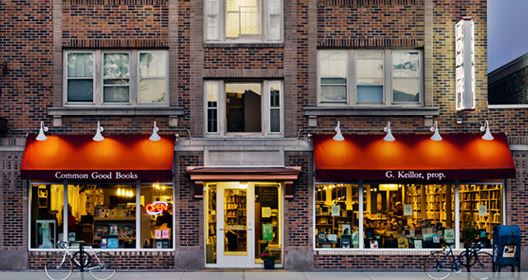 David Enyeart, the bookstore's event coordinator and assistant manager, explained that transitioning from a regional contest to a national one has been a natural evolution for the store: "Having fun and drawing some attention to poets sounds like a good day to me. But this isn't altruism. We're living up to our motto--'Live Local, Read Large'-- by showing everyone that reading and writing are important because they connect us with each other and with the whole world. That message is worth a little effort, we think."
He also noted Common Good Books "is fortunate among bookstores to have a solid base of poetry fans among our customers. So of course, we're serving them by running this contest and helping them to become better writers and readers of poetry. Last year's contest was well received here in St. Paul, and we're pleased to continue our burgeoning tradition with this year's bigger prizes.
 |
| Colin McDonald in promo video for this year's Common Good Books' Poetry Contest |
"Poetry isn't just something that Minnesotans like; it's for everyone. The more people are talking about poetry and writing, the better for all of us in the book world. If our contest sends someone into a bookstore in Wichita, Kansas, or Portsmouth, New Hampshire, looking for a writing guide or a slim volume of inspiration, we'll be happy. If a bookseller in Michigan can use our contest to lure a customer into their Poetry section, our efforts will not be in vain."
Poets, aspiring poets and even non-poets are welcome to enter. For those who need a little help, the Common Good Books tumblr features a contest advice page, where tips will be shared "on how to win at (writing) love from some of our country's best poets," including Tony Hoagland, Deborah Garrison (poetry editor at Knopf), Richard Blanco, Henri Cole, Sophie Cabot Black, Kathleen Flenniken, Jim Moore and Kristin Naca. Sage counsel on "How to Write a Love Poem" begins today with Graywolf Press executive editor Jeff Shotts.
 |
| Last year's poetry finalists on display at Common Good Books |
To enter the Common Good Books Poetry Contest, "just craft a paean to your favorite person, place, or thing. Pour your love onto the page, shape it well, and mail your love letter to Common Good Books before April 15. Fame and fortune could be yours," the organizers proclaimed.
Why snail mail entries in a digital age? The answer is both traditional and practical, according to Enyeart: "I'm going to make entrants mail us their poems because we are proponents of ink on paper and because I need a signed release so we can publish their work."
The rules:
- The contest is open to anyone living within the United States.
- The poem must be a declaration of love for a specific person, or being, or object, or place--i.e., something tangible.
- The entries must be unpublished anywhere, and the author must have full rights to the material.
- Only one entry per person.
- Entries must be mailed to Common Good Books (38 S. Snelling Ave., St Paul MN 55105), postmarked no later than April 15, 2014.
- Entries must include a signed release, available at http://commongoodbooks.tumblr.com/advice
"My dream is to spark a nationwide conversation about poetry. I'd love to see grandparents and grandchildren sitting down together and writing odes to breakfast cereal or mud puddles," said Enyeart. "I'd like to know that lovers across the country will craft slightly better text messages because they honed their skills writing poems for our contest. I want to eliminate the wrinkled noses and shy stammers that come when you say the word 'poetry' in airports and shopping malls. I want to discover the next Poet Laureate in an overlooked ZIP code.
"More realistically, we'd like to show everyone that poetry is not only something that you read, it's something that you can make. And whether a poem earns a thousand dollars or just one smile, our contest aims remind people that words on paper can change lives. As booksellers and book lovers, we're big believers in the power of words on paper to move people."
--Published by Shelf Awareness, issue #2187.
You know the feeling: irritability and listlessness resulting from long confinement or isolation indoors during winter. Diagnosis: cabin fever. Prognosis: according to Punxsutawney Phil, six more weeks. Prescription: Wendy Welch, co-owner of Tales of The Lonesome Pine bookstore, Big Stone Gap, Va., offered a delightfully vengeful Groundhog Day recipe variation on Mulligatawny, though I'd suggest we consider the medicinal benefits indie bookstores provide as warming huts.
For those who live in toastier climes, a warming hut is a small building with perpetually burning log fire. Hikers, skiers, snowshoers and their kindred winter spirits are invited to stop in and thaw out their feet for a while. There's one in the state park where I walk, and even the distant smell of wood smoke can take the edge off an arctic blast.
 During our current winter of discontent, I've also been warmed by reading cozy e-mail newsletters and social media posts from indie booksellers to counter the mind-numbing cold. Gradually, I began thinking of bookstores as warming huts, too. Here are just a few of many entries that focused on the three Cs: coping with nasty weather, communicating with snowbound customers and conjuring up snug, put another log on the fire, imagery:
Literati Bookstore, Ann Arbor, Mich.: "'A Polar Vortex is best spent inside a bookstore'--Note left on our typewriter. Even our paper snowman agrees."
WORD, Brooklyn, N.Y.: "Shake a fist at the polar vortex and warm up at our JC café with some butternut squash soup (courtesy @RomanNoseJC catering) or a mocha!"
Norwich Bookstore, Northfield, Vt.: "Our intrepid booksellers Kathryn and Katie made it to the bookstore in time to open this morning. We might close early depending on the storm, so call ahead if you are in need of reading materials today! Liza is going to hole up at home, feed the woodstove and work on the website upgrade. Enjoy the snow..."
Blue Willow Bookshop, Houston, Tex.: "If you are wondering. YES we are open! Alice and Girlboss don't take snow days. They would walk to work in the snow if they had to--Maria."
Market Block Books, Troy, N.Y.: "Is there a bookstore in your thoughts today? Come and see us!"
Rainy Day Books, Fairway, Kan.: "Looks like we are all going to be snowed in tomorrow. Any reading suggestions???... 'Snow is falling. Books are calling.' From our friends @literacykc--'That's right! Stay warm and safe on this snowy day.' "
Bank Square Books, Mystic, Conn.: "We will be open no matter what tomorrow as we have staff who can WALK to work. That's why we love being in Mystic. Not sure what the hours will be so best to check or give us a call before you come. You can also shop our website anytime or give us a call and we will deliver on Thursday, within a reasonable drive. Thanks for supporting your locally owned and fiercely independent bookstore.... We are open. I think the only store in downtown Mystic that is but don't you need a book to curl up with on this snowy wet day or some cards to write to your faraway friends?"
 |
| McLean & Eakin Booksellers, Petoskey, Mich.: "The bravest book club in Northern Michigan! The Dinner by Herman Koch got over 35 members to battle the weather this morning!" |
Northshire Bookstore, Saratoga Springs, N.Y.: "It's a snow day, but we're open. Come beat cabin fever with an Eric Carle-inspired art project from 11:30-12:30--an impromptu activity for kids ages 4-14 and their grownup assistants."
 |
| via LittleFreeLibrary.org |
Charis Books and More, Atlanta, Ga.: "L5P is still a bit of a winter wonderland but we are here and open today for all of you bookworms who are running low on reading supplies. We have decided to postpone tonight's event because of concerns about the roads after dark. Thank you!"
Joseph-Beth Booksellers, Cincinnati, Ohio (e-mail): "Snow Day! Get great deals today only! Take an extra 10% off any kids book. Free kids meal with purchase of an adult meal at Bronte Bistro. Enjoy a delicious cup of hot cocoa or specialty drink--Yum! Make this snow day special!"
"Winter is coming." That deadly long-range forecast in the first teaser trailer for HBO's Game of Thrones alerted even those of us who hadn't read George R.R. Martin's novels to the fact that in Westeros, winter lasted not for a season, but for years. Oh, the horrors! Oh, the heating bills!
And tonight, the voice of Tyrion Lannister (Peter Dinklage) in NBC's opening tease for its Olympic coverage will add symmetry to the season, blending cold fantasy with snowbound fact--skiers & groundhogs & White Walkers & Polar Vortices, Oh Myyy! (which is, coincidentally, the title of a book by George Takei, who shared a meme pic offering due tribute to Winterfell, the Stark clan and their family motto: #winteriscoming). Be not afraid, however. You will always find welcoming shelter in the closest indie bookstore warming hut.
--Published by Shelf Awareness, issue #2182.
View Next 25 Posts


