new posts in all blogs
Viewing Blog: Venetian Cat - Venice Blog, Most Recent at Top
Results 1 - 25 of 416

Cat Bauer has lived in Venice since 1998. She was a regular contributor to the "International Herald Tribune's" Italian supplement, "Italy Daily," and is the author of the novels "Harley, Like a Person" and "Harley's Ninth," published by Knopf.
Statistics for Venetian Cat - Venice Blog
Number of Readers that added this blog to their MyJacketFlap: 7
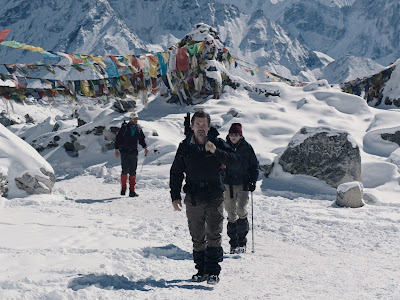 |
| Everest - courtesy of Universal Pictures |
(Venice, Italy) Baltasar Kormakur, the director of
Everest, the opening film of the 72nd Venice International Film Festival, is from Iceland, a geologically active land with erupting volcanoes, gushing geysers, as well as mountains and glaciers. Today, only about 300,000 people live on the 40,000-square-mile island, which makes Iceland the most sparsely populated country in Europe. Iceland taps into its excitable resources for energy, using geothermal energy -- heat from the earth -- and hydropower for 100% of its electricity.
Iceland was first settled by Vikings, and every time an Icelander wanders into Venice, they seem to radiate the power of a harnessed Wagner opera. During the press conference for
Everest, Kormakur was asked if the movie had any Icelandic qualities. Kormakur said, "I trained for the film every day as a kid, walking to school in a blizzard."
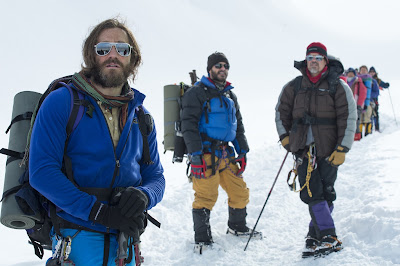 |
| Everest - courtesy of Universal Pictures |
To me,
Everest is a very Icelandic film. It is based on the real-life events of May 10-11, 1996, when eight people died attempting to summit Mount Everest, the highest point on Earth. We screened it here in Venice in 3D, which made vicariously climbing up the mountain and all its extreme challenges triply vivid, but I did not quite have the sense that I was actually there on the mountain -- you are not going to get vertigo from the heights.
It is not a blockbuster in the Hollywood sense. It is an ensemble piece, about several different adventure-for-hire tour groups and their clients climbing up Mount Everest at the same time. With all the heavy-weather gear and goggles, it is often difficult to distinguish Jake Gyllenhaal from Jason Clarke. I found myself longing for a protagonist to hold onto; someone to get to know more intimately; a hero that triumphs over all odds. There is none of that -- every character has weaknesses and strengths; every character is likable and not. No one particularly stands out.
 |
| Everest - courtesy of Universal Pictures |
When a violent storm with hurricane winds suddenly attacks the climbers on the face of the mountain, a slow realization takes place.
Everest is not another "Triumph of the Human Spirit in the Face of all Odds" at all -- it is another story entirely. It is "A Day in the Life of Mother Nature," who does not care if human beings are climbing up the face of her highest mountain on Earth. She is simply being her fabulous self, thunderbolts, lightning, blizzards and all.
That eight people died on the same day was due to many factors, the most obvious one being that too many people were trying to reach the summit of Mount Everest on the same day, and there was too much congestion at a critical point -- about as glamorous as dying on the Los Angeles Freeway. Most of the people froze to death rather undramatically -- but, again, it is a true story.
 |
| Everest - Courtesy Universal Pictures |
Why certain people have an obsession with climbing Mount Everest was not really answered; the standard "because it's there" is not a good reply. But it did cost a lot of money for the adventurers to pay for the privilege -- $65,000 back in 1996 -- and most of them were middle-aged men. Perhaps it's for the same reason why a middle-aged dentist would kill one of the world's most beloved lions for sport...
Maybe it takes a director from the Arctic Circle, the Land of the Midnight Sun and the Aurora Borealis, to tell the story of that fatal day on Mount Everest from the mountain's point of view.
Everest opens on September 18th.
Ciao from the Venice Film Festival,
Cat
Venetian Cat - The Venice BlogP.S. Jake Gyllenhaal just gave some girls a thrill by signing autographs on the red carpet!

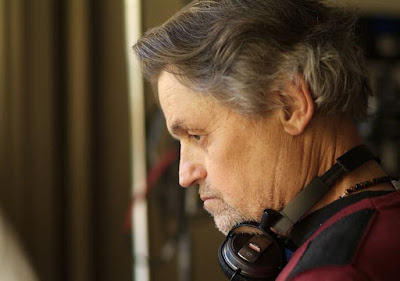 |
| Jonathan Demme |
(Venice, Italy) Jonathan Demme won the Academy Award for directing
The Silence of the Lambs, which also won Best Picture, Best Actor (Anthony Hopkins), Best Actress (Jody Foster) and Best Adapted Screenplay (Ted Tally).
The next picture Demme directed,
Philadelphia, won a Best Actor Oscar for Tom Hanks. Remember
Married to the Mob starring Michelle Pfeiffer? Directed by Jonathan Demme. How about
Melvin and Howard, that funky movie about Howard Hughes leaving his fortune to a service station owner? Directed by Jonathan Demme. One of my favorite concert movies of all time,
Stop Making Sense by the Talking Heads was directed by Jonathan Demme.
Here's a clip of the energetic and prophetic
Life During Wartime (This Ain't No Party... This Ain't No Disco... This Ain't No Foolin' Around):
(For those of you who subscribe by email, here's the link:
https://youtu.be/obAtn6I5rbY)
The latest film Jonathan Demme directed was this year's
Ricki and the Flash starring Meryl Streep. But my fondest Demme film is his first feature venture for Roger Corman, as co-writer and producer of
Angels Hard as They Come -- a bizarre, silly, surreal biker film co-written and directed by Joe Viola, who was a pal of my ex-husband back in Los Angeles. Back then, those boys had some swashbuckling imagination.
For his impressive body of work, Jonathan Demme will receive the Persol Tribute to Visionary Talent Award on September 3rd on the Lido at the 72nd Venice International Film Festival.
Alberto Barbera, Director of the Venice Film Festival, said: "Jonathan Demme is part of that generation of cinephile auteurs who revolutionized Hollywood in the Seventies. ...Colorful, exuberant, straightforward, passionate and intelligent, his cinema moves easily from studio productions to independent, fiction and documentary films, indulging his personal taste for the unexpected, for a shift in tone or genre within each individual film, which has become the original and recognizable hallmark of his style."
Jonathan Demme is totally cool.
The 2015 Venice International Film Festival runs from September 2 to 12, 2015.
Click to go to
La Biennale.
Ciao from Venezia,
Cat
Venetian Cat - The Venice BlogThis post goes out to Tom Buchan of Tombstone, Arizona. 
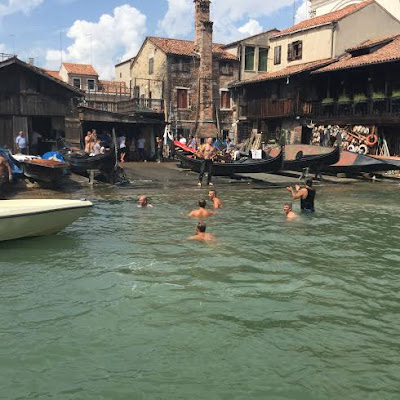 |
| Gondoliers at Squero di San Trovaso jump into Canal |
(Venice, Italy) A new gondola was born today in Venice, at the Squero di San Trovaso, which has been in operation since the 1600s; one of the oldest -- and certainly the most famous --
squeri in Venice. The work is done by hand, with a lot of clamoring and banging going on every day except Sundays.
Today, there were lots of Venetian songs being sung; lots of prosecco bottles popping; lots of splashing going on over at the Squero of San Trovaso. It was because a new gondola had just been completed, a cause for great celebration, which included jumping into the canal.
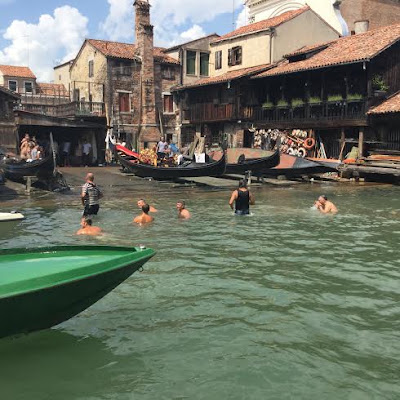 |
| A Gondola is born at the Squero di San Trovaso |
It's a wonderful tradition, much alive, still pulsing in the blood of the gondoliers. In keeping with the lazy, hazy days of Flashback Summer, here is a post from July 30, 2012:
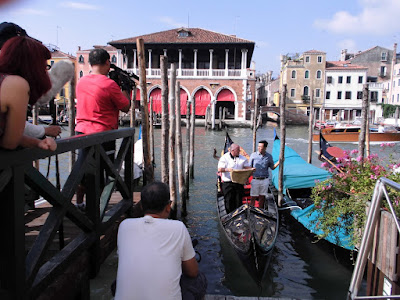 |
| Gondoliers on TV |
Bryan Wong is a television star in Singapore, and the host of a Chinese-language Mediacorp program called JOBS AROUND THE WORLD. He travels the globe focusing on unique occupations, and learns them hands-on. The Singapore branch of Kuoni Travel, a global travel company, contacted me after they read my interview with a gondolier named Simone entitled:
Conversations with a Gondolier Click the link below to continue reading:
Ciao from Venezia,
Cat

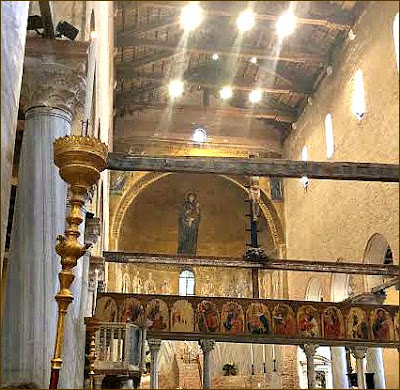 |
| Cathedral of Santa Maria Assunta |
(Venice, Italy) A little after midnight on August 15, 2015, all Heaven broke loose here in Venice. Thunder. Lightning. Hurricane winds. It was fantastic. August 15th is the day that Mary, the mother of Jesus Christ, ascended to Heaven, according to the Catholic Church. Like a science fiction story, Mary was one day on earth, and then, finished with Her earthly adventures, zoomed straight up to heaven, body and soul. It is one of my favorite holidays, which I have written about in depth several times before.
This year on August 15th, I went out to Torcello, which was founded in the 5th century -- even before Venice. I wanted to visit the Cathedral of Santa Maria Dell'Assunta; the church, established in the year 639, is specifically dedicated to Mary's Assumption into heaven. Here in Venice, we have been suffocated by a heatwave for too many weeks, which, thankfully, broke during the storms on August 15th, so the long journey to Torcello was pleasant -- even though it seemed that all of Europe had the same plan I did. Inside the church, there was a free concert in honor of the holy day, with music by Franz Joseph Haydn, Baldassare Galuppi and, of course, Antonio Vivaldi. However, one thing was missing -- no holy water! (I had to make my own:) Hopefully, next year someone will correct the situation.
Since I have written so much about
Ferragosto before (and since the whole world seems to be on vacation), I think it's time for a Flashback Summer!
From 2008: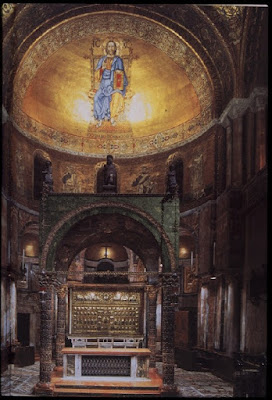 |
| Basilica of San Marco |
Yesterday, I found myself in a miraculous position -- alone, on my knees, on the high altar of the Basilica in front of the tomb of Saint Mark, the brilliant gold of the Pala D'Oro shimmering in the background.
August 15th is
Ferragosto here in Italy, and also Assumption Day, the day that Mary, the mother of Jesus Christ, was assumed into Heaven. It is an ancient pagan festival combined with a Catholic holiday.
Click to continue reading:
From 2011:
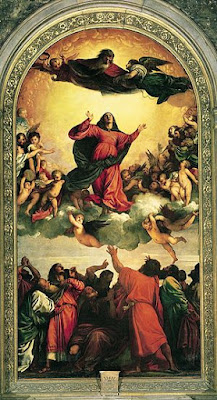 |
| Assumption of Mary by Titian (1516-18) |
The Assumption of the Blessed Virgin Mary, August 15, is one of my favorite holidays here in Italy. It is when Mary ascended into Heaven, body and soul. I went to Mass at the Basilica this morning in the company of a German woman whose father is Catholic and mother is Lutheran. She remarked that the Catholic religion is one of the few where female divinity is worshipped along with the male image of God.
Click to continue reading:
From 2013:
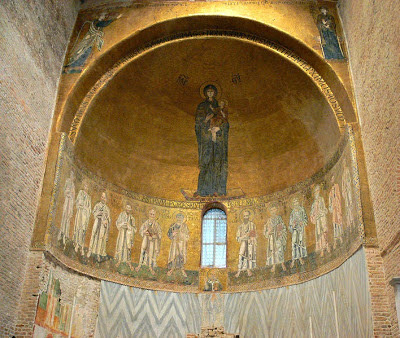 |
| Santa Maria Assunta (Interior) - Torcello |
It seems that every year August 15th is a glorious day here in Venice, both in terms of the weather and in spirit. Yesterday the temperature dropped, and we had strong winds and rain, as if the heavens themselves were sweeping the earth fresh and new for today, Assumption Day, the day that Mary Went Up to Heaven. Today it is sunny and warm, but not too hot, with plenty of pleasant, polite people, but not too crowded. Today Venice is just right.
Click to continue reading:
Happy Ferragosto!
Ciao from Venezia,
Cat

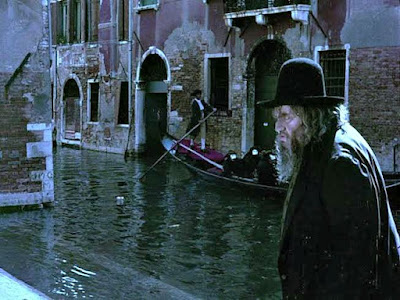 |
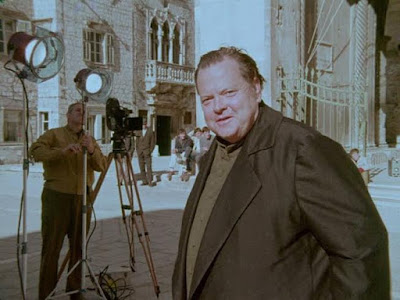
| Orson Welles as Shylock in Merchant of Venice (1969) |
(Venice, Italy) Orson Welles said "...I've always felt a special sympathy for Shylock and I've wanted to communicate that sympathy to a loving audience." In 1969, while in the middle of shooting a condensed version of
The Merchant of Venice as part of a television special,
Orson's Bag, for CBS, the network yanked the funding over tax disputes with US authorities. Welles completed the project himself, playing the character of Shylock. After a private screening in Rome, two of the three working copy reels were stolen in "some mysterious way," leaving the original negative, which had no sound. When Orson Welles died in 1985 at age 70,
The Merchant of Venice was unable to be completed the way Welles had envisioned. That is, until recently, after the original script was found, together with the composer's notes and other lost elements, and all the king's horses and all the king's men finally put Humpty Dumpty together again.
 |
| Orson Welles |
In honor of the centennial of the birth of Orson Welles -- May 15, 1915 -- two Venetian masterpieces inspired by Shakespeare will screen at the pre-opening tribute of the 72nd Venice Film Festival on the Lido. On the evening of September 1, 2015 at 8:30 PM, the world premiere of the reconstructed and restored 30-minute film
The Merchant of Venice will be shown in the Sala Darsena, along with the original full-length Italian version of
Othello.
The world premiere of
Othello was originally supposed to have been presented at the Venice Film Festival in September, 1951, but Welles withdrew it from competition at the last minute, saying it wasn't ready -- now Orson Welles' Italian version of
Othello will finally show at the Lido. A shorter English version was presented at the Cannes Film Festival in 1952, and won the Grand Prix.
The evening will also include the first live public performance by the Orchestra Classica di Alessandra of the original unpublished score for
The Merchant of Venice by the renowned composer Angelo Francesco Lavagnino, which has been transcribed from the only performance recorded for the film.
Renaissance man Orson Welles was a man gifted with many abilities. In addition to directing, acting and writing, he also dabbled as an artist.
Shakespeare & Cigars is an exhibition that features twelve studies of Shakespearean characters-- Macbeth, Othello, Falstaff, Shylock -- painted by Orson Welles on the backs of the wooden boxes of his favorite cigars.
The
72nd Venice International Film Festival, directed by Alberto Barbera, runs September 2 through 12, 2015.
Ciao from Venezia,
Cat
Venetian Cat - The Venice Blog
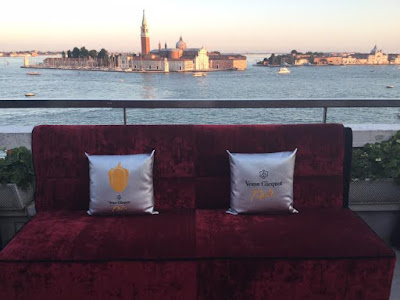 |
| Veuve Clicquot Rich Premieres on Danieli Terrace |
(Venice, Italy) The innovative Champagne, Veuve Clicquot, has been around for centuries. The favorite bubbly in royal courts throughout Europe, Veuve Clicquot is at the forefront in introducing new generations to sparkling wine. Sure to shock conservative Champagne fans and delight those open to new experiences, their latest creation, Veuve Clicquot RICH, breaks all the rules.
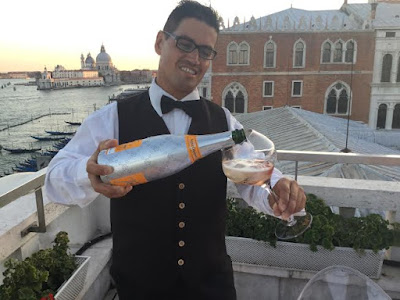 |
| Veuve Clicquot RICH on Danieli Terrace |
Served on ice, with added, selected ingredients -- like pineapple, bell pepper or cucumber -- the sweet Veuve Clicquot Rich Champagne is specifically made for mixing. With this creative mixology, Veuve Clicquot is determined to shatter the notion that Champagne is only for birthdays and New Year's Eve, hoping to transform it into a conventional drink. Last night, Veuve Clicquot Rich made its debut in Venice on the rooftop terrace of the Hotel Danieli.
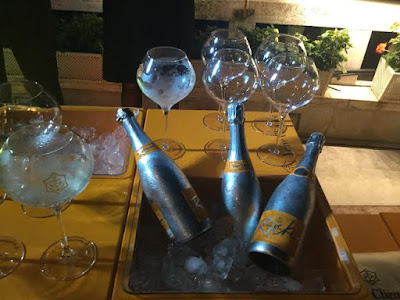 |
| Veuve Clicquot RICH |
According to tradition, the term "rich" was applied to sparkling wines because of their sugar content, which is where Dominique Demarvile, Veuve Clicquot Cellar Master, found inspiration for the new effervescent drink. The glamorous bottle was wrapped in elegant silver foil; the serving glasses were big and bold.
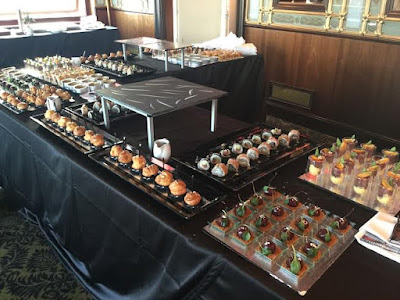 |
| Nibbles at the Danieli Terrace |
The buffet featured lots of fish, much of it raw, including sushi, which I gorged myself on. I love sushi smothered with wasabi, and was given my own scoop so I could indulge. The food was a perfect complement to the sweet Veuve Clicquot Rich -- in fact, I preferred drinking it to Japanese beer.
 |
| Veuve Clicquot Rich Venice debut crowd on Danieli Terrace |
The guests all seemed to enjoy the evening, judging by the quantities of Rich and food consumed. I chatted with the under-30 crowd, who agreed they preferred Veuve Clicquot Rich to "regular" Champagne. The nifty little booklet that accompanied the launch encourages you to become your own mixologist, and includes different recipes you can experiment with.
Veuve Clicquot Rich is one of the exclusive new brands unveiled by LVMH that celebrate the summer season. In Venice, Rich is available only at the Hotel Danieli until the end of the year. Go to
Veuve Clicquot Rich for more information.
Ciao from Venezia,
Cat
Venetian Cat - The Venice Blog
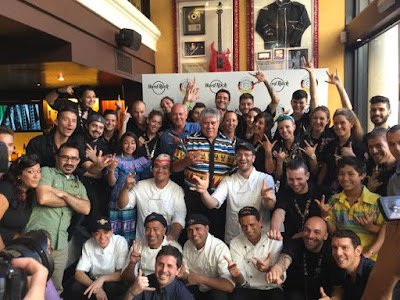 |
| Chief James Billie (center) with Hard Rock Cafe staff in Venice |
(Venice, Italy) Chief James E. Billie, Chairman of the Seminole Tribal Council, is a colorful character -- gutsy, outspoken, warm and sincere, a Native American whose culture rings from his heart. Leader of the only unconquered Native American Tribe in the United States, the Seminole Tribe of Florida, who own Hard Rock International, Chief Billie served 22 years as Chairman/President of the tribe, from 1979 to 2001, "the longest tenure of any elected leader in the Western Hemisphere, other than Fidel Castro." The Seminoles are the only tribe that never signed a formal peace treaty with the United States.
Chief Billie's mother belonged to the Bird clan; his father was was a white sailor who went to Europe during WWII without knowing of the pregnancy. As an infant, Seminole medicine men wanted to kill Jim Billie the traditional way -- by stuffing mud in his mouth and leaving him to die in the Florida Everglades -- because he was a half-breed. His mother, Agnes Billie, who died when he was nine, and Betty Mae Tiger Jumper, another half-breed -- who went on to become the first and only tribal chairwoman -- put a stop to it. To earn money, Jim Billie went on to wrestle alligators for tourists, as well as build chickee huts.
Chief Billie is one of the people responsible for giving birth to the Indian gaming industry in the United States by pushing through a contract to operate high-stakes bingo on the Seminoles' Hollywood reservation in 1979, and then leading the tribe when it won a US Supreme Court 1996 decision upholding the sovereign rights of tribes to conduct gaming on their reservations. Like many Indian tribes, the Seminoles were heavily dependent on federal welfare, which Billie believed were used to keep Indians "down, uneducated, inexperienced in the business world."
When the money started gushing in, Chief Billie became a thorn in the side of the Florida government and big business, insisting on behaving like a Native American by refusing to put toxic dumps and landfills on Seminole land, and being uncooperative about pipelines, flight paths, roads and telephone towers. No American Indian has been more investigated by the US government than Chief Billie-- including by the FBI and the IRS -- yet no agency has brought a single criminal charge against him. When he started to criticize his fellow councilmen's spending habits, and brought in an outside administrator, Chief Billie rankled the Seminole ranks, who began to block him. However, what actually brought him down was a woman scorned, who later said she had been coerced into filing suit against Billie for sexual misconduct by other Seminole leaders. Chief Billie was impeached by the Seminole Council in 2001, and started, once again, to build thatched chickee huts in South Florida, waiting for his opportunity to make a comeback.
 |
| Hamish Dodds, Chief Billie & Pablo Castrogiovanni - Hard Rock Cafe, Venice |
In 2011, at age 67, James E. Billie defeated Mitchell Cypress, the previous two-term chairman, by a landslide to return, once again, as Chairman of the Seminole Tribe... which is why he was here in Venice at the Hard Rock Cafe on Monday, July 27 -- which also happened to be my birthday.
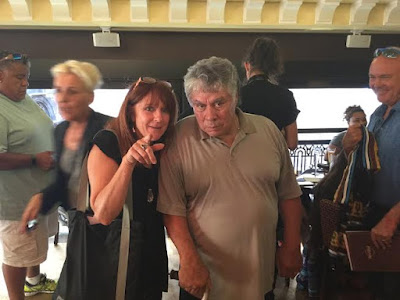 |
| Cat Bauer with Seminole Chief Billie at Hard Rock Cafe, Venice |
With James E. Billie was Hamish Dodds, Hard Rock International President and CEO, as well as Chief Billie's wife, Maria, 13-year-old son, Eecho, 12-year-old daughter, Aubee, and other members of the tribe including Josh John, Nancy Willie, Danny Tommie and Trishana Storm, a descendant of George Storm, the man who had taught Jim Billie how to wrestle alligators. It was a tight group.
As President and CEO of Hard Rock International, Hamish Dodds, a Scotsman, oversees all aspects of the global enterprise, and is responsible for strategic development. Previously, he worked as CEO for Cabcorp, and then in the upper ranks of PepsiCo. He said that Italy was a very, very important market for Hard Rock, and spoke of the passion the Seminole owners have for their own brand. Dodds said that it was not easy to do business in Italy, but that he thought that Prime Minister Matteo Renzi was trying to make it easier.
Dodd said he had been looking into investing in the casino here in Venice for about five years, but back then the environment was not conducive. Hard Rock is interested in buying the casino out by the airport and turning it into a Hard Rock Casino. When it comes to Ca' Vendramin Calergi, the casinò here in Venice on the Grand Canal -- the world's oldest casino -- Dodds said it was a beautiful, historic building that needed to be preserved, and they would be interested in an operating partnership with Venice, but do not want to put the Hard Rock name on it.
At that point I was bursting with excitement -- I had come to the conference hoping for the opportunity to discuss just that topic, and here the CEO of Hard Rock was presenting it himself! To me, if the Hard Rock transformed the casino by the airport into a Hard Rock Casino, yet was behind the scenes at Ca' Vendramin Calergi, it would bring much needed wealth and positive energy to Venice. Venetians and Seminole Indians under the leadership of Chief James E. Billie are a good fit. I THINK THIS IS A FANTASTIC IDEA.
 |
| Seminole Indians at Hard Rock Cafe, Venice |
Chief Billie then told the story of how he had always loved rock and roll, especially Eric Clapton and Jimi Hendrix, and plays himself (he was even nominated for a Grammy for his song, "Big Alligator"). He got back from serving in Vietnam, and kept seeing Hard Rock Cafe tee-shirts everywhere. So he bought a tee-shirt. Then, his tribe opened the first high-stakes bingo on the land of a sovereign Indian nation, and they got some money. One day he found himself sitting next to a guy named Pete on a first-class plane trip, who ended up being Peter Morton, who, together with Issac Tigrett, had founded the Hard Rock Cafe. They spoke about doing business together -- Chief Billie said he thought something along the lines of Hard Rock garb and a franchise, nothing like buying the company, which happened when he was not on the council.
Several times Chief Billie said how grateful and thankful he was. He taught us the Seminole word "Sho Na Bish," which means "thank you," and wants to put that on all the Hard Rocks, too, in addition to the LOVE ALL - SERVE ALL put there by Issac Tigrett.
When the conference was over, Hamish Dodds said that anyone -- the press, the employees, the kitchen staff, anyone -- could ask them anything. He was immediately interrupted and told that a list of questions had already been prepared. He responded that it would lose the spontaneity, but acquiesced. They were then asked several innocuous questions by the translator; for example, to Chief Billie: 'Why do you think the word "Hard Rock" is so successful, and what do you like about it?" To which he replied, "You can probably answer that yourself," and then went on to say it was a romantic word, a sexy word.
 |
| Maria, Chief Billie's wife, and Cat Bauer |
Chief Billie also spoke about how much he loved his wife, Maria, and how grateful he was that she was here with him. He said that the Seminoles were good hunters, and that now they hunt for businesses instead of animals. He said that running into Hard Rock was a good hunt.
Chief Billie ended the conference by saying that back when the Seminole used to fight the military that they called themselves the unconquered, and that he had discovered that Venetians call themselves unconquered, too. Then he exclaimed: "Sho Na Bish!"
From the press notes:
With a total of 202 venues in 64 countries, including 154 cafes, 21 hotels and 10 casinos, Hard Rock International is one of the most globally recognized companies. Beginning with an Eric Clapton guitar Hard Rock owns the world's greatest collection of music memorabilia, which is displayed at its locations around the globe.Visit www.hardrock.com for more information.Ciao from Venezia,
Cat
Venetian Cat - The Venice Blog
 |
| Juditha Triumphas directed by Elena Barbalich at La Fenice |
(Venice, Italy) The third edition of
The Spirit of the Music of Venice concluded last night after zapping the beginning of summer with some profound and impressive events. Organized by the Teatro La Fenice, in collaboration with the University of Ca' Foscari and the Conservatorio Benedetto Marcello, this year focused on Venice as the center of cultural, musical, economic and philosophical exchanges between the different civilizations and cultures of the Mediterranean and the Middle East. Here are a few selected events:
 |
| Judith Triumphs directed by Elena Barbalich at La Fenice |
Judith Triumphs by Venetian hometown composer Antonio Vivaldi was performed for the first time in Venice in 1716 in the Church of the Pieta by the all-female singers of the Church of the Pieta. The new production at La Fenice under the leadership of hometown director Elena Barbalich was breathtaking. The lighting by hometown lighting director Fabio Barettin allowed the audience to use their imaginations to magically transport themselves to another place and time. The sets by Massimo Checchetto and costumes by Tommaso Lagattolla were exquisite in their simplicity. The La Fenice Orchestra directed by Claudio Marino Moretti was in fine form. And the singers -- again, all female -- were dynamic and authentic in their roles.
Judith Triumphans tapped into the energy from the heavens -- pure, elegant and true; I thought it was simply divine.
 |
| Mare Nostrum at Teatrino di Palazzo Grassi |
The Mare Nostrum trio presented a program entitled
From Venice to Constantinople at the Teatrino of Palazzo Grassi. The three musicians - singer Stefano Albarello on zither and lute; Giovanni De Zorzi on flute and Fabio Tricomi on drums -- delighted the audience with classical Ottoman music composed between the 17th and 18th centuries.
 |
| Ute Lemper at La Fenice |
Ute Lemper, the international German singer and actress wowed the crowd on the day of Redentore at La Fenice, belting out a trail of melancholy tunes that led from the Weimar Republic to Editih Piaf to Bertolt Brecht and beyond. In collaboration with the Venezia Jazz Festival, the program took the audience on a journey through dark and light periods in human history. My favorite was the music Lemper had composed herself using the words from the poem "Bluebird," by the troubled German-born American poet, Charles Bukowski, an artist with "a bluebird in my heart that wants to get... but I'm too tough for him, I say, stay in there, I'm not going to let anybody see you..." And Ute Lemper can play a mean brass only with her lips!
 |
| Dimitri Naiditch Trio |
The Music of the Soul of Venice ran from June 15 to July 26, and was packed with more than 40 inspiring events, ranging in a price from €220 to free, allowing Venetian residents and tourists alike to experience some exotic entertainment in unique venues.
Last night
Lo Spirito della Musica di Venezia concluded with the enthusiastic and upbeat
Mozart in Jazz by the Dimitri Naiditch Trio, led by the France-based Ukrainian pianist Dimitri Naidith, accompanied by Gilles Naturel on double bass and Athur Alard on drums. In collaboration with LVMH, the trio transformed the classical musical of Mozart and Bach into contemporary jazz. Naiditch declared that he loved Mozart and felt that he knew him, that he had a beautiful, childlike soul, and that if he were alive today he would be a jazz musician. The encore was Bach, which received a standing ovation, a perfect conclusion to the cornucopia of music living in Venice's soul.
Ciao from Venezia,
Cat
Venetian Cat - The Venice Blog 
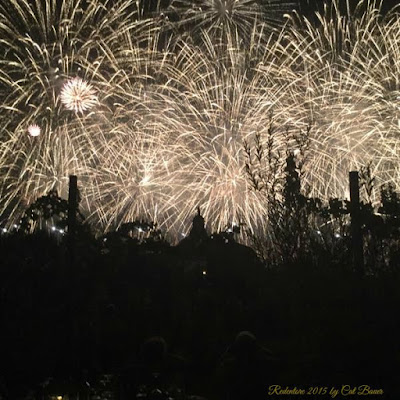 |
| Redentore 2015 - Venice, Italy |
(Venice, Italy) Venice is exploding with Venetian energy these days, with
Arlecchino - The Servant of Two Masters opening at the Goldoni Theater this past Thursday, and fireworks bursting over the lagoon last night for the Feast of Redentore.
 |
| Marco Zoppello as Arlecchino |
Giorgio Sangati, the dynamic young director of
Arlecchino, cleverly adapted Carlo Goldoni's classic 1746 comedy so that it is more accessible to contemporary audiences, yet maintains its original zest. The wild antics of Harlequin as he tries to serve two masters without each of them finding out delighted the opening-night audience, which was filled with a hodgepodge of humanity --Venetians, tourists, grown-ups and kids.
 |
| Rehearsal room press conference |
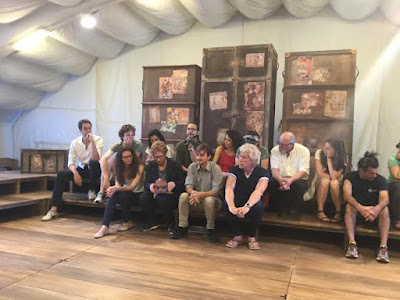
At the press conference -- held in the rehearsal room, which I just loved; it gave the whole event an extra flavor -- we got a peek into the tremendous amount of effort that had gone into creating the production. The script, the actors, the costumes, by the renowned costume designer Stefano Nicolao, the specially-designed masks by Donato Sartori of Centro Maschere e Strutture Gestuali, the music, which included old Venetian folk songs arranged by Veronica Canale, the sets by Alberto Nonnato and the lighting by Paolo Pollo Rodighiero -- all the elements of the production had been deeply researched and thought out as a team.
 |
| Marco Zoppello |
Giorgio Sangati said he wanted the audience to enter the Goldoni Theater and see a Goldoni play performed in the actual theater where the great dramatist worked. He wants tourists to have a real Venetian experience, and to know
Venice, not just Palazzo Ducale. The play is in Venetian, with English and French subtitles, so the wacky plot is understandable to a wide audience.
I thoroughly enjoyed the show. The actors were superb, the pace was quick -- there is no intermission -- and the action was easy to follow. It's a fun evening out for the whole family -- the kids were laughing harder than anyone.
Arlecchino Il Servitore di due Padroni runs all through the summer of 2015 up until October, but not every night. Click
HERE to go to the Goldoni Theater for more information.
If you are a regular reader of
Venetian Cat - The Venice Blog, you know I have written about the Feast of the Redentore nearly every year. Here is a link from 2013:
 |
| Floating bridge to the Church of Redentore |
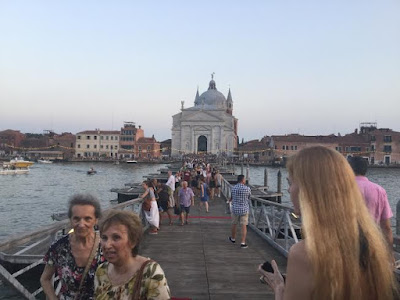
For centuries, Venice has constructed a floating bridge from the historic center to the island of Giudecca, where the Church of Redentore was built to implore the Redeemer to give relief from the deadly plague. Every year since 1577, Venice has held a celebration to commemorate the day.
 |
| On Giudecca |
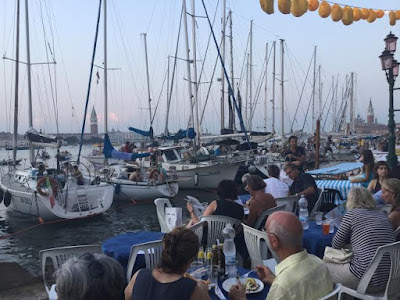
Venetians eat typical food and wine with friends and family, topped off by the best fireworks on the planet. This year the fireworks climaxed with a blazing explosion of gold that seemed to fill the entire sky with a million tiny comets. It was simply awesome.
Ciao from Venezia,
Cat

 |
| Curator Alberto Craievich with Amorino alato by Antonio Canova |
(Venice, Italy) For centuries, the Pisani dynasty was synonymous with wealth and power in Venice. The family divided into two branches in the 14th century. The Pisani dal Banco, who were located in Santo Stefano district, were responsible for building Villa Pisani in Stra, "The Queen of the Venetian Villas." Over on the other side of the Grand Canal were the Pisani Moretta, who acquired the majestic Pisani Moretta
palazzo in San Polo in 1629, one of the most impressive palaces in Venice that is still privately-owned.
The exhibition
The Pisani Moretta Family - History and Collecting at Ca' Rezzonico, home of the Museum of 18th Century Venice, allows the public a gander at some of the goodies that have passed through the famous family over the centuries.
 |
| "Palazzo Pisani Moretta (Venice)" Photo: Didier Descouens |
Like any good tale about Venetian aristocrats, the story involves a scandal over an inheritance. In 1721, at the age of 17, Chiara Pisano, the only child of Francesco Pisani, married Gerolamo Pisani of the "dal Banco" branch. Her father died in 1737, and the then 33-year-old Chiara inherited a substantial fortune. Her husband died the next year; making Chiara an enormously wealthy widow with six kids. Flush with funds (and no father or husband to accommodate), Chiara decided to restore her palace. She added a third floor complete with terrace overlooking the Grand Canal, and hired some of the most renowned artists and artisans to decorate it, including Giovanni Battista Tiepolo.
 |
| Toilet set by Augsburg silversmiths |
Meanwhile, the kids grew up. Pietro Pisani, Chiara's oldest son, married Venetian noblewoman, Caterina Grimani, an excellent catch -- her father was a Procurator of San Marco, the second most prestigious life appointment in the Republic -- after the Doge, who happened to be her uncle.
However, Vettore, Chiara's younger son, fell in love with a woman who was not a member of the Venetian aristocracy. He secretly married her, which meant that any children he had would not be eligible to be in the ruling class. Chiara stepped in, and convinced Vettore to have the marriage annulled. But it was too late -- the undesirable bride was already pregnant with Vettore's son (who would eventually be recognized and given the name Pietro Vettore). The boy-who-would-be-known as Pietro Vettore was shipped off to an exclusive boarding school in Rome.
 |
| The Pisani-Moretta Exhibition |
Chiara Pisani died suddenly in 1767, leaving her entire estate to Pietro, the eldest son, who had by then been given his father-in-law's job as a Procurator of San Marco. Unfortunately, Pietro and Caterina were childless.
However, younger brother Vettore came through and married a second, more suitable wife named Cornelia Grimani (yes, both brothers' wives had the same last name), and hopes for preserving the Pisani line were raised. Cornelia conceived, and, in 1774, had a baby... girl. Whom was named... Chiara. After her deceased grandmother.
Then Vettore died suddenly! Leaving no male heir! Except, of course, for Pietro Vettore, his first-born child from the unsuitable bride who was down in the boarding school in Rome. Uncle Pietro, the first Chiara's first-born son, was now the guardian of both his deceased brother's children -- Pietro Vettore, and his half-sister, Chiara II.
 |
| Baby carriage |
Uncle Pietro was now the lord of the Pisani-Moretta Palazzo, and he is the one who hired Antonio Canova, the famous Venetian sculptor, to execute some statues, one of which was his masterpiece "Daedalus and Icarus," which was in the entrance hall of the palace, and is now in the Correr Museum.
Meanwhile, Pietro Vettore, Vettore's son, had come of age and came barreling up to Venice from Rome, making it very clear that Uncle Pietro was going to have a battle on his hands. Pietro Vettore wanted his rightful inheritance, and hired some powerful lawyers to present his case. (Since his uncle was a Procurator, which was supposed to be the second most powerful job in Venice, this was no easy feat).
[An aside: the Office of the Procurator of San Marco was never abolished at the fall of the Republic of Venice in 1797.
It still exists to this very day. There are seven procurators these days, and they are responsible for administering the assets of the Basilica of San Marco under the authority of the Patriarch of Venice.]
 |
The Farewell between Hector and Andromache by Luca Ferrari (1605-54)
|
The legal battle began in July, 1783, and it was the Trial of the Century. The boarding school in Rome had transformed Pietro Vettore into a charming, well-bred, likable young man, and the masses were rooting for him. Not only did he win his rightful share of his father's inheritance, he also got a title -- the Count of Bagnolo, located out in the Province of Rovigo. Running low on the supply of Venice-born aristocrats, the Venetian Republic had passed a law in 1775 allowing the nobility from the Veneto
terra firma acceptance into the Venetian patriciate, so just like a real-life fairy tale, the once-unwanted Pietro Vettore was now a wealthy member of the ruling class.
Pietro Vettore made a brilliant marriage to Laura Zusto in 1785. Unfortunately, Napoleon had already conquered the Venetian Republic by that time. When Pietro Vettore died in 1847, he left his son, Vettor Daniele, as his legal heir. Vettor Daniele had five children, two of whom were male; both died young, wiping out the male Pisani line. Vettor Daniele's daughter Laura married into the noble Giusti del Giardino family, who left the Pisani Moretta palace to their Sammartini relatives in 1962, who own it today.
 |
| Pendant - Venice |
According to the Venice Civic Museum site, "the Pisani -- and their heirs -- have for more than a century sought to ensure that a number of the extraordinary works of art in their collection remain within the city of Venice." Thanks to the generous support of the heirs, about one hundred works that once belonged to the Pisani Moretta are now on display at Ca' Rezzonico through October 19, 2015, documenting not only the precious works of art that belonged to the family, but allowing a peek into the daily life of one of Venice's most prominent families.
THE PISANI MORETTA FAMILYHistory and Collecting
July 4 - October 19, 2015Ca' RezzonicoMuseum of 18th Century VeniceCLICK for more information.
Ciao from Venezia,
Cat
Venetian Cat - The Venice Blog
(Venice, Italy) Anne Teresa De Keersmaeker, the Belgian dancer, choreographer, and founder of the Rosas dance company, was the recipient of this year's Golden Lion for Lifetime Achievement for Dance awarded by the Venice Biennale. De Keersmaeker is so original that Beyoncé "borrowed" some moves to create the dance steps for her
Countdown video. Here are the two dancers side by side:
When De Keersmaeker got a Facebook message about the Beyoncé videoclip -- which is the way she learned that her work
Rosas danst Rosas had zapped its way into pop culture -- she
commented:
...People asked me if I’m angry or honored. Neither, on the one hand, I am glad that Rosas danst Rosas can perhaps reach a mass audience which such a dance performance could never achieve, despite its popularity in the dance world since 1980s. And, Beyoncé is not the worst copycat, she sings and dances very well, and she has a good taste!
On the other hand, there are protocols and consequences to such actions, and I can’t imagine she and her team are not aware of it.
To conclude, this event didn’t make me angry, on the contrary, it made me think a few things.
Like, why does it take popular culture thirty years to recognize an experimental work of dance? A few months ago, I saw on Youtube a clip where schoolgirls in Flanders are dancing Rosas danst Rosas to the music of Like a Virgin by Madonna. And that was touching to see. But with global pop culture it is different, does this mean that thirty years is the time that it takes to recycle non-mainstream experimental performance?
And, what does it say about the work of Rosas danst Rosas? In the 1980s, this was seen as a statement of girl power, based on assuming a feminine stance on sexual expression. I was often asked then if it was feminist. Now that I see Beyoncé dancing it, I find it pleasant but I don’t see any edge to it. It’s seductive in an entertaining consumerist way.
Beyond resemblance there is also one funny coincidence. Everyone told me, she is dancing and she is four months pregnant. In 1996, when De Mey‘s film was made, I was also pregnant with my second child. So, today, I can only wish her the same joy that my daughter brought me. |
| Anne Teresa De Keersmaeker & Tale Dolven |
De Keersmaeker's extraordinary performance on Saturday night, June 27, of her 1982 piece
FASE, Four Movements to the Music of Steve Reich, received a standing ovation. According to Biennale, "this piece exploded onto the scene and is still considered to have been the starting point of the contemporary dance movement that developed in Flanders during the eighties."
De Keersmaeker was born in 1960, which made her about 22-years-old when she created
Fase 33 years ago.
Fase is a sophisticated masterpiece, danced to complex phasing music created by minimalist pioneer, Steven Reich.
 |
| Before the show - Outside Teatro alle Tese, Arsenale |
To appreciate how extraordinary the evening was, we must first understand what phasing means when applied to music. According to
Wikipedia:
Phasing is a compositional technique in which the same part (a repetitive phrase) is played on two musical instruments, in steady but not identical tempi.Steven Reich experimented with this technique back in 1967 to create the first piece of the evening,
Piano Phase, which is easier to define by listening, rather than explain with words, but the folks at
Wikipedia give it a shot:
Reich's phasing works generally have two identical lines of music, which begin by playing synchronously, but slowly become out of phase with one another when one of them slightly speeds up. Reich had previously applied this technique only to sounds recorded on magnetic tape, but experimenting in his studio, he found it was possible for humans to replicate the effect. In Piano Phase, he has the two pianists begin by playing a rapid twelve-note melodic figure over and over again in unison (E4 F♯4 B4 C♯5 D5 F♯4 E4 C♯5 B4 F♯4 D5 C♯5). After a while, one of the pianists begins to play his part slightly faster than the other. When he is playing the second note of the figure at the same time the other pianist is playing the first note, the two pianists play at the same tempo again. They are therefore playing notes at exactly the same time, but they are not the same notes as they were at the start of the piece. The process is repeated, so that the second pianist plays the third note as the first pianist is playing the first, then the fourth, and so on until the process has gone full circle, and the two pianists are playing in perfect unison again. The second pianist then fades out, leaving the first playing the original twelve-note melody. They then seamlessly change to a similar melody made up of eight notes. The second piano fades in again, only this time playing a different eight-note melody at the same time. The phasing then begins again. ...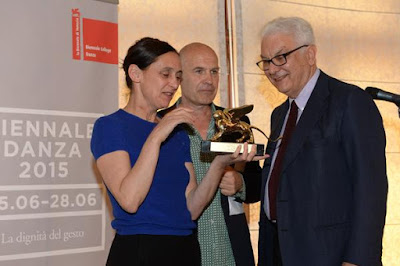 |
| Anne Teresa De Keermaeker, Dance Director Virgilio Sieni, Biennale President Paolo Baratta - Golden Lion |
Now just try dancing to that. De Keersmaeker and the more-than-20-years-younger Tale Dolven started off in unison as if they were both pendulums on two different clocks, perfectly in sync. As the dance progressed, the women spun in a circle, skirts twirling, moving slightly out of sync, as did the music, until they were directly facing each other... The mathematics and skill involved were riveting. They never missed a beat. Anne Teresa De Keersmaeker is a woman who is tapped into the mystical, sensual female energy that never grows old, but teems with eternal life. No wonder Beyoncé stole her moves.
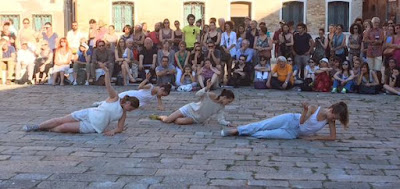 |
| Dirty Hands and Beauty by Cesc Gelabert in Campo Sant'Angelo |
Meanwhile, throughout Venice, Virgilio Sieni, the Director of the Biennale Dance Section had scattered the Biennale College of Dance throughout strategic
campi in Venice, allowing tourists and locals alike to suddenly find themselves in the audience of a performance. I was impressed with the quality of the students -- I thought most of them were not only talented, but daring and courageous.
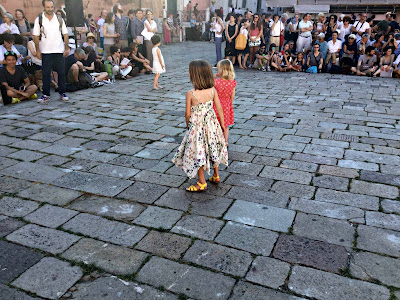 |
| Tiny dancers |
But what moved me the most was the amount of children -- the under 5-set -- that spontaneously moved into the empty
campi just before the shows, in front of the eyes of the adults, and simply started dancing.
Ciao from Venezia,
Cat
Venetian Cat - The Venice Blog
 |
| Melissa Conn & St. Mark Enthroned with Saints Cosmas & Damian, Rocco & Sebastian by Titan |
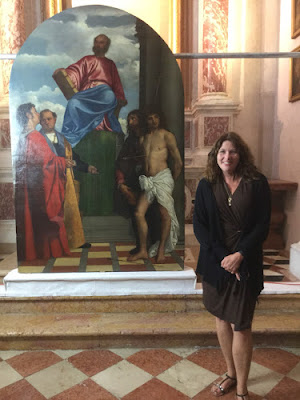
(Venice, Italy) Michelle Obama and the female contingent of her family were here in Venice on Friday, June 19, 2015, the same evening that Melissa Conn, Director of the Venice Office of
Save Venice, was honored with a Titian that had been restored in her honor.
Saint Mark Enthroned with Saints Cosmas and Damian, Roch and Sebastian was one of Titian's earliest works, thought to be his first independent commission (1508-9). The great Venetian artist lied about his age, so we are not exactly sure how old Titian was when he painted it -- he was born about 1488, so around 20-years-old, which seems astonishing given the sophistication of the work. At that time Venice was worried about being stricken by the deadly plague, which was viewed as divine punishment, so not only was Saint Mark the Evangelist evoked, but also four other saints known for their abilities to ward off illness. The painting was originally executed for the Church of Santo Spirito in Isola, but transferred to the Madonna della Salute, one of Venice's most spectacular votive churches, in 1656.
 |
| Saint Mark Enthroned with Saints Cosmas and Damian, Roch and Sebastian by Titian (1508-09) |
Saint Mark is the patron saint of Venice, of course. Saints Cosmas and Damian were twin brothers; both were doctors and, more importantly, Christians -- Christians who worked for free -- "unmercenary physicians" -- during the time when the Emperor Diocletian was targeting Christians who did not comply with Roman religious practices -- around the year 300. Diocletian was a conservative right-wing Roman who was determined to crush the expanding infidel, which, at that time, were Christians. Refusing to recant their faith, Cosmas and Damian were tortured: hung on a cross, stoned, shot with arrows and then beheaded.
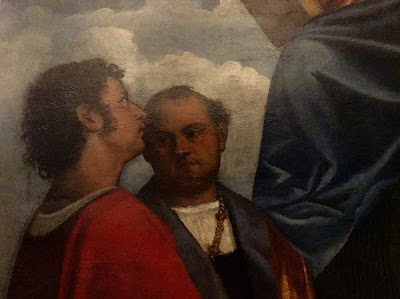 |
| Cosmas and Damian |
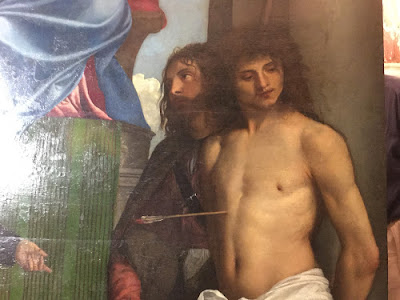
Saint Sebastian lived around the same time as Cosmas and Damian. Sebastian was one of Emperor Diocletian's bodyguards -- the emperor obviously did not know Sebastian was actually a Christian. So when Diocletian would haul in someone who would refuse to sacrifice to the Roman gods, Sebastian would convert them to Christianity on the sly. When Diocletian found out one of his own guards was converting prisoners to Christianity, he had Sebastian shot full of arrows, which is how he is often portrayed in works of art. However, Sebastian did not die. He was rescued by Irene of Rome, who nursed him back to health. Sebastian then went straight back to a staircase where Diocletian was passing and condemned the emperor for targeting Christians, which did not go over too well with Diocletian --not only was Sebastian not dead, he had not learned to keep his mouth shut. Diocletian had Sebastian clubbed to death and thrown into a sewer. As the centuries went on, people would pray to Sebastian as a defense against the plague, which is why he is in Titian's painting with the doctors.
 |
| Roch and Sebastian |
Saint Roch did not come along until about a thousand years later, around 1300. He was a French nobleman from Montpellier, the son of the governor, who gave up his worldly goods to tend to the sick. He came to Italy during the plague, and could heal the ill with just the sign of the cross or the touch of his hand. When he himself became ill, he went to the forest, where he was tended by a hunting dog who brought him bread (and eventually his owner). When he became well, Roch returned to incognito to Montpellier, where his uncle, now the governor, (not knowing who Roch was) threw him in prison for being a spy, where Roch died. But Roch, too, had become a popular figure invoked for deliverance from the plague -- even though he was not a proper saint. The Venetians brought Roch's body to Venice in 1485, where a church, hospital and confraternity were erected in his honor. Roch was not officially canonized until Pope Gregory XIV came along in 1590, so when Titan painted him in this painting around 1510, Roch was a saint-in-waiting. His body is here in Venice in the Church of San Rocco.
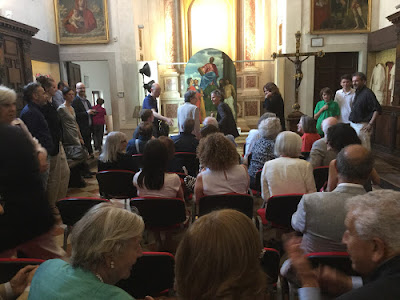 |
| Melissa Conn Honored with Titian at Salute |
Saint Mark Enthroned was restored "thanks to a contribution of David and Ellen Rosand in honor of Melissa Conn with an anonymous contribution in honor of David Rosand." David Rosand was a revered art historian who died last August, as well as the project director of Save Venice, Inc., an American organization that restores precious works here in Venice. Rosand's specialty was 16th-century Venetian art; Titian in particular.
That David and Ellen Rosand have honored Melissa Conn with the restoration of a Titian in her name illustrates the high esteem in which she is held not only within the organization, but within the city of Venice itself. Melissa herself selected which painting would be restored, which she said was a "tremendous responsibility." The powerful
Saint Mark Enthroned was a wise choice -- a compelling votive painting inside a formidable votive church. With such illustrious saints watching Saint Mark's back, the freshly-restored painting should hold the Lord's attention for another thousand years.
Meanwhile, Michelle Obama, daughters Maila and Sasha, and mother Marian, arrived in Venice after a trip out to the U.S. military base in nearby Vicenza. After visiting the Basilica and the Palazzo Ducale in Piazza San Marco, apparently they had to hole up in the Molina Stucky Hilton due to a glitch in the satellite signal that provides security for the First Lady. However, on Saturday morning (after a hearty breakfast of cereal:) they did manage to make it out to the Biennale International Contemporary Art Festival, where they met Joan Jonas, the artist of the award-winning United States Pavilion, and curator Paul Hu. Paolo Baratta, the President of La Biennale, accompanied them across the bridge for an impromptu visit to the pavilions of Syria, Egypt and Poland. Michelle exclaimed that she thought the exhibition, "amazing." She said that a lot of her friends told her that she had to see the Venice Biennale, and that she was very happy to be here.
Next it was out to Murano to visit the Cenedese glass factory, and lunch at B Restaurant (the former Vecchia Pescheria) where they enjoyed a fresh, healthy meal of local Venetian delights. Because of another satellite glitch, they were not able to go to the lace-making island of Burano, or the Cini Foundation, or the Peggy Guggenheim Collection, but returned to the Molina Stucky Hilton.
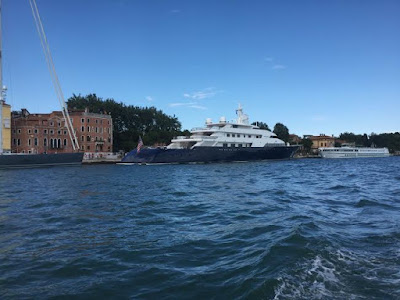
Also on Saturday, I saw a superyacht named
Limitless in the lagoon, docked over by Giardini where Michelle and the gang were visiting La Biennale.
Limitless was flying a large American flag and creating an extremely high profile. Curious, I googled the owner, who turned about to be Leslie Wexner of The Limited and Victoria's Secret fame, and the richest man in Ohio. One could spend hours reading about Les Wexner's activities, which are related to Israel, strong support for the war in Iraq, fund raising for Mitt Romney during the 2012 campaign and long ties to Jeffrey Epstein -- in other words, he did not seem to be in the Barack Obama camp. Perhaps his superyacht just happened to be in the neighborhood...
 |
| Superyacht Limitless in Venice lagoon |
Saturday night, June 20th, was also Art Night Venezia, a glorious night when many of Venice's museums and art galleries remain open late, and the town is filled with vibrant energy. Then, Michelle and the gang did manage slip out of the Stucky to take a night ride on the Grand Canal, and visit the Peggy Guggenheim Collection after it had closed to the public, where they had a chance to view the superb
Jackson and Charles Pollock exhibitions now on show.
After sprinkling American goodwill all over Venice, on Sunday morning, Michelle and the gang hopped back on Air Force Two, which was parked out at Marco Polo Airport. Michelle Obama declared that she had fallen in love with Venice, and that she would be back soon with Barack. The energy she left behind was so dazzling, it gave me a new appreciation of the subtle power the First Lady of the United States of America can wield.
Ciao from Venezia,
Cat
Venetian Cat - The Venice Blog 
(Venice, Italy) The strong words:
THE RAPE OF VENICE is the title of an installation by the Venetian photographer Andrea Morucchio on the ground floor of Palazzo Mocenigo, the former residential palace of the San Stae branch of the prolific Mocenigo family that gave Venice seven doges. Opened to the public in 1985, Palazzo Mocenigo is now part of the Civic Museums of Venice, and is dedicated to fashion, fabric and fragrance. The elegant palace was completely restored two years ago, in 2013, with the enthusiastic assistance of the Venetian Vidal family and
Mavive, their international fragrance company.
Mavive uses provocative marketing to sell some of their brands like Police, Replay and Zippo Fragrances. Mavive is also the sponsor of
The Rape of Venice by the Venetian multi-media artist, Andrea Morucchio, who was inspired by words from Joseph Brodsky's
Watermark: "To be sure, everybody has designs on her, on this city. Politicians and big business especially, for nothing has a great future than money. [...] The goal of all that is one: rape."
The installation bombards the senses. It features actual headlines like
VENICE IS SINKING UNDER A TIDAL WAVE OF CORRUPTION from international newspapers that stream by on two large screens, accompanied by a cacophony of underwater recordings of maritime traffic in the lagoon. The ancient tiled floor of the Basilica of San Marco has been reproduced and recomposed with disjointed elements. The air is filled with the scent of the Essence of Venice especially created by Mavive for the installation, inspired by Brodsky's description of utter happiness after arriving in Venice, which radiates "the smell of freezing seaweed." (I am wearing the scent right now, and it is bewitching.)
Mavive's own Marco Vidal has written an excellent essay for the slim catalogue that accompanies the exhibition, which powerfully clarifies the situation Venice finds itself in today. Here it is in its entirety:
"I have always thought that Venice could become a model city in the world for its quality of life and a human and social dimension now lost in most modern cities, where meeting in the street and sharing public spaces has become something rare and sought after.
 |
| Marco Vidal |
Having the chance to travel I have often had confirmation of this. The most advanced cities try to create pedestrian and social spaces within them. The more enlightened public administrations and town planners tend to try to create residential areas where social life is encouraged, with meeting places often enriched by fine architectural surrounds, offering museums and green 'lungs' where the external noise, pollution, advertising pressure and chaos are neutralised.
Thirty years ago this could have been the starting point for a new Venice projected toward the future; a place where this dimension already existed, enriched by a unique architectural and artistic heritage and an absolutely extraordinary environment, its lagoon.
The challenge was economic, to give the resident population prospects in terms of jobs, differentiated work sectors and fast connections with the surrounding district compatible with the speed of modern life.
Thirty years ago, for example, it would probably have been possible to convert the Porto Marghera area in such a way that it could have accommodated the many extraordinary, non-chemical production plants that were scattered throughout the Veneto region in those years of economic growth. An economy related to Venice as its vital heart, in a few words, could have been able to present us as an advanced city.
This was a big lost opportunity for Venice. The political choices of the last thirty years have focused on an economic and social model contrary to what I have described above, a model based solely on the uncontrolled exploitation of Venice's land and beauty.
The only economy to which Venice opened its doors was tourism, but without any organisational or management plan that would draw on its proper value. Year by year the uncontrolled flows have grown to a level that seems to be 30 million visitors. I say 'seems' because not even the statistical analysis of the flows has been institutionalized, perhaps to arouse less concern.
But in these last twenty years as tourism grew to the point of reaching 30 million visitors, what happened to the city of Venice? Did the tourist economy correspond to any wealth for Venice?
In the same years as the tourist boom there was a drop in the resident population from 93,000 in 1981 to 56,000 in 2014: about 40% fewer residents in the last thirty years.
Entire generations of young people born in Venice, or who have graduated from the prestigious Venetian universities, have been forced to pack their bags to find a job and a house to build themselves a future, away from Venice. Here there is no work outside the tourist sector, and the property market has surged due to the demand for holiday homes and space for tourism.
Every year tens of thousands of square metres of residential space once intended for residents have been the subject of a change of use allowed by the city council for tourist reception activities, room lets, B&Bs and hotels.
In the last three years the Venice city council has accumulated a budget deficit of several hundred million euros against the growth of the tourist economy, necessitating the cutting of some fundamental services and an increase in council taxes, which are now among the highest in Italy. The city council has for years not had the money to maintain Venice and its monuments, and has been obliged to sell its own prestige property holdings to cover only part of the hole in the balance, and to use the facades of the most significant monuments for advertising campaigns that can sustain restoration costs.
In addition to the flight of the resident population, thousands of historic Venetian activities and public and private offices have moved or closed down: all unable to maintain their base in Venice because of the property prices swollen by tourist demand and the pool of users now cut to the bone.
Alongside, commercial activities are now in the hands of big brands owned by luxury multinationals on one hand and of souvenir bazaars on the other, defined as Venetian but made in third world countries. Neither of these kinds of activity leads to any extended redistribution of local wealth; most of the goods sold in Venice to the 30 million tourists are not made in the area, residents are seldom employed in their sale and often their owner is not even a physical person.
The land is then exploited without any logic of organisation or flow distribution, with the result that Venice suffers overcrowding at various times of the year, while other parts of the council's territory have been completely forgotten: the Lido di Venezia, antique pearl of elite international tourism, is in a state of abandon; Porto Marghera, which was one of the biggest industrial areas in Europe, is now empty, does not offer jobs and is a decaying industrial desert. After thirty years Mestre is still in search of its own identity.
These are the results of political choices made and supported for decades in Venice by a local political class that has been distinguished by numerous corruption scandals, the squandering of public money on pointless public works, favours in exchange for patronage votes and insufficiency on all sides.
This political class is certainly supported by a population that is in some cases compliant, in some myopic and in others resigned, but certainly needs replacement with new lifeblood from outside.
Because of the active rejection I feel towards this model that is killing Venice, as an entrepreneur and citizen of Venice I support Andrea Morucchio's work and his political message.
It is a message that starts with the hundreds of articles in international papers dealing with Venice that genuinely report the outrage every person feels in knowing the condition towards which the most beautiful city in the world seems destined.
An exposé of the shame we feel at having to read all over the world about scandals that concern us directly, from the big ships that continue to sail undaunted through St. Mark's Basin, to the corruption of a political class that in any case continues to govern the city, and the depopulation of a city that is becoming a themed amusement park.
 |
| Venus Anadyomene by Titian (1520) |
But it is not a resigned message. Together with the artist, it is precisely the path of smell that marks a call to what is the essence of Venice and around which the future of the city must be built. This primordial perfume, extrapolated from a passage by Brodsky defining the essence of Venice as that of algae frozen in winter, a mixed green and vegetal perfume, takes us back to the natural and primordial essence of the 'Anadyomene' city, born from the water like Venus Anadyomene.
In order to create this essence we made use of a great Italian 'nose,' Maurizio Cerizza of AFM, a highly experienced master perfumer who has created hundreds of successful perfumes during his professional career. On a winter's day we accompanied him by boat to immerse himself in the smells of Venice and the most unpolluted part of the lagoon in order to perceive the same smells that inspired Brodsky's piece and recreate them for our installation. We then made a very limited production of it for those wishing to possess the 'essence of Venice.'
Morucchio's work is intended to recreate a synaesthetic atmosphere that envelops the visitors' senses, striking their sight in strong tones with the shocking headlines of international papers exposing the speculation on Venice, and their hearing with the sound of underwater recordings of maritime traffic in the lagoon. But finally, through smell, the visitor is recalled to the primordial essence of Venice, a smell that leads the mind to its water, its vegetation, its delicate and most real dimension.
And with respect for its natural dimension and appreciation of this unique heritage, the artist and all of us who worked on the project entitled
The Rape of Venice want to attract the attention and active involvement of all those who will synaesthetically experience the work in favour of Venice."
 |
| Inside Palazzo Mocenigo |
In 1900, Marco Vidal's great-grandfather, Angelo Vidal, created a small perfume laboratory at San Stae, in the center of Venice. He began by manufacturing household products, then went on to create soaps, and finally perfumes and cosmetics. In keeping with tradition, Mavive is offering 2-hour perfume composition courses inside the majestic Palazzo Mocenigo, where participants will learn the basics and then create their own scents. The €80 price of the course includes the kit and perfume, requires a minimum of six participants, and can be held in Italian, English or French. The link to book doesn't seem to be running yet, but it will be found at
mocenigo.visitmuve.it.
 |
| Venice Lagoon Bird Strikes "La Fenice" Pose |
Like Marco Vidal, I, too, have always thought that Venice could become the model city of the world, with solar-electric hybrid boats inside the lagoon, and green areas where people can relax, children can play and dogs can romp -- even a baby park like the one in the Hudson River Park in Manhattan. If the State and the City of New York can work together to create an immense 550-acre park which transformed the decrepit area along the Hudson River into something splendid, then surely the Region of the Veneto and the City of Venice can do something similar to Venice.
I recently attended a cyber conference conducted by the
International Center for Climate Governance, and was amazed to learn that Venice could have the capacity to produce its own energy due to the natural gasses produced by the salt marshes in the lagoon. Venice could even sell the energy for a profit:) The focus of the conference was:
"The importance of protecting and restoring coastal wetlands and specifically salt marshes, mangrove forests and seagrass prairies will be discussed during the seminar, using the Venice lagoon as an example. These ecosystems have a direct ability of mitigating climate change since they are able to sequester large quantities of carbon dioxide (CO2) from the atmosphere and store it in the soil (blue carbon) as organic matter and peat. Once the peat is stored underground, the preservation of these reservoirs should be a priority, since these areas, once drained and cultivated, become an important source of CO2. The example of the Bacino Zennare, a very productive agricultural area in the South basin of the Venice Lagoon, will be presented during the seminar and the hypothesis of re-wetting the basin will be discussed, also showing the results of a costs-benefits analysis."Joseph Brodsky also said that Venice is "the greatest masterpiece our species produced." Venice is a great work-in-progress, a masterpiece that needs to be restored, and then transformed into a shining example of a model city for all humanity.
The Rape of Venice runs through November 22, 2015.
Click for more information.
Ciao from Venezia,
Cat
Venetian Cat - The Venice Blog
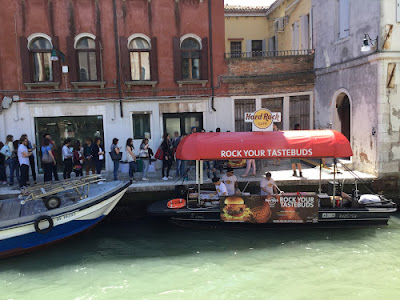 |
| Hard Rock Cafe on a boat - Free food! |
(Venice, Italy) Hard Rock Cafe was giving out free food all last week in choice locations throughout Venice as part of their World Burger Tour. Hard Rock has 199 venues in 63 countries, and encourages each location to add local flavor to the traditional burger. Here in Italy, they hooked up with Piaggio Ape, the classic Italian three-wheel light-weight commercial vehicle, to take their food to the streets. Since we've got streets made of water in Venice, they came up with a Hard Rock Cafe food boat, which traveled to five different locations and handed out mini burgers, fries and a chocolate brownie to everyone who lined up to grab some free food.
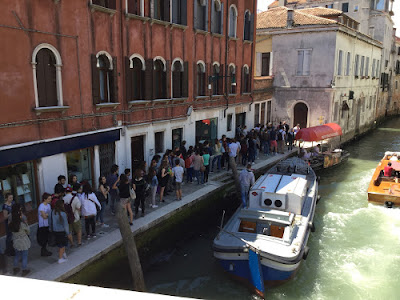 |
| Line for Hard Rock Cafe boat |
I went to the venue over by Ca' Foscari, Venice's university. The line went all the way down the fondamenta. The mood was festive; the music of a local Venetian band, Pittura Fresca, cranked over the loud speakers. The cooks were whipping up their Local Legendary Burgers on a grill designed by Electrolux Professional, who collaborated with Hard Rock.
The ingredients were local: Speck, Asiago cheese, and Radicchio from Treviso, or a tasty veggie burger with fresh toppings (I sampled both:). All the employees seemed to be from the Veneto. The only thing that wasn't local were the drinks -- Pepsi or Lipton ice tea -- but they did have an Italian beverage, Nastro Azzuro beer, who was their main partner.
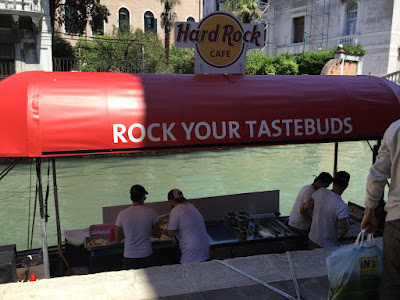 |
| Chefs at work |
So it seems that Hard Rock Cafe is actually continuing on its mission to support local businesses and encourage Venetian culture. It is a refreshing change from when Hard Rock first arrived in Venice on April 9, 2009. Back then, many employees were not Venetian at all, but from places like Naples. It seemed to be the Venice headquarters for the newly-expanded American military base in Vicenza, about 40 miles away. The United States was about to begin its surge in Afghanistan, and Venice was crawling with military personnel hopped up on warrior energy... it was drugs, sex and rock 'n roll with an added, dangerous element: soldiers. And the business of soldiers is completely different than the business of rockers. Think Altamont, when the Hells Angels ended up doing security during the Rolling Stones performance. Something like that, only with people armed with military weapons instead of knives...
Under the management of the Seminole Tribe of Florida, who had acquired the international company on March 11, 2007, the Hard Rock Cafe in Venice seemed to have gotten far away from the original inspiration of the founders, Isaac Burton Tigrett and Peter Morton, who created one of the world's largest collection of rock and roll memorabilia -- or perhaps HRC had just hooked up with the wrong locals...
After that dark beginning, the Hard Rock Cafe needed to work hard to change its image here in town. So, I'm happy to learn that they have make many positive efforts in that regard. To me, the greatest change has been in the staff. Everyone I met was charming and enthusiastic -- and from the Veneto!
The Seminole Tribe of Florida is the only Native American tribe who never surrendered to the US Army and never signed a formal peace treaty. The United States was determined to force the tribe out of Florida, and did manage to kill or drive the majority of Seminoles off their land. But a tiny group hid out in the Everglades swamp land, refusing to leave Florida. They have come a long way since then, earning revenues of $1.1 billion in 2005 after establishing tax-free smoke shops and high-stakes bingo. Their newspaper,
The Seminole Tribune, is subtitled: "The Voice of the Unconquered."
From their
website:
The Seminole Tribe is headquartered in Hollywood, Florida, near Fort Lauderdale. It is a sovereign government with an elected Tribal Council of five members. Governmental expenditures are earmarked for police and fire protection, emergency medical services, education, health care, housing, water treatment, economic development, and parks and recreation.
More than 90 percent of the Tribe’s budget is currently derived from gaming revenue. The Hard Rock International acquisition will provide additional diversification sought by the Tribal Council. Its business operations currently include cattle ranching, citrus production, tourism promotion, sports management and tobacco sales.
Nearly 3,300 Seminole Indians live on and off reservations throughout Florida. Seminoles pay taxes, serve in the U.S. Armed Forces and vote in elections. They are descended from a few hundred Seminoles that escaped into the Everglades in the mid-1800s, when the U.S. Government attempted to relocate all of Florida’s Seminoles and other Indians to Oklahoma in what became known as “The Trail of Tears.”
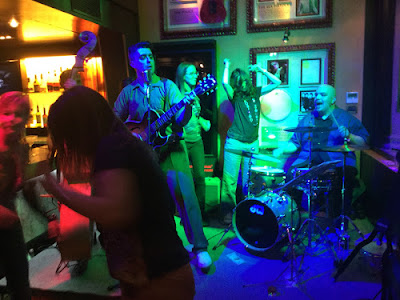 |
| Matthew Road and His Henchman |
Venetians and Seminole Indians seem born of the same spirit, so it is no wonder that the tribe rapidly changed the way they do business in town. I was invited to an American 50s night last Friday, featuring Wild Turkey Bourbon and rockabilly band Matthew Road and His Henchman, who were Italian. (I was surprised to learn that Wild Turkey is now owned by the Campari Group, an Italian company! Talk about globalization...) I kicked back with a Mint Julep (I was born in South Carolina:) to enjoy the show. It is hard for me to resist old time rock and roll, and before I knew it, I was dancing with a group of much younger women to Elvis Presley and Jail House Rock. I had a genuinely good time, and it seemed that so did everyone else. It was some good ol' American rock and roll, Italian style.
 |
| Hard Rock Cafe - LOVE ALL. SERVE ALL. |
Upstairs, over the diners' heads blazed the famous words:
LOVE ALL. SERVE ALL, the words of Sai Baba, Isaac Burton Tigrett's guru, which the Seminole Tribe inherited when they bought the Hard Rock Cafe. Tigrett said that he ran the Hard Rock Cafe business not only on that message of love, but also on Sai Baba's teaching of the five human values: Peace, Love, Truth, Righteousness and Non-violence.
It feels like the Seminole Tribe of Florida has finally gotten on the right path. And if we have an American business like the Hard Rock Cafe right in the heart of Venice, it's fitting that it's owned by an unconquered Native American Tribe.
Ciao from Venezia,
Cat
Venetian Cat - The Venice Blog
 |
| Vogalonga 2015 |
(Venice, Italy) The Vogalonga or "long row" has evolved into an international rowing event, with people who have a passion for boats that are propelled only by oars or paddles arriving in Venice from all over the world. It is one of the most beautiful days to be in Venice because there are
no motorboats allowed -- not even the vaporettos run on the Grand Canal.
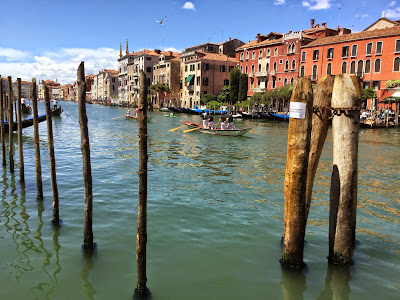 |
| Vogalonga 2015 |
Rowing clubs from the Veneto and beyond fill the lagoon with the sweet sound of oars gliding into the water. Even though there are no cars in Venice, the noise the motor boats make with their grinding engines sometimes sounds as bad as the Los Angeles freeway. On Vogalonga, the loudest noises are made by human voices and the pounding drums that keep the dragon boats on track. The silence is awesome... and inspiring.
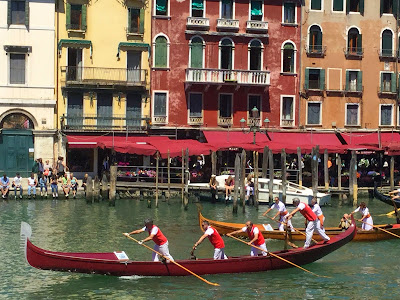 |
| Vogalonga 2015 |
The Vogalonga began 41 years ago, back in 1974. A group of Venetians who were rowing enthusiasts wanted to draw attention to how motor boats run by fossil fuel were damaging the Grand Canal and lagoon by the violent waves they made -- something that Venetians still fight to bring to the world's attention today. They decided to have a long, non-competitive race, starting in the Bacino of San Marco in front of Palazzo Ducale.
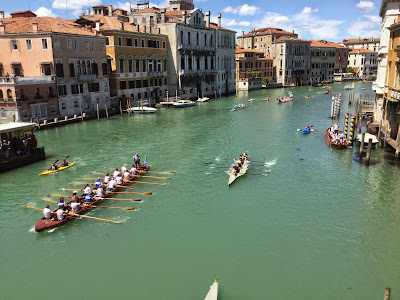 |
| Vogalonga 2015 |
The route is about 30 kilometers long (about 19 miles), winds out past the islands, and ends up on the Grand Canal -- really one of the most fantastic routes on the planet that a rower could hope to enjoy. It takes anywhere from 2 hours (if you're very fast) to 6 hours (if you want to kick back and see the scenery) to complete the race.
The event is entirely self-funded -- no sponsors, no government support -- just the €20 entry fee each rower pays to participate. These days there are thousands of participants; each year seems to set a new record.
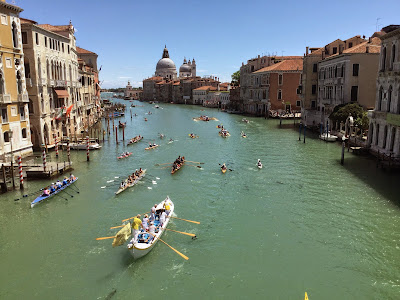 |
| Vogalonga 2015 |
For a few hours, on the day of the Vogalonga, it is easy to see how Venice came to be called
La Serenissima -- the Most Serene Republic. How peaceful and serene the world seems without gasoline motors!
CLICK to go to the official Vogalonga website.
Ciao from Venezia,
Cat
Venetian Cat - The Venice Blog
 |
| Festa della Sensa 2015 |
(Venice, Italy) Venice and the Sea have been married now for more than 1000 years. Yesterday, Ascension Day, Venice once again renewed her vows to her watery husband. I spent the weekend out on the Lido, and, for the first time, really appreciated the significance of the ceremony, which was first instituted by Doge Pietro II Orseolo more than a millennium ago.
 |
| Festa della Sensa 2015 |
On May 9, 1000, Ascension Day -- the day on which Jesus Christ had zoomed up to heaven 1000 years before -- the dynamic Doge Pietro Orseolo II sailed a fleet across the Adriatic Sea to Croatia to crush the irritating Dalmatian pirates who had been a thorn in Venice's side -- and everyone else who was trying to do business in the Adriatic Sea -- for far too long. From
Venice - The Rise to Empire by John Julius Norwich:
...the Doge heard Mass in the cathedral of S. Pietro di Castello, and received from the Bishop of Olivolo a consecrated standard [a banner believed to depict the famous Venetian emblem, the winged lion with an open book in his paws, for the first time]. Thence he proceeded in state to the harbour where the great Venetian fleet lay waiting for him, boarded his flagship and gave the signal to weigh anchor. After a night at Jesolo, the fleet came the next morning to Grado, where the Patriarch... ceremonially greeted them and invested the Doge with relics of St. Hermagoras [friend and disciple of St. Mark]. |
| Festa della Sensa 2015 |
Doge Pietro Oreseolo II succeeded gloriously in his mission, and returned in great triumph to Venice. This was a victory that needed to be commemorated. Norwich again:
...it was decreed that on every succeeding Ascension Day -- the anniversary of the fleet's departure -- the Doge, with the Bishop of Olivolo and the nobles and citizens of Venice, should sail out again by the Lido port into the open sea for a service of supplication and thanksgiving. In those early days the service was short and the prayer simple, though it asked a lot: 'Grant, O Lord, that for us and for all who sail thereon, the sea may ever be calm and quiet.' |
| Policeman patrolling on a Jet Ski |
Apparently the Lord was listening this Ascension Day, because the sea was calm and quiet, the sun was blazing, and the temperature was pleasant and warm. Venice doesn't have a Doge anymore -- right now, we are even without a mayor -- but we still have a Patriarch after all these centuries. Francesco Moraglia was installed as the Patriarch of Venice on March 25, 2012 -- Venice's birthday. That the Patriarch should still travel out to the Lido to celebrate Mass in the Church of San Nicolò (where some of the bones of St. Nicholas himself are stashed) on the Feast of the Ascension when Venice marries the sea illustrates the importance of the festival. |
| Francesco Moraglia, Patriarch of Venice - Festa della Sensa 2015 |
I have written about the Festa della Sensa before, detailing how it was ramped up into a proper marriage ceremony by Pope Alexander III in 1177 after the Venetians succeeded in coaxing Emperor Frederick Barbarossa to calm down and come to Piazza San Marco where he prostrated himself in front of the Pope and received the kiss of peace. It seems it is always a beautiful sunny day on the Festa della Sensa. Click the links below to revisit 2012 and 2013.
The Ancient and the Contemporary, the Sacred and the Profane merge once again in Venice. Today is Ascension Day, the day that celebrates the bodily ascension of Jesus Christ into heaven. In Venice, it is known as the Festa della Sensa; "sensa" is the word "ascension" in the Venetian language. Whenever Venetians get their hands on a special day, they like to pack as much power into that day as possible. So, in the morning there is the traditional Festa della Sensa celebration, and in the afternoon -- the America's Cup!
 |
| Festa della Sensa 2015 |
In one of the world's longest marriages, today Venice once again tossed her ring into the Sea, cementing a relationship that has endured for more than a thousand years. Oh, sure, there have been some quarrels, as in any intimate relationship, but Venice and the Sea have managed to endure century after century. Despite a few storms, floods and other shows of temper, Venice and the Sea always work out their differences and arrive at a state of equilibrio. It is a beautiful day here in La Serenissima, full of sunshine and good feelings -- perfect weather for a wedding.
 |
| Fort of Sant'Andrea |
With the flag of San Marco flying in the distance on the Fort of Sant'Andrea, a fortress built in 1543 on the island of Sant'Andrea century to defend Venice, it felt safe and snug to be inside the arms of La Serenissima on her wedding anniversary.
Ciao from Venezia,
Cat

 |
| Bruce Nauman - Life, Death, Love, Hate, Pleasure, Pain |
(Venice, Italy) The World of Art tornadoed into Venice last week for the preview of
ALL THE WORLD'S FUTURES, flinging colors throughout the city like a giant kaleidoscope released from its cylinder. Arsenale and Giardini were the center of the storm, where Okwui Enwezor, curator of the Biennale's 56th International Art Exhibition has gathered together a montage of artists to monitor the state of the planet.
 |
| Angelus Novus by Paul Klee (1920) |
Enwezor was inspired by
Angelus Novus by Paul Klee, and the writing of German philosopher Walter Benjamin, who owned the painting. The Angel of History is the seed of the show. Benjamin wrote:
A Klee painting named Angelus Novus shows an angel looking as though he is about to move away from something he is fixedly contemplating. His eyes are staring, his mouth is open, his wings are spread. This is how one pictures the angel of history. His face is turned toward the past. Where we perceive a chain of events, he sees one single catastrophe which keeps piling wreckage upon wreckage and hurls it in front of his feet. The angel would like to stay, awaken the dead, and make whole what has been smashed. But a storm is blowing from Paradise; it has got caught in his wings with such violence that the angel can no longer close them. The storm irresistibly propels him into the future to which his back is turned, while the pile of debris before him grows skyward. This storm is what we call progress. |
| Everything will be taken away by Adrian Piper |
I love it when the artists come to town with their divine offerings. Private palaces wake up, shops stay open late and the air is sprinkled with refreshing conversations. Creative people arrive from all over the globe to witness the birth of the exhibition. It is impossible to be everywhere you are supposed to be; you can be spirited away to someplace you never intended to go. I went to the wrong party, which was so much fun that I skipped the right one. I stumbled into
Rock & Roll Private Library over at Santa Maria Della Pieta, a hodgepodge of cool stuff collected for decades by Punk rocker Mick Jones of The Clash. Since Mick and I are the same age, he's got a lot of perfectly preserved relics from the last century that brought back personal memories --
life was so much fun!
 |
| Mick Jones & Cat Bauer - Opening of Rock & Roll Public Library, Venice |
Inside Biennale, my three favorite installations were:
1. In addition to her
Everything will be taken away series, Golden Lion winner
Adrian Piper created the Probable Trust Registry. Three young women perched behind three corporate office desks, armed with iPads. Over their heads were three statements: I WILL ALWAYS MEAN WHAT I SAY, I WILL ALWAYS BE TOO EXPENSIVE TO BUY and I WILL ALWAYS DO WHAT I SAY I AM GOING TO DO. After reading The Rules of the Game, I signed a Personal Declaration for the first two statements, which will be sealed in Piper's archive in Berlin for 100 years. I didn't sign the last statement because I thought, what if I say I am going to do something that involves other people and they don't want to do it?
2.
Oscar Murillo debuted
Frequencies, his ongoing project, which I absolutely loved. Students aged 10 to 16 around the globe have canvases fixed to their classroom desks and can doodle whatever they want on them for an entire semester. The difference in the sizes of the canvas and the wealth of the countries was impressive. Some kids shared a desk, and a line was drawn down the middle of the canvas. Some countries had lots of colors; some countries only pen and ink. A website will archive each canvas and make it searchable by country, school and age, as well as subject matter and style, illustrating both the dramatic differences and astonishing similarities across continents, races, and social status.
3.
Céleste Boursier-Mougenot's installation for the French national pavilion is
revolutions, three living trees that sing and dance while humans lounge on cushions and absorb the magic. The three Scotch pines (two outside; one inside) are mobilized by the electricity generated by the conversion of data drawn from their metabolisms -- variations in their sap flow and their sensitivity to light and shade. Part of Boursier-Mougenot's inspiration was Francesco Colonna mysterious book,
The Dream of Poliphilus, when trees morph into trans-human creatures, freed from their roots to the ground. It was so peaceful and relaxing, I could have spent all day in there, listening to the music of the trees.
ALL THE WORLD'S FUTURES runs to November 22, 2015
Ciao from Venezia,
Cat
Venetian Cat - The Venice Blog
 |
| RIGHT HAND DOD-044403 by Jenny Holzer (2007) |
(Venice, Italy)
War Paintings by the renowned American artist Jenny Holzer at the Correr Museum packs a powerful emotional punch. Holzer has spent more than a decade researching the behavior of the United States government after 9/11, using declassified and other sensitive government documents written by U.S. politicians, CIA and FBI officials, members of the U.S. Department of Defense, detainees captured by the U.S. military in Iraq and Afghanistan, and civilian victims of war. She then transformed what she learned from the heavily redacted documents about the War on Terror into haunting oil-on-linen paintings, writing with her own hands the words from the actual government documents she accessed. "I wanted the paintings to show time and care. I wanted the hand work to be an indicator of sincerity and attention. I wanted it to be human."
 |
| Gabriella Belli, Jenny Holzer, Walter Hartsarich |
Thomas Kellein, the curator from The Written Art Foundation in Frankfurt, Germany, said it was fitting that the exhibition was in Room 32, the
Sala delle Quattro Porte of the Correr Museum, because he always thought of it as "a secret city hall," and said how much he admired and respected Jenny Holzer's work.
But the words... the words... those heartbreaking words on linen... Because of the direct, personal experience I have had as an American writer living overseas targeted by our government, perhaps I know better than many civilians how horrific the behavior of the US government can be, and how extremely difficult it is to communicate such darkness to the people who live in the Land of the Free and the Home of the Brave. Jenny Holzer has done it. She feels: "the material speaks for itself; having torture seemingly normalized is not a positive development."
 |
| in (JIHAD) time by Jenny Holzer (2014) |
The exhibition is accompanied by a weighty catalogue, also created by Jenny Holzer and published by Walther Konig in Cologne, Germany, which I strongly recommend. It includes some of the redacted documents, the material that, as Hozler says, "speaks for itself." For example, a document dated July 10, 2001 from the FBI in Phoenix to Counterterrorism illustrates that they were aware long before September 11th that radical Muslims were training as pilots...
Even more than the words of those who had been tortured, what struck me were the words of the Americans themselves. Many, many Americans who love their country, and everything it stands for, tried to stop what was going on. They bravely filed official sworn statements and other documents.
After members of the special forces terrified a redacted prisoner while an interrogator had stepped outside for a break, on February 13, 2002, the interrogator wrote a sworn statement by hand: "I was very upset that such a thing could happen. I take my job and responsibility as an interrogator & as a human being very seriously. I understand the importance of the Geneva Convention & what it represents. If I don't honor it, what right do I have to expect any other military to do so?"
Another redacted document that broke my heart was a letter dated September 26, 2003 from a father "To Whom it May Concern." It starts: "I am writing this letter for my wife and myself. The purpose of this letter is to appeal to you, as a parent, for relief for my son 1st. Lt. ______ in his current situation. I understand that the U.S. Army wants to court martial him and send him to prison."
The father goes to describe himself as a basic, upstanding US citizen, in education for 30 years, appointed by Jeb Bush (?!) to a post that was... redacted. He has friends who are Congressmen. He knows the former governor of Florida. His wife had just retired after spending 17 years as the business manager of their 1000 member church.
His son had led an exemplary life, and wanted to be a career officer. On July 12, 2003, the redacted son wrote to his parents: "Needless to say the Army has made a decision, or helped me make a decision, that I will only serve for 4 years. I still love my country and have faith in her virtues, though she has none in mine. If this goes to court martial it will be broadcast over the news and my name, and yours, will be tarnished forever. You didn't sign up for that, but I did. If this happens I apologize in advance. All I ever wanted to do was to serve and protect those who loved me, and spread freedom to others less fortunate... I have brought hundreds of criminals to prison, captured countless weapons, saved lives of coalition and civilian personnel, have my life threatened on a daily basis from insurgents and criminals alike. Yet all I ever wanted was to be left alone with my platoon so I could continue doing what I love the most..."
Those words struck a deep chord. If they could do that to a soldier who obviously loves his country....
 |
| Phase IV Operations pewter Text: U.S. government document © 2007 Jenny Holzer |
Prisoners were starved, left shackled in a freezing room, left shackled in a sweltering room, sleep deprived, suffocated and beaten to death. Only the names have been redacted on several of the prisoners' autospy reports, so we can read in cold medical terminology over and over the cause of death: Homicide. After reading the actual descriptions of the harsh interrogation techniques condoned by Donald Rumsfeld and Dick Cheney -- that Cheney publicly declared he would "do it again in a minute" -- I can assure you that policy cannot be classified as anything other than torture to any civilized human being.
War Paintings is a project between the Musei Civici and the Written Art Foundation, and a Collateral Event of the 56th Venice Biennale International Contemporary Art Festival,
ALL THE WORLD'S FUTURES, which opens to the public on on May 9th and runs through November 22nd. President Paolo Baratta stated: "We know that evoking the dramatic facts and occurrences that characterise the present also means admitting history. The present, after all, demands to be understood through the signs, symbols, and recollections that history accords us and from which we draw a sense of desperation but also of illumination. It also means evoking fragments of our recent and remote past, which must not be forgotten."
Jenny Holzer is not the only artist at the international Biennale looking at the past behavior of her country in order to be present and move forward into the future, but because I am American and have personally experienced the shock of how frightening our government can be when it is out of control, it affected me profoundly.
 |
| The Dreamer by Heinrich Maria Davringhausen |
To get to the Jenny Holzer exhibition at the Correr, you must pass through another incredible exhibition called
NUOVA OGGETTIVITA brought here to Venice by the vibrant genius of Stephanie Barron, curator at the Los Angeles County Museum of Art.
NEW OBJECTIVITY addresses the Weimar Republic, the period in Germany after WWI and before WWII, which is eerily similar to our own times, and must have its own post.
Go to the Correr MuseumCiao from Venezia,
Cat
Venetian Cat - The Venice Blog
 |
Charles Pollock
Jack [Jackson Pollock], 1935
Smithsonian American Art Museum |
(Venice, Italy) Before Peggy Guggenheim proclaimed that Jackson Pollock was "the greatest artist of the 20th century," his oldest brother, Charles, sketched him strumming a banjo at age 23. For it was Charles who first left the family of five brothers to head East to New York City to study painting, inspiring his siblings to follow in his footsteps.
 |
Pollock family, Chico, California, ca. 1918
Sanford LeRoy, Charles Cecil, LeRoy, Stella, Frank Leslie, Marvin Jay, Paul Jackson.
Private collection |
There is a Pollock Party going on over at the Peggy Guggenheim Collection with three exhibitions here in Venice --
JACKSON POLLOCK'S MURAL: ENERGY MADE VISIBLE,
CHARLES POLLOCK: A RETROSPECTIVE and
ALCHEMY BY JACKSON POLLOCK: DISCOVERING THE ARTIST AT WORK -- zapping the walls of Palazzo Venier dei Leoni with the visible energy of a mid-western American family that wrote poignant letters to each other as they struggled through two World Wars and a Depression, and rocked the art world to its core.
 |
Jackson Pollock
Going West, ca. 1934-35
Smithsonian American Art Museum. |
The Charles Pollock Retrospective puts his kid brother, Jackson, in an entirely different light. Charles was born on Christmas Day, 1902; he died in 1988. Jackson was born on January 28, 1912; he died in 1956. In between there were three more brothers, Marvin (1904-86), Frank (1907-94) and Sanford (1909-63). Whenever he was asked what he would like to be, Jackson would reply, "I want to be an artist like brother Charles."
 |
Charles Pollock
Self-Portrait, 1930s
Private collection |
LeRoy Pollock, their father, was born a McCoy whose mother and sister died when he was an infant, and whose father gave him to local farmers named Pollock. LeRoy supported his family with odd jobs: farming, working as a land surveyor and a dishwasher. Stella, their mother, was a talented seamstress and weaver. Both parents were amazingly encouraging and supportive of their sons; Charles described them both as "gentle" people. Touching letters and personal photos are sprinkled throughout the exhibit. Some of Stella's potholders are on display.
 |
| Stella Pollock’s potholders |
I would suggest visiting the Charles Pollock Retrospective first, which winds its way through his life from figurative works to the abstract -- including what he worked on before and after Jackson crashed and died --and concludes with a video installation of how the haunting
Alchemy by Jackson Pollock was restored, and new revelations about how the artist worked.
 |
Jackson Pollock
Murale / Mural, 1943
The University of Iowa Museum of Art, gift of Peggy Guggenheim |
Then head over to the main
palazzo where you will find the famous
Mural that Peggy Guggenheim commissioned for her townhouse in 1943 -- the largest painting that Jackson Pollock ever created -- which "
has exerted a seismic impact on American art down to the present day" in the same room as the real-life Alchemy blazing with restored colors.  |
Jackson and Charles Pollock, New York, 1930
Private collection |
After visiting the excellent exhibitions, I think there would have been no Jackson Pollock without brother Charles first hacking down the brambles along the path.
JACKSON POLLOCK'S MURAL: ENERGY MADE VISIBLE April 23 – November 16, 2015Curated by David AnfamCHARLES POLLOCK: A RETROSPECTIVEApril 23 – September 14, 2015Curated by Philip RylandsALCHEMY BY JACKSON POLLOCK. DISCOVERING THE ARTIST AT WORKFebruary 14 – September 14, 2015Curated by Luciano Pensabene and Roberto BellucciGo to the
Peggy Guggenheim Collection.
Ciao from Venezia,
Cat
Venetian Cat - The Venice Blog 
 |
| Malamocca by Paolo Leoncini (2012) |
(Venice, Italy) Paolo Leoncini paints because he loves the raw, natural world of the Venetian lagoon, finding inspiration from the original Architect of the Universe. When he was just a small boy, he would go on fantastic adventures with his father, the artist, Marcello Leoncini, as he captured images of Venice on his sketchpad.
Paolo remembers the first solo exhibition his father had in at the Opera Bevilacqua La Masa in Piazza San Marco in August, 1947. Paolo was not yet seven-years-old, but the excitement of the opening left an indelible memory. As soon as he could hold a brush, Paolo, too, began to paint. It seemed that artistic talent ran in the family.
 |
| Cupola of San Simeon Piccolo by Marcello Leoncini (1956) |
Marcello Leoncini was born in Florence on December 9, 1905. He grew up in Sulmona in Abruzzo, Ovid's hometown, where he got his degree at the Istituto d'Arte. After his beloved mother died in 1929, Marcello made his way to Venice where he found a job working for the Water Authority as a designer. He quickly established himself on the local artistic scene, participating in a group exhibit at the Bevilacqua La Masa in 1933, where he would remain a vital presence until 1950.
 |
| La Spiagga (The Beach) by Marcello Leoncini (1948) |
In October, 1942, Marcello qualified as an art teacher and immediately quit his job working for the Water Authority. After WWII, he became an active member of the cultural association, "Gruppo dell'Arco," a group of Venetian intellectuals who sought to revitalize the cultural climate, exhibiting in the Galleria dell'Arco at the Palazzo delle Prigione. The visionary film director Pier Paolo Pasolini praised Marcello's
Ritratto d'uomo (Portrait of a Man), which won the Premio Mogliano at the Triveneta in Udine in 1947. As an artist initially from the regions of Tuscany and Abruzzo, Marcello was winning acceptance in the Veneto -- not an easy achievement.
The year 1948 started off with a bang -- Marcello was invited to participate in the 24th Venice Biennale International Contemporary Art Exhibition, as well as the Quadrennial in Rome, and the National Exhibition of Contemporary Art, "April in Milan." On November 28, 1949, the Minister of Education bought Marcello's
Natura morta con i pesci (Still Life with Fish) for the Ca' Pesaro museum, Venice's International Gallery of Modern Art.
 |
| Maternità by Marcello Leoncini (1956) |
In the 50s, Marcello disagreed with the direction the creative community in Venice was taking, and withdrew from exhibiting, concentrating instead on his students, and working in seclusion. It would not be until 1975 that he would again exhibit his work, nearly 30 years after his first solo exhibition.
In 1992, two years after Marcello's death, the City of Venice mounted a retrospective entitled,
Marcello Leoncini. Works from the '30s to the Postwar.
 |
| Paesaggio con mezzaluna (Landscape with Half Moon) by Paolo Leoncini (1978) |
Paolo Leoncini was born on December 7, 1940, two days before his father's 35th birthday. He began painting as a young boy, guided by the hand of Marcello. But Paolo was more interested in nature than in the human figures that inspired his father.
Instead of going to art school, Paolo got his degree in Humanities and became a respected critic and professor of contemporary Italian literature, while still focusing intensely on his art. Diego Valeri, the poet and literary critic, wrote about Paolo Leoncini: "in his double-act" -- artistic and critical -- "there is no trace of amateurism because his commitment is the most serious and profound of those working in these difficult fields."
 |
| Spaccato collinare (Hillside cutaway) by Paolo Leoncini (1979) |
Paolo began exhibiting in 1971. Henri Goetz, the acclaimed French American artist and engraver, delighted the crowd at Paolo's first solo exhibition in April, 1974 by making a surprise appearance at
Galleria Segno Grafico. In the same circle as Picasso, Braque, Brancusi, Kandinsky, Gonzalez, Picabia and Max Ernst in Paris, Goetz had invented carborundum printmaking, opening up another universe to artists, and Paolo had studied his method.
 |
| Lunar Carnival by Paolo Leoncini (2004) |
Throughout his life as an artist, Paolo has traveled through different mediums and methods -- black and white, colored inks, mixed, tempera, oils and engraving -- as he expanded his voyages throughout Italy and Europe, visiting hills, mountains, forests and streams, and capturing nature on his canvas.
 |
| Girasole (Sunflower) by Marcello Leoncini (1973) |
Fifteen years ago, father and son began exhibiting together for the first time. In 2010, the Galleria Perl'A in Venice presented an exhibit entitled
A Family of Artists: the Leoncini, featuring the work of both Marcello and Paolo Leoncini. In 2012, the National Museum of Oradea in Romania presented 100 works by the duo called,
Two Venetian Artists: Marcello and Paolo Leoncini. In 2014 Effata published a volume called
I due Leoncini a Venezia, which literally means "two lion cubs in Venice" -- "Leoncini" is Italian for "lion cubs" and, fittingly, the symbol of Venice is a winged lion. The volume featured 50 works by both Marcello and Paolo Leoncini, with a text by Domenico Carosso.
Now Paolo's journeys have led him to Paris where he will once again share the stage with his father, Marcello, at
La Capitale Galerie, a gallery that also represents the work of Henri Goetz. From April 28 to May 23, 2015, La Capitale presents
Marcello et Paolo LEONCINI, deux vénitiens à Paris, or Two Venetians in Paris. The vernissage is on Tuesday, April 28 at 6:00 p.m. April 28 to May 23, 2015
La Capitale Galerie18 Rue du Roule
75001 Paris, France
Tel:
+33 1 42 21 03 26This is a sponsored post.Ciao from Venezia,
Cat
Venetian Cat - The Venice Blog 
(Venice, Italy) A super-cool new 3d interactive website called the
Wonders of Venice, or Meraviglie di Venezia, Sacred and Profane Treasures in St. Mark Area launched yesterday, April 15, 2015. In 10 languages, it is the first virtual museum that zooms in on some of the stash that Venice has collected over the centuries. You can go on virtual tours, view nearly 400 virtual objects, go backstage and watch the camera drones buzz over Piazza San Marco, and visit 2 museums that no longer exist but have been reconstructed in cyber space. You can spin round and round, or fly up to the ceiling and examine an object in minute detail. They even put the statues back in the Tribuna of Palazzo Grimani!
The Treasure of San Marco is the most important treasure in the world in terms of rarity and type of objects it contains. Just the four Horses of San Marco are priceless beyond imagination. Even France returned the beloved Triumphal Quadriga, the imperial symbol par excellence, after Napoleon had plundered the astonishing horses and put them on top of the Arc de Triomphe du Carrousel. Of course, Venice herself had looted the horses from the Hippodrome when she sacked Constantinople in 1204 during its realm as the capital of the Roman Empire. The Venetians mounted the powerful quadriga on the facade of the Basilica in Piazza San Marco; there are copies there today. The original ancient horses are now
inside the Basilica, which protects them from pollution and makes them a bit more difficult to loot:)
And now to the
VOTE. Europa Nostra, "the voice of cultural heritage in Europe," has chosen
WONDERS OF VENICE: VIRTUAL ONLINE TREASURES IN ST. MARK’S AREA as a winner in the Research and Digitization category. Venice wants to win the Public Choice Award. That's where you come in. It's relatively easy to vote if you remember it is a European contest:) For instance, it says you "can" vote for 3 winners. In reality, you "must" vote for 3 winners. Just be sure that one of your votes is for Wonders of Venice, which is about three quarters of the way down the page. You can't vote for the same country twice. After the third vote, click "complete." Next fill in your name, country and email, and then confirm the email. The deadline is May 31.
GO TO EUROPA NOSTRA TO VOTEGO PLAY ON THE WONDERS OF VENICE SITECiao from Venezia,
Cat
Venetian Cat - The Venice Blog 
 |
Designer: Tapio Wirkkala
Jääpala (Chunk of Ice) - Bowl, 1950
Company: Iittala |
|
(Venice, Italy) Finland is a land of the Midnight Sun, covered with lush forests and more than 180,000 pristine lakes born from glaciers. Lapland, in the north, lies within the Artic Circle, where the reindeer roam. Helsinki is the second most northern capital in the world after Reykjavik, Iceland. In ancient times, Finns believe that each tree was ruled by a spirit, and that certain wise old trees were sacred. So it is no wonder that much of the glass designed by the Finns was inspired by ice with a touch of whimsy from the woodland nymphs.
 |
Designer: Alvar Aalto
Vase, 1937
Company: Karhula |
Bruno Bischofberger, the Swiss art dealer and gallerist, and his wife, Christina, collect glass art objects from the most important Finnish designers of the 20th century. On display for the first time in Venice are over 300 works of art that reflect the soul and spirit of the collectors -- the Bischofbergers are passionate about magical, mystical Finnish glass.
 |
Designer: GUNNEL NYMAN
Rågåkern / Ruispelto (Rye Field)
Vase, 1937
Company: Karhula |
In the early 1920s, after becoming independent from what was about to become the Soviet Union, Finland used design as its manifesto in an attempt to establish its autonomy and cultural sovereignty. Some of the country's greatest designers began to use glass to create works of art that blended tradition, experimentation and technique. Unlike Venice, Finland had no tradition of glass blowing, but it did have one important element needed to create the blaze that melts glass -- wood, and plenty of it. Finland is the most forested nation in Europe; 76% of the land area is covered with trees. The decision to concentrate on the production of glass was pragmatic for a country rich with wood but without fossil fuels and other natural resources; to hire artists, architects and graphic designers to design the glass was divine inspiration.
 |
Designer: AINO MARSIO-AALTO
Pitcher, Mug, Tumbler 1932
Company: Karhula |
Finnish glass came on the international scene in the 1930s, after five top Finnish names designed glass objects for the first time. The impulsive
Alvar Aalto (1898-1976) was Finland's most widely known architect; his realistic wife,
Aino Marsio-Aalto (1894-1949) was also an architect, and worked in her husband's office -- the two opposites balanced each other.
Arttu Brummer (1891-1951) designed furniture and glass, but was more influential as a highly-regarded teacher of design, spawning a pack of uber-cool future designers like Goran Hongell, Kaj Franck, Gunnel Nyman, Timo Sarpaneva and Tapio Wirkkala.
Goran Hongell (1902-1973) was an interior designer before becoming a pioneer in Finnish glass design. He was the very first designer hired by a Finnish glassware company, Karhula-Iittala, to give the everyday piece of glass a lift.
Gunnel Nyman (1909-1948) majored in furniture design, but started working with glass in her student years, and would become the most widely known Finnish glass artist in the late 1940s. These five designers would put Finland on the map when it came to visionary Scandinavian glass design.
Then came World War II. Once part of the Russian Empire, Finland had dicey relationships with both the Soviet Union and Nazi Germany -- it did not declare war on Germany, its former partner, until March 3, 1945 when the war was winding down; it would lose 10% of its territory to the Soviet Union. After three personal wars during the Second World War: two with the Soviet Union -- the Winter War, which the vastly outnumbered Finns fought
on skis with reindeer, and the Continuation War -- and one with Germany, the Lapland War -- Finland need good publicity to illustrate that their sympathies were with the West, and they decided to use glass as the medium. Glass was beauty; glass was hope; glass was peace.
After the war, Finnish glass design had two different perspectives: as high quality art objects and as industrial products. During the press conference, the curators, Kaisa Koivisto and Pekka Korvenmaa, said that Finns are a practical people, and an object must be useful, so a glass sculpture that served no useful purpose was greeted with skepticism. While Italy has "always appreciated beauty for beauty's sake," in Finland, "first you take care of your basic needs."
 |
Designer: KAJ FRANCK
Pitchers, 1954
Company: Nuutajärvi |
The 1950s saw the beginning of the Golden Age of Finnish glass.
Tapio Wirkkala (1915-1985),
Timo Sarpaneva (1926-2006),
Kaj Franck (1911-1989) and
Oiva Toikka (1931-) burst on the scene, creating beautiful glass sculptures that served no useful purpose, as well as industrial objects such as practical drinking glasses, but with a flair. In Finland, glass designers were considered artists; the companies they produced for used their names to market the glass; they achieved cult status. You already know who Tapio Wirkkala is because he designed this bottle:

Wirkkala began his career as a commercial artist, and served at the front during the war. After the war, he married artist Rut Bryk. In 1946, he entered the Iittala glassworks design competition and won first prize.The international Milan Triennial in Italy was the Olympics of design, attracting top designers from all over the planet, and in 1951, Wirkkala won three Gran Premios, putting himself and Finland firmly on the globe. He and his wife loved Lapland in the north, and acquired a summer residence there; the magic of Lapland had a profound influence on his work. A highlight of the exhibition is
Pilkkiavanto, or "Hole in the Ice," which the city of Helsinki commissioned in 1970 for the 70th birthday of Urho Kekkonen, the President of Finland. Wirkkala was inspired by the chunk of ice cut to form the hole for ice fishing.
 |
TAPIO WIRKKALA
Pilkkiavanto (Hole in the Ice)
Plate, 1970
Company: Iittala |
Long before Apple started making iThings, Timo Sarpaneva created the i-glass collection for Iittala division of Karhula-Iittala, which focused on Art glass, while the Karhula division of the company focused on mass production. The i-glass logo turned Iittala into a coveted brand. Like Tapio Wirkkala before him, Sarpaneva won the Gran Premio for glass design at the Milan Triennial of 1954, transforming
him into an internationally known glass artist. The Finns were the rock stars of glass design just about the same time Elvis became a rock star. Both Timo Sarpaneva and Tapio Wirkkala would go on to work with the renowned Venetian glass company, Venini, here on Murano.
 |
Designer: Timo Sarpaneva
Kajakki (Kayak) - Bowl, 1953
Company: Iittala |
During the 60s and 70s, Finnish glass focused on color and energy, like most of the rest of the world. The last designer of renown, who is still working today, is Oiva Toikka, whose fanciful
Birds became popular gift items and collectibles, and kept the Nuutajärvi glassworks in operation for several extra years.
 |
Designer: Oiva Toikka
Kiikkuri (Red-throated Diver) - Sculpture, 1975
Company: Nuutajärvi |
The Bischofberger Collection ends in 1973, when Finnish glass ceased to flourish due to international reasons. The energy crisis hit the glass industry hard, Finland and the Nordic countries in particular, which were known for handcrafted art and glass design.
 |
Designer: ARTTU BRUMMER
Bowl with lid, 1936
Company: Riihimäki |
Personally, I would love to see a time when glass designers were rock stars once again and our everyday glassware had a little touch of soul.
Ciao from Venezia,
Cat
Venetian Cat - The Venice Blog
(Venice, Italy) The Basilica of San Marco is Easter headquarters here in Venice, but it wasn't always that way. Before there was a basilica in Piazza San Marco, Venice's cathedral was located on San Pietro di Castello, an island off the eastern tip of Venice, orginally called Olivolo. Castello means "castle," and there once was a castle on the Island of Olivolo, which then morphed into the Island of San Pietro di Castello.
The first church on the island was built way back in the 7th century and was dedicated to the Byzantine saints Sergius and Bacchus, officers in the Roman army on the Syrian frontier who refused to sacrifice to the pagan god Jupiter because they were Christians, and were martyred for their defiance. The new church dedicated to St. Peter the Apostle was built in the 9th century; the one that stands today dates to the end of the 16th century.
Many years ago, when I wrote for the
International Herald Tribune's Italian supplement,
Italy Daily, I wrote a sidebar about the church, which was first published on November 8, 2002. Here it is again, slightly edited:
 |
| San Pietro di Castello by Francesco Guardi (1712-93) |
INSIDE SAN PIETRO DI CASTELLO
By Cat BauerOnce the cathedral of the Republic, this church played a central role in Venetian history. San Pietro is situated on the island of Olivolo, a name that, perhaps, originated from the numerous olive trees that once stood there. Doge Pietro Tribuno (888-912) built a castle there for the defense of the city; hence the name "di Castello."
Olivolo was the first settlement in the lagoon and was once the center of religious, commercial and political life in the city. From 775 to 1451, San Pietro was a Diocesan Church under the patriarchy of Grado, a town on the Adriatic Sea north of Venice.
In 1451, the Grado patriarch merged with the Episcopal see of Venice, and Venetian nobleman Lorenzo Giustiniani (1381-1456), who is buried in the church, was named the first Patriarch of Venice. Back in 1433, Pope Eugene IV, who was also Venetian, had made Giustiniani the Bishop of Castello. Pope Alexander VIII (1689-91), who was
also Venetian, then made him a Saint.
The current building was started during the time of Patriarch Vincenzo Diedo, dating to 1594-96, and is the result of Andrea Palladio's project, realized years after his death by his follower Francesco Smeraldi. The architect incorporated a family chapel from the late Gothic period that had been commissioned by Bishop Marco Lando (c.1425), who is buried in a tomb in the floor. The Lando Chapel boasts an impressive ensemble of sculpture and decorative elements spanning an entire millennium. The oldest work of art (dated to between the second and fifth centuries) is a decorative Roman mosaic embedded in the floor in front of the altar. The large marble slab supporting the top of the altar, carved on both sides, is from the ninth century. Other examples of Veneto-Byzantine architecture are two freestanding columns from the 11th century that were probably part of the old baptistery, flanking a bust depicting San Lorenzo Giustiniani, the first Patriarch of Venice (1381-1456). The mosaic "All Saints" altarpiece is by Arminio Zuccato from a cartoon by Tintoretto. Near the entrance to the Lando Chapel is an altarpiece attributed to Paolo Veronese, "St. John the Evangelist, Peter, Paul."
 |
| Madonna and Child with Souls in Purgatory by Luca Giordano (1650) |
The prolific Neapolitan artist Luca Giordano painted the brilliantly colored "Madonna of the Carmelites with Souls in Purgatory" inside the Vendramin Chapel. The painting was stolen in 1994, but found six weeks later in a garage in Mestre on the mainland.
The "Throne of St. Peter" made of marble with decorations in Arabic patterns and writing from the Koran was probably assembled in the 13th century, and incorporates an Arab funerary stele. Also in the right aisle is Tizanello's "God the Father Eternal in Glory." To the right of the presbytery is Pietro Liberi's masterpiece, "The Plague of Serpents," painted in 1660.
The impressive
campanile, the bell tower in Istrian stone, was almost completely rebuilt between 1482 and 1488 by Mauro Codussi, who also built the Clock Tower in Piazza San Marco.
*********************
Well, I just learned something new when I wrote this post based on an article I had written almost 13 years ago. Lorenzo Giustiniani, the first patriarch, who is buried in the church and was made into a saint, was in power when Constantinople fell to the Ottoman Empire. Giovanni Giustiniani (1418-1453) part of the Genoa branch of the family, personally financed, organized and led 700 professional soldiers to Constantinople to help defend the city, but he died after being wounded by an Ottoman cannon. Almost overnight, the Eastern capital of Christianity turned into the Islamic capital of the Ottoman Empire. Constantinople morphed into Istanbul -- and dramatically altered the core of a major Venetian trading partner. Interesting.
Ciao from Venezia,
Cat
Venetian Cat - The Venice Blog
(Venice, Italy) James Ivory was the inaugural guest at Crossroads of Civilization, Venice's International Literary Festival, which kicked off on March 25, 2015 at the Goldoni Theater. Ivory was a unique choice since he is, of course, a film director, responsible for such stellar films as
A Room with a View,
Howards End, and
The Remains of the Day which he created with his long-time partner, the producer Ismail Merchant and the Booker Prize-winning author, Ruth Prawer Jhabvala. Just those three Merchant-Ivory films were nominated for 25 Academy Awards, and won six.
Watching a Merchant-Ivory film is like having a weighty work of literature transformed into something more digestible, and Ivory gave the credit for that to Ruth. According to
Wikipedia, "Of this collaboration, Merchant once commented: 'It is a strange marriage we have at Merchant Ivory... I am an Indian Muslim, Ruth is a German Jew, and Jim is a Protestant American. Someone once described us as a three-headed god. Maybe they should have called us a three-headed monster!'"
James Ivory has such vibrant energy that I was stunned to discover he will be 87-years-old on June 7th. He is also a screenwriter; he would first write the screenplay and then give it to Ruth, who was a novelist as well as a screenwriter. Ivory said he never read the classics he should have read when he was a teenager, and that he had to read
Howards End by E.M. Forster three times because he "didn't get it." Ruth pressured him to make the film, insisting, "Let's climb that mountain."
The evening opened with a half-hour documentary called
Venice: Theme and Variations that Ivory wrote, photographed, produced and directed in the winter of 1952-53 for the thesis for his masters degree in cinema at USC with money his father gave him. He had no crew; he was just one person with a camera shooting wherever he could in Venice, and didn't include Titian or Veronese because the paintings were "too big."
He said he always had wanted to make a feature in Venice. He had the idea to set the
Aspern Papers by Henry James not in the 1880s but the 1950s, and to use the papers of Ezra Pound. He had already completed his first draft and sent it to Ruth when he fell down the stairs and broke both his legs. Then Ruth became ill. Unfortunately, the film never happened, but that is one movie I would have loved to see!
Incroci di Civiltà 2015 presented 29 authors from 21 different countries, making Venice the literary Crossroads of Civilization from March 25 to 28. Inviting international writers to share their singular perspectives of the world adds zesty ingredients to the rich stew that is Venice.
COUNTRIES
Armenia, Belgium, Brazil, China, Colombia, Korea, Cuba, Denmark, France, Germany, Jamaica, Great Britain, Iran, Italy, Kenya, Holland, Poland, Portugal, Russia, United States, and Taiwan.
WRITERS
Sergio Álvarez from Columbia
Mathieu Amalric from France
Ana Luísa Amaral from Portugal
Li Ang from Taiwan
Sascha Arango from Germany
Antonia Arslan from Italy/Armenia
Jerry Brotton from Great Britain
Roberto Costantini from Italy
Francesco Cataluccio from Italy
Patrick Deville from France
David Foenkinos from France
Stefan Hertmans from Belgium
James Ivory from the United States
Billy Kahora from Kenya
Hanif Kureishi from Great Britain
Lucio Mariani from Italy
Shara McCallum from Jamaica
Kim Min-jeong from Korea
Mahsa Mohebali from Iran
Mark Mustian from US/Armenia
Vladislav Otrošenko from Russia
Víctor Rodríguez Núñez from Cuba
Tatiana Salem Levy from Brazil
Morten Søndergaard from Denmark
Agata Tuszyńska from Poland
Ludmila Ulitskaya from Russia
Tommy Wieringa from Holland
Wu Ming 1 from Italy
Xu Zechen from China
Click to go to Incroci di Civiltà 2015Ciao from Venezia,
Cat
Venetian Cat - The Venice Blog
 |
| Vishwa Mohan Bhatt |
(Venice, Italy) Vishwa Mohan Bhatt, the virtuouso Indian musician, plays the mohan veena, a modified slide guitar he invented himself that sings the music he hears from the heavens. Vishwa believes that "music is the language of God for the benefit of mankind." On Thursday evening at the Giorgio Cini Foundation, God sang to the enthusiatic audience through Vishwa's mohan veena, accompanied by Krishna Mohan Bhatt on the sitar and Nihar Metha on the tabla, the drums.
Classical Indian music first hit the Western world big time in 1965 when the Beatles recorded John Lennon's
"Norwegian Wood" for
Rubber Soul, and George Harrison played his newly-acquired sitar. In 1966 George Harrison studied sitar with the legendary Ravi Shankar, and then in 1968 all the Beatles and their women went off to India to study Transcendental Meditation with the Maharishi. During their stay, they wrote a bunch of songs which made it onto the
White Album and
Abbey Road. A spiritual craze for all things Indian set the planet on fire, affecting me deeply on a personal level -- I listened to Indian music to the point of obsession, had a copy of the Bhagavad Gita on my nightstand and wrote my high school term paper on reincarnation. So when I heard that the Intercultural Institute for Comparative Music Studies, the IICMS, which is one of the Giorgio Cini Foundation's institutes, was featuring the mohan veena and sitar, I had to go.
Vishwa Mohan Bhatt is a pandit, which is a wise or learned man. He, too, is a disciple of Ravi Shankar, as is sitarist Krishna Mohan Bhatt (I have not confirmed how they are related; I think they are cousins). Vishwa explained that a raga -- the musical structure -- in classical Indian music is connected to nature and human emotions, and associated with different times of day. The musicians improvise the notes within the raga as they play. Since it was evening when the concert began, Vishwa, Krishna and Nihar Metha played an Evening Raga, which left the audience transfixed.
Someone said the mohan veena was "dobro meets sitar," and that is just what it sounds like. I thought it was amazing that Vishwa created an instrument to express the music he feels inside, a kind of blues guitar with Indian zest. (I just discovered we share the same birthday, July 27; it feels like music made by a Leo.) Here's a
YouTube clip so you can hear the mohan veena yourself:
From the
Giorgio Cini Foundation:
Founded in 1970 by Alain Daniélou, and subsequently directed by Ivan Vandor and Francesco Giannattasio, the Intercultural Institute of Comparative Music Studies (IISMC) promotes knowledge about some of the finest forms of expression in various musical cultures by organising courses, workshops, concerts, seminars, conferences and publications.One of the magical things about living in Venice is that you can visit another world, another time and space, just by taking the boat across the canal.
Ciao from Venezia,
Cat
Venetian Cat - The Venice Blog
View Next 25 Posts


.jpg?picon=1499)


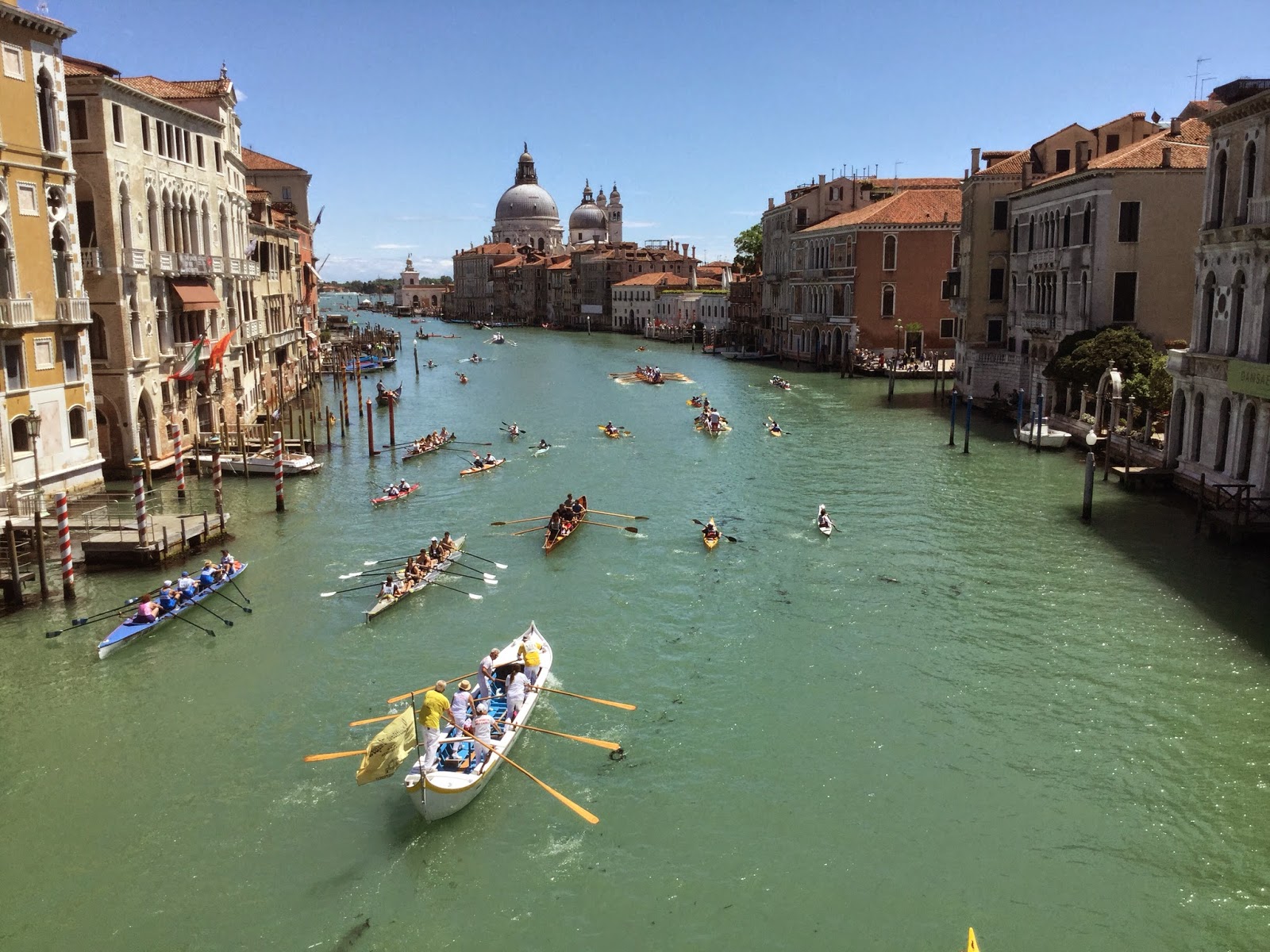


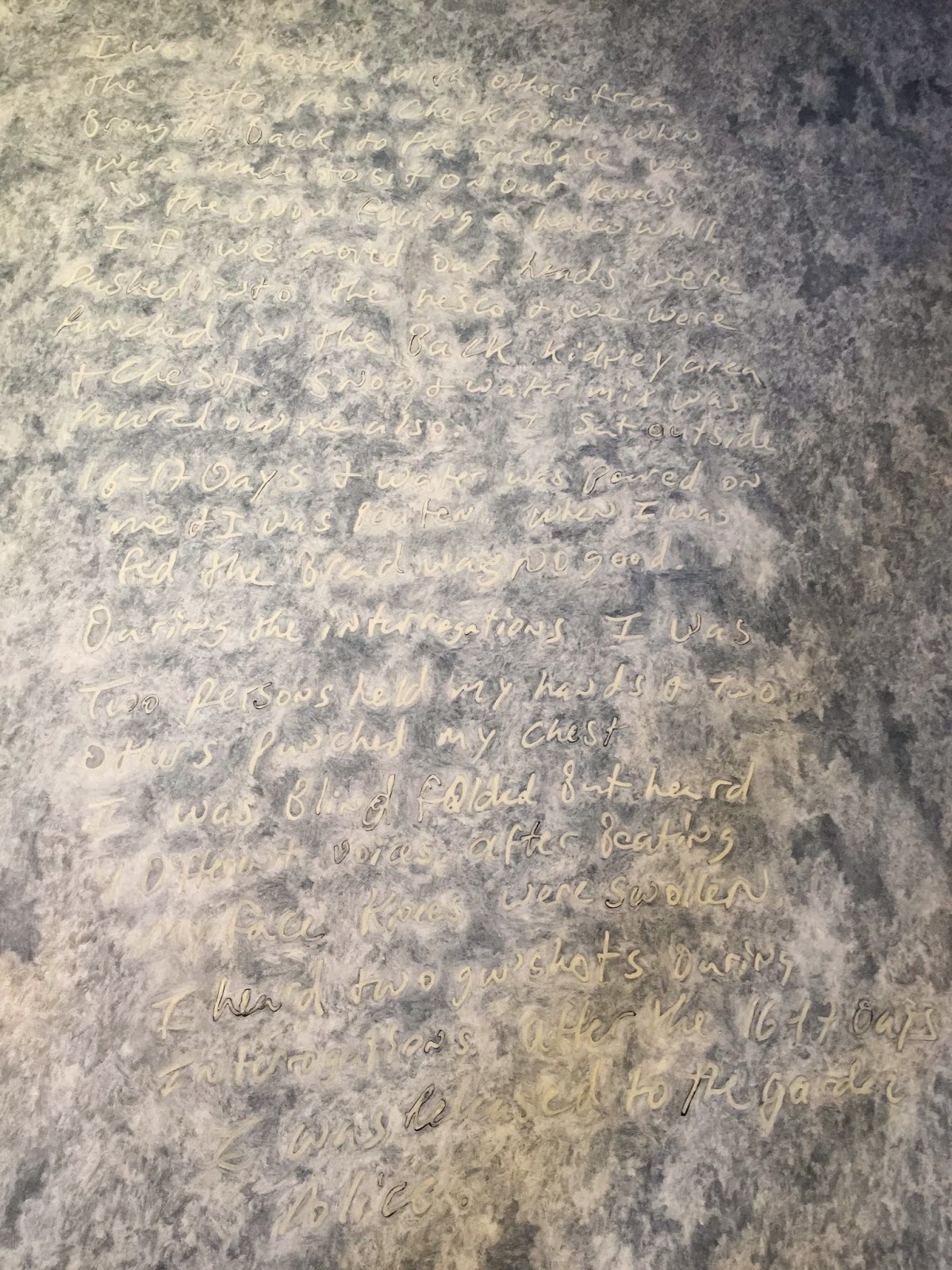

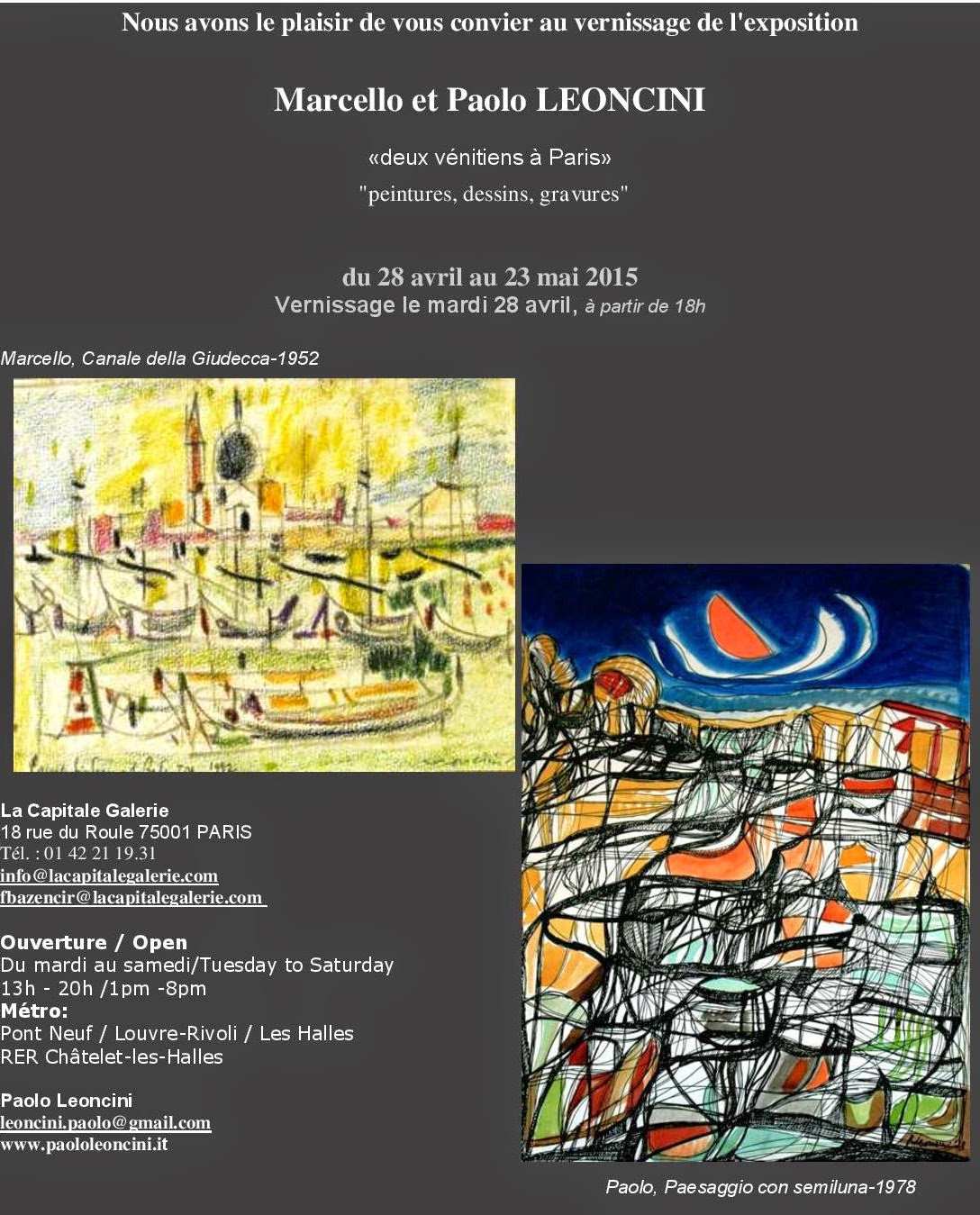


.jpg)