


If your young independent reader is looking for a great read with a wonderful girl protagonist, or maybe she's looking for a new series to latch onto, you can't go wrong with either of these two books or their prequels.
Add a Comment
new posts in all blogs
 By: Rebecca (Becky) Fjelland Davis,
on 3/3/2014
By: Rebecca (Becky) Fjelland Davis,
on 3/3/2014
Blog: Becky's Blog (Login to Add to MyJacketFlap)
JacketFlap tags: Marla Frazee, Sara Pennypacker, Clementine, Add a tag
 By: Jen Robinson,
on 2/18/2014
By: Jen Robinson,
on 2/18/2014
Blog: Jen Robinson (Login to Add to MyJacketFlap)
JacketFlap tags: Reviews, Newsletter, field trip, Early Elementary School, clementine, marla frazee, sara pennypacker, Add a tag


 Add a Comment
By: Jen Robinson,
on 9/17/2013
Add a Comment
By: Jen Robinson,
on 9/17/2013
Blog: Jen Robinson (Login to Add to MyJacketFlap)
JacketFlap tags: Baby Bookworm, penderwicks, harry potter, children's books, middle grade fiction, Book Lists, chapter books, laura ingalls wilder, Late Elementary School, pippi longstocking, Early Elementary School, book series, clementine, read-aloud, Add a tag
 Add a Comment
 By: Darcy Pattison,
on 12/13/2012
By: Darcy Pattison,
on 12/13/2012
Blog: Darcy Pattison's Revision Notes (Login to Add to MyJacketFlap)
JacketFlap tags: humor, show don't tell, how to write, reader, openings, clementine, novel revision, Add a tag


 Add a Comment
 By: Betsy Bird,
on 5/21/2012
By: Betsy Bird,
on 5/21/2012
Blog: A Fuse #8 Production (Login to Add to MyJacketFlap)
JacketFlap tags: Uncategorized, Sara Pennypacker, Clementine, Top 100 Children's Novels Poll, Add a tag
 By: Mary Lee,
on 9/21/2011
By: Mary Lee,
on 9/21/2011
Blog: A Year of Reading (Login to Add to MyJacketFlap)
JacketFlap tags: wisdom, Clementine, Add a tag

Clementine and the Family Meeting
by Sara Pennypacker
illustrated by Marla Frazee
Disney*Hyperion, 2011
This is the fifth book in the Clementine series, and I like Clementine more than ever. I like her parents more than ever, I like her teacher, Mr. D'Matz more than ever, and even her makeup-obsessed friend Margaret is a little easier to deal with in this book.
I love that the characters in this series continue to grow and change.
But the thing I love most about the Clementine books is the wisdom that Sara Pennypacker weaves in so unobtrusively.
In this book, Clementine has to learn to deal with change. Her family is growing from the perfect number of FOUR people, to the awkward number of FIVE. She says, "It's all moving too fast and we're not ready."
Her mom replies,
Lucky Clementine, to have such a family. Lucky us, to get to be a part of that family for another book. Keep 'em coming, Sara Pennypacker and Marla Frazee. Keep 'em coming!
My review of Clementine, Friend of the Week (#4) here.
Franki's review of Clementine's Letter (#3) here.
My review of The Talented Clementine (#2) here.
Surely we reviewed the first book?!? We have Mr. D'Matz, Clementine's teacher, on our 100 Cool Teachers in Children's Literature list...but I can't find the review for the life of me...

 By: Chandler A.,
on 6/30/2009
By: Chandler A.,
on 6/30/2009
Blog: First Book (Login to Add to MyJacketFlap)
JacketFlap tags: Holes, Louis Sachar, Rick Riordan, Mary Pope Osborne, Michelle Obama, Authors & Illustrators, Books & Reading, Jeanne Birdsall, The Penderwicks, Kyle Zimmer, Jonathan Stroud, Magic Tree House, Random House Children's Books, Clementine, First Family, The Lightning Thief, President Barack Obama, Heroes of the Valley, United We Serve, Disney Publishing Worldwide, Philanthropy, First Book Events, Marla Frazee, Sara Pennypacker, Add a tag
By: Mary Lee,
on 10/26/2008
Blog: A Year of Reading (Login to Add to MyJacketFlap)
JacketFlap tags: Clementine, Alison McGhee, Julia Gillian, book review, Add a tag
Viewing: Blog Posts Tagged with: Clementine, Most Recent at Top [Help]
Results 1 - 11 of 11
By: Bianca Schulze,
on 4/15/2014
Blog: The Children's Book Review (Login to Add to MyJacketFlap)
JacketFlap tags: Matthew Cordell, Seasonal: Holiday Books, Julie Sternberg, Best Kids Stories, Eleanor Series, Girl Protagonists, Ages 4-8, Ages 9-12, Book Lists, Chapter Books, Marla Frazee, Sara Pennypacker, Series Books, Spring, featured, Books for Girls, Clementine, Add a tag
Blog: The Children's Book Review (Login to Add to MyJacketFlap)
JacketFlap tags: Matthew Cordell, Seasonal: Holiday Books, Julie Sternberg, Best Kids Stories, Eleanor Series, Girl Protagonists, Ages 4-8, Ages 9-12, Book Lists, Chapter Books, Marla Frazee, Sara Pennypacker, Series Books, Spring, featured, Books for Girls, Clementine, Add a tag
By: Rebecca (Becky) Fjelland Davis,
on 3/3/2014
Blog: Becky's Blog (Login to Add to MyJacketFlap)
JacketFlap tags: Marla Frazee, Sara Pennypacker, Clementine, Add a tag
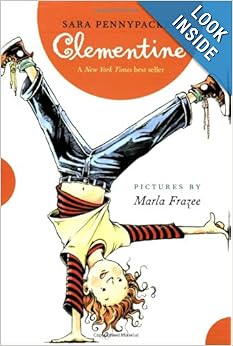
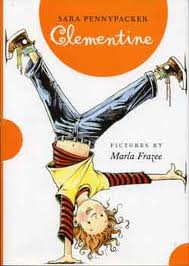
Clementine! If you've read Clementine an her sequels, you'll never forget her.
We read Clementine for Children's Lit tonight, had a good discussion, and we watched this delightful clip of the author and illustrator talking about creating this delightful series:
Sara Pennypacker and Marla Frazee talk about "Clementine"
0 Comments on Clementine by Sara Pennypacker, illustrated by Marla Frazee as of 3/3/2014 10:18:00 PM
Add a Comment
By: Jen Robinson,
on 2/18/2014
Blog: Jen Robinson (Login to Add to MyJacketFlap)
JacketFlap tags: Reviews, Newsletter, field trip, Early Elementary School, clementine, marla frazee, sara pennypacker, Add a tag
Book: Clementine and the Spring Trip
Author: Sara Pennypacker
Illustrator: Marla Frazee
Pages: 160
Age Range: 6-8


In Clementine and the Spring Trip, Clementine is a bit nervous about the upcoming field trip that her third-grade class is taking with the fourth graders. Her friend Margaret is in fourth grade, and continually warns Clementine that loud eating is not allowed among the fourth graders. Clementine worries about what she'll take for lunch that won't crunch or snick, or any of various other noise-related offenses. She also worries that her class will end up on the school bus that has "The Cloud", a truly horrific stink.
Meanwhile, a new girl in Clementine's class, Olive, has Clementine feeling a bit left out. And Clementine's family is preparing for the arrival, in a few months, of a new baby. Her mother is having cravings, and ranting more than usual about social issues. Margaret's family is undergoing changes, too, leaving Margaret more cleanliness-obsessed than ever. [Margaret is actually a really interesting character - she's going to need therapy one day, I think, but Clementine takes her in stride, and understands her issues.]
Like the other Clementine books, Clementine and the Spring Trip has some nice nods to Boston, like this:
"Mitchell acts extra Mitchelly in the spring too. Not because of the weather, but because the Red Sox are back in town. According to Mitchell, the Red Sox are the greatest team in the history of the universe, and it's just a matter of time before they ask him to play for them." (Page 5-6)
And some fun Clementine-isms, like this:
"I dropped the tape and spun around, because elevator doors are like game-show prize doors: until they open, you never know what valuable stuff is hiding behind them. Okay, fine--in our building, it's usually just the same old people, riding up and down from their condos." (Page 43)
"When you are pregnant you get to eat whatever you want, together with whatever else you want, whenever you want it, just by saying the magic words: "I'm having a craving." (Page 63)
That last quote made me laugh out loud. I also continue to adore Marla Frazee's illustrations, and the way that she completely nails Clementine and her family.
And yet, I must admit that Clementine and the Spring Trip is not going to stand out as my favorite of the series. The conclusion felt a bit over the top to me (including the presence of a plot-resolving coincidence), and a couple of aspects seemed a bit message-y. The last couple of chapters left me a little flat.
I still love Clementine, but I didn't end up loving this particular book. I liked it, sure, but I didn't love it overall. Not to worry, I'll still be eagerly awaiting the next book. And all libraries should certainly pick up Clementine and the Spring Trip.
Publisher: Disney/Hyperion (@DisneyHyperion)
Publication Date: January 7, 2014
Source of Book: Bought it at Books, Inc.
FTC Required Disclosure:
This site is an Amazon affiliate, and purchases made through Amazon links (including linked book covers) may result in my receiving a small commission (at no additional cost to you).
© 2014 by Jennifer Robinson of Jen Robinson's Book Page. All rights reserved. You can also follow me @JensBookPage or at my Growing Bookworms page on Facebook.
Related Stories
By: Jen Robinson,
on 9/17/2013
Blog: Jen Robinson (Login to Add to MyJacketFlap)
JacketFlap tags: Baby Bookworm, penderwicks, harry potter, children's books, middle grade fiction, Book Lists, chapter books, laura ingalls wilder, Late Elementary School, pippi longstocking, Early Elementary School, book series, clementine, read-aloud, Add a tag
I wrote a couple of weeks ago about my three-year-old daughter's newly expressed interest in being read chapter books, in addition to her regular diet of picture books and early readers. I asked people on the post and on Facebook to share titles that they had read with their children while were still pre-readers. I collected a number of titles, and was especially pleased to be reminded of a post that Melissa Wiley wrote a couple of years on this very topic (Chapter book suggestions for a four-year-old). Out of these suggestions, and my own opinions, I've come up with a list of the top five series I most look forward to reading with my daughter. They are (in approximate age order):


What books do you look forward to reading aloud with your children? What books did you enjoy when they were younger? If you've already been through it, don't you kind of envy me, having all of these books still ahead of us? An unintentional upside to having a child late in life. Thanks for reading!
© 2013 by Jennifer Robinson of Jen Robinson's Book Page. All rights reserved. You can also follow me @JensBookPage or at my Growing Bookworms page on Facebook. This site is an Amazon affiliate.
Related Stories
By: Darcy Pattison,
on 12/13/2012
Blog: Darcy Pattison's Revision Notes (Login to Add to MyJacketFlap)
JacketFlap tags: humor, show don't tell, how to write, reader, openings, clementine, novel revision, Add a tag
 |
I recently had the privilege of listening to Sara Pennypacker, author of the Clementine series of early-chapter books. Her books are widely recognized as a forte in capturing the reader and drawing them in. The opening scene of Book 1 has Clementine, a third grade dynamo, sitting in the principal’s office and a frequent comment is that the scene is hilarious (I’ve written about how well this scene orients the reader, too.)
But Pennypacker says she didn’t write it humorous. Rather, the reader wrote it funny. What does she mean?
Consider this line:
“Someone should tell you not to answer the phone in the principal’s office, if that’s a rule.”
 It’s funny. You know from this line that Clementine has answered the principal’s phone line and it resulted in disaster. Even without details or without the usual “Tell-Don’t-Show,” it’s funny. But the humor is created in the reader’s mind, by your imagination.
The technique of leaving out the most dramatic part in favor of letting the reader create meaning is useful, especially in opening lines. The danger is when it’s used too often or if it is used as a lazy crutch or excuse for not Show-Don’t-Telling. In other words, most of the time, the important details should be shown, not told. But sometimes, leaving out details and letting the reader fill them in is OK. It’s effective in Clementine’s opening page because it fits Clementine’s voice as a naive character and because Pennypacker already gave the reader specific details: Hamburger Surprise at lunch, Margaret’s mother coming to get her and so on.
Also, while what is left out is not specific, it is absolutely clear. The reader is not confused by having something left out. Clarity rules.
Notice, though, that this introduction is swiftly followed by a conventional scene with a stricter adherence to the Show-Don’t-Tell maxim. Used too often, leaving out the most dramatic part would just confuse the reader.
Another place to leave out the most dramatic information is when you set up a new scene. The tendency is to provide a summary–that holdover from having to write a thesis statement, probably.
Consider:
Emily knocked on Bruce’s door. She just had to make it through his Christmas party.
Here, we’re told in a summary statement what the upcoming scene will entail, “making it through his Christmas party.” Instead, you could use a scene cut and let the reader experience the party for themselves.
Emily knocked on the door.
* * *
Emily wanted to plug her ears against the jazzed up Christmas carols that blasted above the crowd noise. She edged around the edge of the room toward the punch table, avoiding an elbow here and barely keeping a cowboy boot from stomping on her foot, hoping to find someone familiar.
Here, we are experiencing the party with Emily. Leaving out the summary statement about making it through the party strengthens the reader’s curiosity about what happens next. That’s the only thing we leave in question: what happens next? Don’t undercut this natural curiosity by summarizing the action before you present it. Time enough later for Emily to gripe to Joe about the lousy party.
Pennypacker had a hard task, to introduce a specific scene, to set up a voice, a character, a situation, and eventually a series of books about this endearing third grader. She succeeded by letting the reader participate in creating humor.
By: Betsy Bird,
on 5/21/2012
Blog: A Fuse #8 Production (Login to Add to MyJacketFlap)
JacketFlap tags: Uncategorized, Sara Pennypacker, Clementine, Top 100 Children's Novels Poll, Add a tag
 #62 Clementine by Sara Pennypacker (2006)
33 points
For my eight-year old self, and every other child, whose name is followed by, “pay-attention.” We all know that what is happening outside the window is much more worth “paying-attention” to, than what the teacher is saying. – DaNae Leu
The Ramona for this generation, Clementine is spunky, quirky, funny, and most of all entertaining. You can’t get a better beginning reader book than this. – Melissa Fox
Red heads are no stranger to classic works of children’s literature. Recent successful red heads, however, are a bit on the rare side. And early chapter book red heads? Well, they exist but none are quite so prominent or popular as Clementine.
The plot from my review reads, “Clementine can tell you right from the start when her week started going poorly. It all began when her best friend Margaret let Clementine cut her hair in the school bathroom. Margaret’s always been jealous of her friend’s bouncy red curls, so it makes perfect sense to Clementine to take the strongest red marker she has and color some curls onto Margaret’s nearly bald head. That’s the kind of kid Clementine is. She’s always willing to go the extra mile. For example, she cuts all her own hair off in sympathy with Margaret and gets her own head painted green. Not that these were the only bad things that happened to our heroine this week. Her father, who takes care of the apartment building they live in, is fighting The Great Pigeon War against, what he labels, pigeon splat. And her parents have been planning something in secret that is making Clementine very nervous indeed. It’s not easy being the creative one in the family, but this is one gal who’s willing to be that person.”
Ms. Pennypacker is breaking new ground this year with a novel that’s very different from the Clementine series. I know a number of you out there have already had a chance to read her remarkable Summer of the Gypsy Moths. A Newbery contender in its own right, it proves that Ms. Pennypacker is not afraid to go places Clementine would dare not tread.
- There is an official Clementine site at this point, as is right.
- Watch the book trailer or, better yet, see the Video Read-Aloud with Sara Pennypacker.
- The girl also gets around.
- And be sure to check out Anita Silvey’s Children’s Book-a-Day Almanac posting on this book.
Booklist approved saying, “Sometimes touching and frequently amusing, this engaging chapter book is well suited to reading alone or reading aloud to a roomful of children.”
So did SLJ with, “A delightful addition to any beginning chapter-book collection.”
Personally I preferred how Horn Book put it, “Clementine’s first-person narration is fresh and winsome, and the episodic plot is accessible to young readers but includes details and layers that add a richness rare in short chapter books.”
Said <
0 Comments on Top 100 Children’s Novels #62: Clementine by Sara Pennypacker as of 1/1/1900
Add a Comment
By: Administrator,
on 11/3/2011
Blog: Margo Dill's Read These Books and Use Them! (Login to Add to MyJacketFlap)
JacketFlap tags: Elementary Educators, Making Personal Connections, Pennypacker, Sara, Frazee, Marla, Book Club Possibility, funny chapter books, Chapter Books, character education, Reading Skills, Clementine, Add a tag
Blog: Margo Dill's Read These Books and Use Them! (Login to Add to MyJacketFlap)
JacketFlap tags: Elementary Educators, Making Personal Connections, Pennypacker, Sara, Frazee, Marla, Book Club Possibility, funny chapter books, Chapter Books, character education, Reading Skills, Clementine, Add a tag

*Chapter book, realistic and contemporary fiction
*Third-grade girl as main character
*Rating: I’m a huge fan of Sara Pennypacker and the Clementine series. This is book four, and it is as cute as ever. If you are a pet lover, it can be a little sad in the middle–but happy endings all around (even for Margaret. 
Short, short summary:
In Clementine’s third grade class, she has been chosen as friend of the week. This comes with all sorts of privileges such as line leader, but Clementine is most excited, well and anxious, about the booklet she’ll receive at the end of the week. All the kids will write a message to her, and she wants to make sure they have something nice to write. She wants hers to be as good as Margaret’s from last year. She spends all week coming up with grand plans, like only Clementine can, so she’ll have the best Friend of the Week booklet ever. However, the importance of this week is put into perspective when Moisturizer, Clementine’s beloved cat, goes missing.So, what do I do with this book?
1. A fun emotional intelligence activity is to have everybody in the classroom draw the name of another classmate. Then the students have to write something nice about the person whose name they drew. You write/draw it on an 8 x 10 inch piece of construction paper. You can draw students’ attention to how Clementine feels when she reads the nice comments on her Friend of the Week booklet. (If you homeschool, you can do this activity with members of the family and post the nice things on the refrigerator!)
2. In this segment of Clementine, Margaret shows her younger friend just how much she likes her and how important Clementine is to Margaret. Ask students what Margaret does to show her friendship in the novel. How does Clementine react? Then how does Margaret maintain her personality at the end of the novel?
3. There are really two problems in this novel–one is created by Clementine trying to figure out something wonderful to do for her friends, so they’ll write nice things in her booklet, and the other is when Moisturizer goes missing. How are these problems solved in the novel? This is an easy book to talk about problems and solutions because in each case, Clementine does different, obvious tasks to attempt to solve her problems.
Add a Comment
By: Mary Lee,
on 9/21/2011
Blog: A Year of Reading (Login to Add to MyJacketFlap)
JacketFlap tags: wisdom, Clementine, Add a tag
Clementine and the Family Meeting
by Sara Pennypacker
illustrated by Marla Frazee
Disney*Hyperion, 2011
This is the fifth book in the Clementine series, and I like Clementine more than ever. I like her parents more than ever, I like her teacher, Mr. D'Matz more than ever, and even her makeup-obsessed friend Margaret is a little easier to deal with in this book.
I love that the characters in this series continue to grow and change.
But the thing I love most about the Clementine books is the wisdom that Sara Pennypacker weaves in so unobtrusively.
In this book, Clementine has to learn to deal with change. Her family is growing from the perfect number of FOUR people, to the awkward number of FIVE. She says, "It's all moving too fast and we're not ready."
Her mom replies,
"Oh, honey. Life is always moving too fast and we're never ready. That's how life is. But somehow that's just perfect."Her dad continues,
"Things are always changing -- that's life. And this?" He spread his hands to the tornadoed kitchen. "Us? Toy-truck ziti, missing hats, drill-gun mixers? Well, this is how we roll, Clementine. This is how we roll."
Lucky Clementine, to have such a family. Lucky us, to get to be a part of that family for another book. Keep 'em coming, Sara Pennypacker and Marla Frazee. Keep 'em coming!
My review of Clementine, Friend of the Week (#4) here.
Franki's review of Clementine's Letter (#3) here.
My review of The Talented Clementine (#2) here.
Surely we reviewed the first book?!? We have Mr. D'Matz, Clementine's teacher, on our 100 Cool Teachers in Children's Literature list...but I can't find the review for the life of me...
4 Comments on The Wisdom of Clementine, last added: 9/21/2011
Display Comments
Add a Comment
By: Administrator,
on 9/10/2009
Blog: Margo Dill's Read These Books and Use Them! (Login to Add to MyJacketFlap)
JacketFlap tags: Chapter Books, Susan Patron, Sara Pennypacker, Lucky, Middle Grade Novel, Beverly Cleary, Clementine, classic books for kids, Elementary Educators, Making Personal Connections, Cleary, Beverly, Timeless Thursdays, Patron, Susan, Pennypacker, Sara, Ramona Quimby Age 8, Ramona Quimby series, Add a tag
Blog: Margo Dill's Read These Books and Use Them! (Login to Add to MyJacketFlap)
JacketFlap tags: Chapter Books, Susan Patron, Sara Pennypacker, Lucky, Middle Grade Novel, Beverly Cleary, Clementine, classic books for kids, Elementary Educators, Making Personal Connections, Cleary, Beverly, Timeless Thursdays, Patron, Susan, Pennypacker, Sara, Ramona Quimby Age 8, Ramona Quimby series, Add a tag
Two weeks ago, I talked about Judy Blume’s classic Are You There, God? It’s Me, Margaret and about the recent controversy over book covers. As you can see, today’s Timeless Thursday book Ramona Quimby, Age 8 also has a new, modern book cover, but that’s not what I’m here to blog about today.
Beverly Cleary has created some of the most endearing child characters ever, and my favorite is Ramona. Some more modern writers have written stories about strong,funny, independent girls such as Sara Pennypacker’s Clementine series or Susan Patron’s award-winning character, Lucky. I love these new girl characters, but my heart still belongs to Ramona. I am an only child, and as much as Beezus and Ramona might have driven each other crazy, I wanted my Beezus. I also remember learning to write cursive and being as proud as Ramona was when she wrote Ramona Quimby, Age 8 carefully in cursive. I could relate to Ramona, and that is why she will forever remain timeless in my heart.
Why would kids today want to read a book written by Beverly Cleary in 1981? Why wouldn’t they? The answer is as clear as day on the front cover of the latest version of Ramona Quimby, Age 8–”Life as a third grader is tough!” Don’t all elementary kids think they have it the toughest? Don’t they want to read something written by an author who truly understands them? Yes and yes!
So, although there are new, wonderful books out, don’t forget to share the old classics with your children and your students, too. If they haven’t heard of Ramona Quimby yet, give them this first book and let them decide for themselves.
What’s your favorite Beverly Cleary book?
Add a Comment
By: Chandler A.,
on 6/30/2009
Blog: First Book (Login to Add to MyJacketFlap)
JacketFlap tags: Holes, Louis Sachar, Rick Riordan, Mary Pope Osborne, Michelle Obama, Authors & Illustrators, Books & Reading, Jeanne Birdsall, The Penderwicks, Kyle Zimmer, Jonathan Stroud, Magic Tree House, Random House Children's Books, Clementine, First Family, The Lightning Thief, President Barack Obama, Heroes of the Valley, United We Serve, Disney Publishing Worldwide, Philanthropy, First Book Events, Marla Frazee, Sara Pennypacker, Add a tag
 Last Thursday, June 25th, I was lucky enough to join the President, the First Lady, and hundreds of Congressional family members to prepare 15,000 backpacks with books and other items for the children of servicemen and women. With the incredibly generous support of Random House Children’s Books and Disney Publishing Worldwide, First Book was able to donate 30,000 books (two for each backpack!) with a retail value of almost $250,000.
The service event highlighted ‘United We Serve,’ President Obama’s call to all  Americans to engage in service projects and create meaningful impact in their towns and communities. The ‘United We Serve’ summer service initiative began June 22nd and runs through the National Day of Service and Remembrance on September 11th. The initiative is being led by the Corporation for National and Community Service, the federal agency dedicated to fostering service in communities across the country.
Curious about the books the President and the First Lady helped us pack? Here’s the list — full of great choices for your own summer reading!
- Clementine by Sara Pennypacker and illustrated by Marla Frazee
- Magic Tree House #28: High Tide in Hawaii by Mary Pope Osborne
- The Lightning Thief by Rick Riordan
- The Penderwicks by Jeanne Birdsall
- Heroes of the Valley by Jonathan Stroud
- Holes by Louis Sachar
By: Mary Lee,
on 10/26/2008
Blog: A Year of Reading (Login to Add to MyJacketFlap)
JacketFlap tags: Clementine, Alison McGhee, Julia Gillian, book review, Add a tag
 Julia Gillian (and the Art of Knowing)
by Alison McGhee
illustrated by Drazen Kozjan
Scholastic, 2008
review copy provided by the publisher
Julia Gillian is a great new girl character. She lives in a third floor apartment in Minneapolis with her parents (mother is a first grade teacher and father is a high school teacher). She has a St. Bernard and her parameters include walking Bigfoot for an hour alone within a 9 square-block area. Her list of accomplishments has filled one whole side of a sheet of paper and goes onto the back. Down one floor live her friends Enzo and Zap, who are brother and sister. Enzo is 18 and chooses to live with her brother Zap who is in his twenties and wants to become a famous chef.
Julia Gillian is nine years old and she's starting to realize that the adult world isn't quite as great as it's cracked up to be. Her parents read the newspaper, despite all the bad news, so that they will know what's going on in the world. Julia Gillian is starting to realize that perhaps her parents don't always tell her the truth. And she's afraid to finish reading her book because she doesn't think she's going to like the ending.
Julia Gillian works through her fears with the help of Enzo and Zap, Bigfoot, and a little girl in the neighborhood who is afraid of kindergarten. In the process, she helps her parents to better understand themselves and their "marvel of a child."
Julia Gillian is a spunky as Clementine, with as unique a world view, but she's a little older and a little more serious. I'll be waiting just as anxiously for the next book in the series.
2 Comments on Julia Gillian, last added: 10/28/2008
Display Comments
Add a Comment
I absolutely LOVE clementine books. I love her character and how she is not the typical looking main character with her messy red hair. I look forward to reading this novel myself as well as sharing it with my students.
Is this it? http://readingyear.blogspot.com/2007/01/clementine.html
Thanks for finding your review of the first book, Franki! Not sure why I couldn't find it, but oh, well. I've edited the post and we've got all the links in one place now!
I love these books! I just read the Friend of the Week one recently--adored it. I had read one before that was fine, but FOTW was awesome. Can't wait to check out this latest one. Thanks!