new posts in all blogs
Viewing: Blog Posts Tagged with: Schools, Most Recent at Top [Help]
Results 1 - 25 of 187
How to use this Page
You are viewing the most recent posts tagged with the words: Schools in the JacketFlap blog reader. What is a tag? Think of a tag as a keyword or category label. Tags can both help you find posts on JacketFlap.com as well as provide an easy way for you to "remember" and classify posts for later recall. Try adding a tag yourself by clicking "Add a tag" below a post's header. Scroll down through the list of Recent Posts in the left column and click on a post title that sounds interesting. You can view all posts from a specific blog by clicking the Blog name in the right column, or you can click a 'More Posts from this Blog' link in any individual post.
The new one-year program, in partnership with University of Technology Sydney, will launch in 2017.
The post ‘LEGO Movie’ Studio Animal Logic To Offer Animation Degree appeared first on Cartoon Brew.
After being booted by the school last month, the legendary filmmaker has reached an agreement to continue teaching at the school.
The post Victory for Priit Pärn Who Will Continue Teaching At Estonian Academy of Arts appeared first on Cartoon Brew.
All this week I've been on an illustration book tour of the Scottish Highlands! At first I thought I was going to have to do it solo, but I asked Beth Bottery at Scottish Book Trust if I could bring Stuart along and she said yes. Then all my knitted book characters decided they wanted to come along, too.

This is the first time I've ever gone on an extended tour with Stuart! And he wasn't just tagging along, he was WORKING. In fact, I thought I'd let him do the blogging. So... OVER TO STUART:
Hi, everyone! My first job was help Doug the Pug sharpen up his drawing skills in anticipation of all the pictures he was going to be making during the course of the week. He drew some pictures on the train.

Here's one he did of me!

And here's one he did of the First Minister Nicola Sturgeon. You can't get more Scottish than that.

Our first port of call was GLASGOW, to see Sarah's auntie.
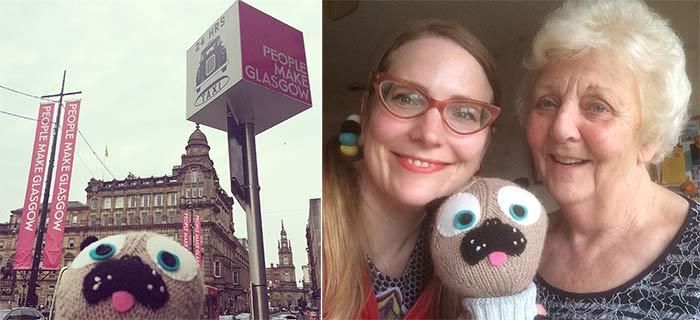
On Sunday, Beth Bottery and Thomas Jefferson from Scottish Book Trust came to pick us up and drove us all the way to Thurso, right in the north of Scotland.

Here they are in the wilds of the Highlands.
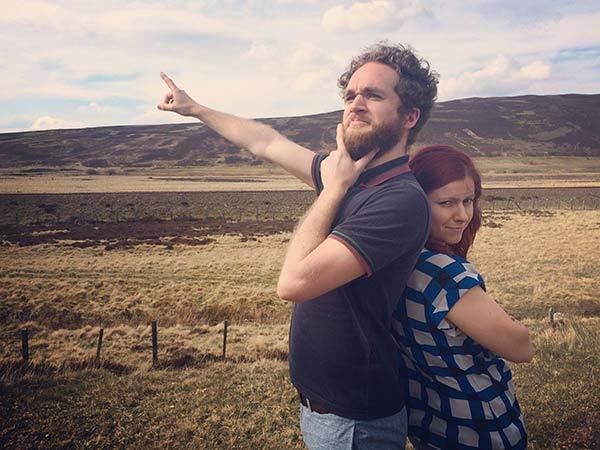
Here are a couple of snapshots of Thurso in late evening.


MONDAY, 9 May:
My first stage appearance was at Mount Pleasant Primary School in Thurso (coordinated by Suzanne Urquhart) and Pennyland Primary came along, too. Here I am with Sarah in my new role as PROFESSOR SNOWSTORM!

I'm supposed to know a lot about the different types of snow in Sarah and Philip Reeve's book Pugs of the Frozen North. Being on stage was exciting but also a bit nerve-racking. Luckily I didn't mess up too many of my lines.

Here are some books the children made in advance, which are pretty impressive.


For the afternoon, Miller Academy Primary School (and Pat Ramsay) hosted us, along with visiting school Melvich Primary. At each visit we created a board game, featuring a race to the North Pole from the school. We wanted to give them ideas on creating a story, how (like a board game) it needs a beginning, an end, and perils in the middle. This group game up with some really unusual perils, culminating in the greatest peril: Donald Trump.

We also met Reading Champion Alex Patience, who works with the kids on this reading scheme.

On a beautiful evening - tropical for Thurso! - Sarah made a new friend named Kali.

TUESDAY, 10 MAY:
We visited Castletown Primary School, just outside Thurso, with the visit coordinated by Rhona Moodie. Having a day's practice, I was beginning to get into my character a bit more. Things didn't seem to be quite so scary, particularly when the class was a bit smaller.

Tom took us to a roadside cafe for lunch, just outside Wick, The Rumblin' Tum. It felt like something you might find in the Australian outback.

Sarah took this photo of Tom and me and mystery guest in the background.

In the afternoon, we were at Noss Primary School (which was only a few weeks old!), with Watten Primary visiting. Headmaster Ally Budge had really researched Sarah and Beth told us he'd filled out the application form for the visit in Russian! (Sarah and I both speak some Russian.) This was our largest event yet, with more than 200 children. The school gave Sarah a very thoughtful Russian-themed gift, Baggage by Marshak & Lebedev.

We drove on to Tain and stayed in the Royal Hotel, which was very grand.

Tain was lovely, with some very striking buildings.

We had dinner at the restaurant at Tain railway station. Sarah shot this video because she thought Beth had a wonderful Hull accent.
During the week the four of us did some drawing challenges. Here's our #ShapeChallenge drawings. (Can you guess who drew which one?) Sarah sets daily Shape Challenges on Twitter which you can discover at @StudioTeaBreak.


WEDNESDAY, 11 May:
In the morning we visited Knockbreck Primary School in Tain (coordinated by Mhairi Miller), with Dornoch Academy visiting. Sarah drew this picture of her and Doug the Pug but she forgot to take any more photos.

After lunch, we headed to Strathpeffer Primary School (hosted by Carolyn Ritchie and Mr Spence), with visiting school Mulbuie St Clements.

The afternoon was so sunny that we sat out on the lawn of our hotel and did a Comic Jam together. Here are some teaching videos if you want to learn how to do a Comic Jam in your school.

Beth shot this video of the Comic Jam at different stages.

THURSDAY, 12 May:
Our first stop was Teanassie Primary School (with Sharon Gallacher), with visiting school Beauly Primary, which was our most intimate event with just over 30 children. When we drove in, we saw the chickens and three pigs the school raise.

Everyone on our tour loved knitted Doug the Pug, designed by Lauren O'Farrell (aka Deadly Knitshade). Here's the link if anyone wants to download the free pattern from Sarah's website. And here are some of the pugs the children drew at Teanassie:

In the afternoon we arrived in Inverness to visit Drakies Primary School (coordinated by Rebecca Fleming), with visiting school Bun-sgoil Ghàidhlig Inbhir Nis. Drakies were very excited about the visit and prepared some posters to advertise Sarah's event to the other children. Sarah was so pleased!

Drakies even tweeted to Sarah before the event (@DrakiesPS). She loves it when teachers and pupils prepare things before the visit and this group made lots of great stuff.


Even after the visit, this mum sent us a picture which made us all go 'Awww'.

On Sarah's drawing challenge @StudioTeaBreak, Thursday is #PortraitChallenge day. Here's a family portrait of pop stars if they were animals.


FRIDAY, 13 MAY
My costume for the week included wearing this pair of yellow trousers. Don't park on my double yellow lines!

For our final day, we began at Crown Primary School in Inverness, organised by James Cook.

The school had a blog up by the same evening! We got some very encouraging feedback from the teachers, including one who said in twelve years of teaching, it was the best event she had seen and gave the teachers lots of ideas of things to do with the kids later.

And finally, Hilton Primary School (with Amy Fraser) and visiting school Cradlehall Primary. We received a warm welcome from the dinner ladies!

The dinner ladies even baked us banana flapjack! This was our biggest event. It will be funny telling my colleagues back at work what I've been doing all week.

Here are cards Sarah drew for Tom and Beth, thanking them for all their hard work. Thank you very much, guys!! And to all the schools who hosted us, Scottish Book Trust, and our sponsors Scottish Friendly.

This was a never-to-be-forgotten week! It gave me a whole new perspective of Sarah's work. I hope all the children we met go away and do a lot more drawing, writing and reading. I might try to do some more drawing, too!

Ages and ages ago, I was chatting via email with author Julia Jarman. We talked about this and that, then she mentioned that she had been invited to Beijing, to visit an International School, but she wasn't very keen to go. She thought it might be a little scary in China on her own, so she was thinking of turning them down. Purely as a joke, I quipped that she should ask the school if they wanted an illustrator too, then we could go together. Which is how it began.
Over a year later, Julia and I have visits booked at 4 different Beijing schools - 7 day's work - and we will be there for just over two weeks. Quite an adventure. I imagine that it will be very hard work, a bit like World Book Day week with knobs on, but I do like new and interesting experiences, plus we will get a few days at the end to explore. Of course, I'm hoping I'll have enough energy left over to sketch a bit too.
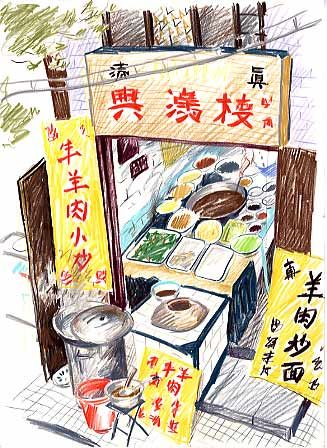
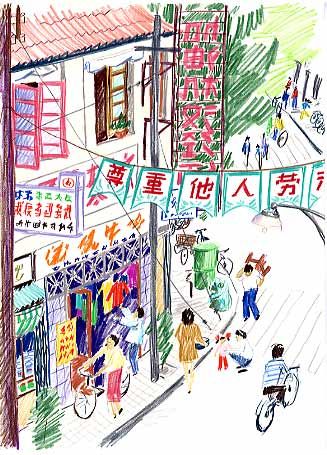
I have been to China before, but a very long time ago. In 1988, I back-packed around the north of China for 6 weeks, with a friend. It is probably the single most challenging, but also exciting thing I have ever done. That's when these sketches were done.
Apart from sights like The Forbidden City, I can't imagine that there will be much that is recognisable about Beijing now. Things were still very traditional at that time and there were certainly no gleaming, glass structures. It will certainly be fascinating to see the changes for myself.
We are due to fly out mid September, which I fully expect to be here before I know it. Yeehah!
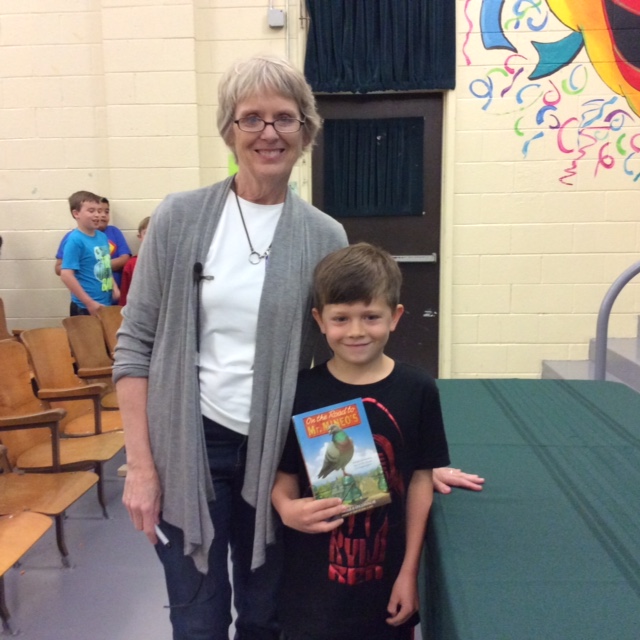
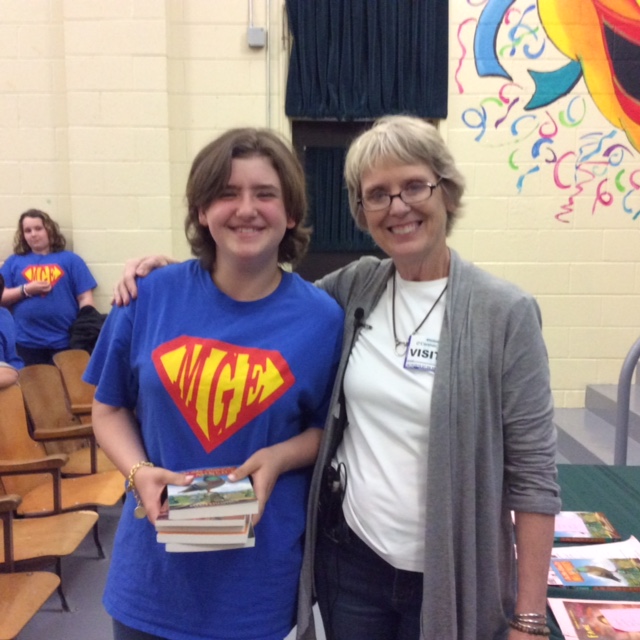
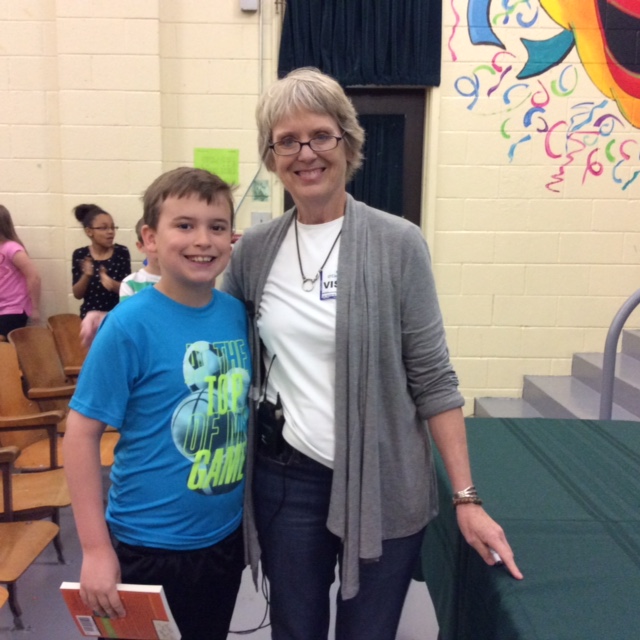
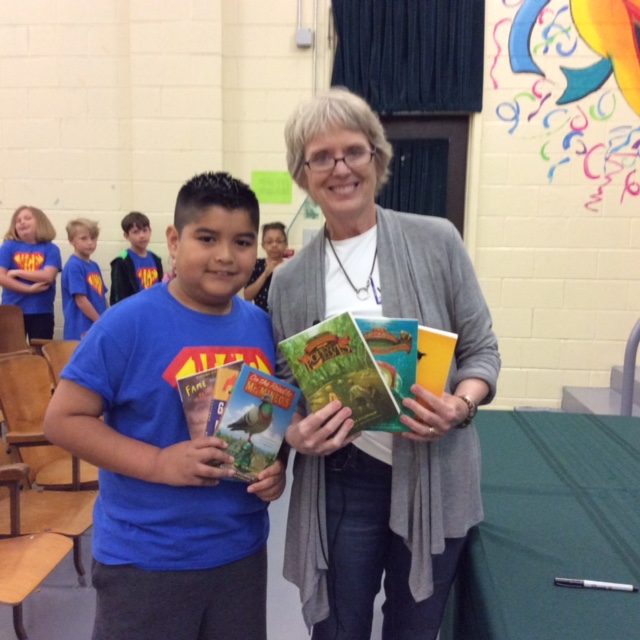
Big thanks to Mrs. Weeks
and all the great students at
McDonald Green Elementary School
in Lancaster, SC.
I had a blast!
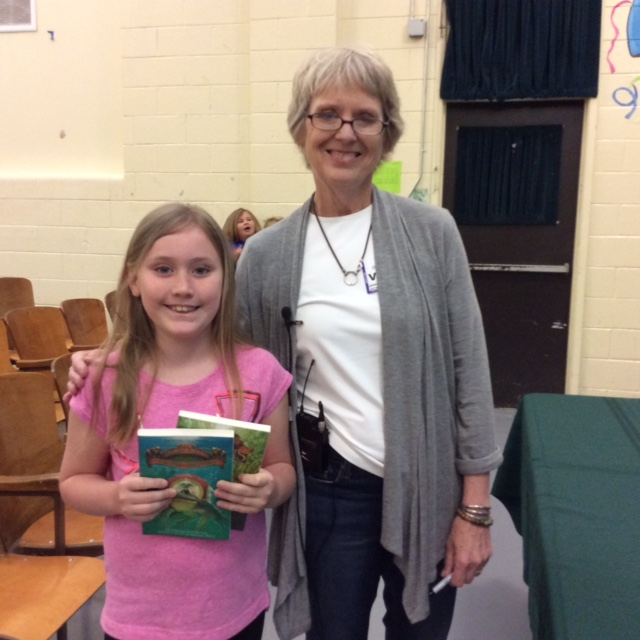
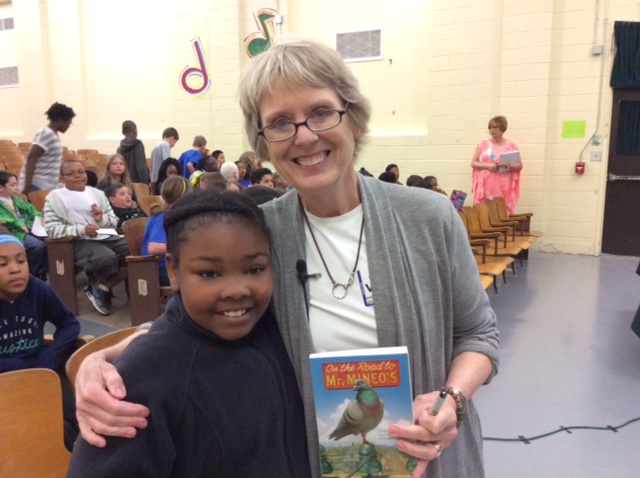
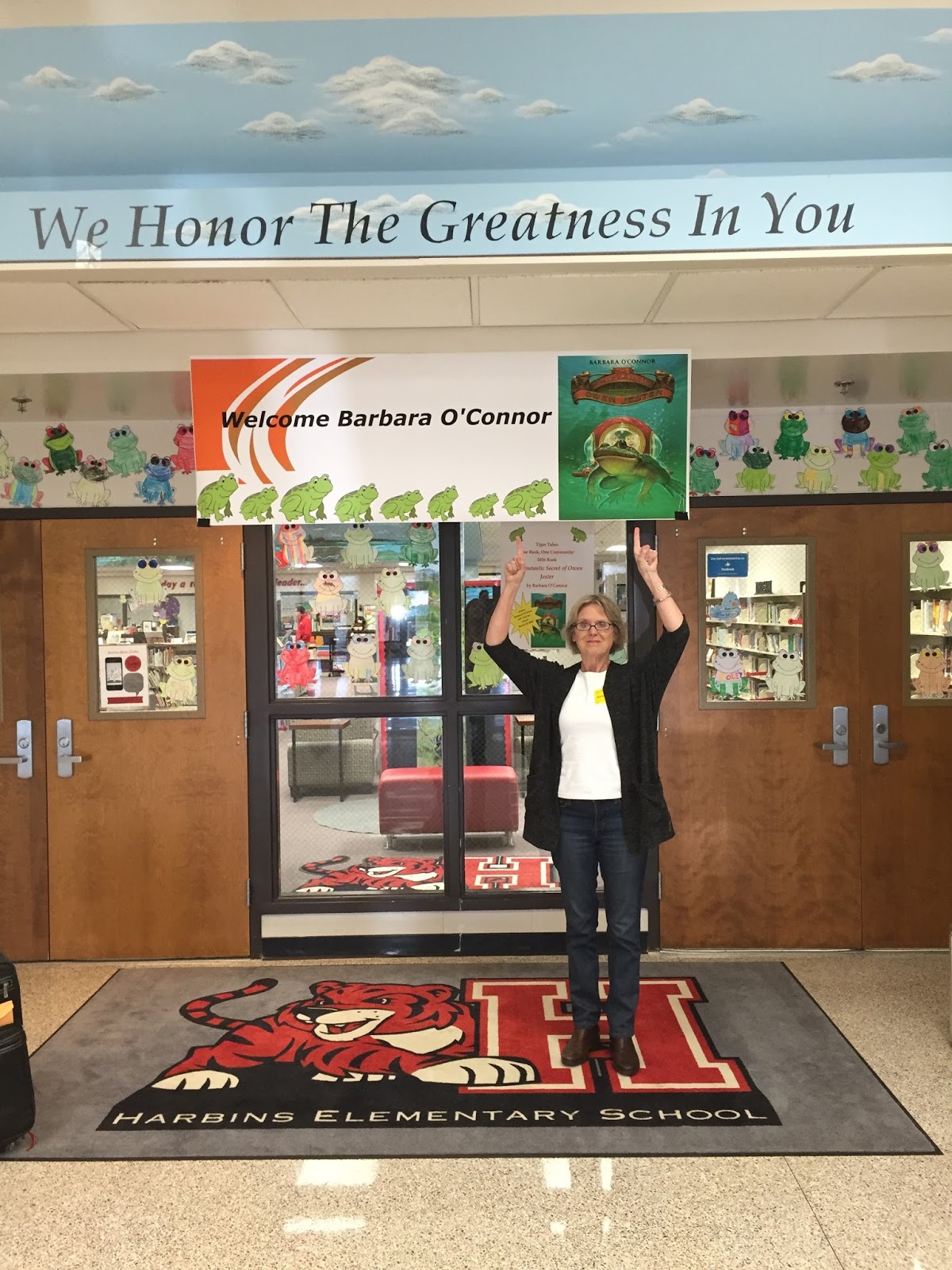
I had a great day at Harbins Elementary School
in Dacula, Georgia.
They chose THE FANTASTIC SECRET OF OWEN JESTER
for their One School-One Book program.
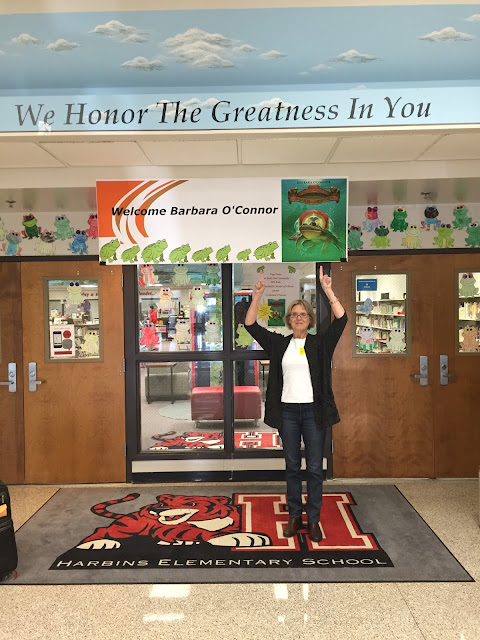 |
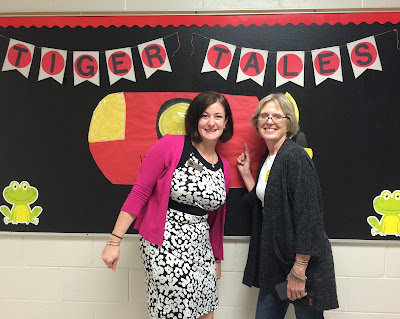
| I was greeted by a super sign. |
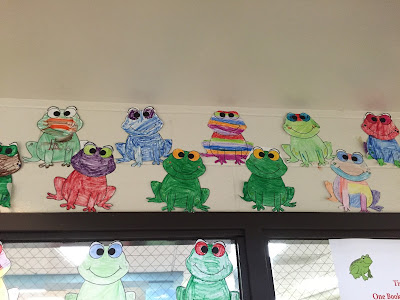 |
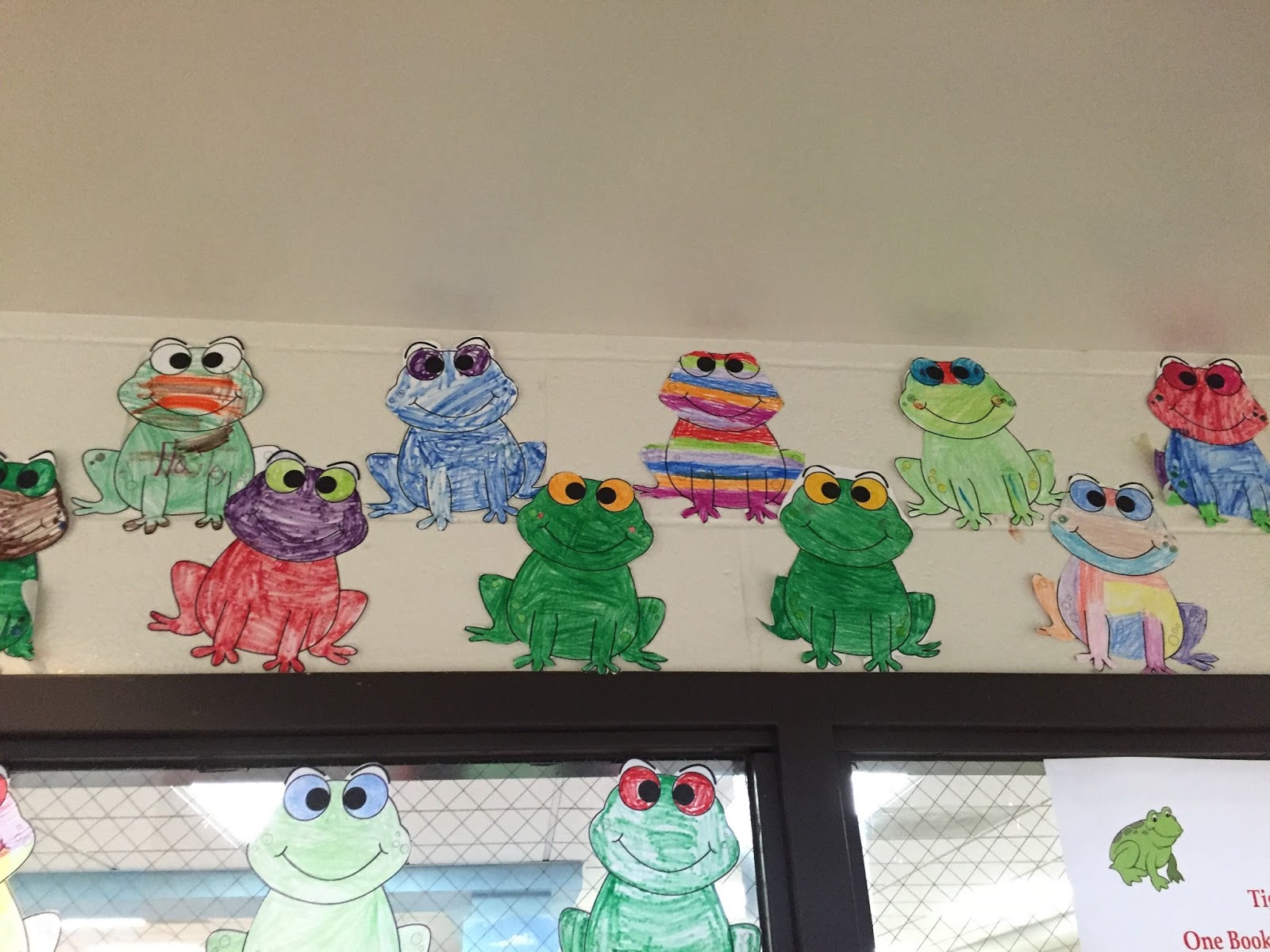
| The students had made some terrific frogs like Tooley Graham in the book. |
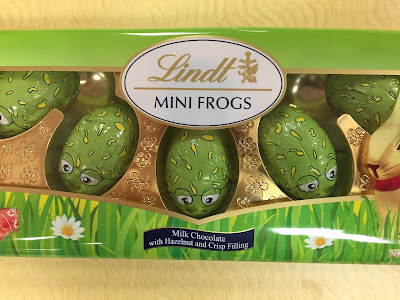 |
| I got some chocolate frogs! |
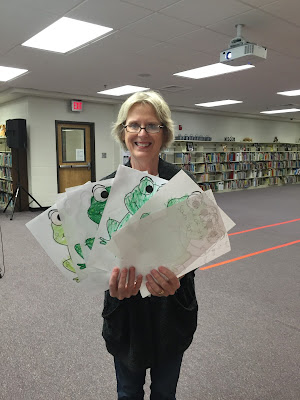 |
| More frogs and even a letter! |
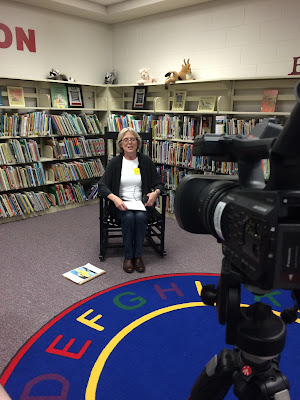 |
| Here I am talking to the K-2 students over their closed circuit TV. |
 |
| Amazing media specialist, Kathy Schmidt, showing me their Water Wonder 4000. |
 |
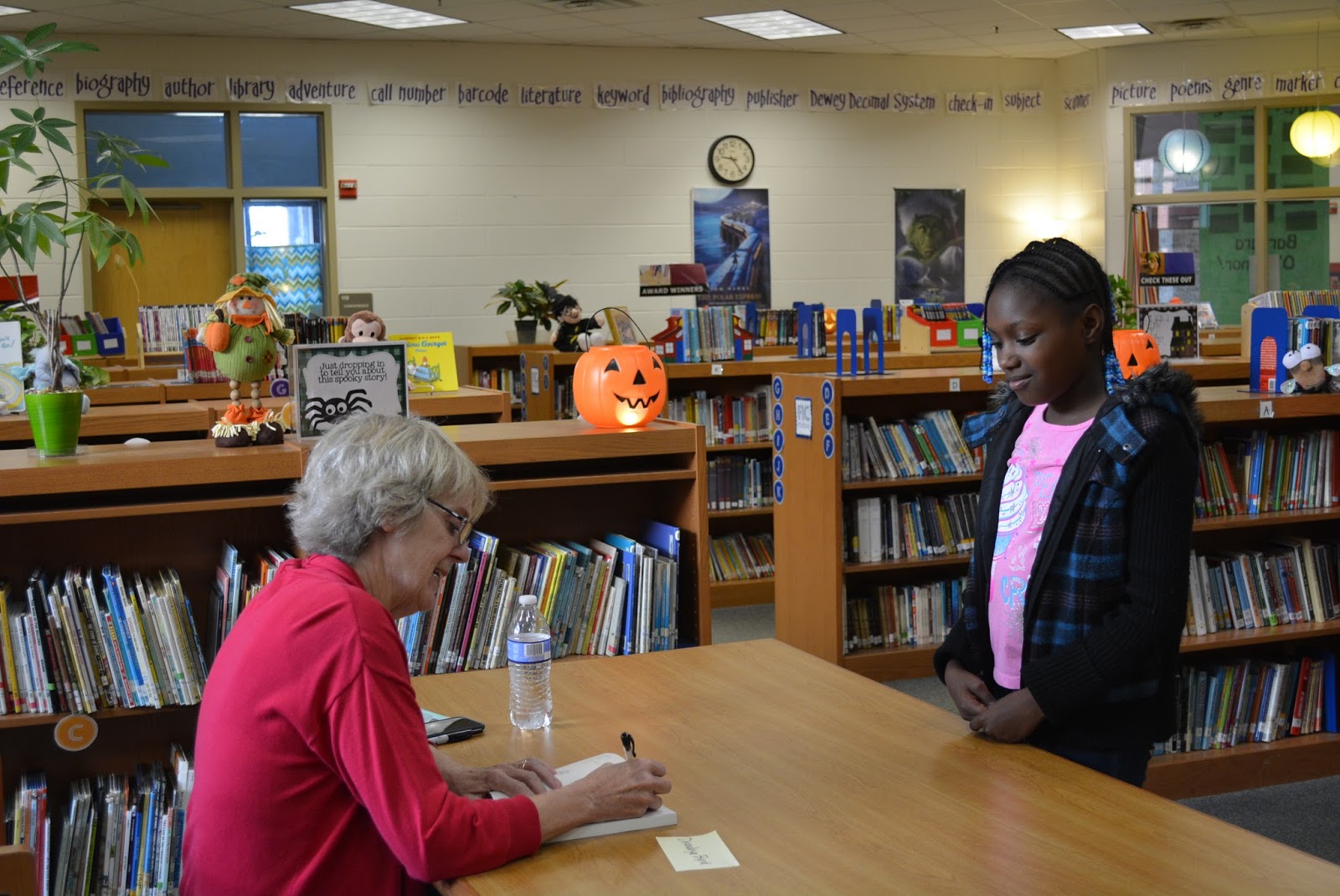
| I signed a lot of books. |
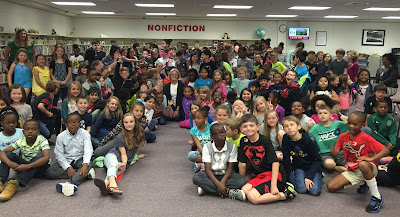 |
| Third graders |
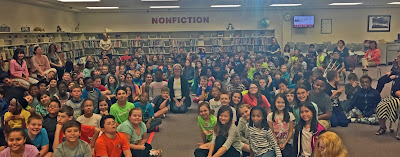 |
| Fourth graders |
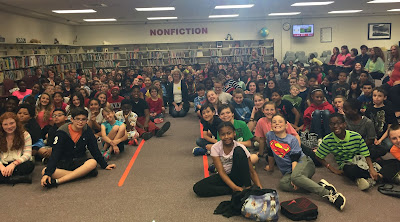 |
| Fifth graders |
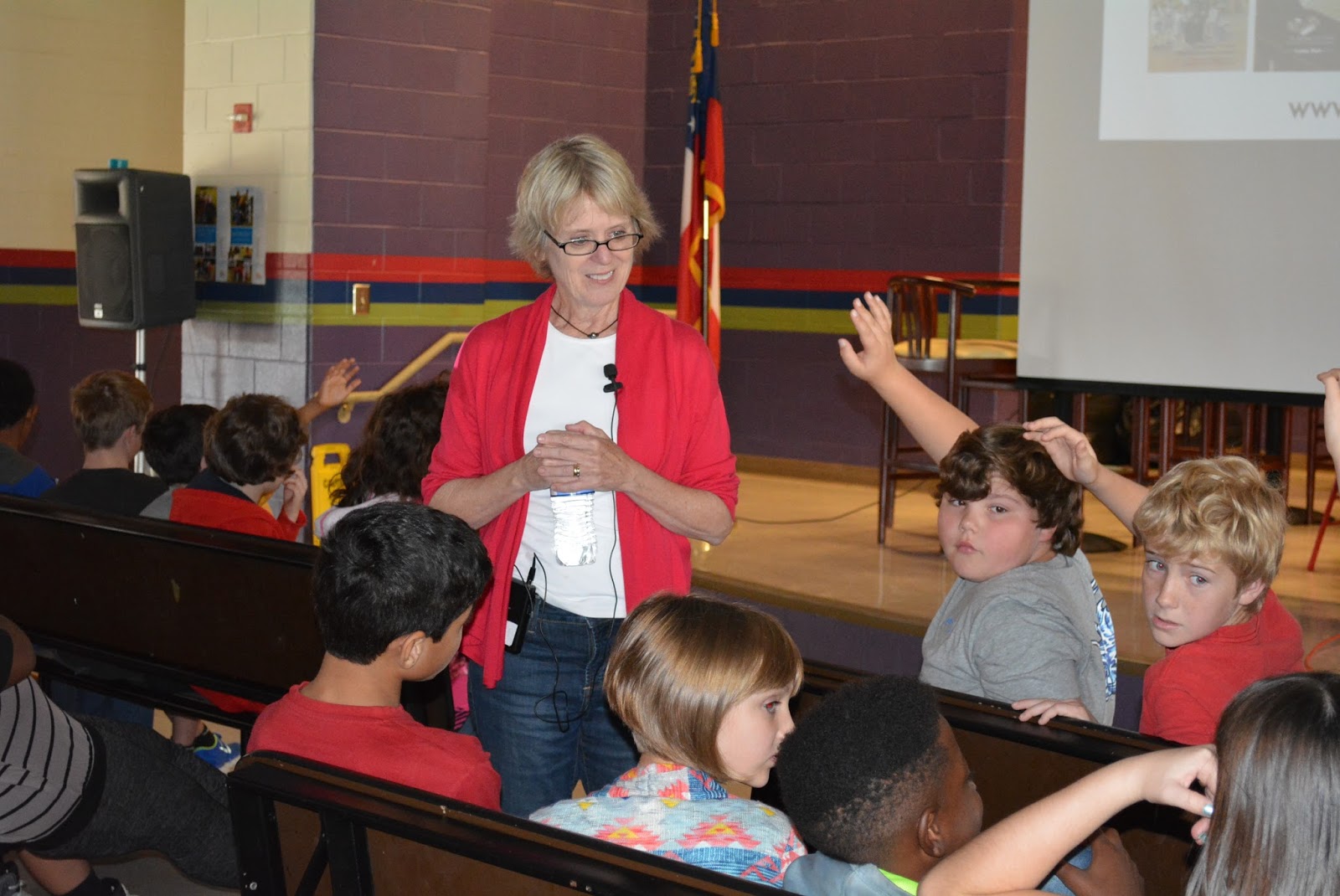
Thanks for a great day, Harbins!
Thanks to the sixth graders
from South Middle School
in Salina, Kansas
For hanging out with me today
I had a bit of an adventure recently...
It began with me getting a plane to Scotland on a Sunday afternoon. Things got off to a dodgy start though - I nearly missed my flight. I had bags of time, right up to the point where, approaching the departure gate, I realised I'd left my watch in the tray at the security bit, so had to try and get back through. It's not so easy in the other direction. 'Last call for Lynne Chapman...' Luckily someone had handed my watch in. Thank goodness I noticed before I got on the plane.
I had been invited to spend 4 days at the International School of Aberdeen: the longest school visit I think I've ever done. I was put up in a rather nice hotel and had a big, if VERY taupe room: not a whisper of colour anywhere!
Bizarrely, on that Sunday night, I was the only person staying in the entire hotel. I could have run naked through the corridors at midnight. Instead I was very boring and went to bed. Well, I needed to be up bright and early for my first day at school.
The excitement was at a pretty high level before I even got there but, as the days went by, it got better and better. I moved around the school to a constant soundtrack of 'There she is!' and 'Look, it's Lynne Chapman!' with children waving and calling hello. I was nipping to the loo one lunchtime when I overheard an excited whisper: 'Look, she's going to the toilet!', as if it was a shock that I actually needed to.
I kicked off that first Monday morning with a lecture about how picture books are created. They had a totally gorgeous theatre. It was packed tight with all the kids and quite a few parents. I immediately felt very welcome. Everyone was obviously really keen and the talk went down extremely well. Good start!
I read stories and larked about with the younger ones as usual. I read Rocky and the Lamb for the first time in ages and we designed monsters. These are some of the children's monster drawings. Very inventive - I love how they often come up with elaborate stories about their invented creature:
At the end of the session, I got them all to hold them up and make a monster noise:
With the slightly older ones, I had time for 2 different workshops for each group, which is very unusual - normally it's a squeeze to see everyone once. This meant I could try a couple of new things. After passing on all my hot tips for creating characters (basically the 'best of' my Craftsy class), I tried demo sessions, showing them how to colour artwork. Some classes experimented with the Inktense watercolour pencils I love so much and others used pastels.
I did a big demo-drawing of Giddy Goat in pastels to show them specific techniques. I added to it over the days until it was finished and left it with the school as a present. These are a few of the pastel drawings the children created:
It was a bit scary doing something I've not tried before, but the children were great and absolutely loved the Inktense watercolour pencils. Both children and teachers were all so enthusiastic about everything I shared, I walked around in a warm glow all week.
I was looked after really well too. I was taken out a couple of times for meals in the evenings with the school librarian who had booked me (Thai and Lebanese - yum). I even got to try my hand at an after-school yoga class (oh dear: lots of creaky bits). Come Thursday afternoon, I was almost sad to be going home.
Luckily, the flight back home went without incident or recourse to stupidity.
I recently had the great pleasure of visiting Parkton Elementary School in Parkton, North Carolina, thanks to the wonderful Angie Tally of The Country Bookshop in Southern Pines, NC.
 |
| Me with the amazing media specialist, Janice Gardner |
 |
| Janice and I showing off the AMAZING cake made by Tara Bishop |
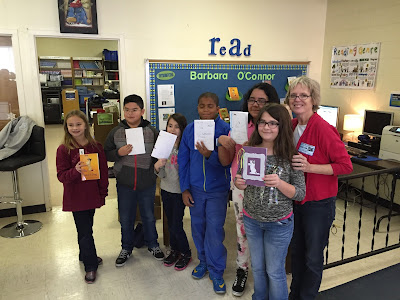 |
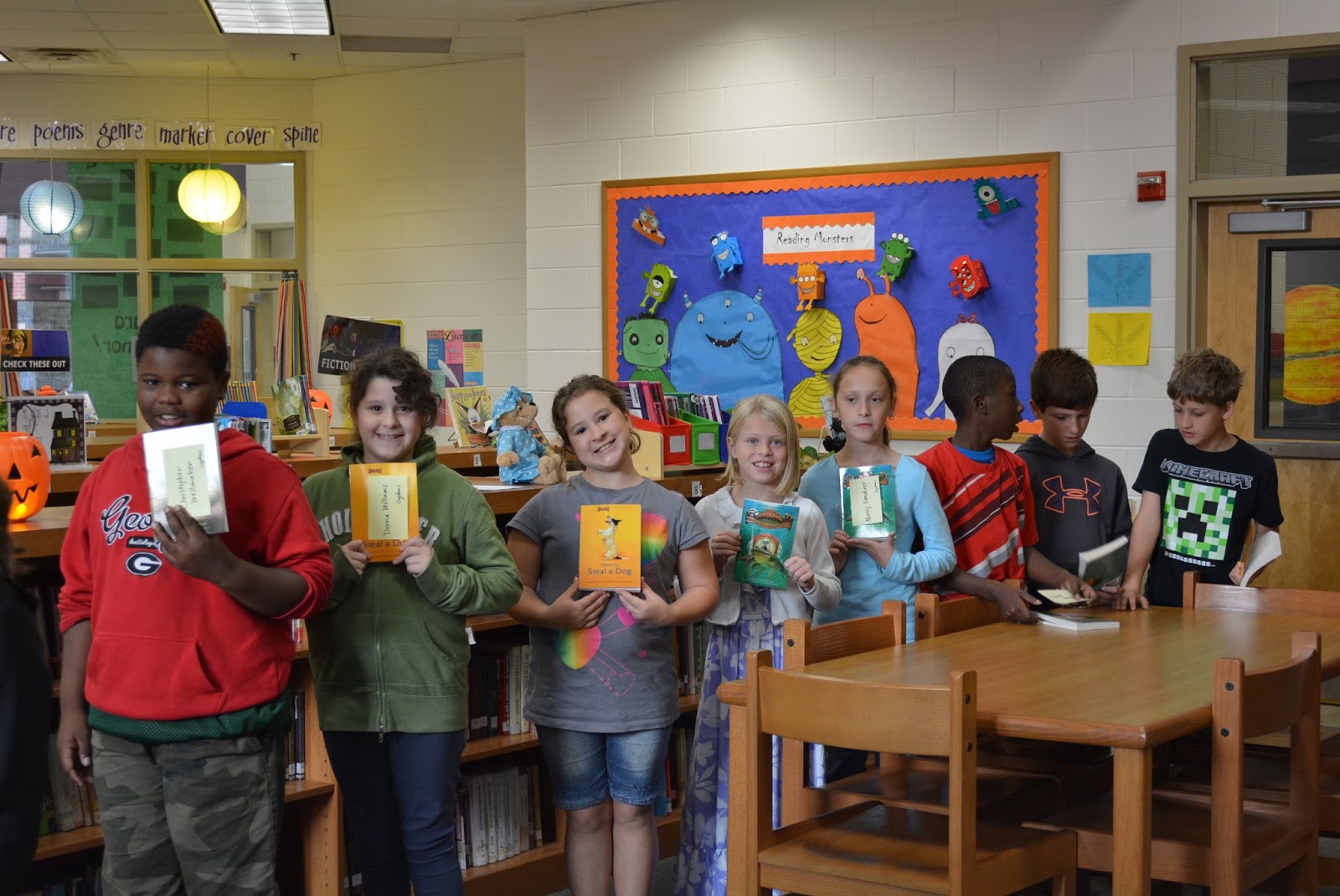
| These students made awesome projects for How to Steal a Dog (notebooks with the rules, like Georgina's). Thank you all for those! |
And because a picture's worth a thousand words, I'll let the following pictures tell you about my great day.
Two more days of Norway school visits! I wasn't entirely planning to make this visit a comics-themed visit, but comics games work so well that I've fallen into it anyway.

I'm back at my loft apartment above the art gallery, blogging on their little wooden table in front of the window overlooking the orange roofs of Skudeneshavn, with Radio Norge playing... uh... Phil Collins... in the background. This evening as I was coming home from dinner, a young couple (Peter and Lisa) spotted me and said they recognised me from Skudeneshavn's top 'feel-good book', by Svein Arthur Kallevik.

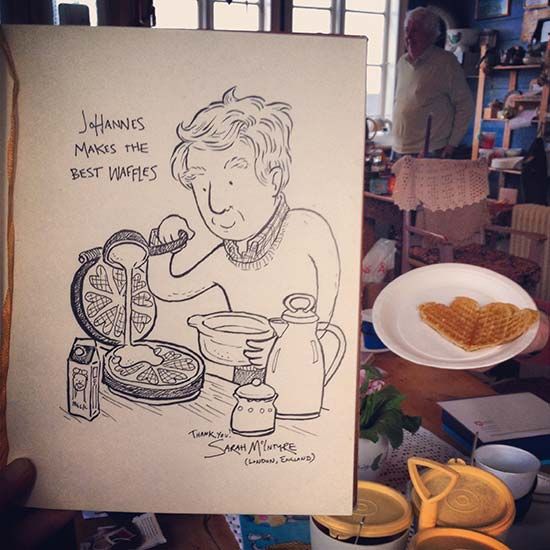
Oddly enough, Svein Arthur spotted me on London Southbank when Philip Reeve and I were on our London Pugwalk, and recognised me from the encounter at Johannes's waffle cafe, even under the wig and icicle tiara! I didn't realise I was in his book, which was a nice surprise. :)

(Here's my drawing of Johannes from February last year.)
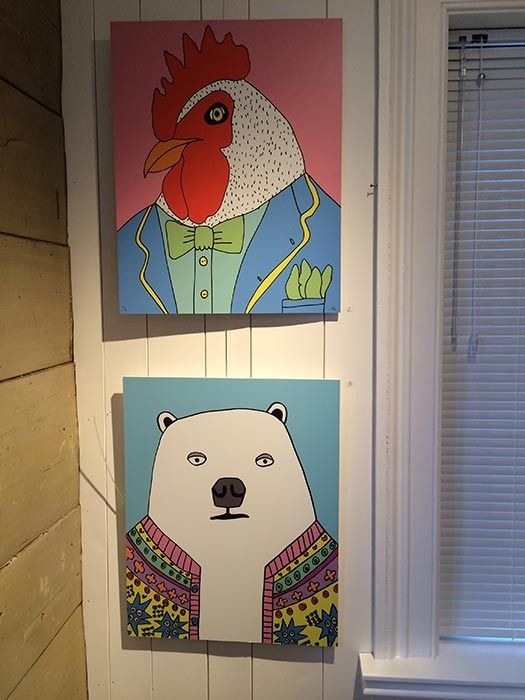
On this visit, I'm staying in the apartment connected with Studio 21, a new gallery run by Eli Aarskog Monsen and Ingvar Torbjørn Øritsland. For the SILK Festival this week, they're featuring the lovely graphic work of Stavanger-based artist < ahref="http://www.anettemoi.com/">Anette Moi</a>. The gallery's shut on Mondays, but they opened it up after my first day of school visits to show me the exhibitions. The prints are all very reasonably priced and I hope they make lots of sales. (You can see details about Studio 21 on Facebook.)

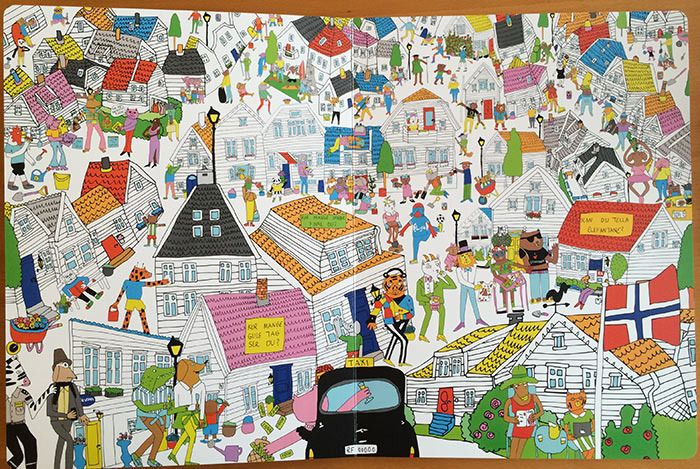
Check out Anette Moi's picture book, I Love Stavanger. Such pretty colours and wonky lines!

And these pictures made me smile, especially the polar bear.
Some drawings of Stavanger buildings, which made me want to go out and draw a bunch of Skudeneshavn buildings... (I hope I have some time to do it on this trip!)
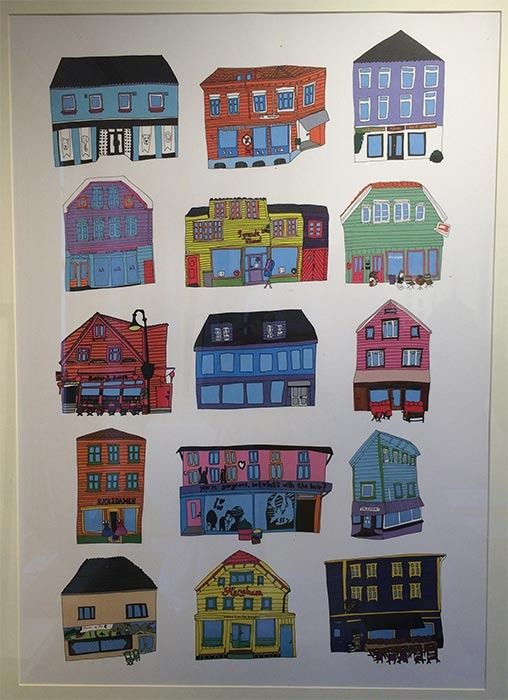
Love her sense of design so much.
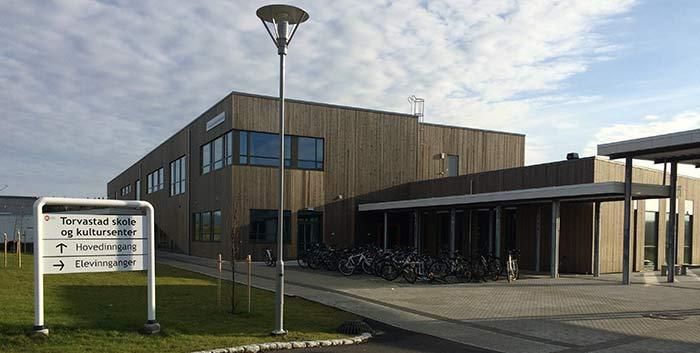
Right, back to school visits! The very first school I visited was Torvasted Primary School, and it's so brand-new that the building's only been open for one month!
Norwegian kids tend to be very cheeky, but this group was cheeky in a really nice way, and I enjoyed the visit very much. I'd only ever done Pugs of the Frozen North events as a double act with writer Philip Reeve, so I was wondering how it would work, but it seemed to go well.
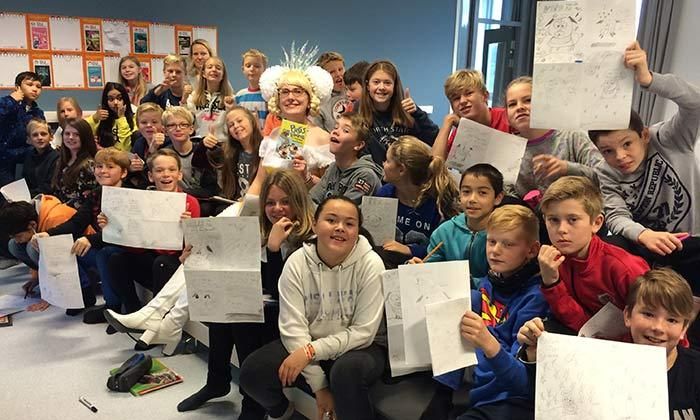
We used pugs as characters and set off on Comic Jams featuring our pugs. (They tell me that 'pugs' is 'mops' in Norwegian.)
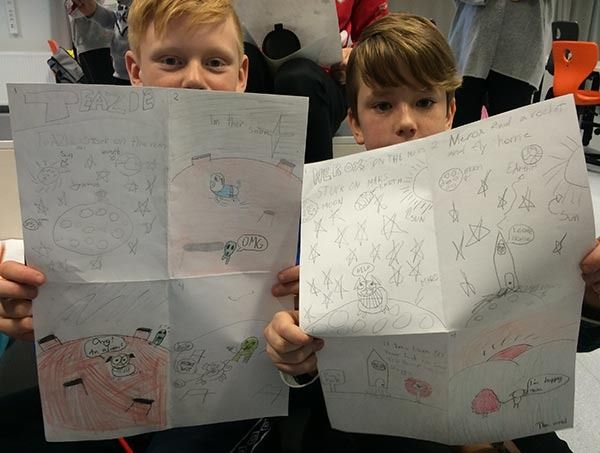
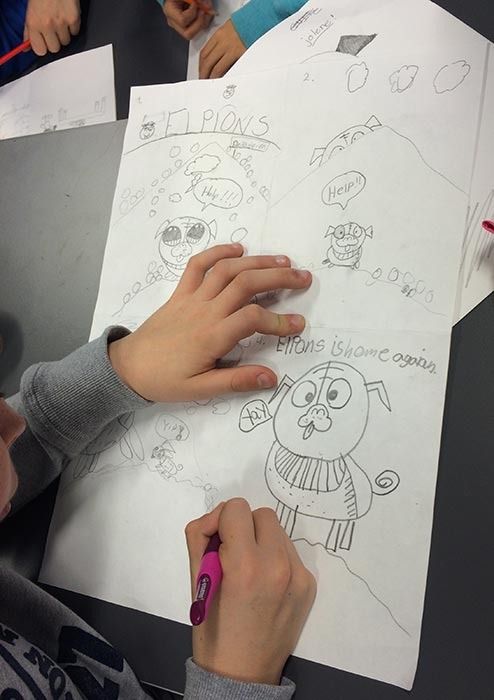
The kids drew quite confidently, it was nice to see. (In our Comic Jam, each of the four panels is drawn by a different person. You can find out more about Comic Jams over on the Jampires website.)
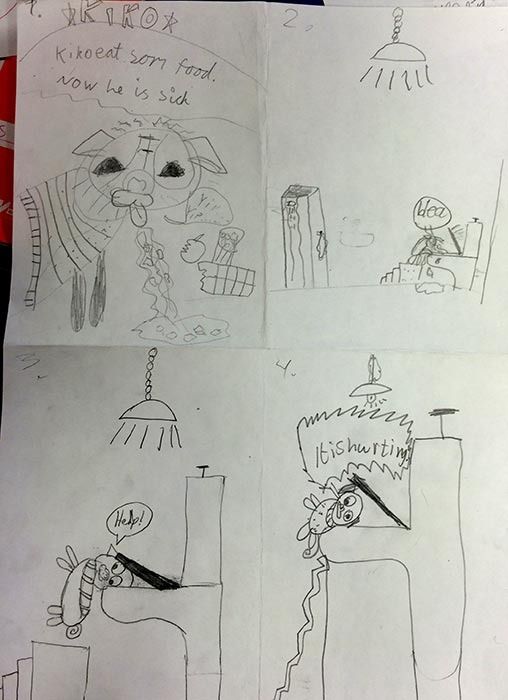
This comic made me laugh. I told them I might use the 'It is hurting' panel for my new Facebook profile picture, ha ha.
Teacher Evy Vikingstad gave me a tour of the library and I went straight for the stacks of Norwegian picture books, to see if I could find out about some Norwegian illustrators.
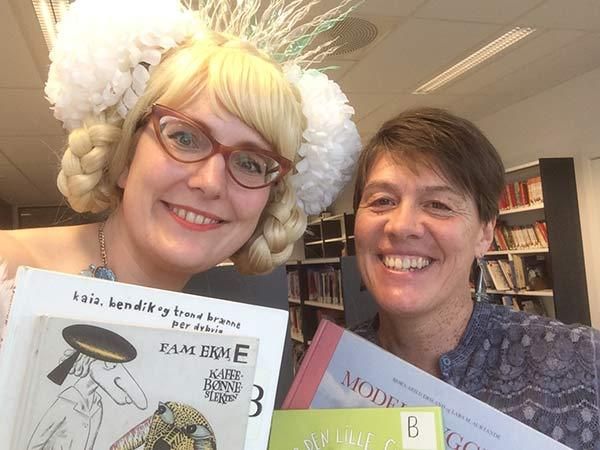
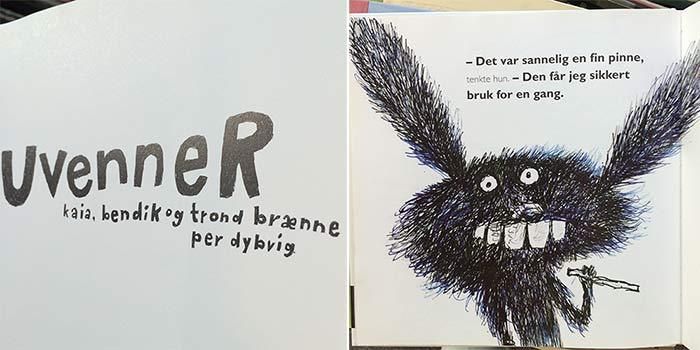
Some of the pictures in this book by Per Dybvig made me smile:
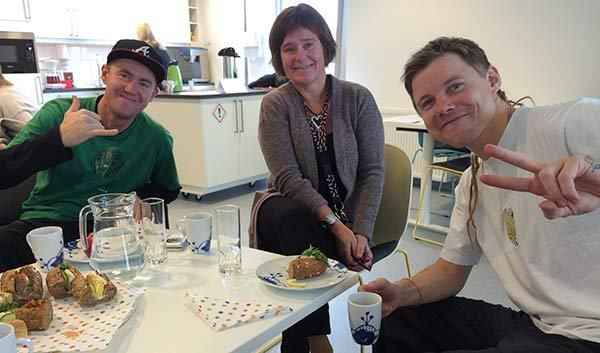
And then I got to have lunch with Headmistress Liv Hammervold, Norwegian rapper Lars A. Toennessen and tattoo artist Anders Meland. Lars and Anders are travelling around the country for ten weeks teaching all-day juggling workshops, which culminate with a performance of the children's new skills at the end of the day. They've been doing it for years and kids look forward to being in Year 7 so they can take part.
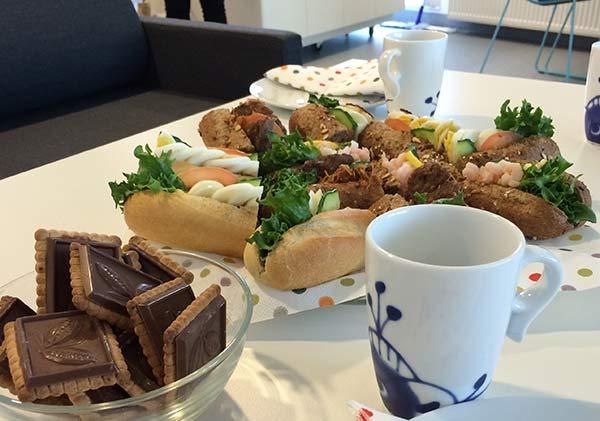
A little peek at the pretty, very Norwegian school lunch:
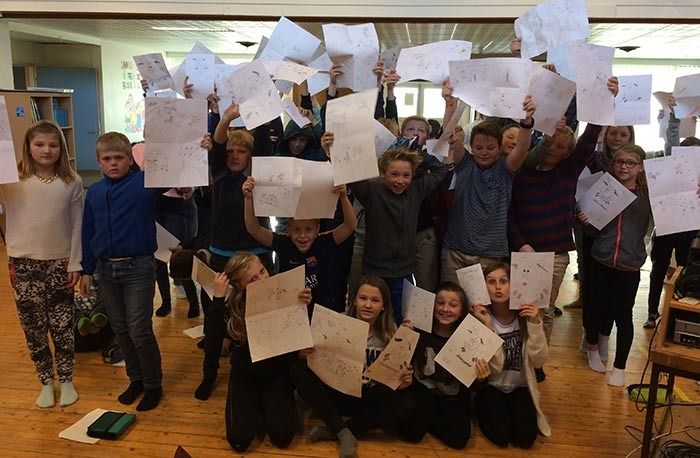
In the afternoon, I visited Avaldsnes School, which is very near the Viking Museum I toured on my first visit to Norway. There's an island nearby where more than 10,000 people gather every year to camp, in the old style, dressed as Vikings. So here are a few of our Vikings, with their Comic Jams:
And my nice teacher hosts, with a glimpse of the library on the left.
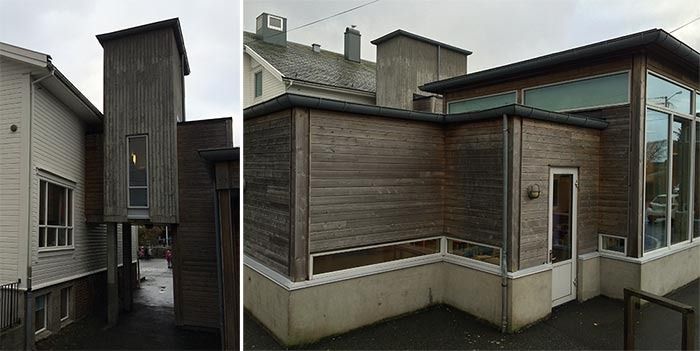
This morning, I started my second day of visits at Sevland School. I like this wooden tower stuck in the middle:
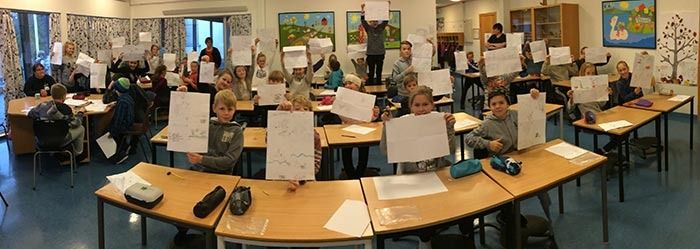
And here's my group with their Comic Jams! A lot of them sent me messages on Instagram, which made me laugh because I usually work with younger children who aren't on social media, so I'm not used to getting messages from 11-12 year-olds, but it was very sweet of them.
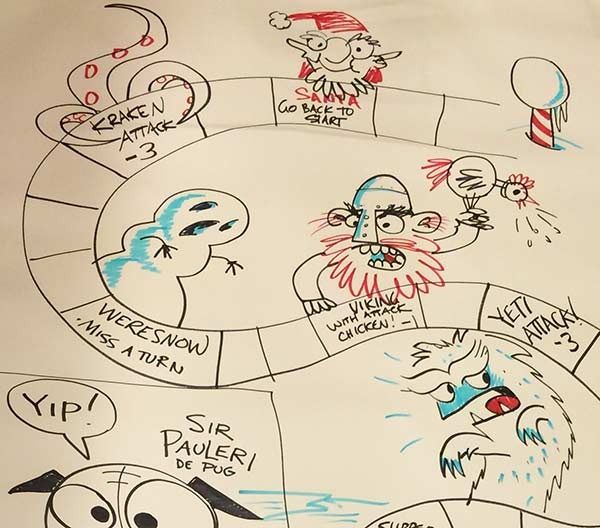
Here's part of the giant Great Northern Race board game they helped me make. They suggested a Viking as one of the perils, and we were going to give him a sword, but then decided an attack chicken would be funnier.
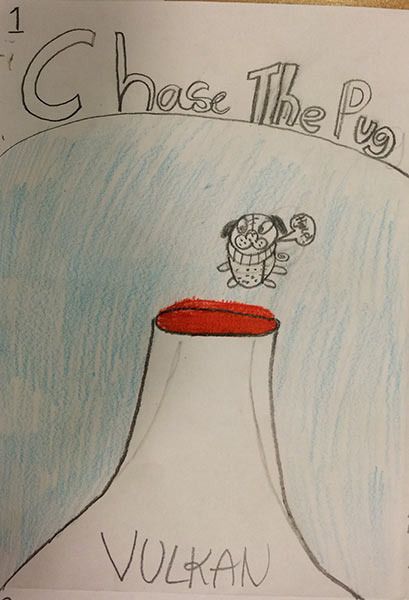
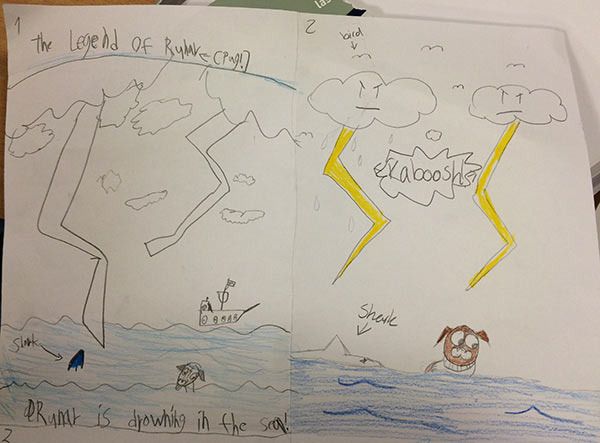
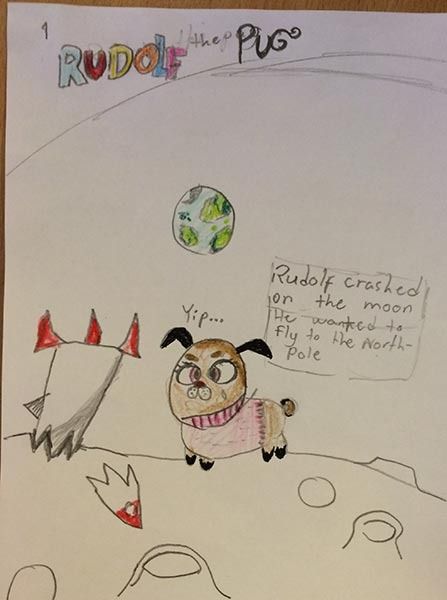
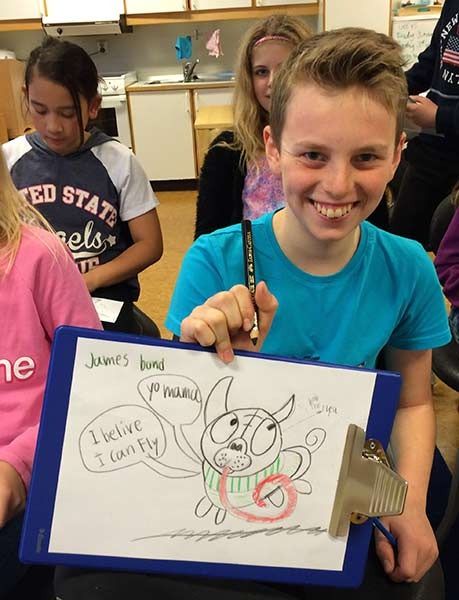
I love seeing what ideas the kids have for their pug stories, especially when they draw them very boldly, like this one.
I like the 'Kaboosh' sound the lightning makes!
And this wins so far for most glam pug.
Lunch in the staff room, and you can just about see SILK Festival's Silje Maria Skaadel (in front), who was my excellent driver for most of the day.
And then we went to a very small school. The state had closed it, but the community wanted so badly to keep their school that they reopened it privately, as Kvalavag Montessori School. It's in a beautiful, wild-looking rocky area, and I had my nose glued to the car window the whole way.
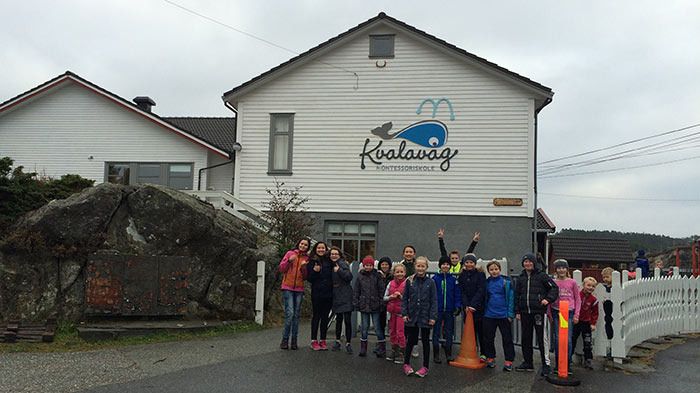
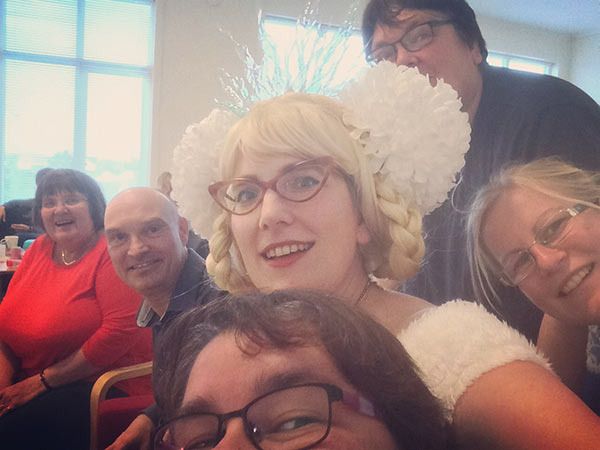
They were a really fun, enthusiastic group of kids and funnily enough they all had mobile phones, so we had a massive selfie session at the end. (I wonder if any of them will pop up on my Instagram!)
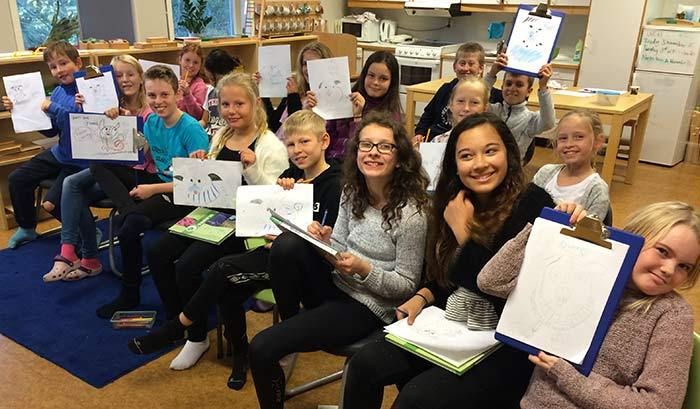
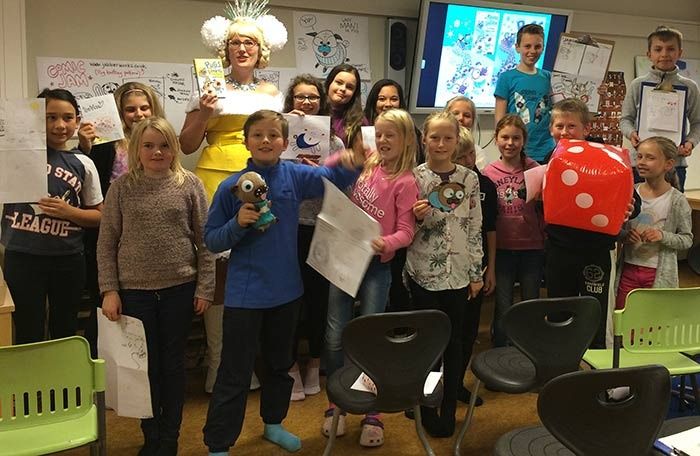
Here you can see some pug drawings and a Comics Jam:
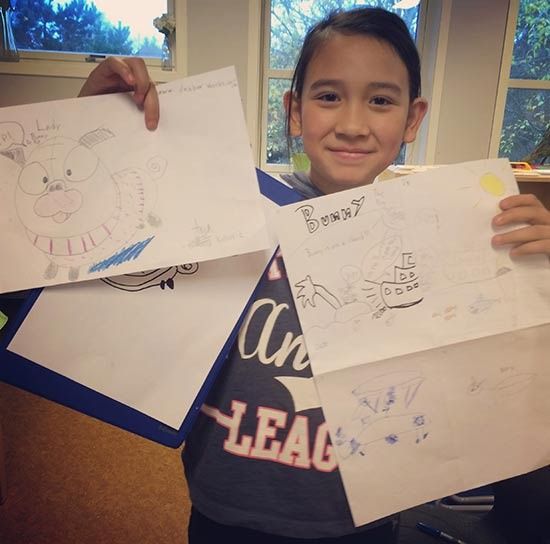
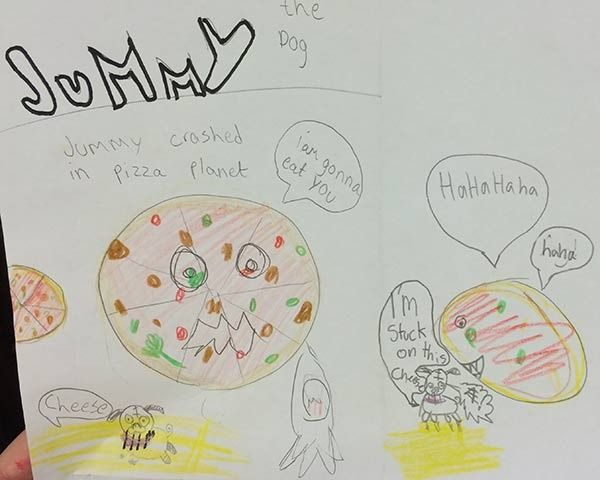
Poor pug is stuck in cheese on Pizza Planet:
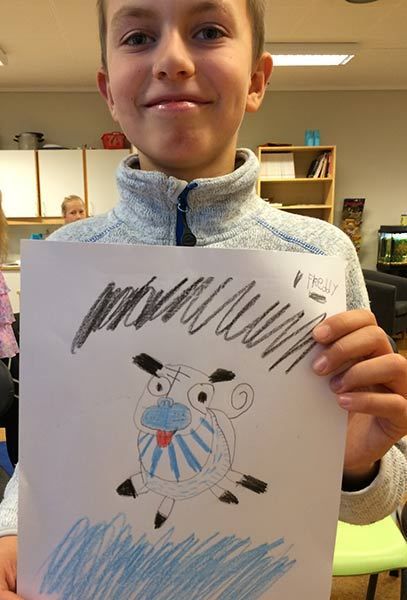
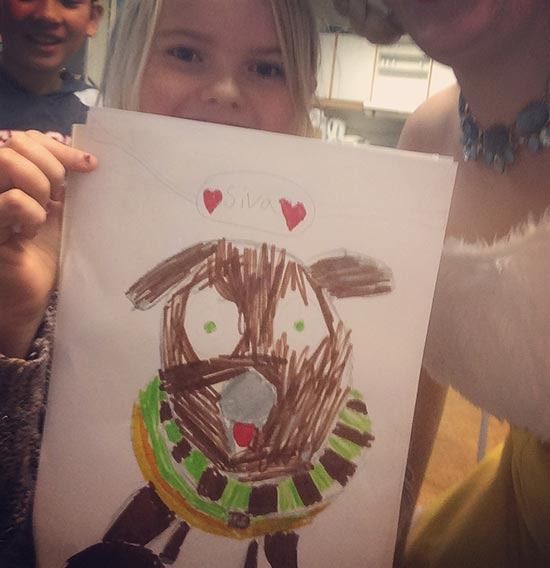
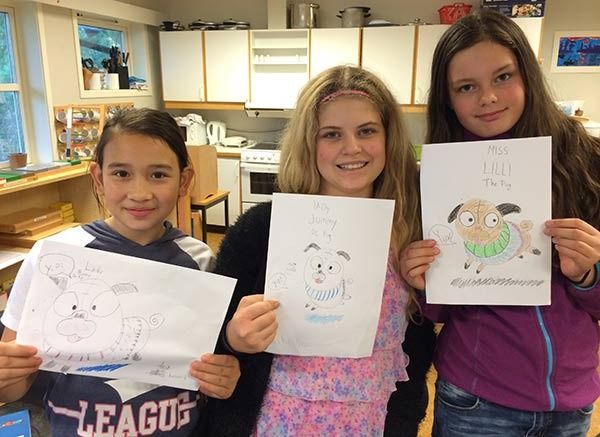
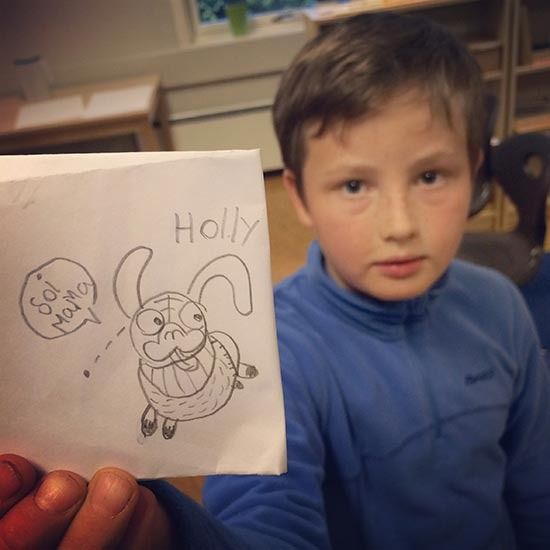
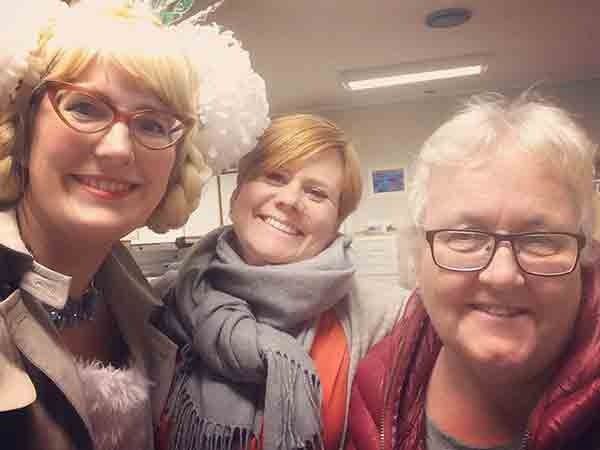
Here's a lovely teacher, and SILK Festival's stalwart trouper Ellen Skaadel, who drove me on the last leg of that day's tour.
Thanks so much to the four schools for hosting me, and John, Silje and Ellen for looking after me!
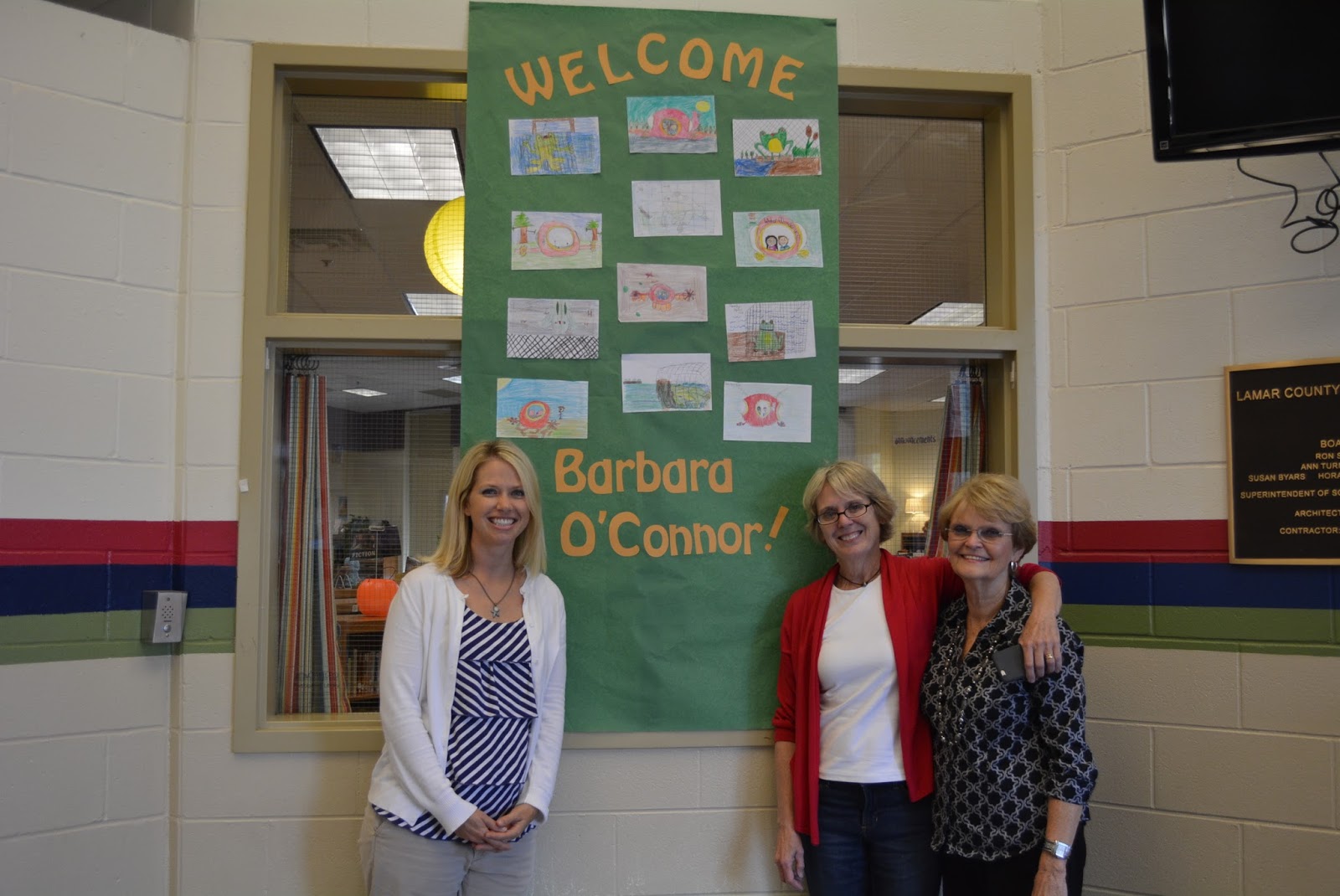
Just had the BEST school visit I've had in a long time.
Thank you, Lamar County Elementary School in Barnesville, Georgia, for making my visit so special.
(And thank you, Mrs. James, for making it possible.)
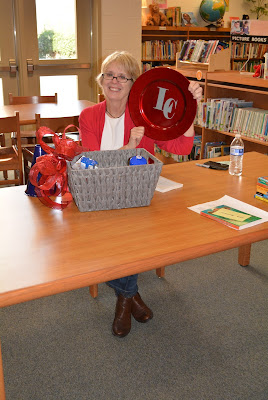 |
| They gave me the BEST gift basket. |
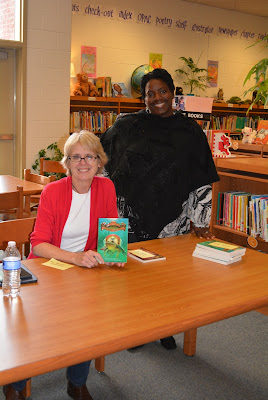 |
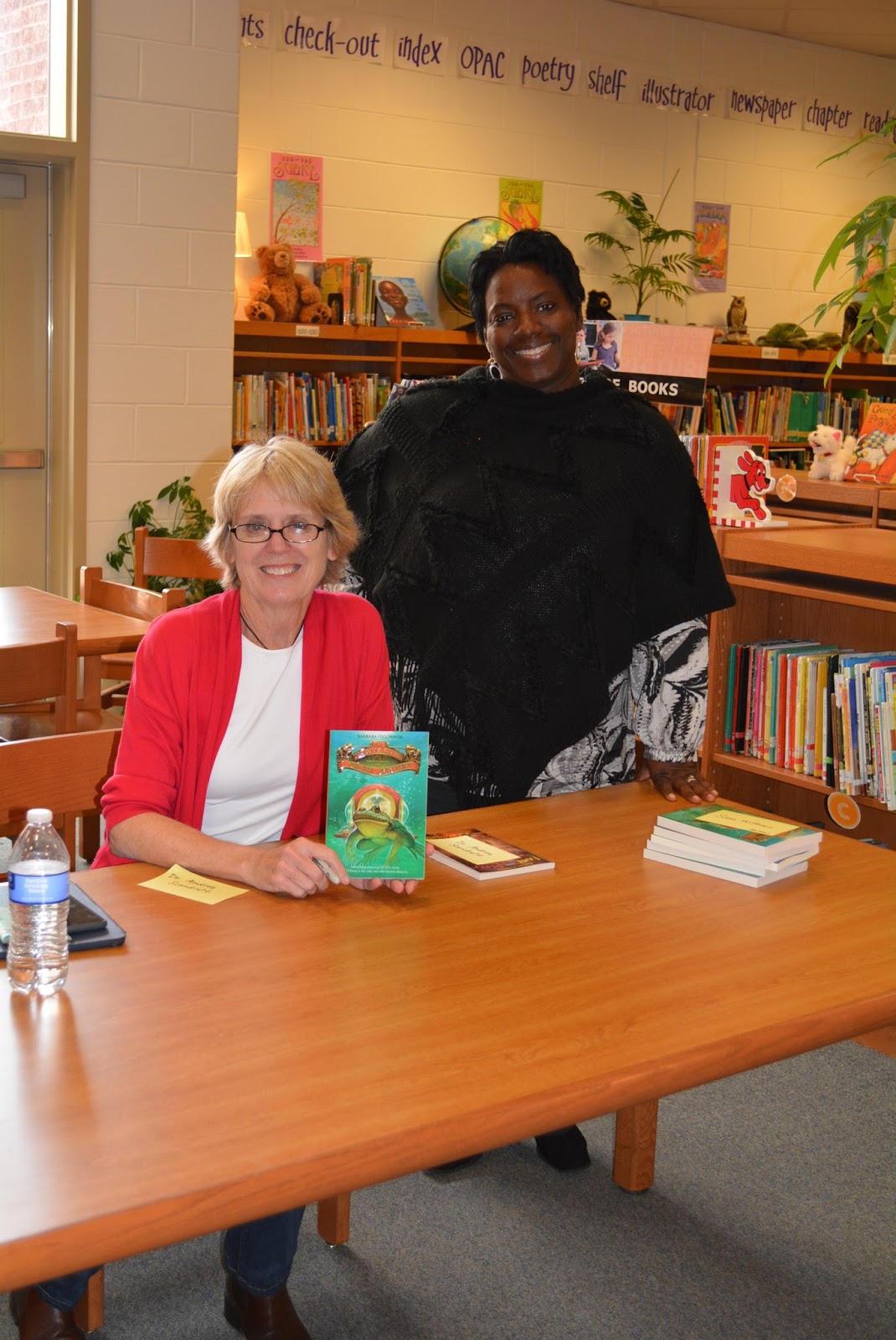
| With principal, Dr. Scandrett |
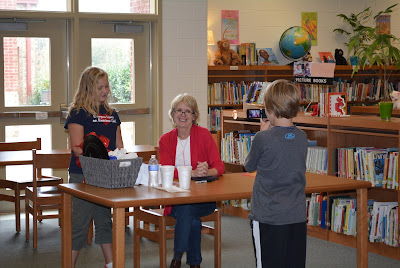 |
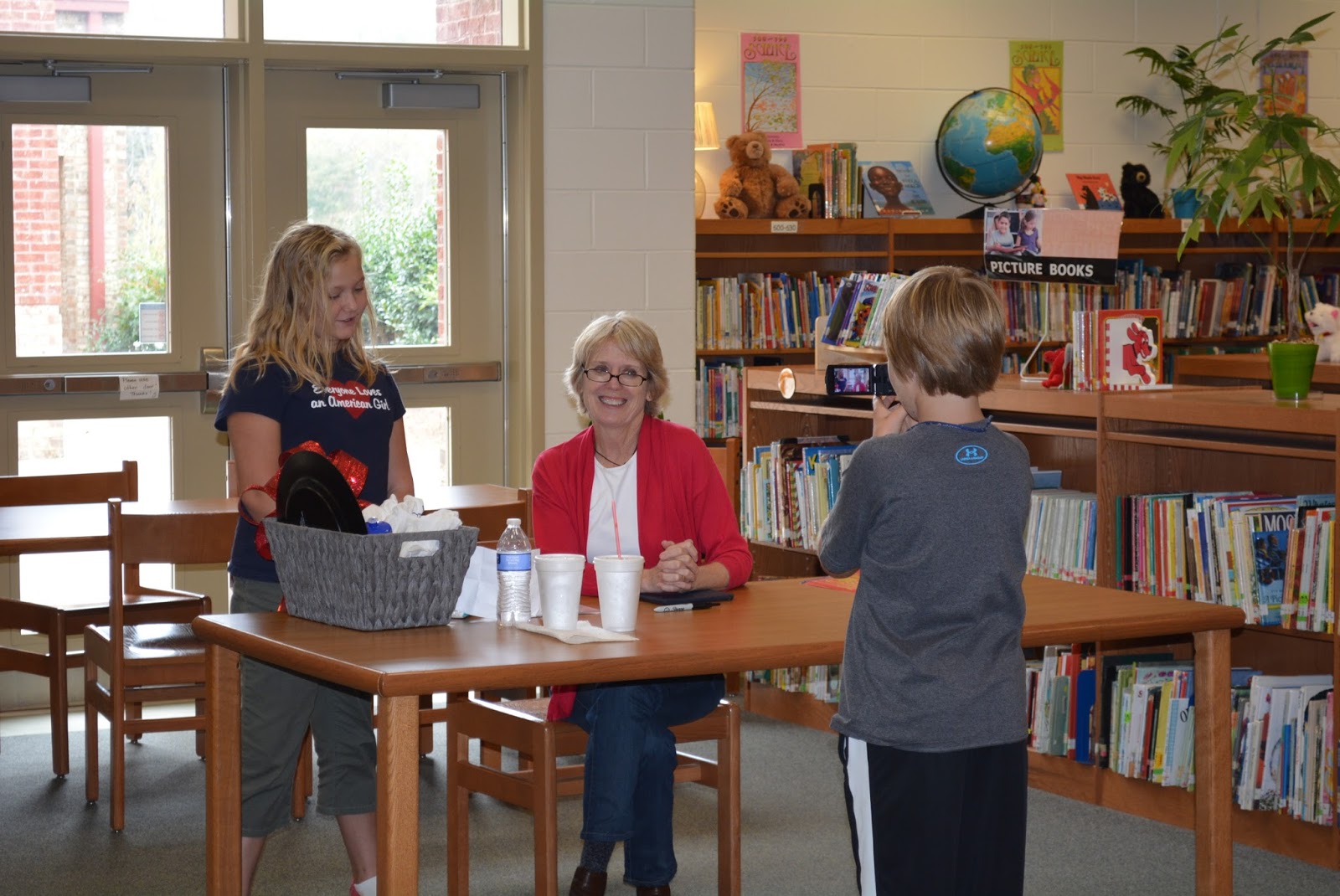
| Being interviewed. Great job, guys! |
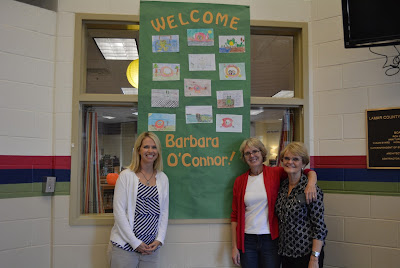 |
| With the BEST library media specialists, Claudia Bryan and Betty Smith. |
Thank you, Lamar County Elementary School!!
A couple weeks ago, I got an excited e-mail from a teacher named Claire Williams:
I'm not sure whether you'll remember me - I was sat next to you at the Book Awards dinner in Nottingham and we talked about how Pugs of the Frozen North sounded like an exciting novel to use for the Polar Bear topic that I have to plan for the first two weeks of term with my Polar Bears class. Well, I've read it, I just know that the children will LOVE it and I have also decided that if we're going to get as much enjoyment out of it as it has to offer, it's going to need more than two weeks! I'm going into school tomorrow to turn my classroom into the North Pole and the novel is going to be at the heart of our topic for the whole first half of this term, which I think I'm going to call ‘The Race to the Top of the World’ … I just wondered whether there is any chance that you and/or Philip might be able to spare a few minutes to come up with some sort of writing challenge based on Pugs of the Frozen North?

So we did! And since we'd done it for Claire, it made sense to turn it into notes that more people could print out. I consulted with Claire to get the notes as accessible as possible for teachers to use and adapt.
**Click here to download the notes as a printable PDF!**
Here are FIVE WAYS to use Pugs of the Frozen North in the classroom!
1. Draw a Pug!
Give your students confidence in character creation by making a pug out of simple shapes. It’s much more fun to write about a character who looks back off the page at you!
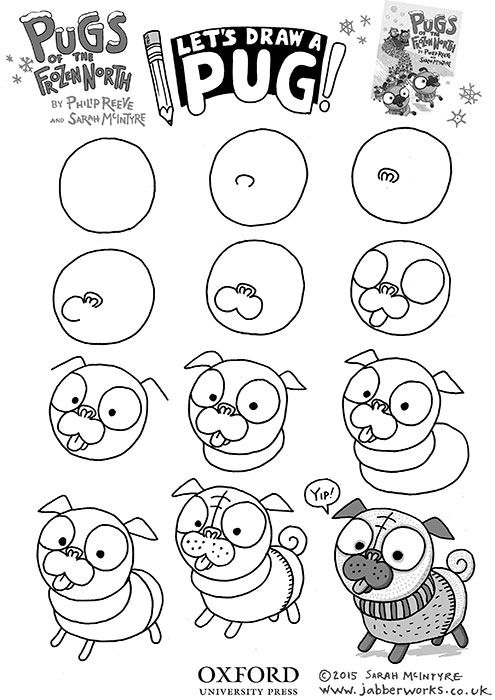
How you could build on this:
• Have everyone draw their pug on brown paper (such as parcel wrapping paper) in thick black pen. Give them pastels to make the whites of the eyes stand out and have each child design a different colour jumper for their pug. Have them cut out the pugs and display them on a class bulletin board.
• You could expand on this by having each child name his or her pug. Perhaps the child could write a paragraph about the pug’s personality and achievements, such as which sled races it’s already taken part in. Cut out these text boxes and hang them next to each pug as part of the classroom display.

Pugs drawn by Katie Hand, Keara Stewart, Teri Smith's daughter, Sam Reeve and Sam Decie
Browse a large gallery of all-ages pug drawings here!
2. 50 Kinds of Snow
In Pugs of the Frozen North, True Winter brings fifty different kinds of snow. With the class, create a list of all the kinds of snow mentioned in the book. Continue writing the list until the class reaches fifty, imagining what other sorts of snow might exist in True Winter.

Songsnow, screechsnow, gigglesnow, fartingsnow
How you could build on this:
• Divide up the snow: Write the fifty kinds of snow on slips of paper, fold them, and have each child draw a piece of paper from a hat to decide which kind of snow each child will focus on for his or her project.
• Create a 50 Kinds of Snow class comic book: Each child creates a one-page comic strip. At the top of the page, they draw the title of their comic, which is the name of that particular kind of snow (Singing Snow, Shrink Snow, Farting Snow, Giggle Snow, etc).
Have the children think about what angle they want to take with their comic strip. Some ideas: a scientist could demonstrate how that kind of snow behaves. A pug could encounter the snow during Shen & Sika’s race and have a mini-adventure which shows how the snow behaves. A snowball made of that kind of snow could be the main character in the comic. Or they could show what would happen if that kind of snow in their own school yard. (The possibilities are endless.)
If you’d like tips on how to make comics, I've has created a series of comic-making videos for Book Trust. They’re based on the Sea Monkey from Oliver and the Seawigs, but the same comic-making tips would apply to Pugs or any book or comic the children create.
Click here for all four Comic Jam videos
The advantage of making comics is that the visuals will pull along the writing and make the overall book a more appealing object. There's also more of a chance that children would want to read each other's work if it's in comic form, and the kids would have to work on making their comics read clearly to each other.
Collect the comics into a book and add a title page, and possibly a short introduction. The introduction could include a one-line quotation from each child on their favourite thing about Pugs of the Frozen North, or a class book review. Look at the pug endpapers in Pugs of the Frozen North and create your own endpapers, possibly using scans or photos of the pugs the children have drawn. Or create more simple endpapers using white paint blobs (snowballs) on coloured paper; liven this up by giving each snowball eyes. Create a cover and have the children come up with a blurb for the back cover. Include the children’s names on the title page and on the page with their comic.
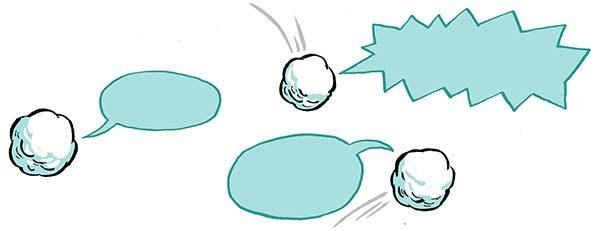
You could expand on this by having the class create a promotional book video trailer, and posters for the book.
• Make a class video about the 50 different kinds of snow. Each child presents a 'snowball' and introduces that particular kind of snow to the camera. Perhaps you cut away during each short talk to pictures or comics further illustrating the snowball's capabilities. Each child could also write out the name of that kind of snow for the camera to focus on before they begin talking.
You can feature one kind of snow per child (‘a selection of the 50 kinds of snow in Pugs of the Frozen North’) or show all 50 kinds. If you want to make the video public on YouTube or Vimeo and there are privacy issues, the children without video permissions could do voice-overs while the camera focuses on their snowball and artwork.
3. The Great Sled Race
Create a Great Sled Race mural on a bulletin board or long strip of paper.
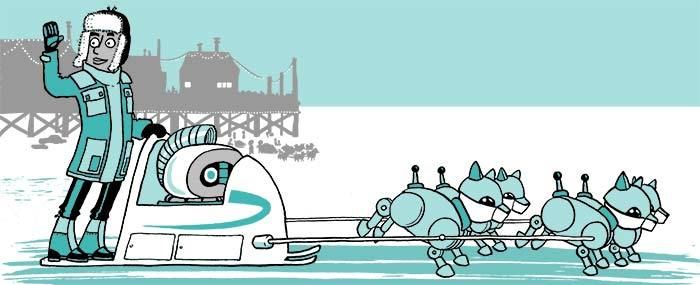
Have each child decide what sort of creature (real or mythical) will pull their particular sled, and how many of these creatures they will need to pull their sled. Have them draw the creature in the top of half a piece of paper and write a short paragraph beneath it, explaining what kind of creatures are in their team, why they think their team is best suited to win the race, and what they have packed in their sled. (This can be serious or jokey.) Make sure the children’s creatures are facing toward the right-hand side of the paper (so everyone’s sled will be going in the same direction).
Have the child go over the outlines of their creature drawing in dark black pen. Cut off the lower half of the paper with the article on it and save this. Have the child trace over the first drawing to create multiples of that creature. (If their team has four dragons, trace over the first dragon three times.) Have them colour their team in bright colours and cut out the creatures. Get them to create a sled out of coloured paper. (This could be as simple as a rectangle, or one of these shapes):
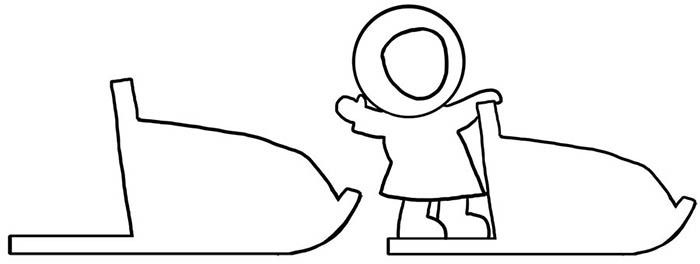
Print out a larger version of this in the downloadable PDF!
For an extra challenge, children could create harnesses for their creatures and draw on coloured paper a picture of themselves riding their sled. For younger children, you could cut around the second shape, glue a headshot photo of the child into the parka hood, and have the child decorate the sled, parka, mittens and boots. A bit of decorative ribbon might make a nice belt. Patterned origami paper might make eye-catching sled blankets.
Create a bulletin board with a coloured background (blue?) and display the sled teams and sleds on the board. Use thread, string or narrow ribbon to connect each sleds to its creatures. Next to each sled, attach the short paragraph the child has written about his or her sled team.
If you have space, have the children cut snowflakes out of paper and add them to the picture. Perhaps you could add a title along the top of the display, such as ‘Race to the Top of the World!’
In Pugs of the Frozen North, the pugs say ‘Yip!’ and ‘Arooo!’ You could create speech bubbles for the children’s creatures with the sounds their various creatures make while they’re racing.

Take a photo (or photos) and tweet it to Philip Reeve at @philipreeve1 and me, Sarah McIntyre at @jabberworks!
4. Polar Board Game
Create a giant board game, adding wonders and perils from the book and inventing some of your own!
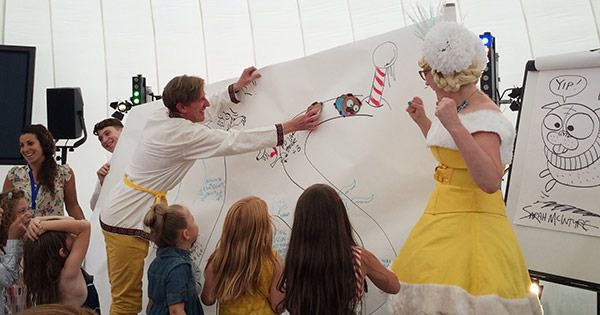
Part 1: You'll need a large piece of paper, possibly a roll of paper or paper covering a display board. In the bottom left corner, create the starting point (possibly the name of your school). In the top right corner, draw the North Pole (possibly an actual pole, with a label reading 'North Pole').
Part 2: Draw a curvy track (two parallel lines) connecting the two points, to form a game board race course. Divide the track up into boxes (like a railroad track).

Part 3: Talk about wonders and perils in the book. What might racers meet along the way, that would either help them or hinder them in their journey? You can debate the merits of each (Fartsnow might set you back three squares because it's horrible, or propel you two spaces forward.) Examples include encountering yeti, avalanches, the Kraken, crevasses, polar bears, Northern Lights, snowstorms, ice palace mirages. You can either write or draw onto the game board the different wonders/perils or have the children do it. The class can decide together if each encounter means going forward or backward (and how many squares... -2? +4?) or missing a turn. Write these directions onto the game board.

Kraken Deep!
Part 4: Create two paper markers with blu-tack on the back of each (possibly using a pug face from the How-to-Draw-a-Pug activity or a sled from the Great Race activity). Divide up the class into two teams. Select a person from each team to roll the dice for that team (or take it in turns). Have each team roll the die to see who goes first, then play the game!

Part 5: Discuss with the children how creating a board game is very much like plotting out a story: there's a beginning, and end, and events and setbacks that happen to the characters in the middle. Consider having each child create his or her own board game as a way of plotting out a story. Have them choose a starting point, a finishing point, and decide what their character might encounter between those two points. Then get them to tell or write the story as though they're playing the game they've created.
5. Heart’s Desire
If you could win the Great Race and get your heart's desire, what would it be?

Part 1: Have the children write the answers to these questions. They may feel very private about these answers and not want to share them with the class.
1. What would you want more than anything?
2. What do you think someone else in your family would want more than anything?
3. Is there anything you feel you ought to ask for, even if it's not what you really want?
4. What would happen if you got your heart's desire? Would it make you happy, could it cause problems, or both?
Part 2: The children could use these answers to inspire a story, showing a character who gets his or her heart's desire, how getting this might make things go wrong, and then showing what they'd do (or not do) to make it right again. The story could be in comics form or in writing with illustrations. They could be serious or silly-surreal stories, depending on how they want to approach the subject.

Further ‘Frozen North’ reading: The White Darkness by Geraldine McCaughrean, The Call of the Wild and White Fang by Jack London, Shackleton’s Journey by William Grill, Moominland Midwinter by Tove Jansson, Northern Lights by Philip Pullman
Click here to download the notes as a printable PDF. And visit my website - jabberworks.co.uk - for other book-related activities (including how to knit your own pug).
I heard back from Claire, who's already started reading Pugs of the Frozen North to her class:
Sarah, I am absolutely buzzing and I just have to pass this feeling on because you are responsible! I read the first chapter of Pugs of the Frozen North to my lovely new class this morning - I'd only planned to read one chapter to them but they were SO desperate for more that I just had to read a second and then they went on at me so much when I finished the second chapter to carry on that I had to read the third chapter and then we were late for PE but they LOVED it!!!! Thank you, thank you, thank you for creating such enjoyable experiences of reading and books for those children - amazing for them but, as a teacher, best feeling ever when learning becomes that exciting!
And thanks for inspiring us, Claire!
Yesterday was an exciting day for Oliver and the Seawigs when Oliver, Iris, Cliff the rambling isle and a jabber of Sea Monkeys picked up a UKLA Award! UKLA is the UK Literary Association and I've heard this award called 'the teacher's Carnegie' because it's judged entirely by teachers and it's a big honour to win it. Here's coverage in the Guardian:

(Read the rest of the article here.)
Even the journey to the ceremony in Nottingham felt a bit special when, in honour of Wimbledon tennis, East Midland Trains surprised everyone with complimentary strawberries.
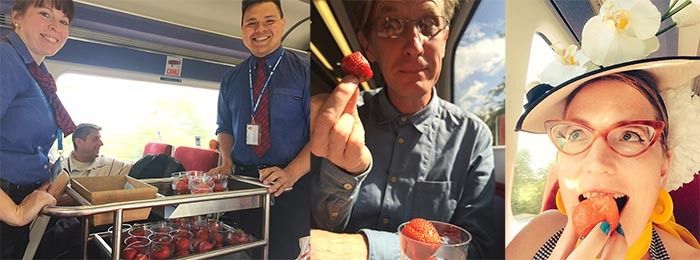
My co-author Philip Reeve snapped pictures of me busily making a #PicturesMeanBusiness cover for my phone.

When we arrived at the National College for Teaching and Leadership, we ran into fellow Oxford University Press-published author Gill Lewis, our Seawigs publisher Liz Cross and UKLA's Joy Court (who's been very helpful with the #PicturesMeanBusiness campaign).

And here's writer Jo Cotterill, and Sarah Howells from OUP who was looking after us for the event.

We were supposed to be schmoozing teachers before the ceremony but Reeve was most uncharacteristically reserved.

Here's UKLA's Lynda Graham opening the ceremony with a slide of all the shortlisted books for the three categories of awards.

We got to see teachers talk about each book and how they'd used in their classrooms and how the children had responded to them.

I loved hearing from these kids about Oliver and the Seawigs. Check out the knitted Sea Nonkey, and that boy in the middle had made a clay version of Oliver!

While Seawigs won the main 7-11 award, Heather Butler's Us Minus Mum received a special commendation for dealing with death and grief. It was great to see a special award created for that book that will be very important for specific children going through these issues.
After the ceremony, teachers came up to us afterward and raved about how important the Seawigs illustrations were to getting kids in their 7-11 age group reading and enjoying the experience. They can't get enough of quality illustrated chapter books. Philip and I didn't go into making these books because we saw a huge niche in the market - we just thought it was a great way to tell a story - but it's amazing to hear all the testimonials of how these illustrated books really hit home with kids. Philip and I took turns giving a short speech and making this drawing, and I talked a bit about #PicturesMeanBusiness and urged teachers to encourage their colleagues to talk just as much about the illustrator as the writer when they read and do class projects on books, so kids could have two sources of inspiration instead of one.

Here's Philip and Chris Haughton mucking around after the dinner UKLA laid on for us.

Huge thanks to UKLA's David Reedy, Lynda Graham and Joy Court, award sponsor MLS, all the teachers and kids who read the huge stacks of books, Marilyn Brocklehurst from Norfolk Children's Book Centre who provided books on the day, our editor Liz Cross for coming along, and Sarah Howell for being so helpful and organised! Oh, and Philip, of course for making an ace book with me. That guy constantly amazes me with the story stuff he comes up with.

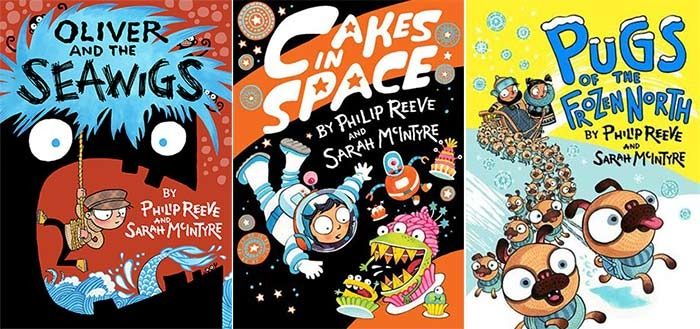
If any teachers are reading this, check out my website for free printable activities to go along with our books Oliver and the Seawigs, Cakes in Space, and the upcoming Pugs of the Frozen North.
Time to use that award bowl... it's strawberry time!

Look! Seawigs have reached Germany! Here are some young rambling isles who we met last week at the European School in Bad Villbel, near Frankfurt.

Dressler, our German publisher, had asked us to go and visit some international schools to spread the word about Oliver and the Seawigs, or Schwupp und Weg as it’s known in those parts.

Our main host was Stephanie von Selchow who is the librarian at the European School in Frankfurt.
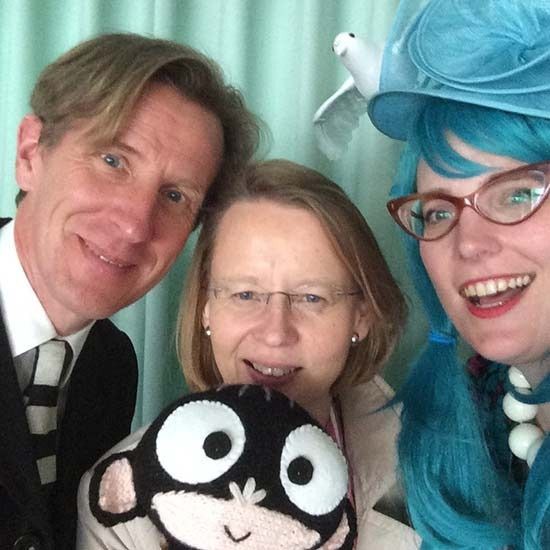
She’d arranged for us to do two sessions there, for her own students, and a visiting class from Textorschule, Sachsenhausen. A lot of the kids had already read Oliver and the Seawigs, so after we’d talked a bit about it we went on to Cakes in Space, which has just been published in Germany as Kekse im Kosmos. Most of the audience spoke good English, and it seemed to go down well... of course, some of the show needs no translation; the bit where I hit Philip over the head with a mandolin case goes down well in any language.
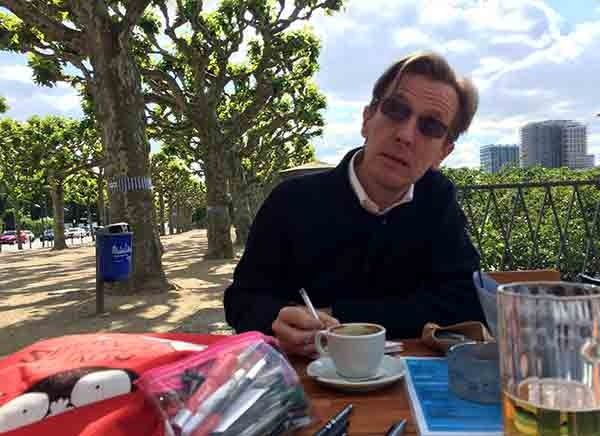
That afternoon we had a quick wander around Frankfurt, and tried to draw some of the odd but attractive nobbly linden trees which line the riverside.
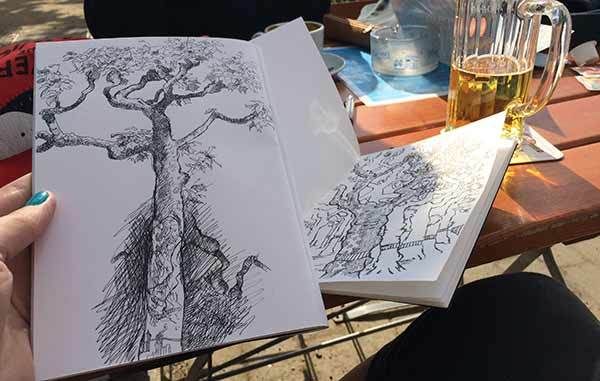
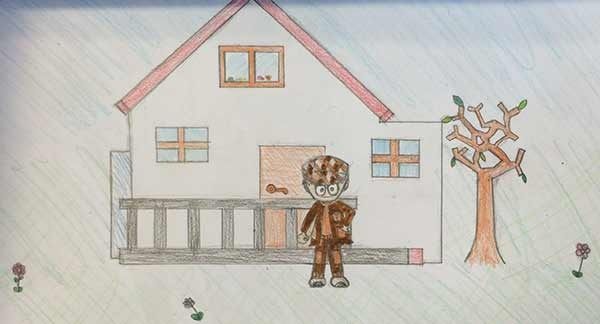
They're quite tricky trees to draw, and I'd love to have another try at them. One of the school kids had a picture of this kind of tree in his Oliver and the Seawigs artwork and he got the funny shape of it just right.
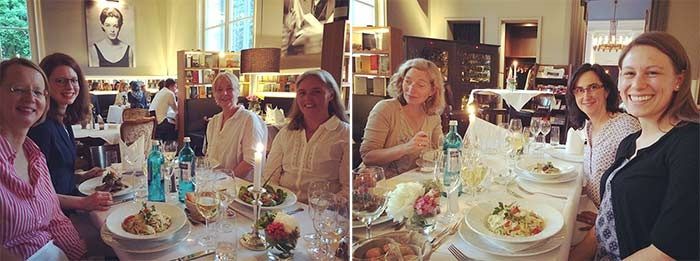
Then it was off to the Literaturhaus restaurant, where we had dinner with Stephanie and some of her colleagues from ESF and other schools.
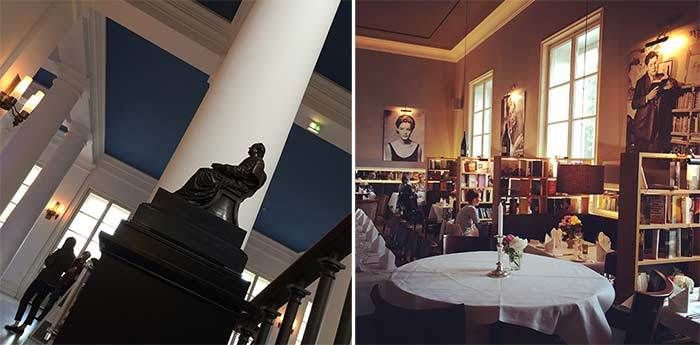
As you can see, it was very grand, and the food and company were first-rate.
The next morning we were picked up by Manuela Rossi, who whirled us down the Autobahn to Bad Villbel, where we talked Seawigs and Cakes to some of the students of the European School Rhine Main.
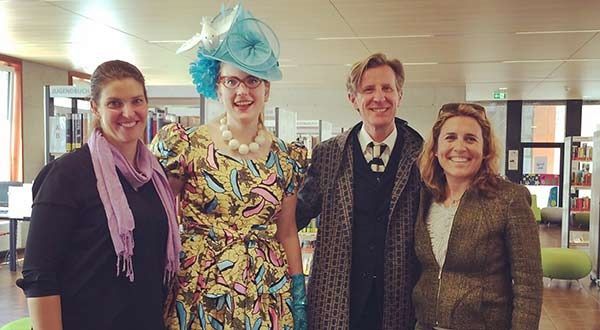
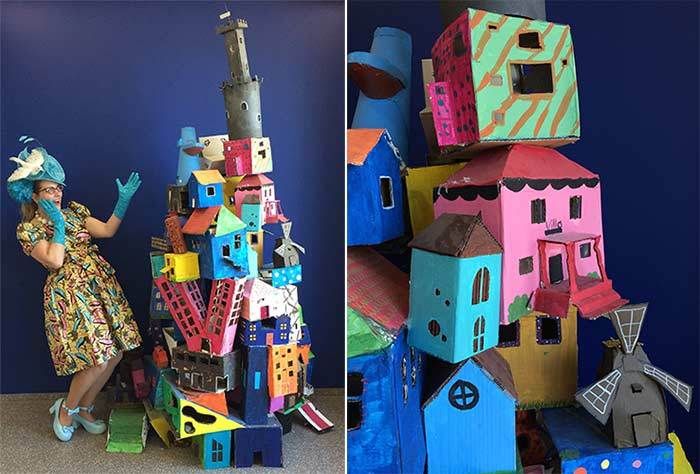
Utte, the librarian there, showed us some of the great artwork the children had produced, including this fantastic tower of houses. It looks a bit like a Traction City out of Philip’s Mortal Engines books.
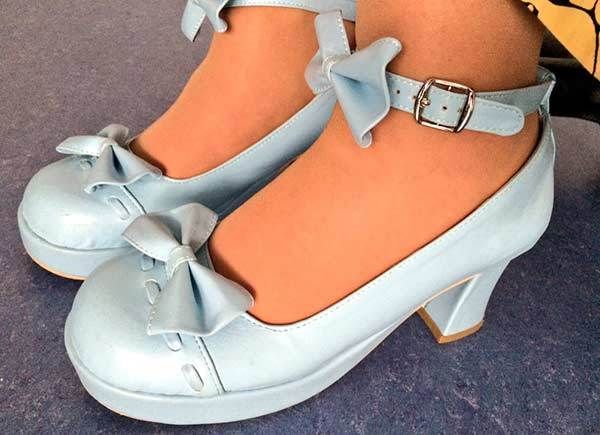
Most amusing question of the day: Where did you get those GIGANTIC SHOES?
Then it was back on the Autobahn to yet another international school, Accadis in Bad Homburg.
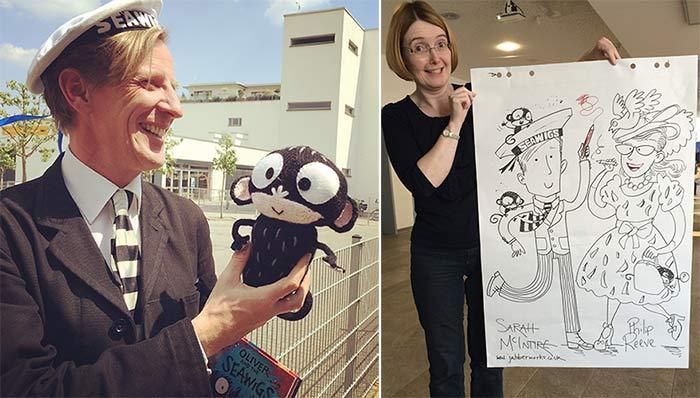
We’d met Samantha Malmberg and Caitlin Wetsch from the school at the previous night’s dinner, so it was good to see them in their natural surroundings, and meet their students, who were VERY EXCITED TO SEE US.
Some of the classes had done whole whole projects on Oliver the Seawigs, complete with some great drawings.
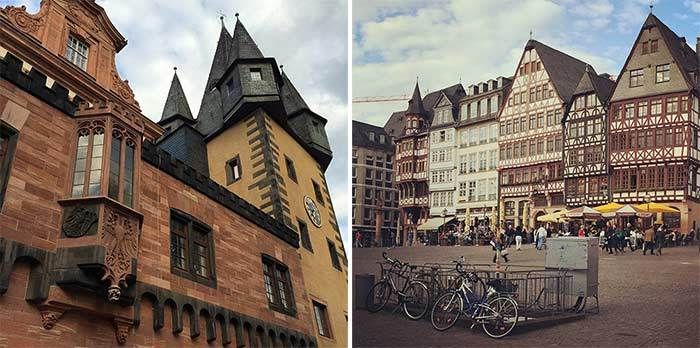
And after that we had a little bit more time to mooch around Frankfurt...
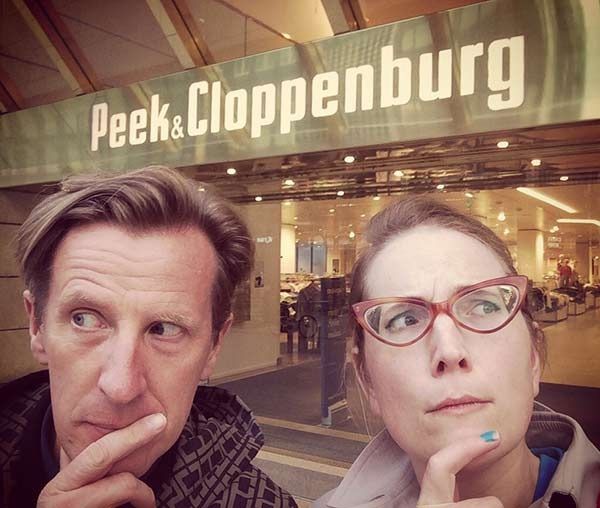
...in the guise of Mitteleuropean crime-fighting duo Peek & Cloppenburg.
Strange things were going on in Frankfurt city centre. Nobody seemed to be bothered by the fact that the shopping mall was being devoured by a wormhole…
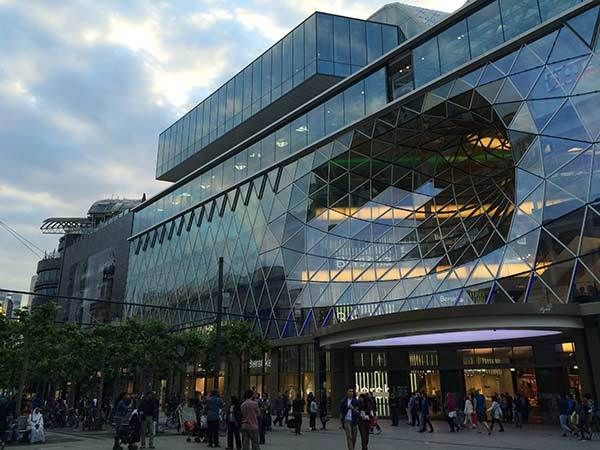
But we discovered a natty German-style TARDIS and were able to save the day.
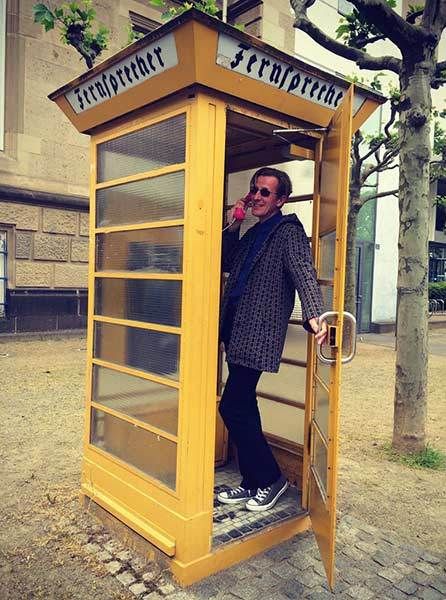
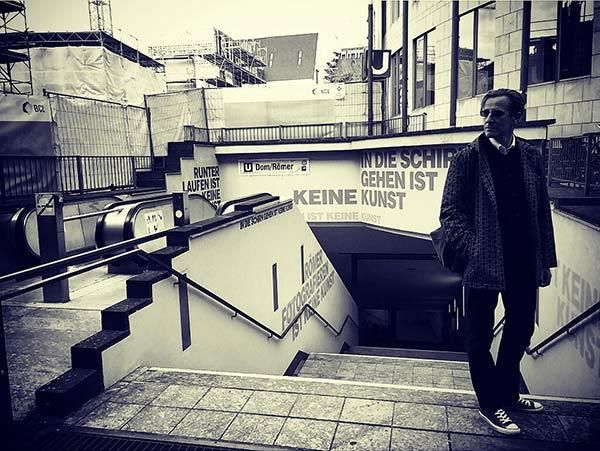
And we both found excellent covers for our pop albums, should we ever find time to write and record them. Here’s Philip, waiting for the Trans-Europe Express…
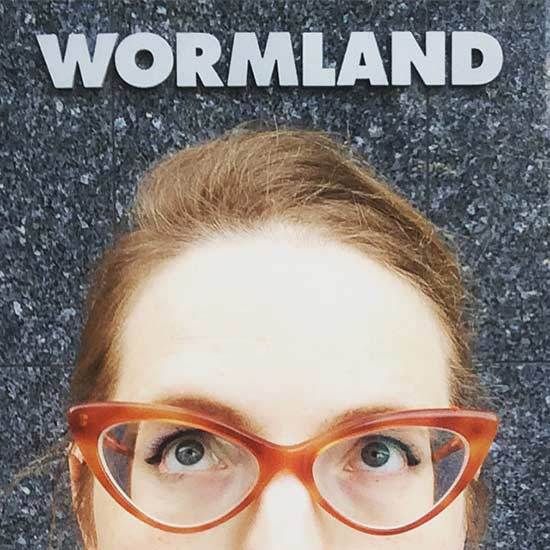
Heaven knows what mine is going to sound like.
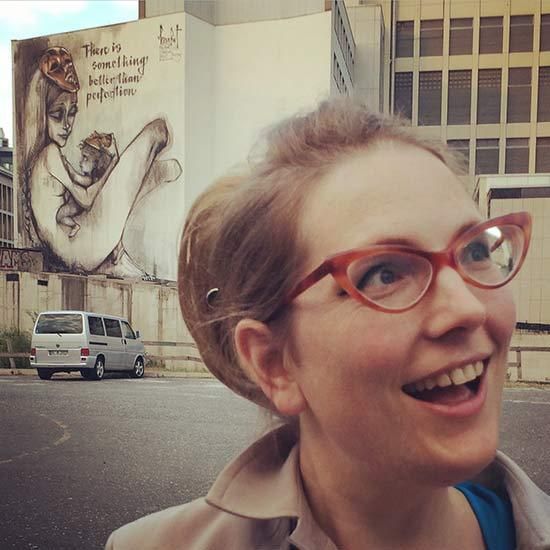
But whatever it is, it will be lovely: some things are Better Than Perfection.
Thanks to Stephanie, Utte, Sam and all the staff and volunteers who helped to make our visit to Frankfurt so enjoyable. We were very sad to leave!
Guys, this is exciting! Booktrust have worked with me to come up with a whole online class on how to make comics! I'm always wishing I could get around to more schools, so this is a huge help. There are four videos: how to make a character, tips on making comics, a walk-through where kids can make a comic along with the video, then a fun song at the end, inspired by the comic character.

The video editor has expertly paced the tutorial so teachers can use it in the classroom. But I think people at home can get a lot out of it, too: kids or grownups! You can watch the videos on the website here.
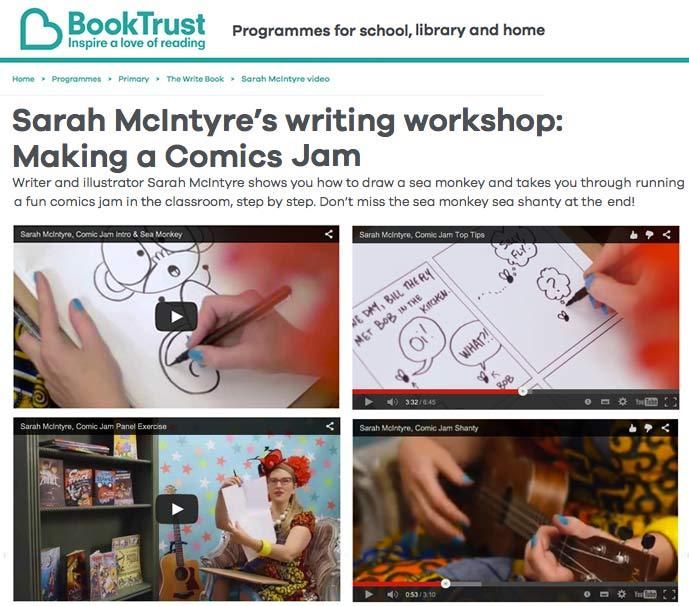
Here's the second video, so you can get a taster. Kids find making comics fun, but it also focuses them on learning how to make a story very clear to a reader. When I lead kids in Comics Jams, I often see them coming to grips with the idea that it's not enough to have a story in their heads, but that they have to give enough clues on the paper for someone else to understand the story without them hovering nearby, explaining it. They partly learn that by drawing the comics, but also by being given someone else's comic, and seeing why it might be difficult to work out what's happening. Learning how to express a series of thoughts clearly is a great concept lesson that applies to any form of communication.
You can find some more tips on leading Comics Jams over on my Jampires website with David O'Connell (who does great workshops). The Write Book site went live yesterday and a few people have already spotted it and seen its potential. Yay!
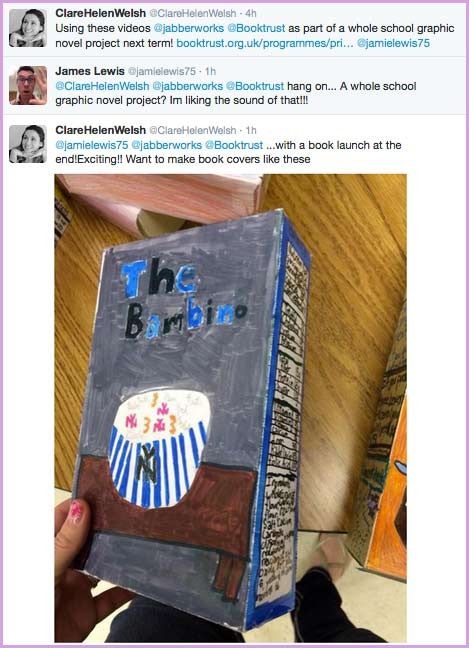
And you know how I'm always banging on about us needing an online comics database? Well, it looks like something's starting to happen! Check out this Booktrust Bookfinder on the website. For people who have no idea what kind of comics to give kids of various ages, this could be super-helpful. It's by no means a comprehensive list, and people can question the age ranging but it's a great start, and user-friendly. I'm always meeting teachers who want to do more with comics but they don't know much about them and need help.

On the Bookfinder, you can find out about my Vern and Lettuce comic book:

You can even download some pages, so you can get a feel for what kind of comic it is!

I'm really excited about this Write Book teacher toolkit; I think it could become a sort of TED Talks about children's books, with good resources just clicks away from the videos. I know kids get a HUGE amount out of it when I lead them in Comics Jam sessions, and I really hope people will use and share these videos.

And explore the other resources on the site! You can watch videos by Tony Bradman on rewriting fairy tales and Laura Dockrill's tips on writing and keeping a notebook. If you use our videos to come up with something creative, we'd love it if you'd share them with us! You can tweet them (or get someone to help you tweet them) to @Booktrust, using the hash tag #thewritebook. (And include me - @jabberworks - I'd love to see your comics!)

Big thanks to Anna McKerrow and the Booktrust team for making this happen!
I recently spent three days visiting schools in Fredericton, New Brunswick.
 |
| To get there, I had to fly on an itty bitty little plane like this, that kind of freaked me out. |
 |
| But I survived. Phew! |
 |
| My first stop was Gibson-Neill Memorial Elementary, where they know that it's the little things that count. A reserved parking spot! (I love all those different-colored letters.) |
 |
| I was greeted by Alex and Quinn. A nice welcome! |
 |
| The students had decorated the gym. Love this greeting sign. |
 |
| Students had made book trailers and illustrated booklets. |
 |
| Such great pictures of dogs! |
 |
| More dogs |
 |
| More drawings and trailers |
 |
| More drawings! The school was so festive. |
 |
| And more drawings.... |
 |
| I loved seeing these booklets the students made for How to Steal a Dog. |
 |
| Some students had made these cool scenes from clay, on display in the library. |
 |
| More decorations in the gym |
 |
| Speaking to Gibson-Neill Memorial students |
 |
| Reading to the students |
 |
| This is a spring-time recess in Canada! Brrrrr |
 |
| Students being interviewed by the local radio station (Canadian Broadcast). She asked them great questions about my books (and they gave great answers). |
 |
| Liam, Boyd, Aiden and Conor had lunch with me and asked some great questions. |
 |
| Next stop was Barker's Point Elementary, where I was greeted by this great sign. |
 |
| Hannah and Amelia greeted me with this great sign. |
 |
| (l to r) The amazing Sherry Norton-Graham, who made this trip possible and treated me like a queen (Thanks for everything, Sherry!), me, and Barker's Point principal Jeanne Wood) |
 |
| Next stop was Park Street Elementary, where I had the pleasure of having lunch with these super nice students. We practiced saying our names in Pig Latin. |
 |
| And more Park Street students. |
The German filmmaker will head the animation program at the the internationally renowned film school.
Heading to Canada to visit some schools
I love this school display from a small town in Georgia.
 |
| Vocabulary Words We Know. Thank you, Barbara O'Connor. |
Leicester earthlings got a surprise last week when my co-author Philip Reeve and I teleported in with our Cakes in Space roadshow! We drew a picture of ourselves, in case we couldn't be seen because our costumes were so blindingly shiny:

We were thrilled to take part in Leicester Author Week, and this is the first time there that I've been able to do a double-act presentation. Which was a lot of fun! The Two Steves have been doing this double act thing for years, here we are with them (Steve Skidmore and Steve Barlow) and writer Andy Briggs, who all worked with their own groups of kids on the day. And we got to see a lot of kids! Over the two days, I got to work with over 800 Leicester school children on the city's innovative scheme, Whatever It Takes to get kids reading.
**Philip Reeve has blogged (magnificently) about our Cakes in Space day over on his website**, so pop over there for a read! (You can print out Cakes in Space drawing resources from my website.) I think one of my favourite things about the day was watching all these kids at the end of the session, rushing up to give Philip big hugs. I don't think he got hugged quite so much when he was doing his Mortal Engines talks. :)

So... JAMPIRES DAY! I spent quite awhile talking about my co-author on this picture book, the excellent David O'Connell, and drawing, of course.

A teacher took this photo with the kids from her class, who were very appropriately dressed in jammy red school jumpers.

The team that run Leicester Author Week is what makes it great; they manage to combine a warm, fun atmosphere with total professionalism. The equipment always works, the planning is very straightforward, and every kid gets a book at the end of the day. Big thanks to technician Mark Lambell, multi-lingual storyteller Jyoti Shanghavi and head organiser Kate Drurey (with jam pot).

We started with a big stage event and I read JAMPIRES to the kids and teachers, talked a bit about how I made it, took questions and we sang the Jampires song. Then we all moved over to the workshop tables, and I led them in drawing their own Jampires. (Hey look, there's Philip drawing a Jampire on the following day!)
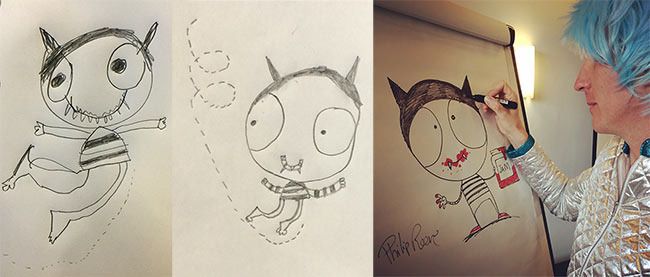
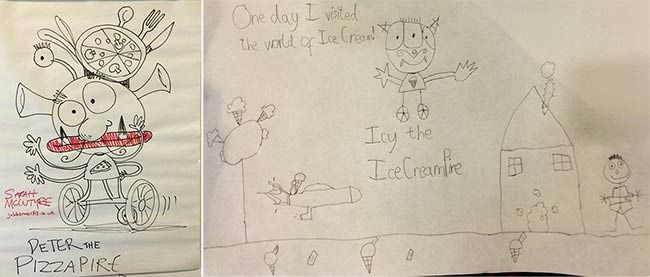
We talked about how foods can inspire characters, which can, in turn inspire stories. So we all wrote down our favourite foods and came up with a character who's obsessed with that particular food. The kids helped me come up with Peter the Pizzapire. Then they drew their own, and we started creating a world for their character, a place where the story could happen. Check out Icy the Icecreampire....
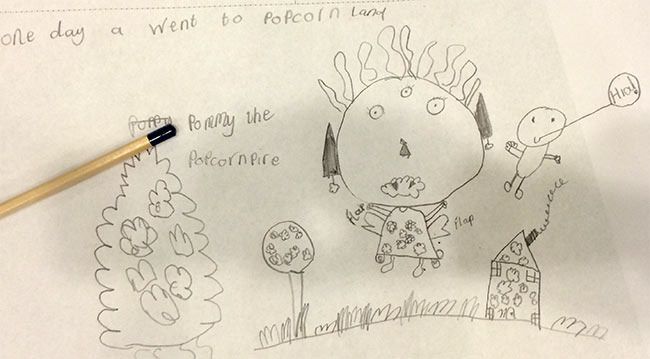
...and Pommy the Popcornpire! I hope the kids were able to take away their characters and settings and turn them into full stories.
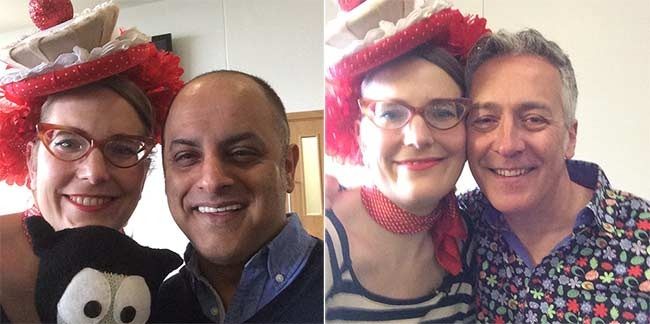
Another fun thing about Leicester Author Week is getting to see lovely colleagues. Here are lovely writers Bali Rai and John Dougherty. (John helped me last year in Leicester to come up with the tune for my There's a Shark in the Bath song, with lyrics by Philip Reeve! It's fun being able to work together.)
I mentioned to the kids that they can knit their own Jampire if they like, and the pattern's available, along with lots of other creative resources, on the fab website David O'Connell designed, jampires.com.

Since every kid gets a book, and there are over 800 kids, that means a LOT of book signing! Luckily I got to sign both sets of books the day before, so I didn't have to rush too much. Here are the boxes of JAMPIRES books that met me when I first got to the hotel. Quite late in the evening, I was joined by John Dougherty, who had only just flown in from the Emirates Lit Fest in Dubai! (I did that last year, going straight from Dubai to Leicester without time to drop off stuff at home. Stuart rescued me by coming with a fresh suitcase of clothes and I had a dramatic and chaotic repacking session in corner of Gatwick Airport. An elderly lady was sitting on a bench nearby, and shaking with laughter as my suitcase kept popping with tentacles, massive petticoats and pirate gear.) Despite his travels, John remembered to bring a full range of pen colours.

Our Leicester hotel was nice and quite quirky. Check out the unexplained portraits of 'Wills' in the restaurant. And the stairway that led to nowhere except a big porcelain dog, marked 'The Kennel'.

I don't usually get any time to explore Leicester, but this time my hotel was right near leafy New Walk, which gave me a whole different impression of the city.
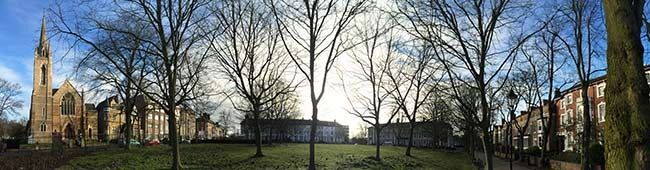
I even popped quickly into the New Walk Museum, which is well worth visiting if you're in the area: cool Victorian paintings, dinosaur skeletons, mummies, and a collection of German Expressionist paintings and illustrations, among other things.

And we even got to join our Leicester friends Selina Lock and Jay Eales and Steve's wife Ali for a curry, hurrah! Huge thanks to the Leicester team, including Juliet Martin, Dan Routledge, Sandy Gibbons, Nicole Dishington (here with Andy Briggs) and everyone who made it happen! You can follow Whatever It Takes on Twitter as @LeicesterWiT.

Want to know how to host the perfect author visit?
Call 1-800-Melanie Roy
She's the amazing librarian at Hampden Meadows Elementary School in Barrington, Rhode Island.
Mrs. Roy and the awesome 4th grade teachers did the most amazing job of preparing the students for my visit.
By the time I arrived, the students had read almost all of my books, worked on some very cool projects, and were super excited about the day.
Here are some of the highlights of my visit there:  |
| They reserved a parking spot for me! Now, that might not sound like such a big deal to you folks in Florida. But, trust me, when there are mounds of snow everywhere, this is a wonderful gift. |
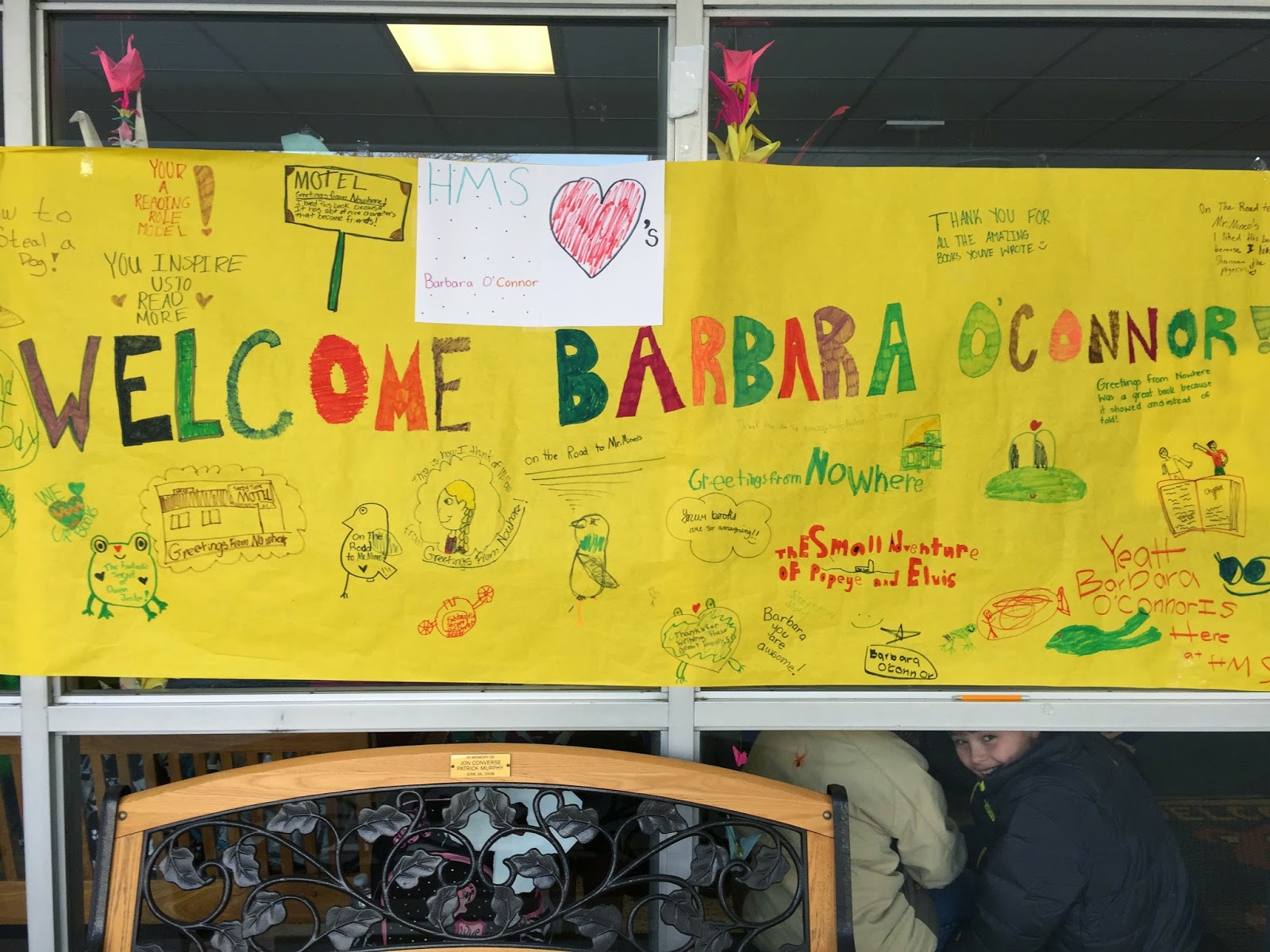 |
| I was greeted with this thoughtful sign. |
 |
| Students interviewing me for the local newspaper. |
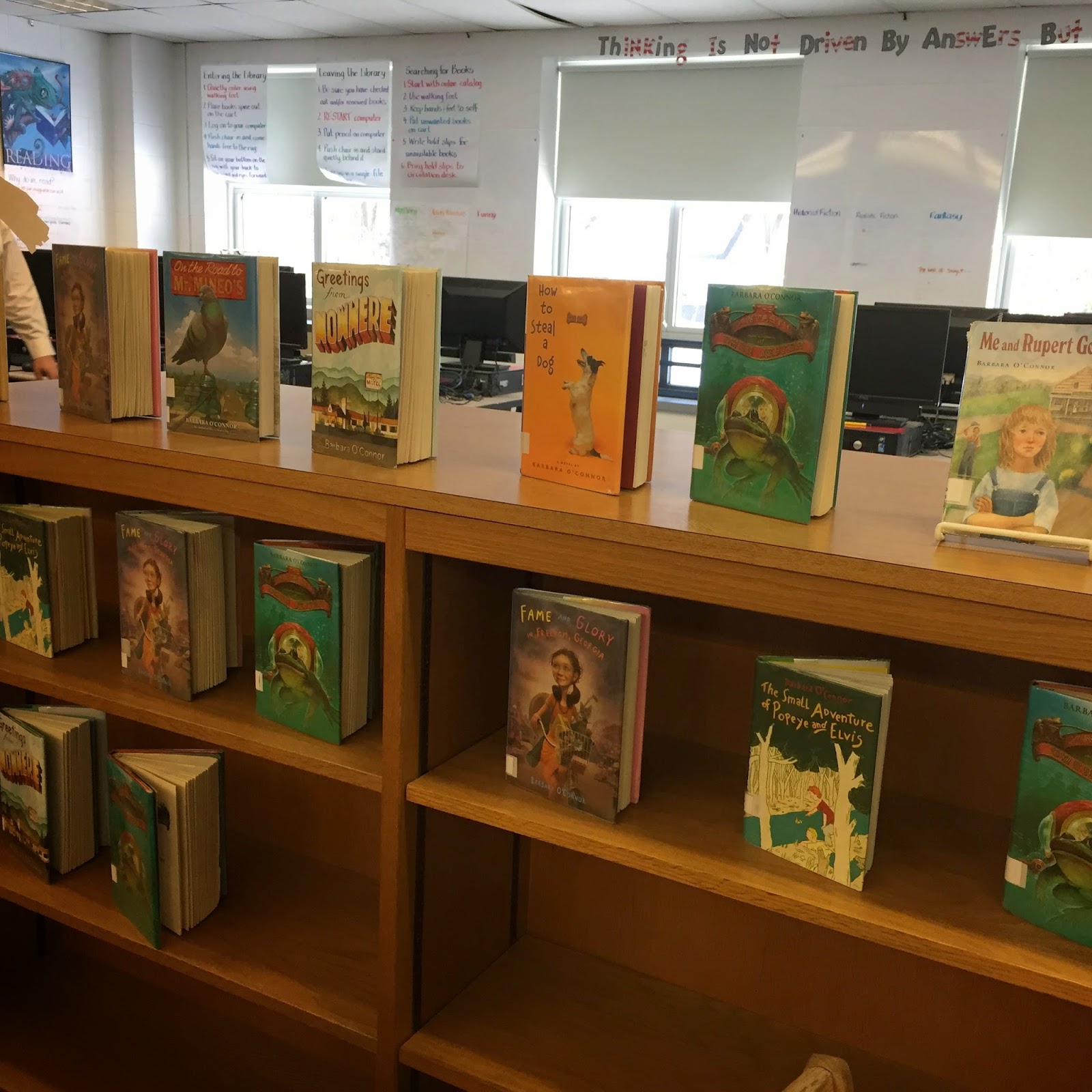 |
| They have all of my books displayed throughout the library. |
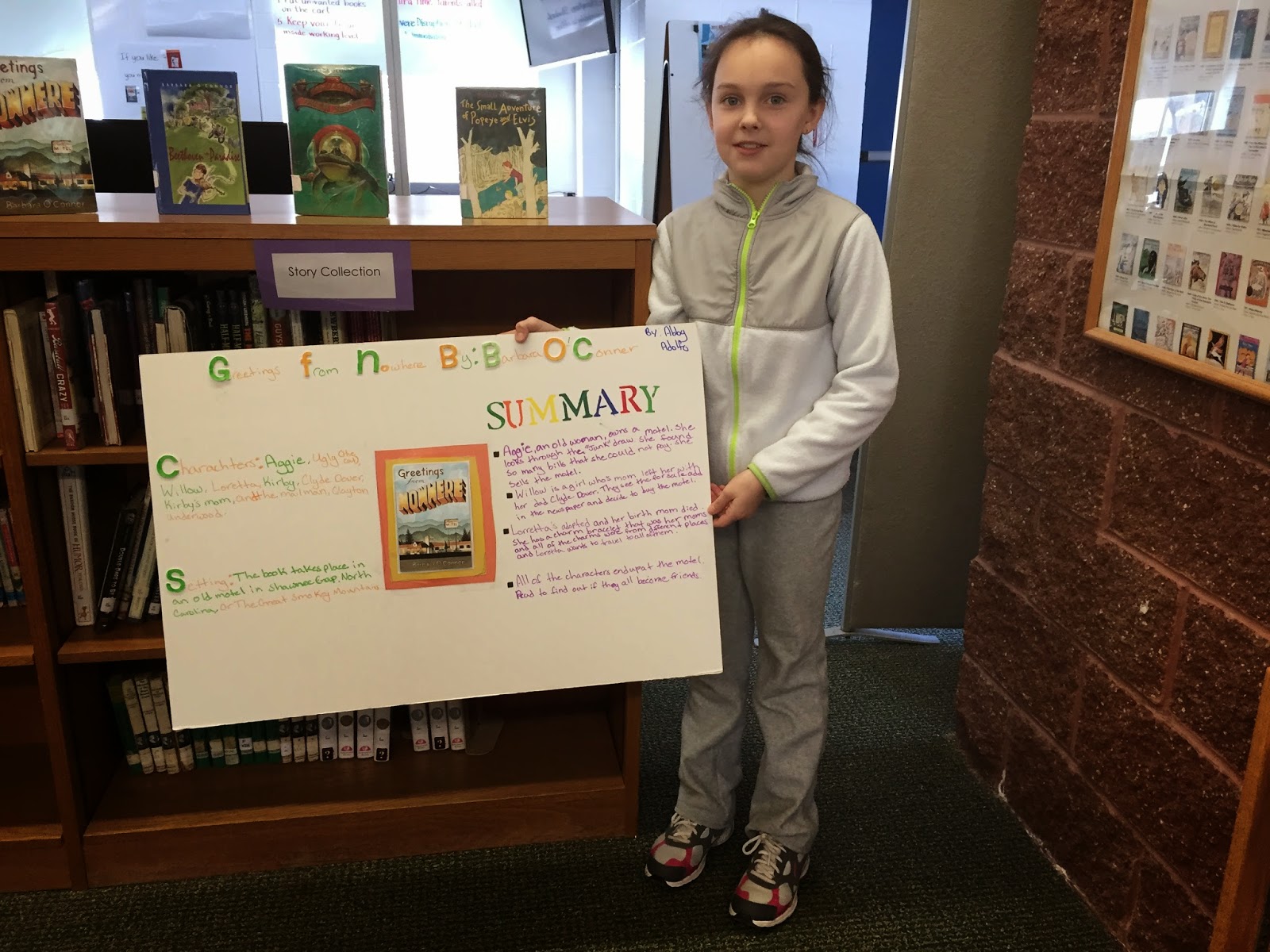 |
| Abby showing me her poster. |
 |
| Kaleigh dressed as Viola from The Fantastic Secret of Owen Jester. |
 |
| Grey, Robby, Katherine and Julia interviewed me. |
 |
| The amazing Mrs. Roy |
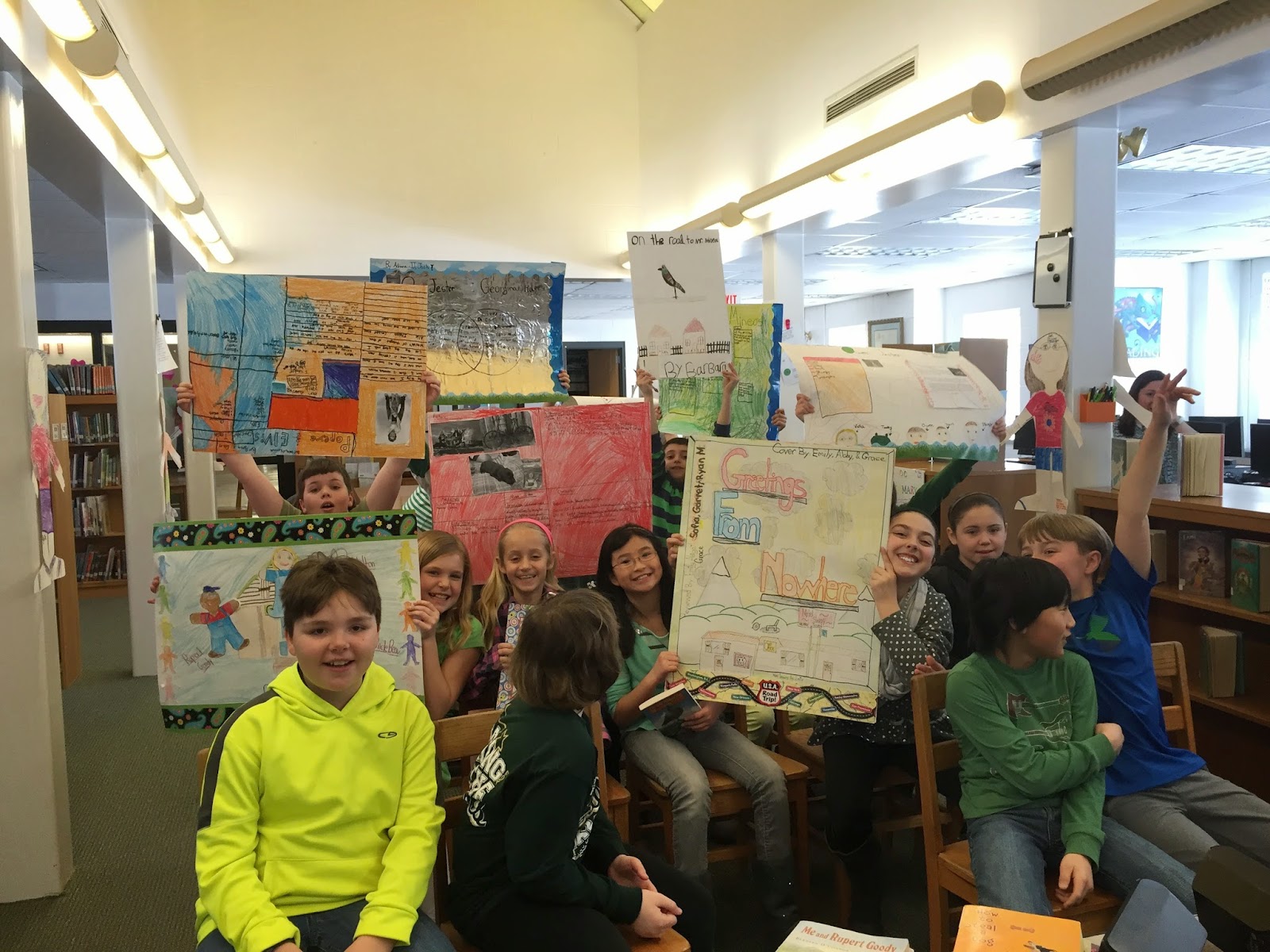 |
| Mrs. Clegg's class showing me their great posters. |
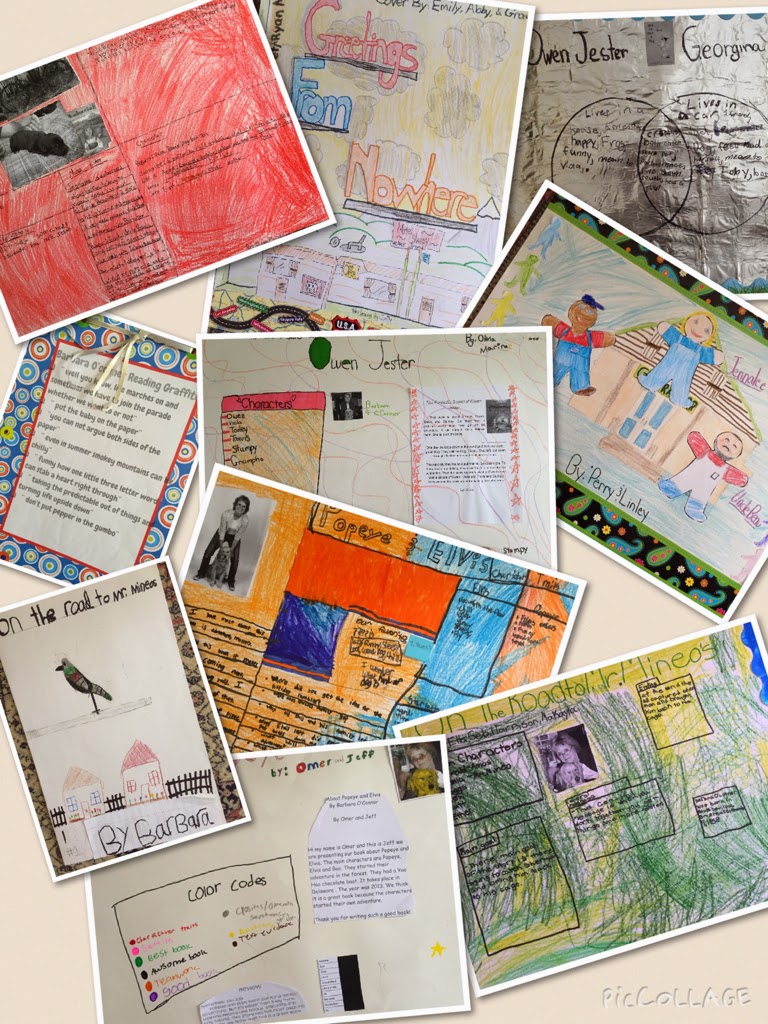 |
| The posters |
 |
| Me! |
 |
| Adeline showing me her poster. |
 |
| Mrs. Mitchell's class showing me their books. |
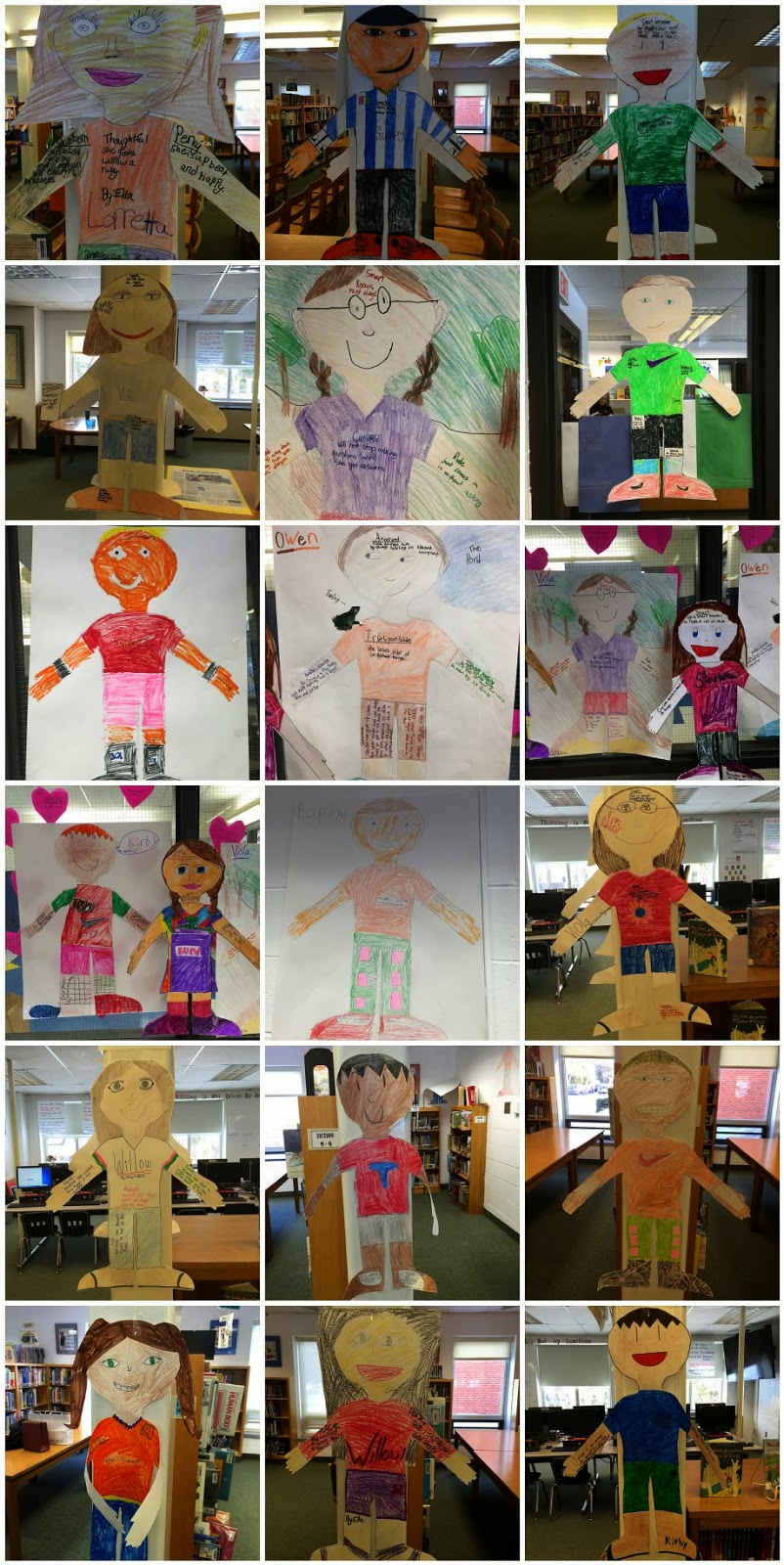 |
| Ms. Myszak's class made these cool character trait projects. |
 |
| The students discussed my presentation afterwards. |
 |
| Rayna showing me her poster. |
 |
| Lindsay showing me her poster. |
 |
| Mrs. Bailey's class made this great chart about my books. |
 |
| Colin dressed as Elvis from The Small Adventure of Popeye and Elvis. |
 |
| Some more thoughts from students about my presentation. |
Thank you to students and staff of Hampden Meadows Elementary School.
Today World Book Day UK hosted my co-author Philip Reeve and me along with a stupendous line-up of book people. Do we look excited?

It's been a ten-city, ten-day tour, and we were the London stop.

I never thought I'd be on stage with the amazing Jacqueline Wilson, Michael Rosen, Francesca Simon, Holly Smale and Steven Butler!

The venue was a big surprise. I'd never visited Walthamstow Assembly Hall before, and it felt like the big People's Palaces I'd seen during my student days in Moscow. Heavy, grand, and a bit imposing. But cool!
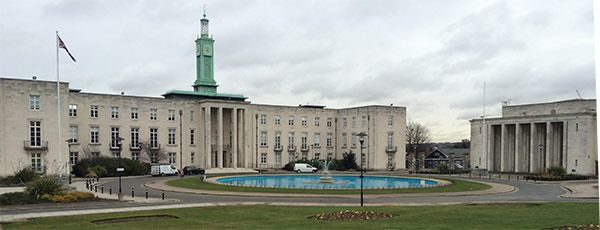
Check out the words above this doorway: FELLOWSHIP IS LIFE AND THE LACK OF FELLOWSHIP IS DEATH. ...WHOAAAA.

I guess it's the Fellowship of the Rings, check out the ceiling pattern. Here's what the hall looked like before the school coaches rolled in. (That's Reeve ahead, carrying my red Sea Monkey bag and his ukulele.)

And here's our presenter, magnificent ringmaster Steven Butler, who grew out his twirly moustache just for the occasion. You might know him as the guy who writes the Dennis the Menace books. He's been ringmaster for the whole tour, and he's still on his feet. Wow!

Steven memorized 'three unknown facts' about each of the speakers, which was rather impressive. My facts were:
1. When Sarah was born, her parents thought she was a sea monkey.
2. When she escaped from the zoo, they were sure of it.
3. She now draws sea monkeys in an attempt to distance herself from these silly creatures.
Philip's facts:
1. Philip wrote his first book when he was five, and it was called When Spike and Spook went to the Moon.
2. Philip is actually a highly advanced android named Wilf.
3. Philip hates being called Wilf; please never call him that.

Here we are, just before going on stage.
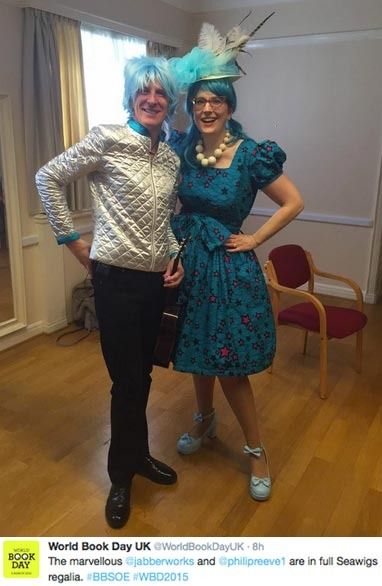
And we did our thing, drawing a Sea Monkey, singing some songs, reading from Oliver and the Seawigs, demonstrating the Power of Science with the Nom-o-Tron from Cakes in Space. (I told the kid that if they wanted to learn how to draw their own Sea Monkey, they could find out on my website.)

I love meeting other authors at festivals and things, but I hardly ever get to sit and watch their talks; I either have to leave or we're on at the same time. So it was great to get the chance to watch Holly Smale, writer of the Geek Girl books, in action!

Holly got almost as much fanfare as Jacqueline Wilson, who entered to screams that rock stars would envy.

Jacqueline's famous not only for her books, but also for the chunky rings she always wears. So Steven decided he had to give her a run for her money on that front. Check out all the BLING!

We got to hear Michael Rosen tell stories:

And Francesca Simon talk about Horrid Henry (and Perfect Peter):

Holly accidentally left her phone on-stage, so Steven took a big selfie.

I thought, with that many other amazing authors present, we'd have a great time but probably not sell a lot of books. But I was WRONG! Oxford University Press brought a big table full of books and sold every single one, and kids were sad not to get even more! The kids were going absolutely mad buying everyone's books and getting them signed, it was awesome. And even kids who didn't get our books brought Holly Smale's World Book Day edition of Geek Girl up for me to sign. So I drew geeky Sea Monkeys, which was fun.

Huge thanks to the colourful Kirsten Grant and her team, who organised the tour, Steve who did our tech, Steven for being a wonderful ringmaster, Newham Bookshop for organising books, our lovely OUP publicists Harriet Bayly & Camille Davis, and the local libraries for the use of the venue. And, of course, to all the schools who came along, and to my fellow authors, who made the day such fun. I'm excited to see which book characters people are going to dress up as on Thursday, World Book Day!
WORLD BOOK DAY DRESSING UP:
If you dress up as a character in one of my books with Philip or any of the other books, please please send along a photo, I'd love to see! Here are a few ideas from past years, if you're looking for some inspiration:
From There's a Shark in the Bath:

From Oliver and the Seawigs:
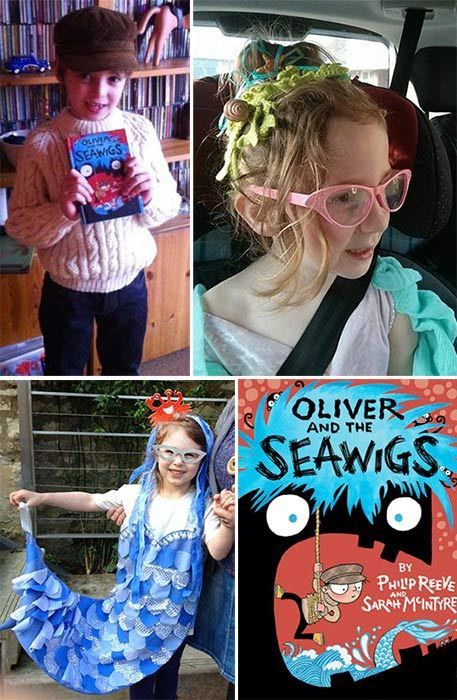
From Jampires (you can print a free mask from here!)


Princess Spaghetti from You Can't Eat a Princess! and You Can't Scare a Princess! (tiara-making tips here):

And you can download and print a free GOBLIN mask from Reeve's GOBLINS books!

Reeve and I would love love LOVE to see some Cakes in Space costumes! Astra, Pilbeam the robot, Poglites, killer cakes....DO IT DO IT DO IT!
Whenever my Cakes in Space co-author Philip Reeve lands his spaceship in London to do an event, we tend to pack in a few more events to make the most of his visit. This week was a busy one! On Wednesday night, we managed to catch a party for The Bookseller magazine at Foyles bookshop on Charing Cross. Then we were off on a train bright and early to visit the Bishop's Stortford Festival of Literature. (Here's a warm-up picture I drew on their flip chart, to add to the prep school library's picture collection.)

Visits are always far better when the kids are prepared. Our first event was in front of hundreds of kids and they'd all read BOTH Oliver and the Seawigs and Cakes in Space! Here's a great drawing of killer cakes by one of the girls in the after-lunch book club meeting:

Dropping in to see the book club between our two big stage events was fun; they sat around us and told us what they liked best about the books and we got to sit and soak it up and eat star-themed cupcakes. Nice!
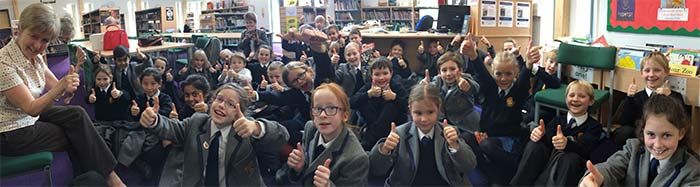
Here are some of the kids at the end of our second stage event, holding aloft the sea monkeys who joined in so vigourously with the chorus of our Sea Monkey sea shanty.

Huge thanks to the team who made it all happen! We hope lots of kids (and maybe some adults, too!) went away inspired to write and draw stories. From the left, here's fabulous stage technician Martin, festival oganiser Rosie Pike, Lynn Bailey (bookseller from the excellent Norfolk Children's Book Centre) and poet Stewart Henderson, who was also doing events with the kids that day at Bishop's Stortford College prep school. I got to wear my brand-new space dress, created by tailor Esther Marfo.

After signing loads of books, we hustled off to the train and rushed down to London to the Society of Authors headquarters, near Gloucester Road tube station. (Note background nosepicker.)

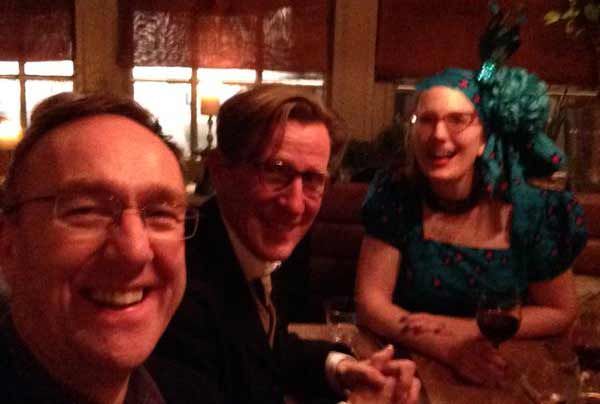
I'd been wearing the blue hair all day, so I switched over to a headscarf in an attempt at a slightly more grown-up look. Or something like that. (Here's a picture by our event technician, Niall Slater)

Writer, illustrator and illustrious YouTuber Shoo Rayner chaired our session and gave us a great intro and helped with question time. I didn't have any photos from the session so I've raided Twitter:

Philip and I talked about how we got started collaborating on our books with Oxford University Press, and we also talked about working relationships we've had with other people we've made books with. We also talked about writers and illustrators being co-authors, something I wrote about in an article for the Awfully Big Blog Adventure. We even had librarian Joy Court in the audience, who was so wonderfully instrumental recently in changing the Carnegie listings to include the illustrator when the books are illustrated. (Here was my blog post about it, which got constantly edited as the situation changed.) Right at the end of the event, we gave the audience a first-ever public reading of our story The Dartmoor Pegasus.

Big thanks to Jo McCrum and the Children's Writers & Illustrators Group for hosting our talk! It was fun bringing Oliver and the Seawigs to the place where the title and central story idea sprang out of (the acronym CWIG). If you've written or illustrated some books, I definitely recommend joining the Society of Authors; they're our best advocates when it comes to politics, complicated contracts, otherwise-unknown sources of money, and tricky legal things I can barely get my head around. Plus, they do events like this one! You can follow them on Twitter at @Soc_of_Authors.

Thanks to Shoo for being lots of fun and chairing, we had a good laugh with him afterward over dinner. He hosts a YouTube drawing channel, where you can learn how to draw almost more things than you can imagine: check out the Shoo Rayner Drawing channel.
The talented Ian Jones-Quartey took to Twitter tonight to vent his frustration with young fans who keep asking him how to get accepted into the animation program at CalArts, even though he never attended the school.
View Next 25 Posts



 By: Jerry Beck,
on 8/22/2016
By: Jerry Beck,
on 8/22/2016
.jpg?picon=925) By: Sarah McIntyre,
on 5/13/2016
By: Sarah McIntyre,
on 5/13/2016
 By: Lynne Chapman,
on 5/2/2016
By: Lynne Chapman,
on 5/2/2016
 By: Barbara O'Connor,
on 4/18/2016
By: Barbara O'Connor,
on 4/18/2016