JacketFlap connects you to the work of more than 200,000 authors, illustrators, publishers and other creators of books for Children and Young Adults. The site is updated daily with information about every book, author, illustrator, and publisher in the children's / young adult book industry. Members include published authors and illustrators, librarians, agents, editors, publicists, booksellers, publishers and fans. Join now (it's free).
Login or Register for free to create your own customized page of blog posts from your favorite blogs. You can also add blogs by clicking the "Add to MyJacketFlap" links next to the blog name in each post.
Blog Posts by Tag
In the past 7 days
Blog Posts by Date
Click days in this calendar to see posts by day or month
Viewing: Blog Posts Tagged with: Dial Books for Young Readers, Most Recent at Top [Help]
Results 1 - 25 of 27
How to use this Page
You are viewing the most recent posts tagged with the words: Dial Books for Young Readers in the JacketFlap blog reader. What is a tag? Think of a tag as a keyword or category label. Tags can both help you find posts on JacketFlap.com as well as provide an easy way for you to "remember" and classify posts for later recall. Try adding a tag yourself by clicking "Add a tag" below a post's header. Scroll down through the list of Recent Posts in the left column and click on a post title that sounds interesting. You can view all posts from a specific blog by clicking the Blog name in the right column, or you can click a 'More Posts from this Blog' link in any individual post.
I was recently commissioned to do a few maps for an upcoming book* due out later this year. A few people asked to see the final art after I posted some work-in-progress details over on Instagram, so here it is, along with some process show-and-tell.
Since I'm usually asked to illustrate places that exist in reality, this project was super interesting, because these were more fantasy-based maps.
In this case, the art director sent over detailed notes about the story, along with a rough sketch of how the author visualized the world in her head. This was all extremely helpful, and gave me a great starting point, yet still left a lot of creative freedom...
Below is the first sketch sent to the publisher. (I swear I had some tiny rough thumbnails, but they were lost in the flurry-of-paper that is my studio.)...
Close up inking details and adding a tone wash...
Coffee meditation break. (No worries! None was spilled! Don't try this at home, kids!!)...
And voilá, one of the finished pieces...
*The book is called THORNGHOST (Dial 2016), by Tone Almhjell, coming in August. Check it out!
0 Comments on A Mappish Show-and-Tell Process Post as of 1/1/1900
Here Comes Valentine Cat Series: Here Comes Cat Written by Deborah Underwood Illustrated by Claudia Rueda Dial Books for Young Readers 12/22/2015 978-0-525-42915-9 88 pages Ages 3—5 Junior Library Guild Selection “Cat is no fan of VALENTINE’S DAY, especially when it brings a new dog to the neighborhood. “Ouch. I’m sorry, Cat. …
$50 Gift Certificate Holiday Giveaway Enter here: Mudpuppy Holiday Giveaway . Here Comes Santa Cat Series: Here Comes Cat Written by Deborah Underwood Illustrations by Claudia Rueda Dial Books for Young Readers 10/21/2014 978-0-8037-4100-3 88 pages Age 3—5 . “HO, HO . . . WHO? CAT! NOT AGAIN. “The holidays are around …
When I whip out the old we’re-living-in-a-golden-age-of-picture-book-creation argument with colleagues and friends, they humor what I’m sure they consider to be my hyperbole. Suuuuuure we are, Betsy. Not prone to exaggeration or anything, are you? But honestly, I think I could make a case for it. Look at the picture books of the past. They were beautiful, intricately crafted, and many of them are memorable and pertinent to child readers today. What other art form for kids can say as much? You don’t exactly have five-year-olds mooning over Kukla, Fran and Ollie these days, right (sorry, mom)? But hand them Goodnight Moon and all is well. Now look at picture books today. We’re living in a visual learner’s world. The combination of relaxed picture books standards (example: comics and meta storytelling are a-okay!), publishers willing to try something new and weird, and a world where technology and visual learning plays a heavy hand in our day-to-day lives yields creative attempts hitherto unknown or impossible to author/illustrators as recently as ten years ago. And when I try to think of a picture that combines these elements (meta storytelling / new and weird / technology permeating everything we do) no book typifies all of this better or with as much panache as Robo-Sauce. Because if I leave you understanding one thing today it is this: This may well contain the craziest picture book construction from a major publisher I have EVER seen. No. Seriously. This is insane. Don’t say I didn’t warn you either.
We all know that kid who thinks pretending to be a robot is the most fun you can have. When the hero of this story tries it though he just ends up annoying his family. That’s when the narrator starts talking to him directly. What if there was a recipe for turning yourself into a REAL robot? Would you make it? Would you take it? You BET you would! But once the boy starts destroying things in true mechanical fashion (I bet you were unaware that robots were capable of creating tornadoes, weren’t you?), it’s pretty lonely. The narrator attempts to impart a bit of a lesson here about how to appreciate your family/dog/life but when it hands over the antidote the robot destroys it on sight. Why? Because it’s just created a Robo-Sauce Launcher with which to turn its family, its dog, the entire world, and even the very book you are reading into robots! How do you turn a normal picture book into a robot? Behold the pull out cover that wraps around the book. Once you put it on and open the other cover, the text and images inside are entirely robotized. Robo-Domination is near. It may, however, involve some pretty keen cardboard box suits.
So you’re probably wondering what I meant when I said that the book has a cover that turns into a robot book. Honestly, I tried to figure out how I would verbally explain this. In the end I decided to do something I’d never done before. For the first time ever, I’m including a video as part of my review. Behold the explanation of the book’s one-of-a-kind feature:
These days the idea that a narrator would speak directly to the characters in a book is par for the course. Breaking down the fourth wall has grown, how do you say, passé. We almost expect all our books to be interactive in some way. If Press Here made the idea of treating a book like an app palatable then it stands to reason that competing books would have to up the ante, as it were. In fact, I guess if I’m going to be perfectly honest here, I think I’ve kind of been waiting for Robo-Sauce for a long time. Intrusive narrators, characters you have to yell at, books you shake, they’re commonplace. Into this jaded publishing scene stepped Rubin and Salmieri. They’re New York Times bestsellers in their own right ( Dragons Love Tacos) so they’re not exactly newbies to the field. They’ve proven their selling power. But by what witchcraft they convinced Penguin to include a shiny pull out cover and to print a fifth of the book upside down, I know not. All I can be certain of is that this is a book of the moment. It is indicative of something far greater than itself. Either it will spark a new trend in picture books as a whole or it will be remembered as an interesting novelty piece that typified a changing era.
Let’s look at the book itself then. In terms of the text, I’m a fan. The narrator’s intrusive voice allows the reader to take on the role of adult scold. Kids love it when you yell at a book’s characters for being too silly in some way and this story allows you to do precisely that. Admittedly, I do wish that Rubin had pushed the narrator-trying-to-teach-a-lesson aspect a little farther. If the lesson it was trying to impart was a bit clearer than just the standard “love your family” shtick then it could have had more of a punch. Imagine if, instead, the book was trying to teach the boy about rejecting technology or something like that. Any picture book that could wink slyly at the current crop of drop-the-iPhone-pick-up-a-book titles currently en vogue would be doing the world a service. I’m not saying I disagree with their message. They’re just all rather samey samey and it would be nice to see someone poke a little fun at them (while still, by the end, reinforcing the same message).
As for Salmieri’s art, the limited color palette is very interesting. You’ve your Day-Glo orange, black, white, brown, and pale pink (didn’t see that one coming). Other colors make the occasional cameo but the bulk of the book is pretty limited. It allows the orange to shine (or, in the case of the robot cover, the limited palette allows for something particularly shiny). And check out that subtle breaking down of visual stereotypes! Black dad and white mom. A sister that enjoys playing with trucks. I am ON BOARD with all this.
I won’t be the last parent/librarian/squishy human to hold this book in my hands and wonder what the heck to do with it. What I do know is that it’s a lot of fun. Totally original. And it has a bunch of robots in it causing massive amounts of destruction. All told, I’d say that’s a win. So domo arigato, Misters Rubin and Salmieri. Domo arigato a whole bunch.
It's been quiet over here with the start of school and getting back into the swing of living the commuting life again. Every September, something has to give and it tends to be this blog.
But I'm back! And to make up for lost time, I am sharing short recommendations for three (yes 3!) books with you.
First up is the delightful and different Unusual Chickens for the Exceptional Poultry Farmer by Kelly Jones. Now if you know me, you know that the saddest part of my summer was finding out there would be no chickens at the county fair due to avian flu paranoia. I do have a soft-spot for all things chicken. And how can you deny that title? Sophie Brown has just moved with her parents to her late great uncle Jim's farm from LA. It's quite the culture shock. Add on the fact that Sophie's dad has lost her job and money is tight, and there don't seem to be any other brown people in Gravenstein aside from Sophie, her mom and the mailman. Readers learn about Sophie's circumstances through the letters she writes. Letters to her grandmother, and to great uncle Jim who have passed on. Letters to the poultry company to help her figure out how to take care of the weird chickens she keeps finding. And letters to the mysterious Agnes. It soon becomes clear that Sophie's chickens are exceptional and that they are wanted by someone else in town. Will Sophie be able to manage all the changes in her life and figure out how to keep chickens at the same time? Wonderfully illustrated by Katie Kath, this is a book like no other.
Next, the dreamy Circus Mirandus by Cassie Beasley. My kid's librarian read it aloud to her class last year, but she liked it so much, she asked me to read it for our family read this summer. After the first few pages I knew that this one is going to be a modern classic. Beasley manages to get that dreamy feeling, respect the reader and get us to suspend disbelief. Micah's grandpa Ephraim is very ill. His sister, Micha's great aunt Gertrudis, has come to live with them and she couldn't be more different from grandpa. She is pinched, closed off and truly hateful. She won't even allow Ephraim to keep telling Micah his stories about the Circus Mirandus...a place she is sure is fictional. But with childlike wonder, Micah vows to find his grandpa's circus and save him. This is a dreamy adventure that will have readers young and old believing in magic.
Next, Rebecca Stead's Goodbye Stranger. I'm not going to lie. When I heard there was a new Rebecca Stead coming out, I did a happy dance. Then I harangued my colleagues to hand over any arcs they had forthcoming! Luckily I got my own eyes on an arc through netgalley. Stead can capture that moment -- that breath of change that happens when kids are on the cusp of that place moving from kid to teen. As usual, I find it difficult to summarize Stead's book. Suffice it to say there is a character for everyone in here...whether it's Bridge who is resisting the changes of growing up, strong willed Tab who jumps into life with two feet, Em who is navigating the changes to her body and friendships with a little less grace than folks would assume or Sherm who is a bit like the Duckie of the modern day. There are moments of breathless beauty in the writing, and I found myself putting the book down and just considering the words.
0 Comments on Quick Bits as of 9/23/2015 5:22:00 PM
These are dark times for children’s fantasy. Dark times indeed. Which is to say, when I pick up a fantasy novel for kids, more often than not I find the books filled with torture, violence, bloody blood, and other various unpleasant bits and pieces. And honestly? That is fine. There are a lot of kids out there who lap up gore like it was mother’s milk. Still, it’s numbing. Plus I really wish that there was more stuff out there for the younger kiddos. The ones who have entered the wide and wonderful world of children’s fantasy and would rather not read about trees eating people or death by cake. Maybe they’d like something funny with lovable characters and a gripping plot. Even Harry Potter had its dark moments, but in the early volumes the books were definitely for the younger readers. Certainly we have the works of Eva Ibbotson and Ruth Chew, but newer books are always welcome, particularly if they’re funny. Maybe that’s part of the reason why Castle Hangnail blew me away as much as it did. Here we have a story that knows exactly what it is, what it wants to do, and manages to be hilarious and charming all at the same time. If you like your children’s fantasy novels full of psychotic villains and mind-numbing action sequences, seek ye elsewhere. This one’s for the kids.
To some, Castle Hangnail might appear to be a “pathetic rundown little backwater” but to the minions who live there it’s home. A home desperately in need of a new Master and Mistress. After all, if they don’t get someone soon the castle might be sold off and destroyed. Maybe that’s why everyone has such mixed feelings at first when Molly appears. Molly is short and young and wearing some very serious black boots. She looks like a 12-year-old kid and Majordomo, the guardian of the castle, is having a hard time coming to terms with the fact that she’s supposed to be their new Wicked Witch. Yet when he gives her the necessary tasks to make Castle Hangnail her own, Molly appears to have a couple tricks up her sleeve. She may have her secrets but everything seems to be okay . . . that is until the REAL master of Castle Hangnail arrives to claim it.
Basically what we have here is Downton Abbey for kids, albeit with significantly more dragon donkeys (and isn’t Majordomo SUCH a Carson?). This raises the question of where precisely this book takes place. Remembering that author Ursula Vernon herself is not actually British, one supposes that the story could be read as a U.S. tale. Due to its distinct Eva Ibbotson flavor, the initial inclination is to see the book as British. Our picturesque little towns pale in comparison to their picturesque little towns, and we’ve far fewer castles lying about the place. Still, there’s no reason it couldn’t be American. After all, I’ve seen many an American author fall into the trap of putting cockney characters into their books for no apparent reason. Vernon has a good head on her shoulders. She’s not falling for that game.
Truly a book like this hinges on the characters created. If you don’t believe in them or don’t like them then you won’t want us to follow them into your tale. You have to sympathize with Majordomo, even when he does some unfortunate things. You have to like Molly, even when you don’t initially understand her back-story. It takes a little while but Vernon also makes it clear how someone can be wicked as opposed to evil. “Wicked was turning somebody into an earwig and letting them run around for a week to give them a good scare. Evil was turning someone into an earwig and then stepping on them.” An evil heroine is tricky to love. A wicked one is on par with your average 12-year-old reader.
Speaking of characters, Vernon makes some very interesting narrative choices as well. For example, our heroine is introduced to us for the first time on page six. However around Chapter 33 she disappears from the storyline and really doesn’t appear again until Chapter 39. You have to have a very strong supporting cast to get away with that one. It would be a lot of fun to ask kid readers who their favorite character was. Did they prefer Pins or his neurotic goldfish? The minotaurs or the moles? Me, I like ‘em all. The whole kooky gang. For a certain kind of reader, there’s going to be a lot of allure to having minions as lovable as these.
Even the lightest bit of middle grade fluff needs a strong emotional core to keep it grounded. If there’s nothing to care for then there’s nothing to root for. For me, the heart of this particular tale lies in Molly’s relationship with the evil sorceress (and teenaged) Eudaimonia. Lots of kids have the experience of wanting to befriend someone older and meaner. The desire to please can lead a person to act unlike themselves. As Molly says, “It’s like a weird kind of magic . . . Like a spell that makes you feel like it’s all your fault.” Molly also wrestles with being different from her kittens and sparkles loving twin and so the theme of finding yourself and your own talents come to the fore.
And now a word in praise of humor. Funny is hard. Funny fantasy? That’s even harder. Vernon has always blown away the competition in the hilarity department. Pick up any “Danny Dragonbreath” comic and you’ll see what I’m talking about. She can sustain a narrative for an early chapter book, sure, but full-blown novels are a different kettle of fish (is that a mixed metaphor?). So how does she do? You’d swear she’d been churning these puppies out for years. Here are three of my favorite lines in celebration:
- “Harrow was one of those people who is born mean and continues to lose ground.”
- “Magic was a requirement in a new Master, unless you were a Mad Scientist, and Molly didn’t look like the sort to hook lightning rods up to cadavers while wild Theremins wailed in the background.”
- “For there are very powerful spells that are very simple, but unless you happen to be the right sort of person, they will not work at all. (And a good thing too. You can raise the dead with five words and a hen’s egg, but natural Necromancers are very rare. Fortunately they tend to be solemn, responsible people, which is why we are not all up to our elbows in zombies).”
Parents wander into the children’s room of a library. They ask the librarian at the desk to recommend a fantasy novel for their 8-year-old. “Nothing too scary”, they say. “Maybe something funny. Do you have anything funny?” Until now the librarian might try a little Ibbotson or a touch of E.D. Baker. Perhaps a smattering of Jessica Day George would do. Still, of all of these Castle Hangnail appeals to the youngest crowd. At the same time, it can be equally enjoyed by older kids too. Smart and droll, it’s the fantasy you’ve always wanted to hand to the 10-year-old Goth girl in your life (along with, let’s face it, everybody else you know). A true crowd pleaser.
Ooh, cannot WAIT for this; some of us Vernon groupies have been urging her over to the dark side of chapter books for awhile, and I continue to be hopeful for more, more, MOAR BERKS!
Catherine said, on 4/11/2015 5:24:00 AM
Sound like the perfect book for one (or ten) of the third & fourth graders I know!
This week’s round-up of middle grade fantasy and said, on 4/12/2015 11:28:00 AM
[...] Castle Hangnail, by Ursula Vernon, at Fuse #8 [...]
Written by Annette LeBox Illustrated by Stephanie Graegin Dial Books for Young Readers 3/10/2015 978-0-8037-4091-4 40 pages Age 3 to 5
x
“Peace is an offering. A muffin or a peach. A birthday invitation. A trip to the beach.
“Follow these neighborhood children as they find love in everyday things—in sunlight shining through leaves and cookies shared with friends—and learn that peace is all around, if you just look for it.”
Review
Peace is an Offering contains a strong message about what the abstract concept of peace means for the young (and old): helping one another, being kind, joining together, and enjoying all aspects of life with respect to your family, friends, and neighbors. Peace does not need to be overcomplicated or forced. Peace is the accumulation of all the small, meaningful acts we do each day.
“Will you stay with me? Will you be my friend? Will you listen to my story till the very end?”
The children in this large neighborhood, make, find, and (most importantly), show kindness to each other every day in simple heartfelt ways. The poem is beautifully written and illustrated. Children will easily understand each deftly visualized line or verse of the poem. Multicultural children interact with each other, families spend time together, and friends stay close.
What is not to love about Peace is an Offering? Nothing, though the spread alluding to 911 seems unnecessary. The verse feels out of place, as does the illustration, which deviates from the light, airy, everyday life depicted on the other spreads (see two examples here). but for those who lost a loved one or friend, the spread may provide comfort. Peace is an Offering is a gratifying read; uplifting and inspiring young and old alike. The author finishes the poem by offering advice to children.
So offer a cookie, Walk away from a fight. Comfort a friend Through the long, dark night.
I loved every aspect of every spread. The poetry speaks to the heart. Pencil and watercolor illustrations have those details I rave about. Simply said, Peace is an Offering is a joy to read.
Astrid rolls her eyes as her mother takes her and bestie Nicole to a surprise "evening of cultural enlightenment!" Astrid knows what that means because in the past it mean poetry readings, opera performances and trips to the modern art gallery. The girls are amazed when Astrid's mom's cultural outing takes them instead to an evening of Roller Derby! Astrid is quickly obsessed with the derby and is quite taken with local Rose City Roller jammer "Rainbow Bite". At dinner after the derby, Astrid's mom shows the girls a flyer for a Jr. Derby League summer camp, and Astrid knows that is exactly how she and Rachel should spend their summer.
Unfortunately for Astrid, Nicole doesn't feel the same way. She'd rather go to dance camp than spend her summer skating. Astrid can't understand this, especially since prissy Rachel is going to be at dance camp too. The same Rachel who embarrassed Astrid back in first grade and had been giving her grief ever since.
Astrid goes through with Derby camp even without Nicole. She doesn't let her mom know that Nicole isn't going, even though it's Nicole's mom who is supposed to drive her home from camp! The first day is a disaster. Not only do all of the other girls look older and different, complete with dyed hair and piercings, but they all seem to know how to skate a whole lot better than Astrid does! Then there is the pain. Lots and lots of it. Add onto this the fact that Astrid has to walk all the way home in the blazing sun, and it turns out the Jr. Derby camp isn't going exactly as amazingly as she had imagined it.
Astrid's summer is filled with the ups and down as they can only be felt in the tween years. Keeping secrets, finding new friends, getting caught in a lie, and growing pains are all a part of Astrid's days at camp. Throw in some rainbow socks and Hugh Jackman voodoo dolls and the result is a graphic novel that hits the sweet spot for the 9-12 year old set. Filled with colorful and welcoming art, Roller Girl is certain to sit on the shelf for the same number of minutes as books by Telgemeier and Bell. Do yourself a favor and get multiple copies.
0 Comments on Roller Girl, by Victoria Jamieson as of 1/1/1900
I have a delightful book to share with you today which is not about a groundhog. But speaking of groundhogs (did you see how smoothly I slipped that in there? :)) if you missed yesterday's Special Edition Post (which you easily might have because I almost never post on Thursdays so why would you think to check?) about Phyllis's Birthday Bonanza (which you definitely will NOT want to miss!), hop on over and check it out HERE! Join the fun and spread the word! :)
Now then. Today's book. Which is not about a groundhog. But IS about a sloth :)
Title: Snoozefest Written By: Samantha Berger Illustrated By: Kristyna Litten Dial, January 2015, Fiction
Suitable For Ages: 3-5
Themes/Topics: bedtime, sleep, animals (sloths), language fun (rhyme and inventive vocabulary)
Opening: "In the center of Snoozeville, dwells the wee one, the sleepiest sloth, Snuggleford Cuddlebun. Now, that sloth can sleep, for a month at a go. The few times she rises, she moves in slo-mo."
Brief Synopsis: It's time for the annual Snoozefest at the Nuzzledome, an arena festival that celebrates sleep. All the best sleepers attend. Snuggleford Cuddlebun settles into a hammock with her blanket and pillow, her favorite stuffed animal and her best bedtime book, and a snack of milk and honey, ready to enjoy the show. But will she?
Links To Resources: the author makes up some wonderful words in this story - what kind of words can you make up that sound just right to describe something you like to do (like sleeping, sledding, riding a bicycle, or any other activity)?; have your own snoozefest - make your room super comfy for sleeping, choose bedtimes stories, music, snacks, stuffed animals, pajamas and anything else that makes bedtime cozy for you. You can even write up and decorate your own snoozefest program. Have a lullaby sing-along and your own pajama fashion show!
Why I Like This Book: How can you not love a book about a snoozefest that takes place at the Nuzzledome? The text is full of delightful made-up words like "snoozillions" and "wumphiest" (as in "wumphiest, comfiest, coziest things" :)) There are designer pajamas by Diane Von Firstinbed and Louis Futon. The snack vendors sell milk and honey. The bands, with names like Chamomile Rage and the Nocturnal Nesters, play lullabies! And everyone brings their nightlight from home :) Adult readers will enjoy the spoof of music festivals. The whole over-the-top celebration of bedtime is just flat out fun! But you'll have to read it to find out what Snuggleford's experience of the show is :)
PPBF bloggers please be sure to leave your post-specific link in the list below so we can all come visit you and see what kind of amazingly wonderful entertaining books you chose this week. It's supposed to snow... a good weekend to stock up on library books and spend the day reading :)
Have a great weekend, everyone!!! :)
0 Comments on Perfect Picture Book Friday - Snoozefest as of 1/23/2015 3:15:00 AM
Which of the following types of children’s books are, in your opinion, the most difficult to write: Board books, picture books, easy books (for emerging readers), early chapter books, or middle grade fiction (older chapter books)? The question is, by its very definition, unfair. They are all incredibly hard to do well. Now me, I have always felt that easy books must be the hardest to write. You have to take into account not just the controlled vocabulary but also the fact that the story is likely not going to exactly be War and Peace (The Cat in the Hat is considered exceptional for a reason, people). And right on the heels of easy books and their level of difficulty is the early chapter book. You have a bit more freedom with that format, but not by much. For a really good one there should be plenty of fun art alongside a story that strikes the reader as one-of-a-kind. It has to talk about something near and dear to the heart of the kid turning the pages, and if you manage to work in a bit of a metaphor along the way? Then you, my dear, have done the near impossible. The last book I saw work this well was the extraordinary Sadie and Ratz by Sonya Hartnett, a book that to this day I consider a successor to Where the Wild Things Are. I didn’t expect to see another book tread the same path for a while. After all, these kinds of stories are enormously difficult to write (or did I mention that already?). Enter Dory Fantasmagory. Oh. My. Goodness. Pick up my jaw from the floor and lob it my way because this book is AMAZING! Perfection of tone, plot, pacing, art, you name it. Author Abby Hanlon has taken a universal childhood desire (the wish of the younger sibling for the older ones to play with them) and turned it into a magnificent epic fantasy complete with sharp-toothed robbers, bearded fairy godmothers, and what may be the most realistic 6-year-old you’ll ever meet on a page. In a word, fantastico.
She’s six-years-old and the youngest of three. Born Dory, nicknamed Rascal, our heroine enjoys a rich fantasy life that involves seeing monsters everywhere and playing with her best imaginary friend Mary. She has to, you see, because her older siblings Luke and Violet refuse to play with her. One day, incensed by her incessant youth, Violet tells Rascal that if she keeps acting like a baby (her words) she’ll be snatched up by the sharp-toothed robber Mrs. Gobble Gracker (a cousin of Viola Swamp if the pictures are anything to go by). Rather than the intended effect of maturing their youngest sibling, this information causes Rascal to go on the warpath to defeat this new enemy. In the course of her playacting she pretends to be a dog (to escape Mrs. Gobble Gracker’s attention, naturally) and guess what? Luke, her older brother, has always wanted a dog! Suddenly he’s playing with her and Rascal is so ebullient with the attention that she refuses to change back. Now her mom’s upset, her siblings are as distant as ever, Mrs. Gobble Gracker may or may not be real, and things look bad for our hero. Fortunately, one uniquely disgusting act is all it will take to save the day and make things right again.
This is what I like about the world of children’s books: You never know what amazingly talented book is going to come from an author next. Take Abby Hanlon. A former teacher, Ms. Hanlon wrote the totally respectable picture book Ralph Tells a Story. It published with Amazon and got nice reviews. I read it and liked it but I don’t think anyone having seen it would have predicted its follow up to be Dory here. It’s not just the art that swept me away, though it is delightful. The tiny bio that comes with this book says that its creator “taught herself to draw” after she was inspired by her students’ storytelling. Man oh geez, I wish I could teach myself to draw and end up with something half as good as what Hanlon has here. But while I liked the art, the book resonates as beautifully as it does because it hits on these weird little kid truths that adults forget as they grow older. For example, how does Rascal prove herself to her siblings in the end? By being the only one willing to stick her hand in a toilet for a bouncy ball. THAT feels realistic. And I love Rascal’s incessant ridiculous questions. “What is the opposite of a sandwich?” Lewis Carroll and Gollum ain’t got nuthin’ on this girl riddle-wise.
For me, another part of what Dory Fantasmagory does so well is get the emotional beats of this story dead to rights. First off, the premise itself. Rascal’s desperation to play with her older siblings is incredibly realistic. It’s the kind of need that could easily compel a child to act like a dog for whole days at a time if only it meant garnering the attention of her brother. When Rascal’s mother insists that she act like a girl, Rascal’s loyalties are divided. On the one hand, she’ll get in trouble with her mom if she doesn’t act like a kid. On the other hand, she has FINALLY gotten her brother’s attention!! What’s more, Rascal’s the kind of kid who’ll get so wrapped up in imaginings that she’ll misbehave without intending to, really. Parents reading this book will identify so closely to Rascal’s parents that they’ll be surprised how much they still manage to like the kid when all is said and done (there are no truer lines in the world than when her mom says to her dad, “It’s been a looooooooong day”). But even as they roll their eyes and groan and sigh at their youngest’s antics, please note that Rascal’s mom and dad do leave at least two empty chairs at the table for her imaginary companions. That ain’t small potatoes.
It would have been simple for Hanlon to go the usual route with this book and make everything real to Abby without a single moment where she doubts her own imaginings. Lots of children’s books make use of that imaginative blurring between fact and fiction. What really caught by eye about Dory Fantasmagory, however, was the moment when Rascal realizes that in the midst of her storytelling she has lost her sister’s doll. She thinks, “Oh! Where did I put Cherry? I gave her to Mrs. Gobble Gracker, of course. But what did I REALLY ACTUALLY do with her?” This is the moment when the cracks in Rascal’s storytelling become apparent. She has to face facts and just for once see the world for what it is. And why? Because her older sister is upset. Rascal, you now see, would do absolutely anything for her siblings. She’d even destroy her own fantasy world if it meant making them happy.
Beyond the silliness and the jokes (of which there are plenty), Hanlon’s real talent here is how she can balance ridiculousness alongside honest-to-goodness heartwarming moments. If you look at the final picture in this book and don’t feel a wave of happy contentment then you, sir, have no soul. The book is a pure pleasure and bound to be just as amusing to kids as it is to adults. Like older works for children like Joey Pigza Swallowed the Key, Dory Fantasmagory manages to make a personality type that many kids would find annoying in real life (in this case, a younger sibling) into someone not only understandable but likeable and sympathetic. If it encourages only one big brother or sister to play with their younger sibs then it will have justified its existence in the universe. And I think it shall, folks. I think it shall. A true blue winner.
Theodora Tenpenny may live in Manhattan, but it's not a glamorous existence for her. She lives in a ramshackle house with her absent minded math genius mother and her grandfather Jack. But right on page 4, Jack is killed and leaves Theo only with the dying message of "Look under the egg."
Not much for a 13 year old who is trying to keep it together to go on. So between gardening, taking care of her chickens and pickling for food, scanning the streets for useful objects and caring for her mother, Theo needs to unravel what her grandfather's wishes were.
Theo is up in her grandfather's art studio one day trying to figure out the mystery when a mouse runs up her leg and she jumps up and spills some rubbing alcohol on one of Jack's paintings - the painting unlike his other paintings. The egg. As Theo desperately tries to clean the rubbing alcohol off, the colors smear and smudge and she is devastated at losing this last bit of Jack. But when she looks closely she realizes that under the egg, a different painting is revealing itself. Could this be what Jack's dying words were about?
Theo is at a neighborhood diner owned by a friend of Jack's where she forms an unlikely friendship with Bodhi - another 13 year old who has just moved down the block and happens to have Hollywood parents. Where Theo's existence is positively Little House on the Prairie, Bodhi's is the Jetsons in comparison. Theo surprisingly lets Bodhi in on the secret painting, and soon with Theo's art history knowledge and Bodhi's internet skills, they are on the trail to the truth.
Woven into the text are explanations of fine art, as well as bits of history involving WWII. There are also real life bits of NYC living including the Staten Island Ferry, Grace Church, the Met and the Jefferson Market Library. All of these true things had me actually google Spinney Lane to see if it was one of those Manhattan streets I've walked by a million times but not walked down.
This is a solid summer mystery with a really fantastic sense of place.
0 Comments on Under the Egg, by Laura Marx Fitzgerald as of 7/13/2014 2:53:00 PM
In spite of the fact that Perfect Picture Books goes on vacation every summer, we are now celebrating the 100th week of Perfect Picture Book Fridays! (Just in time to go on summer vacation again :))
100 weeks of fabulous picture books with resources of all kinds to make them easy for parents and teachers to use at home and in the classroom!
100 weeks of highly recommended books listed alphabetically and by theme to make it easy for gift-givers to find the perfect picture book for that special little someone!
100 weeks of perfect examples that we, as writers, can study and learn from!
To date, we have picture books listed in 226 themes/categories.
And we have - get this! - 2055 Perfect Picture Books on our list!!!
(Or, we would if I ever got caught up updating! Which is on my to-do list for this summer along with about a million other things :))
For those of you who haven't noticed yet (because I haven't announced it because I'm not finished with it :)), Perfect Picture Books is now on Pinterest. I'm hoping it will make it easier to search. But it's a work in progress and far from complete! If you want to check it out, here's the link: http://www.pinterest.com/susannaleonard/
So really, after all the hard work you guys have put in, all the wonderful picture books and resources that are now available to teachers, parents, writers, and gift-givers everywhere, I think we should celebrate!!!
First, we need cake (obviously!) :)
Next, we need streamers. . .
. . . confetti. . .
. . . and balloons!
And last but not least, we need prizes for all the amazing bloggers who have contributed so devotedly week after week to this effort! So let's do today's Perfect Picture Book, and hopefully by then I will have thought up a plan. I'll meet you down below after you're done reading about this delightful book!
Title: I Am Cow, Hear Me Moo! Written By: Jill Esbaum Illustrated By: Gus Gordon Dial (Penguin Group), May 2014, Fiction
Suitable For Ages: 3-7
Themes/Topics: honesty, courage, animals
Opening: "Nadine was a truly remarkable cow. There was nothing she feared - so she claimed, anyhow. "Not lightning?" asked Starla. "Loud noises? A rat?" "I'm not scared," Nadine boasted, "of any of that." "The woods?" asked Annette. "'Cause that place scares me stiff." "Not me," bragged Nadine with a proud little sniff. "As a matter of fact, just to prove it, let's go!" (She was certain her meek-hearted friends would say no.)
Brief Synopsis: Nadine boasts that she isn't afraid of anything! When her friends call her bluff, she learns that sometimes acting brave can make you feel brave... and sometimes it can't! And when she's hailed as a hero for saving her friends, she has the choice to 'fess up and admit she was just as scared as they were or let her friends believe what they want. Which do you think Nadine chooses? :)
Links To Resources: this book will give parents and teachers a great opportunity to have discussions about what courage is, and what makes a person brave. Is it not being afraid? Or is it going forward in spite of your fear? It will also give an opportunity to talk about honesty. Is is okay to lie if it ends up being the truth? Is it okay to let people believe something good about you even if it's not exactly deserved? Talk with kids about things they're afraid of. What do they think could make them feel braver? Ask kids if they've ever lied about something and gotten caught? How did they feel? Classroom Activities: Honesty, Classroom Activities: Courage.
Why I Like This Book: Nadine is so full of herself, so spunky and fun, and so believable because haven't we all met kids (or adults :)) who can bluster their way through just about anything?! Kids will relate to this confident bovine who pretends not to be scared of the Deep. Dark. Woods. only to discover that she really isn't afraid... until the sun goes down! Things unravel a bit (I don't want to spoil it :)) but she ends up saving her friends (completely by accident) and is hailed as a brave hero... an illusion she chooses not to discourage :) The art is lively and entertaining, and the story is fun and full of humor!
So. About those prizes! Since we're celebrating Perfect Picture Books, I'd like to give away a few :) I wish I could give everyone a prize, but I have yet to become one of those authors who makes millions of dollars :) Instead, I've chosen a few books that have been widely well-received that I hope you guys might want to win:
Journey by Aaron Becker (Candlewick) Mr. Wuffles by David Weisner (Clarion) Warning: Do Not Open This Book! by Adam Lehrhaupt, illus. by Matthew Forsythe (Simon & Schuster) The Watermelon Seed by Greg Pizzoli (Disney/Hyperion) On A Beam Of Light: A Story Of Albert Einstein by Jennifer Berne, illus. by Vladimir Radunsky (Chronicle) Mitchell Goes Bowling by Hallie Durand, illus. by Tony Fucile (Candlewick) The Dark by Lemony Snicket, illus. by Jon Klassen (Little, Brown) This Is The Rope: A Story Of The Great Migration by Jacqueline Woodson, illus. by James Ransome (Nancy Paulsen Books) Gaston by Kelly DiPucchio, illus. by Christian Robinson (Atheneum)
+1 - If you'd like to win one of these fabulous books, please leave a comment below. +1 - If you follow the Perfect Picture Books Pinterest Board, you'll get an additional chance to win (if you already follow, please remind me, if you don't already follow, there's no time like the present :)) http://www.pinterest.com/susannaleonard/ +5 - If you've posted 50 or more Perfect Picture Books on your blog over the course of the past 100 weeks, tell me that and I'll give you 5 additional chances to win! (Scout's Honor - I don't have time to count! - but I think I know who qualifies :))
(And if there's a book your particularly hope to win or one that you already own, feel free to let me know.)
Please leave your comments/follow the Pinterest Board/let me know if you've posted 50 or more PPBs etc. by Sunday June 15 at 5 PM EDT. Names will be entered the appropriate number of times into random.org and 9 winners will be randomly chosen and matched with the books.
My deepest thanks to all the bloggers who have supported this effort so whole-heartedly, and to all the readers who come by to share our love of picture books every week! Perfect Picture Books would not exist without you!
And maybe we'll have another celebration/giveaway in September when we start up again because I'd really like to spread the word about PPBF but now is a dumb time since we're about to go on Summer Vacation! :)
PPBF bloggers please be sure to leave your post-specific link in the list below so we can all come visit you one last time before summer!
Have a wonderful weekend, everyone, and I look forward to hearing from you all in the comments!!! :)
0 Comments on 100 Weeks Of Perfect Picture Books! (Celebrated In The 101st Week!) - I Am Cow, Hear Me Moo! PLUS PRIZES! as of 6/13/2014 2:25:00 PM
I think Fridays are just a little bit magic and have an advantage over the other days of the week :)
My plan for this weekend includes baking birthday cake for my step-daughter and babysitting for my granddaughters so she and her husband can have a little much-deserved-no-kids-couple-time. Lucky me - I totally win out! I see acorn and stick collecting, painting, play-doh, sidewalk chalk, tea parties, hide-and-seek, and being a pony in my weekend :)
And I'm thinking I will share this book - my PPBF pick for this week - because it is so cute and sweet!
Title: Extraordinary Jane Written & Illustrated By: Hannah E. Harrison Dial, February 2014, Fiction
Suitable For Ages: 3-8
Themes/Topics: being yourself
Opening: "Jane was ordinary in a world that was extraordinary."
Brief Synopsis: Jane is a little dog who lives at the circus. She's not graceful like her mother, mighty like her father, daring like her brothers, or fearless like her sisters. She's just Jane. But you don't have to be graceful or mighty or daring or fearless to be special.
Links To Resources: together with your child or class, make a list of things you think everyone would agree are extraordinary, like being brave or strong. Do you have any of those qualities? Does your child or the members of your class? Talk about what extraordinary really means. Make a new list of things that could be considered extraordinary, like helping an elderly neighbor take out the recycling, or being kind to the new kid in class. Who has these qualities? Talk about what makes you like people - probably things like they're nice, or they make you laugh. Can those things be considered special? What can you do today to make the world a better place just by being you? Would pair nicely with Ordinary Mary's Extraordinary Deed by Emily Pearson.
Why I Like This Book: This is one of those delightfully simple and sweet books that I just love! Let's face it - lots of us feel ordinary. So many kids can relate to the idea of worrying that they might not measure up in today's world of high expectations. This sweet story reminds us - kids, parents, and teachers alike - that we are all extraordinary in our own way, and that we are all special to somebody. The art is bright and colorful. Some of the spreads are humorous (in particular the balancing ball incident and the page after it :)) and the last one is guaranteed to make you say "Aww!" :)
So what are you all planning for this weekend (besides a trip to the library to read all the great books that are sure to show up on this week's PPBF list)?
PPBF bloggers, please leave your post-specific links on the list below so we can all come visit and make our library lists :)
Have a great weekend, everyone!!! :)
0 Comments on Perfect Picture Book Friday - Extraordinary Jane as of 4/11/2014 4:39:00 AM
Blackwood’s back, baby! And not a minute too soon. Back in 1998, the author released The Shakespeare Stealer which would soon thereafter become his best-known work. A clever blending of historical fiction and adventure, the book allowed teachers the chance to hone Shakespeare down to a kid-friendly level. Since its publication Mr. Blackwood has kept busy, writing speculative fiction and, most recently, works of nonfiction for kids. Then there was a bit of a lull in his writing and the foolish amongst us (myself included) forgot about him. There will be no forgetting Mr. Blackwood anytime now though. Not after you read his latest work Curiosity. Throwing in everything from P.T. Barnum and phrenology to hunchbacks, Edgar Allan Poe, automatons, chess prodigies, murder, terrible fires, and legless men, Blackwood produces a tour de force to be reckoned with. In the press materials for this book, Penguin calls it “Gary Blackwood’s triumphant return to middle grade fiction.” They’re not wrong. The man’s about to acquire a whole new generation of fans and enthusiasts.
Fear for the children of novels that describe their childhoods as pampered or coddled. No good can come of that. Born weak with a slight deformity of the spine, Rufus lives a lovely life with his father, a well-respected Methodist minister in early 19th century Philadelphia. That’s all before his father writes a kind of predecessor to The Origin of the Species and through a series of misadventures is thrown into debtor’s prison. Fortunately (perhaps) Rufus is a bit of a chess prodigy and his talents get him a job with a man by the name of Johann Nepomuk Maelzel. Maelzel owns an automaton called The Turk that is supposed to be able to play chess against anyone and win. With Rufus safely ensconced inside, The Turk is poised to become a massive moneymaker. But forces are at work to reveal The Turk’s secrets and if that information gets out, Rufus’s life might not be worth that of the pawns he plays.
Making the past seem relevant and accessible is hard enough when you’re writing a book for adults. Imagine the additional difficulty children’s authors find themselves in. Your word count is limited else you lose your audience. That means you need to engage in some serious (not to mention judicious and meticulous) wordplay. Blackwood’s a pro, though. His 1835 world is capable of capturing you with its life and vitality without boring you in the process. At one point Rufus describes seeing Richmond, VA for the first time and you are THERE, man. From the Flying Gigs to the mockingbirds to the James River itself. I was also relieved to find that Blackwood does make mention of the African-Americans living in Richmond and Philly at the time this novel takes place. Many are the works of historical fiction by white people about white people that conveniently forget this little fact.
Add onto that the difficulty that comes with making the past interesting and accurate and relevant all at once. I read more historical fiction for kids than a human being should, and while it’s all often very well meaning, interesting? Not usually an option. I’m certain folks will look at how Blackwood piles on the crazy elements here (see: previous statement about the book containing everything from phrenology to P.T. Barnum) and will assume that this is just a cheap play for thrills. Not so. It’s the man’s writing that actually holds your focus. I mean, look at that first line: “Out of all the books in the world, I wonder what made you choose this one.” Heck, that’s just a drop in the bucket. Check out these little gems:
“If my cosseted childhood hadn’t taught me how to relate to other people, neither had it taught em to fear them.”
“I was like some perverse species of prisoner who felt free only when he was locked inside a tiny cell.”
“Maelzel was not the sort of creator imagined by the Deists, who fashions a sort of clockwork universe and winds it up, then sits back and watches it go and never interferes. He was more like my father’s idea of the creator: constantly tinkering with his creations, looking for ways to make them run more smoothly and perform more cleverly – the kind who makes it possible for new species to develop.”
As for the writing of the story itself, Blackwood keeps the reader guessing and then fills the tale with loads of historical details. The historical accuracy is such that Blackwood even allows himself little throwaway references, confident that confused kids will look them up themselves. For example, at one point Rufus compares himself to “Varney the Vampire climbing into his coffin.” This would be a penny dreadful that circulated roundabout this time (is there any more terrifying name than “Varney” after all?). In another instance a blazing fire is met with two “rival hose” companies battling one another “for the right to hook up to the nearest fireplug.” There is a feeling that for a book to be literary it has to be dull. Blackwood dispels the notion, and one has to stand amazed when they realize that somehow he managed to make a story about a kid trapped in a small dark space for hours at a time riveting.
Another one of the more remarkable accomplishments of the book is that it honestly makes you want to learn more about the game of chess. A good author can get a kid interested in any subject, of course. I think back on The Cardturner by Louis Sachar, which dared to talk up the game of Bridge. And honestly, chess isn’t a hard sell. The #1 nonfiction request I get from my fellow children’s librarians (and the request I simply cannot fulfill fast enough) is for more chess books for kids. At least in the big cities, chess is a way of life for some children. One hopes that we’ll be able to extend their interest beyond the immediate game itself and onto a book where a kid like themselves has all the markings of true genius.
It isn’t perfect, of course. In terms of characterization, of all the people in this book Rufus is perhaps the least interesting. You willingly follow him, of course. Just because he doesn’t sparkle on the page like some of the other characters doesn’t mean you don’t respond to the little guy. One such example might be when his first crush doesn’t go as planned. But he’s a touchstone for the other characters around him. Then there’s the other problem of Rufus being continually rescued by the same person in the same manner (I won’t go into the details) more than once. It makes for a weird repeated beat. The shock of the first incident is actually watered down by the non-surprise of the second. Rufus becomes oddly passive in his own life, rarely doing anything to change the course of his fate (he falls unconscious and wakes up rescued more than once,) a fact that may contribute to the fact that he’s so unmemorable on the page.
But that aside, it’s hard not to be entranced by what Blackwood has come up with here. Automatons sort of came to the public’s attention when Brian Selznick wrote The Invention of Hugo Cabret. Blackwood takes it all a step further merging man and machine, questioning what we owe to one another and, to a certain extent, where the power really lies. Rufus finds his sense of self and bravery by becoming invisible. At the same time, he’s so innocent to the ways of the world that becoming visible comes with the danger of having your heart broken in a multitude of different ways. In an era where kids spend untold gobs of time in front of the screens of computers, finding themselves through a newer technology, Blackwood’s story has never been timelier. Smart and interesting, fun and strange, this is one piece of little known history worthy of your attention. Check and mate.
First Line: “Out of all the books in the world, I wonder what made you choose this one.”
Notes on the Cover: And now let us praise fabulous cover artists. Particularly those creating covers that make more sense after you’ve finished the book. The glimpse of Rufus’s eye in the “O” of the title didn’t do much more than vaguely remind me of the spine of the The Invention of Hugo Cabret at first (an apt comparison in more than one way). After closer examination, however, I realized that it was Rufus in the cabinet below. The unnerving view of The Turk and the shadowy Mr. Hyde-ish man in the far back all combine to give this book a look of both historical fervor and intrigue. And look how that single red (red?) pawn is lit. It’s probably not actually a red pawn but a white one, but something about the image looks reddish. Blood red, if you will. Boy, that’s a good jacket.
Care to read Edgar Allan Poe’s actual article for The Messenger about The Turk? Do so here.
A fun BBC piece on the implication of The Turk then, now, and for our children. It appears to have been written by one “Adam Gopnik”. We’ll just assume it’s a different Adam than the one behind A Tale Dark & Grimm.
Videos: Want to see the real Turk in action? This video makes for fascinating watching.
0 Comments on Review of the Day: Curiosity by Gary Blackwood as of 3/31/2014 5:49:00 AM
The small child is a frightening beast. A truly terrifying creature that can level the most powerful adult with the mere pitch of their fury laden screams. As a children’s librarian I used to tell my husband that mine was one of the few jobs I knew where an average day was punctuated by human sobs and screams of terror, misery, and fury. What then is the reasoning behind the idea that you should read a child a book about a fellow kiddo having a meltdown? Well, kids can get a lot out of that kind of identification. They can put themselves into the role of the parent, to a certain extent. Or maybe it’s just good old schadenfreude. Better her than me, eh? Whatever the reasoning, meltdowns make for good picture book fodder. Add in a giant blue gorilla with a penchant for wristwear and you’ve got yourself a picture book as fine as fish hair. A treat to eye and ear alike, Ohora is truly coming into his own with a book that truly has universal appeal. And a gorilla. But I repeat myself.
Amelia and Nilson are inseparable. They play together, eat together, and with some exceptions (Nilson is afraid of water so no baths) they’re never out of one another’s sight. The fact that Amelia is a little girl and Nilson a gigantic blue gorilla? Not an issue. What is an issue is the fact that Nilson has a terribly short fuse. Good thing Amelia knows exactly what to do to calm him down. Don’t want to go with mom to do chores? Amelia calls them adventures instead. Nilson’s getting testy waiting in line at the post office? Amelia hands him her froggy purse. It’s the moment that Nilson gets the the last banana ice cream that Amelia’s composure finally breaks down. Now she’s the one who’s upset. Fortunately, Nilson knows the perfect way to make everything right again.
When we think of the great tantrum picture books out there, the mind immediately leaps to the be all and end all of fits, When Sophie Gets Angry Really Really Angry by Molly Bang. That book sort of set the standards for meltdown lit. It’s simple, it gets to the point, it teaches colors (though that’s more a nice bonus rather than anything else). After Sophie authors tried to come up with different unique takes on a common occurrence. Rosemary Wells came up with Miracle Melts Down, Robie Harris dared to discuss the unmentionable in The Day Leo Said “I Hate You “. And who could forget David Elliott’s truly terrifying Finn Throws a Fit? In the end, this book is almost an older version of Knuffle Bunny by Mo Willems (it involves preschooler fits rather than toddler fits, which as any parent will tell you are a different beast entirely). But part of what I like most about No Fits, Nilson! is that it sort of harkens back to the early days of Sophie. Ohora makes a metaphor out of the familiar and in doing so makes it even more understandable than it would be if his gorilla was nowhere in sight.
Ohora’s previous picture book, Stop Snoring, Bernard! was a lovely book to look upon. As an artist, the man has cultivated a kind of acrylic mastery that really does a wonderful job of bringing out the personalities of his characters within a limited color palette. However, while the art in Bernard was at times beyond stunning, his storytelling wasn’t quite there yet. It was all show without the benefit of substance. So it was a great deal of relief that I discovered that No Fits, Nilson! had remedied this little problem. Story wise, Ohora is within his element. He knows that there is no better way of describing a kid’s tantrums than a 400-pound (or so) gorilla. Most important of all, the metaphor works. Nilson is a marvelous stand-in for Amelia, until that moment of spot-on role reversal.
As I mentioned before, the acrylics threaten to become the stars of the show more than once in this book. Limiting himself to blue, red, pink, yellow/beige and green, Ohora’s is a very specific color scheme. Neo-21st century hipster. Indeed the book appears to be set in Brooklyn (though a map on one of the subways manages to crop out most of the Bronx, Queens, Staten Island and half of Brooklyn, so maybe I’m reading too much into the setting). As I also mentioned before, painting beautifully is one thing, but coming up with delightful, memorable characters is what separates the RISD grads from the true picture book masters. Nilson is the one that’s going to get the kids the most excited to read this book so it was important for Ohora to make him a unique blue gorilla. Not the kind of guy you’d run into on the street. To do this, Ohora chooses to accessorize. Note the three watches Nilson wears on his left arm and the three on his right. Note his snappy black beret with the yellow trim, and yellow and black sneakers. Next, the artist has to make Nilson a gorilla prone to the grumps but that is essentially lovable in spite of them. For this, Amelia is a very good counterpoint. Her sweetness counteracts Nilson’s barely contained rage. Finally, Ohora throws in some tiny details to make the reading experience enjoyable for adults as well. The typography at work when the tiny words “banana ice cream” move from Amelia’s mouth and eyes to Nilson’s mouth and eyes is a sight to behold. Ditto the funny in-jokes on the subway (New Yorkers may be the only folks who get Ohora’s “Dr. Fuzzmore” ads, and the one for the zoo is a clear cut reference to Stop Snoring, Bernard!).
Yeah, I’m a fan. Kids may be the intended audience for books like this one, but it’s parents that are shelling out the cash to buy. That means you have to appeal to grown-up sensibilities as well as children’s. What Ohora does so well is that he knows how to tap into an appreciation for his material on both a child and adult level. This is no mean feat. Clearly the man knows where to find the picture book sweet spot. A visual feast as well as a treat to the ear, this is a book that’s going to find an audience no matter where it goes. At least it better. Otherwise I might have to sick my own 400-pound gorilla on someone, and believe me . . . you do NOT want to get him angry.
On shelves June 13th
Source: Review from f&g sent from publisher.
Like This? Then Try:
Finn Throw a Fit by David Elliott, illustrated by Timothy Basil Ering
I made a discovery during my committee tenure last year about books I love. There are books with chops where I delight in the use of language, setting, characterization et cetera, and then there are heartsong books. You know, those books that you wax poetic about...the ones that speak to you? And every so often, these two things collide into a book that you know will remain a favourite for all of your days.
This is what Three Times Lucky by Sheila Turnage is to me.
"Trouble cruised into Tupelo Landing at exactly seven minutes past noon on Wednesday, the third of June, flashing a gold badge and driving a Chevy Impala the color of dirt." (p. 1) Tupelo landing is where Moses (Mo) LoBeau ended up after her mother strapped her to a make shift raft during a hurricane. She came to stay with Miss Lana and the Colonel and helped them run their cafe. When local oldie Mr. Jesse turns up dead, Tupelo Landing turns upside down, with Mo and bestfriend Dale smack in the middle of everything, due to a little bit of borrowing of Jesse's rowboat.
Turnage has managed to pack an awful lot of goodness into this one including a twisty turny mystery, unforgetable characters, family heart-ache, strong girl-boy friendship and memorable turns of phrase. It is a book that will have readers laughing, wondering and feeling sad in turn.
I was lucky enough to meet Sheila Turnage at ALA in Anaheim and she said that Mo just kept talking to her. She wanted her story told. I'm awfully glad Turnage listened to her!
0 Comments on Three Times Lucky, by Sheila Turnage as of 1/1/1900
The Southern Girl Novel. It’s pretty much a genre in and of itself in the children’s literary world. Some years produce more of them than others but they all tend to follow the same format. Sleepy town plus spunky girl equals mild hijinks, kooky townspeople, self-awakening, etc. After a while they all start to blend together, their details merging and meshing and utterly impossible to separate. I’m just mentioning all this as a kind of preface to Three Times Lucky. Sure, you can slap a Gilbert Ford cover on anything these days and it’ll look good. It’s how the insides taste that counts. And brother, the one thing I can say with certainty about Three Times Lucky is that you will never, but ever, mistake it for another book. We’ve got murder. We’ve got careening racecars. We’ve got drunken louts and amnesia and wigs and karate and all sorts of good stuff rolled up in one neat little package. I’ve read a lot of mysteries for kids this year and truth be told? This one’s my favorite, hands down.
It was just bad timing when you get right down to it. Dale just wanted to borrow Mr. Jesse’s boat for a little fishing and his best friend Mo LoBeau would have accompanied him if she hadn’t been working the town’s only café while her two guardians (the elegant Miss Lana and the amnesia-stricken Colonel) were unavailable. Then Mr. Jesse offered a reward for the boat, and that seemed worth taking advantage of. That was before he ended up dead. Caught inadvertently in the middle of a murder mystery, Mo decides to help solve the crime, hopefully without making Detective Joe Starr too angry in the process.
A good first page is worth its weight in gold in a children’s novel. I always tell the kids in my bookgroup to closely examine the first pages of any book they pick up. That’s where the author is going to clue you in and give you a hint of how splendid their writing skills are. Heck, it’s the whole reason I picked up this book to read in the first place. I had finished my other book and I needed something to read on the way home from work. Deciding amongst a bunch o’ books, I skimmed the first page and was pretty much hooked by the time I got to the bottom. It was this sentence that clinched it: “Dale sleeps with his window up in summer partly because he likes to hear the tree frogs and crickets, but mostly because his daddy’s too sorry to bring home any air-conditioning.” Aside from the character development, I’m just in awe of the use of that term “too sorry” which sets this book so squarely in North Caroline that nothing could dig it out.
Turnage’s writing just sings on the page. Naturally I had to see what else she’d created and the answer was a stunner. Mostly she’s done standard travel guides to places like North Carolina (no surprise) and some haunted inns. The kicker was her picture book Trout the Magnificent. It was her only other book for kids so I checked to see if my library had a copy. We most certainly do . . . from 1984. To my amazement, Ms. Turnage has waited a whopping twenty-eight years to write her next book. The crazy thing? It was worth the wait. I mean, I just started dog-earring all the pa
10 Comments on Review of the Day: Three Times Lucky by Sheila Turnage, last added: 5/5/2012
I agree that it wasn’t Pullman’s intention, but that’s a method a lot of authors tend to take when technology proves an inconvenience. Good advice on Way Down Deep! We had a devil of a time figuring out where to put that in my library system. I think we eventually housed it in the YA section for the younger YA readers.
Sam Eddington said, on 5/3/2012 6:11:00 AM
I really enjoyed this review! And I enjoyed the book too
One question — I might have missed something, but I went back over and over this book, and as far as I can tell, it’s a book set in present day eastern North Carolina that only has one nonwhite character (Mr. Li). Does that seem as impossible — and problematic — to you as it does to me?
Kristi Hazelrigg said, on 5/3/2012 8:37:00 AM
You’ve made me very happy today for two reasons:
1. Though it is brief and in passing, you made a comparison to my #1 favorite children’s novel, Each Little Bird That Sings. If 3xLucky has that kind of feel, my expectations bar just grew a few notches.
2. I just ordered this book from Amazon yesterday!
Thanks for making my day a little brighter!
Elizabeth Bird said, on 5/3/2012 10:23:00 AM
It’s a good point, Sam. Of course the town is incredibly small and there are certainly pockets of all-white communities down there. If it were a larger group of folks I might have had more of an issue with it. I was going to say that Turnage never clarifies race on any of the characters, but that’s kind of a cop out on my part. I’m glad you brought it up and I’d be interested in what other folks think.
Amy Sears said, on 5/3/2012 10:29:00 AM
I loved this book it was great. I liked the mystery aspect as it added an extra element to the story taking it a step above quirky southern story. I heard it described as Because of Winn Dixie meets Savvy. Very enjoyable.
Elizabeth Bird said, on 5/3/2012 10:32:00 AM
Yes, I’m interested in the Winn Dixie comparison since I didn’t see it myself. Not to say it isn’t there, but it’s interesting to me that Winn Dixie is our de facto Southern Girl Novel. The Savvy comparison baffles me. Maybe because they both have cool covers and . . . um . . . star girls? I’m out to sea.
Genevieve said, on 5/3/2012 11:00:00 AM
I’ve been looking for middle grade mysteries! Thanks, Betsy. I went to put it on hold, saw that our library didn’t have it listed as ordered, put in a purchase request linking to your review, and a couple hours later got an email saying they’ve decided to purchase it.
Monica Edinger said, on 5/4/2012 2:44:00 AM
I’m curious — why did NYPL decide to catalog Way Down Deep as young YA? I recollect it as straight middle grade. Not so?
Elizabeth Bird said, on 5/4/2012 4:58:00 AM
Not sure myself. Of course there’s much to be said for having younger books in the teen area for YAers who aren’t ready for the older fare. But that was before my time, catalogwise.
Stacy said, on 5/4/2012 5:30:00 PM
I <3 this one too. I think the Savvy comparison comes because there is a countrified feeling to it that is present in Savvy as well. A bit of off kilter, if you will. I've been meaning to blog it for a while. Definitely worth a re-read. Just the right amount of quirk.
While I am always on the look out for diversity, this wasn't a case of glaring whiteness to me. Small towns are often (in my experience) all one way or another. That said, it is something to think about while looking at the field of new pubs.
Secret Series author Pseudonymous Bosch (a.k.a. Raphael Simon) has inked a deal for a new middle grade trilogy with Penguin’s Dial Books for Young Readers.
The not-yet-titled first book is slated for release in 2013. Literary agent Sarah Burnes (from the Gernert Company) negotiated the deal with editor-at-large Jennifer Hunt. Hunt will edit the project.
Bosch (pictured, via) submitted this “secret” statement in the release: “It is a thrill to be working with Jennifer Hunt again as well as with all my new friends at Dial. As my readers know, I love to eat, especially anything chocolate. I couldn’t be more excited to embark on this important search for three new cooks. If bread is the staff of life, then a good cook is…What? Not cooks, books? I’m supposed to write three new books? Oh, no—how distressing!”
If I were to write up a list of my very favorite Christmas picture books, Trinka Hakes Noble's Apple Tree Christmas would appear near the top. I found her picture book quite by accident at the library last week while searching for books with a "holiday" sticker, though I'm beginning to think that it was rather not by circumstance but by providence.
As each year passes I desire more and more for my family to escape the commercialism surrounding Christmas and focus on family, traditions and meaningful gifts including the true gift of Christmas, Jesus. While Apple Tree Christmas is not a religious book, it is a work of historical fiction that harkens back to simpler times, modest gifts from the heart and family togetherness.
Apple Tree Christmas by Trinka Hakes Noble. Dial Books for Young Readers (October 1984); ISBN 0803701020; 32 pages Book Source: Copy from our public library
Noble's story is set in the late 1800's. The Ansterburgs, a close-knit family, reside in one side of an old barn and live a simple, rural life. They cherish their beloved apple tree -- the tree provides a bountiful crop of apples every fall, and the family uses the apples to make applesauce, cider, apple butter and Christmas tree decorations. The tree also serves a special play space for the two Ansterburg kids, Katrina and Josie.
"Now that all the apples were picked, Katrina and Josie could climb the tree as much as they wanted. The snowy weather didn't stop them. Every day after school they would play in its branches.
On one side Papa had pulled a thick vine down low enough to make a swing for Josie.
The other side of the tree belonged to Katrina. One limb made the perfect drawing board."
Unfortunately, a blizzard comes in with a vengeance and a terrible ice storm knocks down the apple tree. The whole family feels awful about losing the tree. Katrina especially morns the loss of her favorite tree and her drawing perch. Christmas day arrives, but to Katrina "it just didn't feel like Christmas." However, her parents have a surprise in store. The apple tree, though in different form, continues to spread warmth and joy in a new way.
The lovely watercolor paintings in Noble's book provide children with a glimpse into a rural 1880s life, and this emotion-filled family story is similar to those found in Laura Ingalls Wilder's much-loved books. The story also provides a great example of how to craft thoughtful, handmade gifts with determined resourcefulness and shows how to make
8 Comments on Apple Tree Christmas by Trinka Hakes Noble - Star Twig Ornament Craft, last added: 12/9/2011
Thanks for the post about Apple Tree Christmas...that is a book I will definitely check into! The star ornaments are great - good idea about the template/star drawing. Love the results.
Oh, that sounds like a book that I would enjoy (even just for myself)! I love your twig star. Simple, yet beautiful. And the quote by Bob Hope at the end of your post is wonderful.
This book sounds lovely. We lost most of one of our favorite trees in the surprise snowstorm we got this past October, so my kids would definitely identify with that part of the story.
The star twig ornaments look lovely! I think glue dots would stick the twigs together without having to worry about hot glue, if you can find some of those...
Children’s book author and illustrator Jon Agee has landed a three picture book deal at Penguin Group (USA)’s Dial Books for Young Readers. Agee (pictured) wrote The Incredible Painting of Felix Clousseau and many other books for kids.
The first title is Little Santa, a fictional biography starring young Santa Claus. It will be released in fall 2013. Publisher Laura Hornik negotiated the deal with Pippin Properties founder Holly M. McGhee. Hornik secured world rights and will edit.
Hornik had this statement in the release: ”Jon Agee is one of my very favorite picture book creators, and I’m rather giddy about the chance to work with him. I’ve long admired his unique and sly sense of humor, and his spare but exhilaratingly expressive illustrations. I’m full of wonder at his ability to bring brand-new glee to a story as age-old as Santa’s.”
“When I was a boy of 14, my father was so ignorant I could hardly stand to have the old man around. But when I got to be 21, I was astonished at how much the old man had learned in seven years.” This quote is often attributed to Mark Twain though no one has ever been able to prove it much one way or another. The sentiment, however, is universal. There comes a certain time in a young teen’s life when their parents lose a bit of their luster. Suddenly the kid feels that they themselves are the arbitrators of the universe and their parents old has-beens without a brain to share. Not every teenager feels this way, obviously, but a whole mess of them do and it’s rare that I see this feeling portrayed in a work of fiction as brilliantly as it is in Joseph Bruchac’s latest novel Dragon Castle. Best known for his books that have, in some ways, called upon his Abenaki Indian heritage, Bruchac switches gears and presents a book that finds its roots in another part of his family: His Slovakian ancestry. The result is a wry, funny, thoroughly enjoyable book from start to finish. The kind of fantasy novel a person can sink into with glee.
Prince Rashko has a problem. On the horizon marches a large army of foes, clearly bent on conquering his castle. His parents, not the brightest sorts to begin with, have been lured away to fairyland in the interim and don’t look like they’ll be home for a while. His older brother Paulek, meanwhile, keen to invite the invaders in for some good old fashioned sparring exercises, let’s them in without a second thought. Their castle, the impressive Hladka Hvorka, was raised by the legendry hero Pavol and it houses a secret. A secret the army’s evil Baron wants. A secret Rashko will have to use all his ingenuity to protect. That said, if he just pays a little bit of attention, Rashko will find that he has friends of all sorts willing to help him out. He need simply trust them. An extensive Author’s Note, Cast of Characters, Places, and Slovak Vocabulary and Numbers appear at the end of the book.
Right from the start Rashko informs us in no uncertain terms that his parents are less than entirely intelligent. That they’re a sandwich short of a picnic. A Brady short of a bunch. The wheel is running but the hamster’s dead. “Why, I sometimes wonder, am I the only one in our family who ever seems to entertain a thought as anything other than a transient visitor?” Bruchac starts us off with a hero who is sympathetic not necessarily because he has a sterling personality, but rather because kids who see their own families in much the same light will sympathize. Never mind that as the story continues Bruchac manages to show instances of Rashko’s parents and older brother showing great savvy while looking like they are dumb as a trio of stumps. You believe that Rashko is truly ignorant of these moments. To my surprise, he does change his tune a little by the story’s close but not as much as you might think. Though he ends his story by saying that he has been too quick to judge his family, he still doesn’t quite understand his brother’s role in everything that has occurred. Telegraphing information to your readership without overdoing it is no easy task. Mr. Bruchac, however, is clearly an old pro at the height of his game.
I confess that I haven&rsquo
0 Comments on Review of the Day: Dragon Castle by Joseph Bruchac as of 1/1/1900
When I was in high school I started reading Toni Morrison’s novel Beloved on my own. At the time, my mother said something about the book that I’ve been turning over in my mind ever since. She noted that the novel was remarkable because it showed that even the best possible slave situation was still an intolerable one. There is no “good” slaveholder, no matter how nice they might be, and no matter how well they treat their slaves. I understood a bit of this but I’ve never really encountered a book for kids that approaches this idea. I’d say that a good 95% of middle grade novels written for kids about slavery tend to show the same idea. The slaveholders are all evil except for one or two wives/daughters/granddaughters who teach our hero/heroine to read. Kids know that people who own slaves are bad so what’s the point in throwing in questionable morality? Yet Jefferson’s Sons couldn’t exist under those restrictions even if it wanted to. If a good chunk of the American population has a hard time wrapping its head around the idea that the Founding Fathers owned slaves then how much harder would it be for an author of children’s literature to bring the point up? Kimberly Brubaker Bradley doesn’t just tackle the issue of someone like Thomas Jefferson owning slaves, though. She tackles the notion that he owned his own children as well. To pull this storyline off and to make it child appropriate, Bradley has a couple tricks up her sleeve. And danged if it doesn’t pay off in the end. To her I doff my cap.
Three residents of Monticello. Three boys with a connection to its owner, Thomas Jefferson. The first boy, Beverly, is the eldest son of Sally Hemings. He is also, as it happens, a son of Jefferson himself. Born with light-colored skin, Beverly comes to learn from his mother that when he turns twenty-one he is expected to leave Monticello, never see his family again, and go into the world as a white man. On this point he is conflicted (to say the least). After him comes Madison, or Maddy for short. Born with darker skin, Maddy will never be able to live as a white person like his siblings, and he fights with his anger at his father and at the system of slavery itself. Finally there is Peter, a young slave boy, who ends up suffering the most at the hands of Jefferson’s negligence. Through it all, these three boys help one another and attempt to come to terms with how a man can be considered great and yet participate in an institution of evil.
Before we get any further I’m going to cut short an objection to this book that a segment of adult gatekeepers are going to lob straight off. The idea that Thomas Jefferson sired children with Sally Hemings is widely but not universally accepted. Some people believe that her kids were fathered by a cousin of Jefferson’s. Bradley even incorporates this theory into her story, mentioning that Jefferson’s daughter Martha spread the rumor of the cousin to distract the curious from making connections she deemed inappropriate. Bradley also tackles the fact that the Hemings/Jefferson connection is something she and “almost everyone else who’s investigated the subject” believes. She offers up a plethora of research for this, including a “Report of the
0 Comments on Review of the Day: Jefferson’s Sons by Kimberly Brubaker Bradley as of 1/1/1900
We are participating in 5 Minutes For Books Kids' Picks this month, so it is time to share a couple of the Brimful kids' favorite July library finds. Interestingly enough, both books are written by authors from England.
Daughter's Pick:
"Paddiwak yawned and slid off his chair. He sniffed at the box with the noisy feet. The lid flipped up and out came a whisker and two and three and four and more of another cat."
Paddiwak and Cozy by Berlie Doherty, illustrated by Teresa O'Brien. Dial Books for Young Readers (March 1989); ISBN 0803704836; 32 pages; Book Source: Copy from local library
Paddiwak the cat thinks he rules the roost until his owner, Sally, brings home a special present and out jumps another cat named Cozy. The "getting acquainted" period doesn't go as Sally plans. Paddiwak isn't fond of the idea of a new friend and runs out the door, repeatedly proclaiming, "I'm never, never, never going home again." Cozy, like most cats trying to adjust to new surroundings, appears frightened and distressed and immediately goes into hiding. Change isn't easy for either cat, but each finally finds a cozy place to rest.
More often than not, my daughter picks out books about animals. Cats is an especially favorite subject of hers. She usually chooses her books based on the cover illustrations and this one, with the two distinguished and realistic looking cats, instantaneously caught her eye. We were very happy to learn from Doherty's website that the book is a true story about two of her cats. The exquisite and highly detailed watercolor-and-ink drawings really do capture both cats' personalities and there is much to pour over in each illustration, from tiny bugs and little mice to interesting cat paintings hanging on the wall. The rhyming, poetic text is fun to read aloud and we just adore the names of the two cats - Paddiwak and Cozy sound like opposites but the names fit together so nicely. With underlying themes of jealousy and trust, this is a good book about developing friendships. For some reason, this book was later republished in 1999 with different illustrations by Alison Bartlett. I think we prefer the original, more realistic and delicate illustrations...they just seem fitting for a book about two grown cats.
Be sure to take a look at author Berlie Doherty's website and learn about all her books: http:
Wow, I liked the cartoonish illustrations, because I had seen them first (scrolled down), but then I looked back up at the original, and they are beautiful!
5minutesforbooks.com and jennifersnapshot.blogspot.com
I was sooooo excited to see a posting about cat literature!! We love cats here at our house! Thank you for this wonderful post and the amazing book selections!
"Tashlich is the time we apologize for things we wish we hadn't done. Tashlich means to throw. We throw away things we don't like or don't need. Tashlich is like cleaning your heart's closet. A new year, a clean heart." - New Year at the Pier: A Rosh Hashanah Story by April Halprin Wayland, illustrated by Stéphane Jorisch
This weekend, groups of people will gather together at the water's edge and throw pieces of bread into the water. While it might look as if they are feeding the ducks or seagulls, they're not. They're participating in the Rosh Hashanah ceremony of Tashlich, a symbolic practice where they "cast off" the previous year's sins. Beginning at sundown tonight, Friday, Sept. 18, and continuing through Sunday, Jews celebrate Rosh Hashanah, the Jewish New Year. Tashlich is one part of the Rosh Hashanah celebrations.
April Halprin Wayland's newest picture book New Year at the Pier: A Rosh Hashanah Story introduces children to the ceremony of Tashlich and teaches about forgiveness and making amends. In preparation for Tashlich, a little boy called Izzy makes an "I'm sorry" list by drawing pictures of four things that he's sorry for doing. On Rosh Hashanah, he sincerely apologizes to his sister, mother and others that he had wronged during the year. He follows members of his synagogue as they all make their way to the pier. After listening to the sound of the shofars, he reflects upon what he has done wrong and throws pieces of bread into the ocean's waters.
Stephane Jorisch successfully captures the solitude of the ceremony, the quiet reflection, and the sense of community in his beautiful watercolor and gouache illustrations. Wayland's text has this wonderful, lilting quality, accurately depicting the uplifting, spiritual aspects of Tashlich. You can tell the Tashlich is her favorite tradition. In an email to me, she wrote this description of her feelings about Tashlich:
"The thing I love most about Tashlich is that I'm outside, where I feel particularly spiritual. Even though this wonderful ritual involves community and singing, it is also a very private time--just me and the end of the pier and the wind, thinking about what I've done wrong and how I can do better in the New Year before tossing a piece of bread out to sea."
I admit I didn't know much about Rosh Hashanah before reading this picture book. New Year at the New Pier provides a touching introduction to the Jewish New Year and, in particular, the tradition of Tashlich. Before reading the book, I talked to my preschool daughter about different holidays, and I told her that this book describes one holiday where people take the time to apologize to each other. The important lessons of apology and empathy aren't ones that are easily learned, but Izzy provides an excellent role model for all children, no matter their religion. My daughter's favorite part of the book is where Izzy's mother apologizes to him for always being on the phone. Hmmm...wonder if that is a subtle hint? Izzy has the hardest time apologizing to his best friend, and the actions he takes show children how they can reconcile with their own friends. While my daughter and I appreciate and understand Izzy's story, I imagine that children that have experienced the actual ceremony would especially enjoy reading the book. Teachers and librarians may find the book useful in their discussions about New Year celebrations or religious holidays.
After reading the book, my daughter and I were curious how people observe Tashlich if they don't live near a body of water. Wayland provided an interesting response,
"When my friend Diane lived in Kansas, she put out an old clawfoot bathtub in the yard for the kids in her synagogue class. They wrote what they regretted doing on slips of paper and then walked around the tub singing songs and tossing the pieces of paper into the tub. (She said that they liked this so much, they ran back to write out more "sins" to throw in!)"
Special terms or phrases related to the Jewish New Year discussed in this book: Rosh Hashanah Tashlich L'shanah tovah Avinu Malkenu Shofar
Author April Halprin Wayland regularly contributes to Teaching Authors, a blog where six children's book authors share writing tips, exercises, author interviews and other useful information with aspiring and experienced children's book writers.
New Year at the Pier: A Rosh Hashanah Story by April Halprin Wayland, illustrated by Stéphane Jorisch. Dial Books for Young Readers; (June 2009); 32 pages; ISBN 9780803732797; Ages 5-8 Book Source: Review copy provided for free by Dial Books for Young Readers (View my full disclosure statement for more information about my reviews.)
Have you ever read the first couple of pages of a sequel, smiled to yourself and felt like you had come home again? Well, when I cracked open Al Capone Shines My Shoes I was immediately transported back to Choldenko's world of Alcatraz and into the Flannagan's apartment.
We pick up right where we last let off. Natalie is getting ready to head into San Fransisco to go to the Esther P. Marinoff School. Moose knows that one of the only reasons that she is going is that he asks inmate #85 (also known as Al Capone) to help him get her in. Moose is still confused as to why #85 would help him. Moose has been thinking about this when he heads over to Annie's place. When he gets there, Annie is looking peculiar, and she tells Moose that she got his laundry...and that there was a note in the pocket of his shirt. The note simply says, Your turn. By the way, the con who does the Flannagan's laundry is #85. What can Capone mean?
As if Moose didn't have enough to worry about, Piper is acting out, Mr. Flannagan gets put on probation, Scout seems to be eyeing up Piper, Jimmy is mad at Moose, and staying out of Darby's way is getting harder and harder. Even baseball, which used to make Moose feel better, is getting all political with Annie refusing to play with Moose until he tells about the note in his laundry. Moose is so stressed he is breaking out in hives and itching to beat the band.
Gennifer Choldenko is in her element in this story. It's so masterfully told that it seems effortless and completely believable. The cast of characters from children to adults are spot on and coexist in such a way that readers will feel like they know each and every one of them. Moose's growing pains are palpable, and his need to please will have you reading through your fingers, after-school-special-style. Simply delightful, fans of Al Capone Does My Shirt will be pleased, and new readers can easily pick up the plot and will enjoy this story as well.
2 Comments on Al Capone Shines My Shoes, last added: 6/15/2009





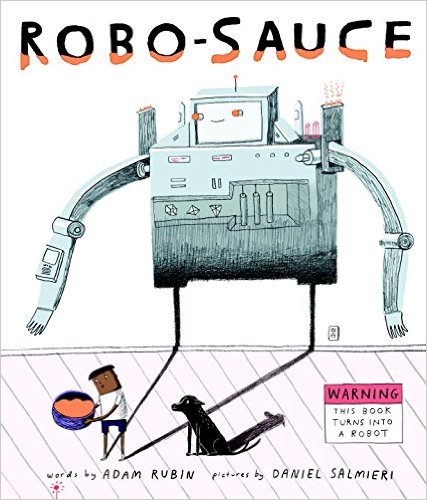
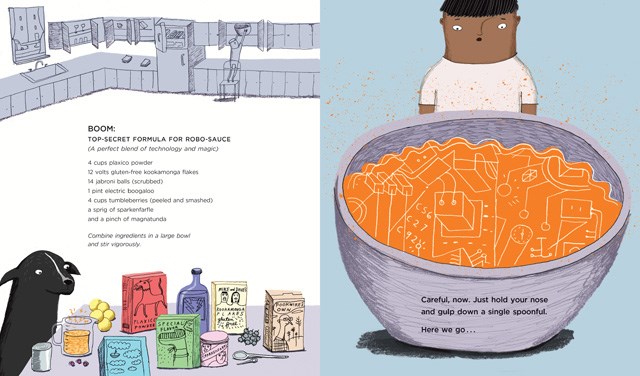


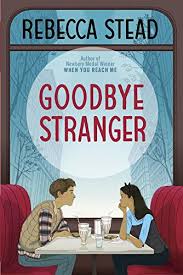
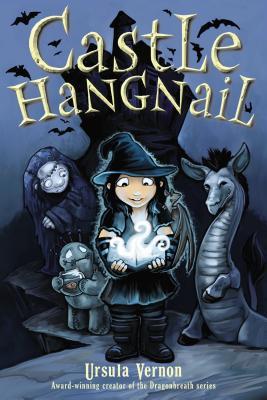
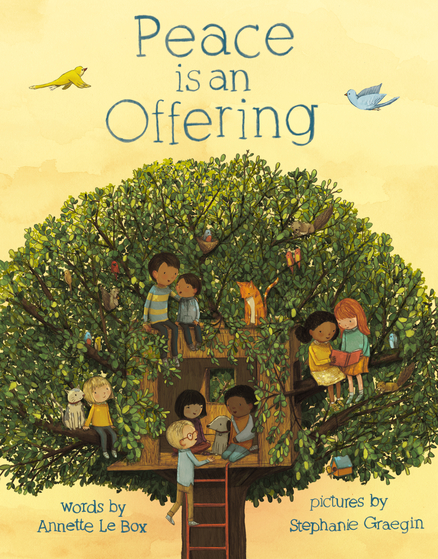





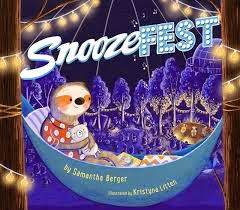


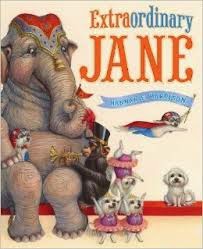
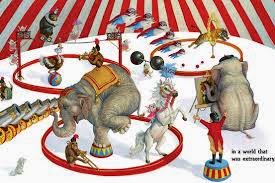
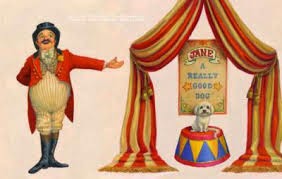
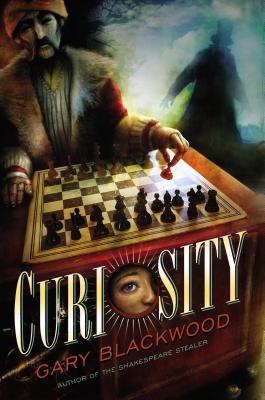
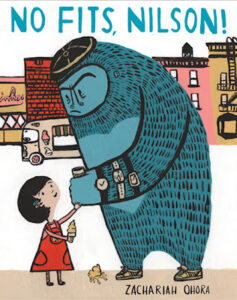


 by Trinka Hakes Noble. Dial Books for Young Readers (October 1984); ISBN 0803701020; 32 pages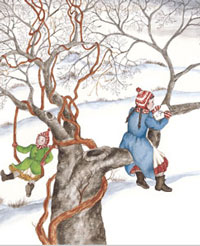

 Children’s book author and illustrator Jon Agee has landed a three picture book deal at Penguin Group (USA)’s Dial Books for Young Readers. Agee (pictured) wrote The Incredible Painting of Felix Clousseau and many other books for kids.


 by Berlie Doherty, illustrated by Teresa O'Brien. Dial Books for Young Readers (March 1989); ISBN 0803704836; 32 pages; Book Source: Copy from local library

 introduces children to the ceremony of Tashlich and teaches about forgiveness and making amends. In preparation for Tashlich, a little boy called Izzy makes an "I'm sorry" list by drawing pictures of four things that he's sorry for doing. On Rosh Hashanah, he sincerely apologizes to his sister, mother and others that he had wronged during the year. He follows members of his synagogue as they all make their way to the pier. After listening to the sound of the shofars, he reflects upon what he has done wrong and throws pieces of bread into the ocean's waters.


WHY HAVEN’T I SEEN THIS BOOK? I MUST SEE IT.
How long do you think it will last in a library? I’m think of it for our schools primary library (K-2nd grade)
I honestly have no idea. As long as HOW MANY JELLY BEANS lasts, I guess is the best answer.