JacketFlap connects you to the work of more than 200,000 authors, illustrators, publishers and other creators of books for Children and Young Adults. The site is updated daily with information about every book, author, illustrator, and publisher in the children's / young adult book industry. Members include published authors and illustrators, librarians, agents, editors, publicists, booksellers, publishers and fans. Join now (it's free).
Login or Register for free to create your own customized page of blog posts from your favorite blogs. You can also add blogs by clicking the "Add to MyJacketFlap" links next to the blog name in each post.
Blog Posts by Tag
In the past 7 days
Blog Posts by Date
Click days in this calendar to see posts by day or month
Viewing: Blog Posts Tagged with: yeats, Most Recent at Top [Help]
Results 1 - 12 of 12
How to use this Page
You are viewing the most recent posts tagged with the words: yeats in the JacketFlap blog reader. What is a tag? Think of a tag as a keyword or category label. Tags can both help you find posts on JacketFlap.com as well as provide an easy way for you to "remember" and classify posts for later recall. Try adding a tag yourself by clicking "Add a tag" below a post's header. Scroll down through the list of Recent Posts in the left column and click on a post title that sounds interesting. You can view all posts from a specific blog by clicking the Blog name in the right column, or you can click a 'More Posts from this Blog' link in any individual post.
I’m writing from Palermo where I’ve been teaching a course on the legacy of Troy. Myths and fairy tales lie on all sides in this old island. It’s a landscape of stories and the past here runs a live wire into the present day. Within the same hour, I saw an amulet from Egypt from nearly 3000 years ago, and passed a young, passionate balladeer giving full voice in the street to a ballad about a young woman – la baronessa Laura di Carini – who was killed by her father in 1538. He and her husband had come upon her alone with a man whom they suspected to be her lover. As she fell under her father’s stabbing, she clung to the wall, and her hand made a bloody print that can still be seen in the castle at Carini – or so I was told. The cantastorie – the ballad singer – was giving the song his all. He was sincere and funny at the same time as he knelt and frowned, mimed and lamented.
The eye of Horus, or Wadjet, was found in a Carthaginian’s grave in the city and it is still painted on the prows of fishing boats, and worn as a charm all over the Mediterranean and the Middle East, in order to ward off dangers. This function is, I believe, one of the deepest reasons for telling stories in general, and fairy tales in particular: the fantasy of hope conjures an antidote to the pain the plots remember. The street singer was young, curly haired, and had spent some time in Liverpool, he told me later, but he was back home now, and his song was raising money for a street theatre called Ditirammu (dialect for Dithryamb), that performs on a tiny stage in the stables of an ]old palazzo in the district called the Kalsa. Using a mixture of puppetry, song, dance, and mime, the troupe give local saints’ legends, traditional tales of crusader paladins versus dastardly Moors, and pastiches of Pinocchio, Snow White, and Alice in Wonderland.
A balladeer in Palermo. Photograph taken by Marina Warner. Do not use without permission.
Their work captures the way fairy tales spread through different media and can be played, danced or painted and still remain recognisable: there are individual stories which keep shape-shifting across time, and there is also a fairytale quality which suffuses different forms of expression (even recent fashion designs have drawn on fairytale imagery and motifs). The Palermo theatre’s repertoire also reveals the kinship between some history and fairy tale: the hard facts enclosed and memorialised in the stories. Although the happy ending is a distinguishing feature of fairy tales, many of them remember the way things were – Bluebeard testifies to the kinds of marriages that killed Laura di Carini.
A few days after coming across the cantastorie in the street, I was taken to see the country villa on the crest of Capo d’Orlando overlooking the sea, where Casimiro Piccolo lived with his brother and sister. The Piccolo siblings were rich Sicilian landowners, peculiar survivals of a mixture of luxurious feudalism and austere monasticism. A dilettante and dabbler in the occult, Casimiro believed in fairies. He went out to see them at twilight, the hour recommended by experts such as William Blake, who reported he had seen a fairy funeral, and the Revd. Robert Kirk, who had the information on good authority from his parishioners in the Highlands, where fairy abductions, second sight, and changelings were a regular occurrence in the seventeenth century.
The Eye of Horus, By Marie-Lan Nguyen, Public Domain via Wikimedia Commons.
Casimiro’s elder brother, Lucio, a poet who had a brief flash of fame in the Fifties, was as solitary, odd-looking, and idiosyncratic as himself, and the siblings lived alone with their twenty servants, in the midst of a park with rare shrubs and cacti from all over the world, their beautiful summer villa filled with a vast library of science, art, and literature, and marvellous things. They slept in beds as narrow as a discalced Carmelite’s, and never married. They loved their dogs, and gave them names that are mostly monosyllables, often sort of orientalised in a troubling way. They range from ‘Aladdin’ to ‘Mameluk’ to ‘Book’ and the brothers built them a cemetery of their own in the garden.
Casimiro was a follower of Paracelsus, who had distinguished the elemental beings as animating matter: gnomes, undines, sylphs and salamanders. Salamanders, in the form of darting, wriggling lizards, are plentiful on the baked stones of the south, but the others are the cousins of imps and elves, sprites and sirens, and they’re not so common. The journal Psychic News, to which Casimiro subscribed, inspired him to try to take photographs of the apparitions he saw in the park of exotic plants around the house. He also ordered various publications of the Society of Psychical Research and other bodies who tried to tap immaterial presences and energies. He was hoping for images like the famous Cottingley images of fairies sunbathing or dancing which Conan Doyle so admired. But he had no success. Instead, he painted: a fairy punt poled by a hobgoblin through the lily pads, a fairy doctor with a bag full of shining golden instruments taking the pulse of a turkey, four old gnomes consulting a huge grimoire held up by imps, etiolated genies, turbaned potentates, and eastern sages. He rarely left Sicily, or indeed, his family home, and he went on painting his sightings in soft, rich watercolour from 1943 to 1970 when he died.
Photograph by Marina Warner. Do not use without permission.
His work looks like Victorian or Edwardian fairy paintings. Had this reclusive Sicilian seen the crazed visions of Richard Dadd, or illustrations by Arthur Rackham or John Anster Fitzgerald? Or even Disney? Disney was looking very carefully at picture books when he formed the famous characters and stamped them with his own jokiness. Casimiro doesn’t seem to be in earnest, and the long-nosed dwarfs look a little bit like self-mockery. It is impossible to know what he meant, if he meant what he said, or what he believed. But the fact remains, for a grown man to believe in fairies strikes us now as pretty silly.
The Piccolo family’s cousin, close friend and regular visitor was Giuseppe Tomasi di Lampedusa, the author of The Leopard, and he wrote a mysterious and memorable short story about a classics professor who once spent a passionate summer with a mermaid. But tales of fairies, goblins, and gnomes seem to belong to an altogether different degree of absurdity from a classics professor meeting a siren.
And yet, the Piccolo brothers communicated with Yeats, who held all kinds of beliefs. He smelted his wonderful poems from a chaotic rubble of fairy lore, psychic theories, dream interpretation, divinatory methods, and Christian symbolism: “Out of the quarrel with others we make rhetoric; out of the quarrel with ourselves we make poetry.”
Featured image credit: Capo d’Orlando, by Chtamina. CC-BY-SA-2.5 via Wikimedia Commons
American composer and self-proclaimed “bad boy of music” George Antheil was born today 114 years ago in Trenton, New Jersey. His most well-known piece is Ballet mècanique, which was premiered in Paris in 1926; like Stravinsky’s Rite of Spring, from which Antheil seems to have derived quite a bit of inspiration, the premiere resulted in audience outrage and a riot in the streets. The piece is scored for pianos and a number of percussion instruments, including airplane propellers.
Though he died at the age of 58, polymath Antheil managed to accomplish quite a bit in his relatively short life both in and outside the field of music. Here are some highlights:
His name appears alongside the actress Hedy Lamarr’s on a patent, granted in 1942, for an early type of frequency hopping device, their invention for disrupting the intended course of radio-controlled German torpedoes.
His music was championed by the likes of James Joyce, Ezra Pound, Sylvia Beach, W.B. Yeats, Erik Satie, and Pablo Picasso.
Under the pseudonym Stacey Bishop, he wrote Death in the Dark, a detective novel edited by T.S. Eliot, the hero of which is based on Pound.
After spending the majority of the 1920s and 30s in Europe, he settled in Hollywood and wrote dozens of film, television and radio scores, for directors such as Cecil B. DeMille and Fritz Lang (and with such titillating titles as “Zombies of Mora Tau” and “Panther Girl of the Kongo”).
Oxford Music Online is the gateway offering users the ability to access and cross-search multiple music reference resources in one location. With Grove Music Online as its cornerstone, Oxford Music Online also contains The Oxford Companion to Music, The Oxford Dictionary of Music, and The Encyclopedia of Popular Music.
Subscribe to the OUPblog via email or RSS.
Subscribe to only music articles on the OUPblog via email or RSS.
With today being St Patrick’s Day, we’ve taken the opportunity to recommend a few classic works of Irish literature to dip into while you’re enjoying a pint (or two) of Guinness.
Joyce is one of the most famous figures in Irish literature, and Finnegans Wake is infamous for being one of the most formidable books in existence. It plays fantastic games with language and reinvents the very idea of the novel in the process of telling the story of Humphrey Chimpden Earwicker and his wife Anna Livia, in whom the character of Ireland itself takes form. Around them and their dreams there swirls a vortex of world history, of ambition and failure, pride and shame, rivalry and conflict, gossip and mystery.
This was the first major work written by Jonathan Swift. The author explains in a preface that it is the practice of seamen when they meet a whale to throw out an empty tub to divert it from attacking the ship. Hence the title of the satire, which is intended to divert Hobbes’s Leviathan and the wits of the age from picking holes in the weak sides of religion and government. The author proceeds to tell the story of a father who leaves as a legacy to his three sons Peter, Martin, and Jack a coat apiece, with directions that on no account are the coats to be altered. Peter symbolizes the Roman Church, Martin (from Martin Luther) the Anglican, Jack (from John Calvin) the Dissenters. The sons gradually disobey the injunction. Finally Martin and Jack quarrel with the arrogant Peter, then with each other, and separate.
In The Playboy of the Western World, the action takes place in a public house, when a stranger enters and is persuaded to tell his story. Impressed, the admiring audience thinks he must be very brave indeed to have killed his father, and in turn the young tramp blossoms into the daring rollicking hero they believe him to be. But then his father, with a bandaged head, turns up seeking his worthless son. Disillusioned and angry at the loss of their hero, the crowd turns the stranger, who tries to prove that he is indeed capable of savage deeds, even attempting unsuccessfully to kill his father again. The play ends with father and son leaving together with the words “Shut yer yelling for if you’re after making a mighty man of me this day by the power of a lie, you’re setting me now to think if it’s a poor thing to be lonesome, it’s worse maybe to go mixing with the fools of earth.”
One of the greatest horror stories ever written. This is the novel that introduced the character of Count Dracula to the world, spawning a whole host of vampire fictions in its wake. As well as being a pioneering text in horror fiction, it also has much to say about the nature of empire, with Dracula hell-bent on spreading his contagion into the very heart of the British empire. Fun fact: Bram Stoker’s wife, Florence Balcombe, had previously been courted by Oscar Wilde.
W. B. Yeats was born in 1865 and died in 1939. His career crossed the 19th and 20th centuries, from the Romantic early poems of Crossways and the symbolist masterpiece The Wind Among the Reeds to his last poems. Myth and folk-tale influence all of his work, most notably in Cathleen ni Houlihan among others. The importance of the spirit world to his life and work is evident in his critical essays and occult writings, and he also wrote a whole host of political speeches, autobiographical writings, and letters.
This is the story of the son of an English lord, Horation, who is banished to his father’s Irish estate as punishment for gambling debts, he adopts the persona of knight errant and goes off in search of adventure. On the wild west coast of Connaught he finds remnants of a romantic Gaelic past a dilapidated castle, a Catholic priest, a deposed king and the king’s lovely and learned daughter, Glorvina. In the process he rediscovered a love for the life and culture of his country. Written after the Act of Union, The Wild Irish Girl (1806) is a passionately nationalistic novel and an essential novel in the discourse of Irish nationalism. The novel was so controversial in Ireland that the author, Lady Morgan, was put under surveillance by Dublin Castle. There is a bust of Lady Morgan in the Victoria and Albert Museum in London and the plaque mentions that Lady Morgan was “less than four feet tall.”
This dark collection of five stories was said by none other than Henry James to be “the ideal reading… for the hours after midnight”. Indeed, J. Sheridan Le Fanu himself had a reputation for being both reclusive and rarely seen in the daytime. His fascination with the occult led to his stories being truly spine-chilling, drawing on the Gothic tradition and elements of Irish folklore, as well as on the social and political anxieties of his Anglo-Irish contemporaries.
Kirsty Doole is Publicity Manager for Oxford World’s Classics.
For over 100 years Oxford World’s Classics has made available the broadest spectrum of literature from around the globe. Each affordable volume reflects Oxford’s commitment to scholarship, providing the most accurate text plus a wealth of other valuable features, including expert introductions by leading authorities, voluminous notes to clarify the text, up-to-date bibliographies for further study, and much more. You can follow Oxford World’s Classics on Twitter, Facebook, or here on the OUPblog. Subscribe to only Oxford World’s Classics articles on the OUPblog via email or RSS.
Subscribe to the OUPblog via email or RSS.
Subscribe to only literature articles on the OUPblog via email or RSS.
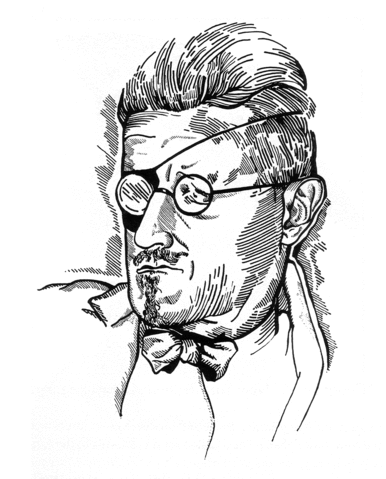
Image credit: James Joyce. By Djuna Barnes. Public domain via Wikimedia Commons.
There had been rumours for months. When Dublin’s Abbey Theatre announced that John Millington Synge’s new play The Playboy of the Western World would be produced on Saturday, 26 January 1907, all were on alert. Controversy had followed Synge since the production of his first Wicklow play, The Shadow of the Glen, in which a bold, young, and lonely woman leaves a loveless May/December marriage to go off with a fine-talking Tramp who rhapsodizes over the freedom of the roads. Irish women wouldn’t do that!
In The Playboy the action takes place in a public house on the wild coast of Mayo, when a travel-stained stranger enters and is persuaded to tell his story. Impressed, the admiring on-stage audience thinks he must be very brave indeed to have killed his father, and in turn the young tramp blossoms into the daring rollicking hero they believe him to be – winning all the prizes at the races and the love of the publican’s daughter. But then his father, with a bandaged head, turns up seeking his worthless son who is not the courageous father-slayer after all. Disillusioned and angry at the loss of their hero, the onstage crowd turns brutally on Christy, who tries to prove that he is indeed capable of savage deeds, even attempting unsuccessfully to kill his father a third time. The play ends with father and son leaving together, dismissing the onstage audience with the words “Shut yer yelling for if you’re after making a mighty man of me this day by the power of a lie, you’re setting me now to think if it’s a poor thing to be lonesome, it’s worse maybe to go mixing with the fools of earth”.
Irish actors Sara Allgood (“Pegeen Mike”) and J. M. Kerrigan (“Shawn Keogh”), in ‘The Playboy of the Western World’, Plymouth Theatre, Boston, 1911.
The offstage audience, thrown off guard by the comedy of the opening scenes, erupted at the word “shifts” (a woman’s chemise) in the third act. Some were outraged by the intimation that not all Irish girls were pure or holy, others were shocked by the strong (and strange) language. All were doubtless bewildered by finding themselves laughing as church and the law are banished from a world eager for a hero, charmed by the language and the love story, then challenged again when the tale threatens to invade reality. Synge and his colleagues were in turn accused of “playing” with a nation’s ideals. The riots continued for almost a week. Yeats, eager to champion the rights of the artist, exacerbated matters by calling in the local police, and Dublin and beyond were agog with press reports of the playacting on stage at night and in the courts by day. The actors loyally performed in dumb show until the play at last had a full hearing. But even they were not always comfortable with the control exerted by the playwright through language and gesture, sometimes in their confusion making matters worse by causing their actions and speeches to be more realistic. And who could blame them?
Yet the playwright does not seem to have been aware of the response his play would cause, insisting that it was merely a comedy, an “extravaganza”, meant to entertain, and that “the story — in its ESSENCE — is probable, given the psychic state of the locality.” Not to this audience, who charged him with immorality, obscenity and blasphemy, “a sordid, squalid and repulsive picture of Irish life and character”, making a hero of “a foul-mouthed scoundrel and parricide”.
For three years Synge had painstakingly developed his original idea, producing more than a thousand typescript pages, drafts and scenarios, all the way to draft “K” before he finally hit on the brilliantly ambiguous final form. For a “playboy” may be an athlete, performer, seducer, trickster, manipulator, creator, hero, or all of the above; while “the western world” might refer to County Mayo, to the United States, or to this world as contrasted with that “eastern world” of folk and fairy tales — or to all. “What a blessing you did not go to version L, if Version K had such a disastrous effect!” a friend commented in the turbulent months that followed.
Like Christy’s own tale of slaying his Da, the story of his injuries to Ireland’s good name continued to grow with the years. When the Abbey theatre took the play on tour to the United States, the clash between the idea of a pure nationhood cherished by Irish immigrants and what they saw on stage was even more pronounced. In New York missiles were thrown on the stage, and a hundred police attempted to keep order. Lady Gregory, who led the tour, received death threats; Theodore Roosevelt’s presence at the second performance ensured a more sedate reception. But when the company arrived in Philadelphia all hell broke loose, and the players were hauled into court by an Irish-American patriot who accused the company and the play of indecency. The case was dismissed when the judge learned that the accusers had not read the text.
In the theatre individual response to what is clearly not real can quickly become an excuse for objecting to what is perceived to be real. Audiences have always felt justified in expressing their disapproval of what is staged, or attempted to be staged. In 18th century London theatre managers petitioned the King for a guard of soldiers; one manager engaged thirty prize-fighters as well. Destruction of scenery, benches and even musical instruments was all too common when the audience felt cheated; often foreign performers were pelted with rotten fruit and other missiles (and told to go home).
Patriotism was perhaps the most frequent cause, especially in Ireland where the stage Irishman, created by English dramatists, was a subject of mockery and ridicule, and where class, nationalism, and religion were inextricably entwined. In 1907 however the disturbance was premeditated, with members of the audience carrying in stink bombs, rotten vegetables, trumpets, whistles, and other paraphernalia. There was clearly an organized cabal determined to silence a work which is now considered a masterpiece of comedy, performed throughout the world and recently the centrepiece of a world tour.
Would such events happen today? We are much more accustomed to onstage violence; but censorship is still very much with us. Synge suggests that to hold a dream is better than to live with caution; the outsider serves to perpetuate the myth-making process while at the same time challenging it, introducing a heightened self-awareness which embraces community on both sides of the footlights. Thus the audience is caught off-guard, encouraged to enter the world of fantasy, then betrayed by a reality of a different sort — the dream itself can threaten if fulfilled; we are briefly dangled above two worlds at once.
For over 100 years Oxford World’s Classics has made available the broadest spectrum of literature from around the globe. Each affordable volume reflects Oxford’s commitment to scholarship, providing the most accurate text plus a wealth of other valuable features, including expert introductions by leading authorities, voluminous notes to clarify the text, up-to-date bibliographies for further study, and much more. You can follow Oxford World’s Classics on Twitter and Facebook.
When searchable editions of classic philosophical texts became available in the 1980s, one proud publisher advertised the benefits of this new technology at an APA meeting by inviting participants to do a sample search of John Locke’s Essay concerning Human Understanding. Even non-experts knew the disdain for innateness that Locke notoriously displayed in Book I. So I tapped into the machine: “Innate ideas”. It churned for a while and responded: “there is nothing in the text corresponding to your entry”! I quickly reverted to the single word, “innate,” and found hundreds of references to innate notions and principles. The machine was right: Locke never refers to innate ideas in the Essay.
While the technologies for searching have been transformed almost beyond recognition since then, their benefits presuppose the efforts of dedicated editors to provide scholarly editions of the text. Philosophers can be trusted to dispute the meaning of almost any sentence without the added assistance of disputed texts. We need to agree, first, on the texts — what Aristotle or Scotus, Descartes or Locke actually wrote; and for this we are indebted to generations of editors, many of whom remain anonymous, who produced editions of those texts in their original languages or in translation.
Without disrespect to the scribes of an earlier era, however, the standards of editing improved significantly in the twentieth century. Editors and their publishers produced scholarly editions, which included extensive meta-text that identified hidden references, unacknowledged citations etc., and translations of texts that were not written in the vernacular of the reader.
Unfortunately, the results of this valuable work remain inaccessible to most scholars and students, except in the best libraries, because the editions are no longer in print. Those who have laboured in small colleges in remote locations — I speak from experience! — incurred significant travel expenses and fell asleep in libraries in Paris, London, or Oxford while consulting “the texts.”
W. B. Yeats would not object, I hope, if I use his famous phase about “all changed, changed utterly” in this context. He was writing about the 1916 revolution, but the phrase applies equally to the technological revolution that has made it possible for researchers, anywhere in the world, to access texts online. Resources will include a very wide range of scholarly editions in English literature — Ben Jonson, Shakespeare, Donne, and many more. But it will also include scholarly editions of philosophical texts, many of which are now out of print. These will include The Oxford Francis Bacon, Noel Malcolm’s two-volume edition of the Correspondence of Hobbes, and the Complete Works of Gerrard Winstanley. The works of Edmund Burke, John Locke, and David Hume will follow in an early update, and later on the classical texts of Plato and
W. B. Yeats is usually seen as a great innovator who put his stamp so decisively on modern Irish literature that most of his successors worked in his shadow. R. F. Foster's new book, Words Alone: Yeats and his Inheritances, weaves together literature and history to present an alternative perspective.
0 Comments on Yeats, faeries, and the Irish occult tradition as of 1/1/1900
It doesn’t seem that long since a friend chastised me for writing a long, newsy, e-mail. ‘It’s not meant to be a letter, you know – it’s just an instant message.’ Yet another friend insists on a genuine hand-written letter; texting or e-mailing simply won’t do. In an earlier age, I can recall when one apologized for typing rather than writing by hand. Condolences could not be sent any other way. Now I cannot even think straight unless it is at the computer, and my handwriting sometimes defies even my interpretation. I comfort myself by remembering that John Millington Synge composed over a thousand pages of drafts of The Playboy of the Western World on his typewriter, a bulky 1900 Blickensdorfer. He had to write home regularly for more ink rolls, not all that different from the rapidity with which my printer demands new cartridges.
But even Synge wrote most of his letters in a spikey, ragged hand with much underlining. His Abbey Theatre colleague Lady Gregory also turned to the typewriter for serious composition, and just as well since, when she resorted to the pen for her letters, most of the words end with an imperious straight line. W. B. Yeats never touched a machine and insisted on a good pen. But he was not only dyslexic, a poor speller and careless about punctuation; in the frenzy of composition, be it poetry or prose, many words were left unfinished and sometimes even perplexing.
The internet promises not only easy reading but encourages a hasty reply and is immediately disposable. Personal letters are often kept, sometimes for decades; even years later there is something alluring about them. Writing a letter takes time and thoughtfulness; it provides a sense of ‘being in touch’, gives a fresh meaning to the word correspondence, and demands some element of formality, if only in salutation and signature. It is also more mysterious, when even the occasional illegibility or misspelling evokes personality. Who are these people, what were they feeling? What did they have to say that was so important to communicate?
No wonder we find reading other people’s letters appealing. Unlike biography, where the invasive author selects events and describes actions for us, editions of personal letters offer fresh insight and active participation in the telling of stories. We see the world through the writer’s eyes, are invited to enjoy the anecdotes while interpreting the irony and watching the self-posturing. At the same time we can observe changes in tone and mood, perhaps even the manipulation of facts from one letter to the next. We might even pick up some salacious and slanderous gossip and experience the frisson of sexual innuendo, or at the very least secrets of love, dedication or illegality. We are, in fact, privileged but helpless eavesdroppers to a correspondence meant to be private.
When the letters cover long-term relationships between two people even more is revealed. Synge – whose letters to Molly Allgood, thanks to an astonishingly efficient postal service, could be read and answered within twelve hours – whined about her inattention, but poured out his feelings on love, writing, and the theatre even when they went unanswered. Synge died at 39, and none of Molly’s letters survive. W. B. Yeats on the other hand, while sending detailed accounts, sometimes two or three a day, gloried in a good story well told, and his wife George responded with witty, observant and vivid reports of her own. From her we are kept alive to the political, social and cultural world of Dublin, living them almost as events occur; at the same time their children, Willy’s siblings, close friends and co-workers are all kept centre stage and her husband’s business affairs dealt with.
Meanwhile, WBY deftly works the corrid
0 Comments on The letters of W.B. and George Yeats as of 1/1/1900
Yesterday, I posted a snippet form the old English carol, "Tomorrow Shall Be My Dancing Day". Today is the first day of National Poetry Month, and, as I did last year, I'll be presenting a poem a day, along with analysis, in a series I call Building a Poetry Collection. Each poem will be related in some way to the one from the day before. However, just as brainradio can be unpredictable in what song is playing in my head at any given time, so too are my associations a bit unusual from time to time.
Yesterday's carol has a first line the same as its title. Initially, I rather expected my brain my kick up a love poem, since I spent so much time singing the chorus, but I found this line coming to mind instead "How can we know the dancer from the dance?" It's the final line from today's poem selection, "Among School Children" by William Butler Yeats. A confession: I analyzed this poem here before, so the rest of the post is essentially a reprise of previous content. It is a lengthy post, but I hope you'll read it nevertheless
The set-up Imagine that you're a sixty year-old Irish poet walking through a school in County Waterford back in 1926, because you happen to also be a member of a committee addressing schools. As you walk through, you'd carry with you your sixty years of life experience and education, including your training in the classics, such as the theories of Aristotle, Plato and Pythagoras. You'd also bring with you your recollection of school days, and might wonder if any of the girls in class resemble the woman you consider your soul-mate, believing as you do in a Platonic reality where every soul is split in two and housed in separate bodies, but which, when reunited, creates a sublime single entity. You might ponder the state of education. What the school (and teacher) looks like. Comparing your sixty year-old self to the young children there, you might think about how you were once a child, and that might make you think of your mother: was your life worth the pain of your birth? You might wonder whether there is meaning to life, after all, as you stand there at age sixty, looking at the exuberance of youth surrounding you.
And if you it truly were you, you'd be William Butler Yeats. And you would then go on to write a gorgeous poem about it. Of course, you'd use your own personal mythological associations, like references to Leda (once impregnated by Zeus, who took the form of a swan) as a stand-in for the woman you love. And in the end, you'd have an answer, contained in the following poem:
The poem, with a few interjections
The poem consists of eight stanzas, each containing eight lines, each written in iambic pentameter and with an end-rhyme scheme (per stanza) of ABABABCC, which is known as ottava rima.
Among School Children by William Butler Yeats
I
I walk through the long schoolroom questioning; A kind old nun in a white hood replies; The children learn to cipher and to sing, To study reading - books and histories, To cut and sew, be neat in everything In the best modern way - the children's eyes In momentary wonder stare upon A sixty-year-old smiling public man.
This first stanza is the set-up: where he is, what starts him musing.
II
I dream of a Ledaean body, bent Above a sinking fire, a tale that she Told of a harsh reproof, or trivial event That changed some childish day to tragedy - Told, and it seemed that our two natures blent Into a sphere from youthful sympathy, Or else, to alter Plato's parable, Into the yolk and white of the one shell.
Leda was a favorite topic of Yeats's. She was visited by Zeus in the form of a swan, and is the subject of Yeats's poem, "Leda and the Swan".
III
And thinking of th
0 Comments on Among School Children by William Butler Yeats as of 1/1/1900
Today's poem choice picks up on the penultimate line of yesterday's post, "A Child Said, 'What is the Grass?'" from Song of Myself by Walt Whitman: "All goes onward and outward -- nothing collapses". That line reminded me of the falcon, turning its widening gyre, until things fall apart, rather the opposite of what Whitman is saying. Turning and turning to a different take on things, today's poem is "The Second Coming" by W.B. Yeats, another of the poems that grabbed hold of me in one of my several English Lit. classes in college and never, ever let go.
The Second Coming by William Butler Yeats
Turning and turning in the widening gyre The falcon cannot hear the falconer; Things fall apart; the centre cannot hold; Mere anarchy is loosed upon the world, The blood-dimmed tide is loosed, and everywhere The ceremony of innocence is drowned; The best lack all conviction, while the worst Are full of passionate intensity.
Surely some revelation is at hand; Surely the Second Coming is at hand. The Second Coming! Hardly are those words out When a vast image out of Spiritus Mundi Troubles my sight: somewhere in the sands of the desert A shape with lion body and the head of a man, A gaze blank and pitiless as the sun, Is moving its slow thighs, while all about it Reel shadows of the indignant desert birds. The darkness drops again; but now I know That twenty centuries of stony sleep were vexed to nightmare by a rocking cradle, And what rough beast, its hour come round at last, Slouches towards Bethlehem to be born?
Many people assume, based on the title, that this poem is about the second coming of Christ, as foretold in Revelations or the Gospels. That assumption is incorrect. Yeats's poem depicts a male sphinx, awakened from 2000 years of sleep, stalking through the desert toward Bethlehem, where the next "pure soul" will be born, thereby starting the spiraling cycle in which Yeats believed anew.
To make sense of the poem, it pays to know a bit about Yeats's life and world view. First and foremost, Yeats was Irish, and kept company with Irish revolutionaries including the great love of his life, Maude Gonne. Yeats was also an occultist, and a member of the Golden Dawn. Yeats and his wife, who was purportedly a medium, believed in a System in which life is patterned after the Great Wheel of time, a wheel with 28 spokes (derived from the moon cycle). Each soul moves through all 28 phases of the wheel; each complete rotation of the wheel takes 2000 years.
Yeats was a believer in opposites -- not just that for every action, there is an equal and opposite reaction, but for every being there is a "mask" -- equal and opposite. He conceived of interlocking (and opposite) spirals -- one is at its widest point when the other is at its base, and vice-versa. These correspond to roughly 2100 year cycles, with something resembling equipoise every 1050 years. For a complete understanding of his theory, read A Vision by Yeats; various summaries can be found on the internet, with a decent representation of the Cycles of History to be found at yeatsvision.com. The gyre of which Keats speaks in the first line of the poem is the outward spiral; if a falcon were to follow the spiral, it would eventually travel so far from the falconer as to be unable to hear commands anymore, and would therefore lose the centerpoint of its gyre and destabilize its path.
Discussion
This can be classified in part as a war poem, first written in 1919, shortly after the end of World War I, when everyone was trying to make sense of a world gone mad. Revolution was still sweeping Europe, including the Russian revolution and, more personal to Yeats, the struggle for Irish independence. In the earlier draft of this poem, Yeats complained "And there's no Burke to cry aloud, no Pitt", referring to two denouncers of the French Revolution. He also made reference to Germany invading Russia; both references were removed, thereby making the poem less specifically about a particular world situation, and rendering it more prophetic in tone.
The first stanza
The first four lines describe the state of the world -- the falcon, a bird typically associated with royalty (or aristocracy) has flown ever higher and wider and farther from its source, until it reaches a point where it has lost contact with its source, the falconer. Oh, how I love the next line: "Things fall apart; the centre cannot hold". I picture a pot on a potter's wheel, flaring out nicely but suddenly wobbling and losing its form. These lines are a refences to the political situation in much of the world at the time -- the old kingdoms were no longer able to hold their shapes, and were blown apart, frequently in violence and bloodshed. The folks who should be there to denounce it lack conviction; only the worst elements in society have "passionate intensity."
The second stanza
After setting the stage, Yeats tries to make some sense of it. He grasps for reasons, as the first three lines reflect with their repetition: "Surely some revelation is at hand;/Surely the Second Coming is at hand./The Second Coming!"
Here the poem turns to a vision, which Yeats attributes to Spiritus Mundi (or "the world spirit"), a Zeitgeist type of phrase. He describes his vision of the male-headed sphinx (in Golden Dawn parlance for the mystics in my readership, a representation of Sandalphon, with various connections to Elijah and Enoch, who is historically the entity charged with determining whether a child will be male or female). In the vision, the sphinx "is moving its slow thighs," a sexual turn of phrase, as it moves in the desert.
"The darkness drops again" puts an end to the vision, and Yeats shares its meaning. Twenty centuries of sleep in the desert have ended. A rocking cradle -- here, a sign of instability and not an item of comfort -- has put the sphinx on the move. I can't help but wonder whether the cradle reference is a reference to civilization, which was at the time reeling from so much strife. In any case, Yeats indicates that it was a sign that something big was coming, and that things were about to change (and a new pure soul would be brought into existence, to start the turning of the wheel again).
It bears mention that Yeats paid homage to his two favorite poets, William Blake and Percy Bysshe Shelley in this poem, first with a nod to Shelley's "Prometheus Unbound," and then with a phrase ("stony sleep") borrowed from Blake's "The Book of Urizen." Yeats held both poets in high esteem, and believed that "Prometheus Unbound" should be understood as one of the world's sacred texts.
The final phrase of the poem, "what rough beast, its hour come round at last, slouches towards Bethlehem to be born?" is one of Yeats's best-known lines, and one that sticks in the brain, years after reading it for the first time in college, where I also learned about the spirals and cycles and read "Leda and the Swan" and more Yeats. And more Yeats.
Related references
Some of the lines of this poem are popular references for poets and other writers. Things Fall Apart is a popular English-language text by Chinua Achebe used in African schools. The Center Cannot Hold is a memoir of madness by Elyn Saks. Charles Bukowski referenced it in the title of his collection, Slouching Toward Nirvana. Billy Collins in the title of his poem Dancing Toward Bethlehem. Joan Didion in her collection of essays entitled Slouching Towards Bethlehem, Robert Bork in his conservative political treatise, Slouching Towards Gomorrah: Modern Liberalism and American Decline.
And for HBO fans, Wikipedia tells me that the poem has been often-quoted in The Sopranos, now at an end. "Things fall apart; the centre cannot hold". Bits of the poem have been used to describe the war in Iraq, with The New York Times weighing in on the poem's applicability (or lack thereof) to Iraq.
Despite its doom and gloom, I really like this poem. It sticks to your ribs (or in your brain, more likely). And perhaps it helps to know that Yeats didn't see the beast he describes as a bad thing -- in fact, he was to Yeats a most satisfying companion, and a harbinger of good things to come.
1 Comments on The Second Coming - a National Poetry Month Post, last added: 4/4/2009
I enjoyed reading your post. You've explained the poem beautifully. I love learning something new every day! I can see why the poem made a lasting impression on you.
I've had the good fortune to attend several of Billy Collins' poetry readings, which are always outstanding, of course.
I write non-fiction, but I've been dreaming of writing some poetry; I did in junior high and high school in the 1970s. It's daunting, and I'm mostly afraid I'll get it wrong. One of these days I'll let go of the fear and give it a try.
Imagine that you're a sixty year-old Irish poet walking through a school in County Waterford back in 1926, because you happen to also be a member of a committee addressing schools. As you walk through, you'd carry with you your sixty years of life experience and education, including your training in the classics, such as the theories of Aristotle, Plato and Pythagoras. You'd also bring with you your recollection of school days, and might wonder if any of the girls in class resemble the woman you consider your soul-mate, believing as you do in a Platonic reality where every soul is split in two and housed in separate bodies, but which, when reunited, creates a sublime single entity. You might ponder the state of education. What the school (and teacher) looks like. Comparing your sixty year-old self to the young children there, you might think about how you were once a child, and that might make you think of your mother: was your life worth the pain of your birth? You might wonder whether there is meaning to life, after all, as you stand there at age sixty, looking at the exuberance of youth surrounding you.
And if you it truly were you, you'd be William Butler Yeats. And you would then go on to write a gorgeous poem about it. Of course, you'd use your own personal mythological associations, like references to Leda (once impregnated by Zeus, who took the form of a swan) as a stand-in for the woman you love. And in the end, you'd have an answer, contained in the following poem:
Among School Children by William Butler Yeats
The poem consists of eight stanzas, each containing eight lines, each written in iambic pentameter and with an end-rhyme scheme (per stanza) of ABABABCC, which is known as ottava rima.
I
I walk through the long schoolroom questioning; A kind old nun in a white hood replies; The children learn to cipher and to sing, To study reading - books and histories, To cut and sew, be neat in everything In the best modern way - the children's eyes In momentary wonder stare upon A sixty-year-old smiling public man.
This first stanza is the set-up: where he is, what starts him musing.
II
I dream of a Ledaean body, bent Above a sinking fire, a tale that she Told of a harsh reproof, or trivial event That changed some childish day to tragedy - Told, and it seemed that our two natures blent Into a sphere from youthful sympathy, Or else, to alter Plato's parable, Into the yolk and white of the one shell.
III
And thinking of that fit of grief or rage I look upon one child or t'other there And wonder if she stood so at that age - For even daughters of the swan can share Something of every paddler's heritage - And had that colour upon cheek or hair, And thereupon my heart is driven wild: She stands before me as a living child.
Yeats is thinking of Maud Gonne, an Irish revolutionary whom he loved for years, most of which was unrequited. (She was, from Yeats's perspective, his muse, and to borrow from a song title, a beautiful disaster.) He recalls her telling him some story of a childhood tragedy (real or imagined), and how he knew her to be his soulmate ("two natures blent/into a sphere from youthful sympathy/. . .the yolk and white of the one shell"). He spies a young girl who reminds him of Gonne by virtue of skin tone or hair color, and successfully evokes an image of Gonne as a child.
IV
Her present image floats into the mind - Did Quattrocento finger fashion it Hollow of cheek as though it drank the wind And took a mess of shadows for its meat? And I though never of Ledaean kind Had pretty plumage once - enough of that, Better to smile on all that smile, and show There is a comfortable kind of old scarecrow.
Yeats pictures Gonne as she is now, an old woman. "Quattrocento" is a reference to the Renaissance painters of the 1400s. He compares Gonne to a gaunt statue who has subsisted on air and shadows, and then compares himself to an old scarecrow.
V
What youthful mother, a shape upon her lap Honey of generation had betrayed, And that must sleep, shriek, struggle to escape As recollection or the drug decide, Would think her Son, did she but see that shape With sixty or more winters on its head, A compensation for the pang of his birth, Or the uncertainty of his setting forth?
If you've been tapping out the lines of this poem, you might notice that this one skews a bit by adding an extra syllable here or there. To stay strictly iambic, the first line should be "What youthful mother, shape upon her lap", but Yeats opted to select sense over form and added an article to indicate that he's referring to some thing on her lap (in this case, a child, which was formed by the "honey of generation" — I'll bet they don't teach that term in health class — and his use of the word "betrayed" there is, I think, really strong. Who's betrayed? The woman? The child? It seems to me that he sees the bearing of children as an oppression, and that it's the mother who's been betrayed into bearing the child, but I think it could be open to discussion. Further line skewage (is that a word?) is the result of him inserting masculing articles in to be clear that he's speaking of a specific sixty year old, and not in general terms.
Moving on with this stanza, and skipping all the stuff about the kid, what it asks is "What young mother, if she could see her son at age sixty, would think that she'd been well-compensated for the pains of his birth and her concern for him as a child?"
VI
Plato thought nature but a spume that plays Upon a ghostly paradigm of things; Solider Aristotle played the taws Upon the bottom of a king of kings; World-famous golden-thighed Pythagoras Fingered upon a fiddle-stick or strings What a star sang and careless Muses heard: Old clothes upon old sticks to scare a bird.
Yeats looks to Plato, Aristotle, and Pythagoras for answers and concludes that although their teachings continue to exist, they were nothing but old scarecrows themselves. Anyone else hearing Eliot's lines from "The Love Song of J. Alfred Prufrock" in their head right about now? ("I grow old . . . I grow old . . . /I shall wear the bottoms of my trousers rolled.")
VII
Both nuns and mothers worship images, But those the candles light are not as those That animate a mother's reveries, But keep a marble or a bronze repose. And yet they too break hearts - O presences That passion, piety or affection knows, And that all heavenly glory symbolise - O self-born mockers of man's enterprise;
Nuns worship marble and bronze images; mothers worship their children. Both have their hearts broken in the end: mothers by their children, and others by art, which mocks man by remaining changeless throughout time.
VIII
Labour is blossoming or dancing where The body is not bruised to pleasure soul, Nor beauty born out of its own despair, Nor blear-eyed wisdom out of midnight oil. O chestnut-tree, great-rooted blossomer, Are you the leaf, the blossom or the bole? O body swayed to music, O brightening glance, How can we know the dancer from the dance?
The last two lines of this poem are the most-often quoted part: "O body swayed to music, O brightening glance,/How can we know the dancer from the dance?"
The "dance" to which Yeats refers is defined earlier in the final stanza. It occurs when there's a sort of unity between body and spirit where neither is dominant. Use of the word "Labour" at the start of the stanza refers all the way back to the start of the poem and the work of the school children, but he's saying that work that is worthwhile transcends separation into parts (self or soul - a reference to at least another of his poems, "A Dialogue Between Self and Soul").
The final question about the dancer and the dance is, as you might guess, rhetorical. Because of this (and without meaning to be confusing), this question and the one preceding it are, in fact, the answers to questions posed by the poem. Just as a chestnut tree cannot be separated into parts (leaf, blossom or bole), the creator and its creation (chestnut tree and flower/leaf/bole, human dancer and dance) cannot be completely separated. You may not be what you eat, but I read him as meaning that you are part of whatever it is that you create - dance, art, writing.
Yeats's conclusion is Ars Longa, Vita Brevis, commonly rendered into English as "life is short, but art is long."
So: What have you created today?
My answer? This blog post. And another 12 failed lines for the final 6 lines of the sonnet I spoke of when talking about poetry and ninjas last week.
0 Comments on Among School Children - poetry on a Tuesday as of 1/1/1900
Wednesday was William Butler Yeats's birthday. To mark the occasion, I've decided to go with one of his most famous poems, "The Second Coming," which is widely referenced by other poets.
Brief introduction to Yeats
Many people assume, based on the title, that this poem is about the Second Coming of Christ, as foretold in Revelations or the Gospels. That assumption is incorrect. To the extent that Jesus factors in at all in Yeats's System, his Mask (or mirror image, or inverse) would be born at the end of the 2000-year cycle, thereby triggering another cycle. Yeats depicts a male sphinx, awakened from 2000 years of sleep, stalking through the desert toward Bethlehem, where the next "pure soul" will be born, thereby starting the cycle again.
To make sense of the poem, it pays to know a bit about Yeats's life and world view. First and foremost, Yeats was Irish, and kept company with Irish revolutionaries including the great love of his life, Maude Gonne. Yeats was also an occultist, and a member of the Golden Dawn. Yeats and his wife, purportedly a medium, believed in a System in which life is patterned after the Great Wheel of time, a wheel with 28 spokes (derived from the moon cycle). Each soul moves through all 28 phases of the wheel; each complete rotation of the wheel takes 2000 years.
Keats was a believer in opposites -- not just that for every action, there is an equal and opposite reaction, but for every being there is a "mask" -- equal and opposite. He conceived of interlocking (and opposite) spirals -- one is at its widest point when the other is at its base, and vice-versa. These correspond to roughly 2100 year cycles, with something resembling equipoise every 1050 years. For a complete understanding of his theory, read A Vision by Yeats; various summaries can be found on the internet, with a decent representation of the Cycles of History to be found at yeatsvision.com. The gyre of which Keats speaks in the first line of the poem is the outward spiral; if a falcon were to follow the spiral, it would eventually travel so far from the falconer as to be unable to hear commands anymore.
The Second Coming
Turning and turning in the widening gyre The falcon cannot hear the falconer; Things fall apart; the centre cannot hold; Mere anarchy is loosed upon the world, The blood-dimmed tide is loosed, and everywhere The ceremony of innocence is drowned; The best lack all conviction, while the worst Are full of passionate intensity.
Surely some revelation is at hand; Surely the Second Coming is at hand. The Second Coming! Hardly are those words out When a vast image out of Spiritus Mundi Troubles my sight: somewhere in the sands of the desert A shape with lion body and the head of a man, A gaze blank and pitiless as the sun, Is moving its slow thighs, while all about it Reel shadows of the indignant desert birds. The darkness drops again; but now I know That twenty centuries of stony sleep were vexed to nightmare by a rocking cradle, And what rough beast, its hour come round at last, Slouches towards Bethlehem to be born?
Discussion
This can be classified in part as a war poem, first written in 1919, shortly after the end of World War I, when everyone was trying to make sense of a world gone mad. Revolution was still sweeping Europe, including the Russian revolution and, more personal to Yeats, the struggle for Irish independence. In the earlier draft of this poem, Yeats complained "And there's no Burke to cry aloud, no Pitt", referring to two denouncers of the French Revolution. He also made reference to Germany invading Russia; both references were removed, thereby making the poem less specifically about a particular world situation, and rendering it more prophetic in tone.
The first stanza
The first four lines describe the state of the world -- the falcon, a bird typically associated with royalty (or aristocracy) has flown ever higher and wider and farther from its source, until it reaches a point where it has lost contact with its source, the falconer. Oh, how I love the next line: "Things fall apart; the centre cannot hold". I picture a pot on a potter's wheel, flaring out nicely but suddenly wobbling and losing its form. These lines are a refences to the political situation in much of the world at the time -- the old kingdoms were no longer able to hold their shapes, and were blown apart, frequently in violence and bloodshed. The folks who should be there to denounce it lack conviction; only the worst elements in society have "passionate intensity."
The second stanza
After setting the stage, Yeats tries to make some sense of it. He grasps for reasons, as the first three lines reflect with their repetition: "Surely some revelation is at hand;/Surely the Second Coming is at hand./The Second Coming!"
Here the poem turns to a vision, which Yeats attributes to Spiritus Mundi (or "the world spirit"), a Zeitgeist type of phrase. He describes his vision of the male-headed sphinx (in Golden Dawn parlance, a representation of Sandalphon, with various connections to Elijah and Enoch, who is historically the entity charged with determining whether a child will be male or female). In the vision, the sphinx "is moving its slow thighs," a somewhat sexual turn of phrase, as it moves in the desert.
"The darkness drops again" puts an end to the vision, and Yeats shares its meaning. Twenty centuries of sleep in the desert have ended. A rocking cradle -- here, a sign of instability and not an item of comfort -- has put the sphinx on the move. I can't help but wonder whether the cradle reference is a reference to civilization, which was at the time reeling from so much strife. In any case, Yeats indicates that it was a sign that something big was coming, and that things were about to change (and a new pure soul would be brought into existence, to start the turning of the wheel again).
It bears mention that Yeats paid homage to his two favorite poets, William Blake and Percy Bysshe Shelley in this poem, first with a nod to Shelley's "Prometheus Unbound," and then with a phrase ("stony sleep") borrowed from Blake's "The Book of Urizen." Yeats held both poets in high esteem, and believed that "Prometheus Unbound" should be understood as one of the world's sacred texts.
The final phrase of the poem, "what rough beast, its hour come round at last, slouches towards Bethlehem to be born?" is one of Yeats's best-known lines, and one that sticks in the brain, years after reading it for the first time in college, where I also learned about the spirals and cycles and read "Leda and the Swan" and more Yeats. And more Yeats.
Related references
Those last lines are a popular reference for poets and other writers. Charles Bukowski referenced it in his collection, Slouching Toward Nirvana. Billy Collins in his poem Dancing Toward Bethlehem. Joan Didion in Slouching Towards Bethlehem, Robert Bork in Slouching Towards Gomorrah.
And for HBO fans, Wikipedia tells me that the poem has been often-quoted in The Sopranos, now at an end. "Things fall apart; the centre cannot hold". Bits of the poem have recently been used to describe the war in Iraq, with The New York Times weighing in on the poem's applicability (or lack thereof) to Iraq.
Gee, that all sounds a bit like a downer, which isn't really where I meant to go with this. Because despite its doom and gloom, I really like this poem. It sticks to your ribs (or in your brain, more likely). And perhaps it helps to know that Yeats didn't see the beast he describes as a bad thing -- in fact, he was to Yeats a most satisfying companion.
More Yeats
For a kinder, gentler Yeats poem, check out today's post by Michele over at Scholar's Blog, who's put up "He Wishes for the Cloths of Heaven."
Oh we are so on the same wavelength ! Both chosing a Yeats poem this week (though I snuck in some Shakespeare as well !)
Alkelda the Gleeful said, on 6/15/2007 10:03:00 PM
Yeah! I took a course devoted entirely to Yeats. Have you heard Loreena McKennitt's sung version of "The Stolen Child?" Many Yeats poems beg to be set to music (including the Crazy Jane poems, naturally).
Kelly Fineman said, on 6/16/2007 6:58:00 PM
Michele -- you and I are almost always simpatico when it comes to poetry posts.
Alkelda -- I hope I didn't muff my Yeats explanation!!
Michael Sedano's St. Valentine's Day 2007 Valentine and wishes for us all.
Here are three of the best love poems I've read.
Yeats' "When you are old", already holds a place in most readers' repertoires. I like the contrast in his second, coming as it does a decade later, a decade wiser. Had Maud gone? The third, Ina Cumpiano's "Metonymies" will be new to many readers. The first time I read it, I was electrified, especially in the final stanza. I hope you'll relax and let the intensity of this lover's emotions rule the moment of its reading and afterglow of contemplation.
I'm sure you have your favorites, too. Share them with people you love! And maybe, just maybe, you'll click on the Comment link and share your favorite Valentine-appropriate poems with La Bloga. Maybe next year, I can share four.
Gracias de antemano, or is that antecorazon?
mvs
WHEN YOU ARE OLD
WHEN you are old and grey and full of sleep, And nodding by the fire, take down this book, And slowly read, and dream of the soft look Your eyes had once, and of their shadows deep;
How many loved your moments of glad grace, And loved your beauty with love false or true, But one man loved the pilgrim Soul in you, And loved the sorrows of your changing face;
And bending down beside the glowing bars, Murmur, a little sadly, how Love fled And paced upon the mountains overhead And hid his face amid a crowd of stars.
--William Butler Yeats, 1893
SWEETHEART, do not love too long, I loved long and long, And grew to be out of fashion Like an old song. All through the years of our youth Neither could have known Their own thought from the other's, We were so much at one. But O, in a minute she changed- O do not love too long, Or you will grow out of fashion Like an old song.
--William Butler Yeats, 1904
Metonymies / Ina Cumpiano
1
LAST JULY, they loosened their grip, let go-- plum, sweet plum--until the grass was bloody with the warm flesh. Months later the finches, purple fruit, hide in what's left of leaves so that only when they fly off, when the branches bounce back to true is their presence known. They will not outstay the leaves, the thin white light disclosing those empty hands, the tree, against the sky.
2
This trip south, the egret questions the lagoon: the white curl of its own back is the answer. No matter how many times I return, this shallow inlet to the sea will be here; and the egret, long gone, will grace it with presence. In "The Blind Samurai" the camera zooms to the old man's clever ear: a double metonymy that links our deafness to his danger. By the time we catch on--snap, snap, footsteps in the underbrush-- he has done battle and bandits litter the forest like cordwood.
3
The camellia loses its head all at once; it does not diminish petal by petal so for weeks the severed blossom lingers as moist as pain, at the foot of the bush.
4
If the police ordered me to evacuate, what would I take with me? Baby pictures, computer disks, the silver, proofs of birth? The sun would hang like old fruit until the smoke gathered it in. Then: night in day, sirens, and knowing that whatever I took would hold in its small cup everything I had ever lost. So if the police ordered me to evacuate during a firestorm, I would write your name on a slip of paper, light it, and-- in those few hurried moments allowed me-- watch it burn, brush the ashes into an envelope which I would seal and keep with me, always.
Michael -- That Yeats poem is one of my all time favorites...What woman doesn't live to hear that her life's journey, the lines of time and character are what endures in the heart of her beloved?











Kelly,
I enjoyed reading your post. You've explained the poem beautifully. I love learning something new every day! I can see why the poem made a lasting impression on you.
I've had the good fortune to attend several of Billy Collins' poetry readings, which are always outstanding, of course.
I write non-fiction, but I've been dreaming of writing some poetry; I did in junior high and high school in the 1970s. It's daunting, and I'm mostly afraid I'll get it wrong. One of these days I'll let go of the fear and give it a try.
Thanks for sharing!