new posts in all blogs
Viewing: Blog Posts Tagged with: Scandinavian, Most Recent at Top [Help]
Results 1 - 9 of 9
How to use this Page
You are viewing the most recent posts tagged with the words: Scandinavian in the JacketFlap blog reader. What is a tag? Think of a tag as a keyword or category label. Tags can both help you find posts on JacketFlap.com as well as provide an easy way for you to "remember" and classify posts for later recall. Try adding a tag yourself by clicking "Add a tag" below a post's header. Scroll down through the list of Recent Posts in the left column and click on a post title that sounds interesting. You can view all posts from a specific blog by clicking the Blog name in the right column, or you can click a 'More Posts from this Blog' link in any individual post.

By: Estefania Ospina,
on 8/10/2016
Blog:
OUPblog
(
Login to Add to MyJacketFlap)
JacketFlap tags:
Books,
Oxford Etymologist,
word origins,
French,
Greek,
etymology,
celtic,
anatoly liberman,
Linguistics,
Scandinavian,
Latin,
phonetics,
Old English,
modern english,
Modern Language,
Anatoly Liberman Column,
Middle period,
Old Icelandic,
*Featured,
Add a tag
I keep clawing at the bars of the cage I built for myself. But first a digression. Walter W. Skeat wrote numerous notes on English etymology, some of which he eventually put together and published in book form. Much to my regret, not too many kl-words attracted his attention. But I was amused to discover that the verb clop means not only the sound made by shoes or hoofs but also “to cling, adhere to.”
The post Sartor resartus, or some thoughts on the origin of the word “cloth” and the history of clothes appeared first on OUPblog.
By: Sara Pinotti,
on 10/19/2014
Blog:
OUPblog
(
Login to Add to MyJacketFlap)
JacketFlap tags:
Books,
Language,
old,
German,
english,
Dutch,
Linguistics,
Scandinavian,
Latin,
necromancy,
reconstruction,
*Featured,
linguistic,
george walkden,
linguistic necromancy: a guide for the uninitiated,
proto,
Add a tag
It’s fairly common knowledge that languages, like people, have families. English, for instance, is a member of the Germanic family, with sister languages including Dutch, German, and the Scandinavian languages. Germanic, in turn, is a branch of a larger family, Indo-European, whose other members include the Romance languages (French, Italian, Spanish, and more), Russian, Greek, and Persian.
Being part of a family of course means that you share a common ancestor. For the Romance languages, that mother language is Latin; with the spread and then fall of the Roman empire, Latin split into a number of distinct daughter languages. But what did the Germanic mother language look like? Here there’s a problem, because, although we know that language must have existed, we don’t have any direct record of it.
The earliest Old English written texts date from the 7th century AD, and the earliest Germanic text of any length is a 4th-century translation of the Bible into Gothic, a now-extinct Germanic language. Though impressively old, this text still dates from long after the breakup of the Germanic mother language into its daughters.
How does one go about recovering the features of a language that is dead and gone, and which has left no records of itself in spoken or written form? This is the subject matter of linguistic necromancy – or linguistic reconstruction, as it is more conventionally known.
The enterprise, dubbed “darkest of the dark arts” and “the only means to conjure up the ghosts of vanished centuries” in the epigraph to a chapter of Campbell’s historical linguistics textbook, really got off the ground in the 1900s due to a development of a toolkit of techniques known as the comparative method.
Crucial to the comparative method was a revolutionary empirical finding: the regularity of sound change. Though it has wide-reaching implications, the basic finding is simple to grasp. In a nutshell: it’s sounds that change, not words, and when they change, all words which include those sounds are affected.
Let’s take an example. Lots of English words beginning with a p sound have a German counterpart that begins with pf. Here are some of them:
- English path: German Pfad
- English pepper: German Pfeffer
- English pipe: German Pfeife
- English pan: German Pfanne
- English post: German Pfoste
If the forms of words simply changed at random, these systematic correspondences would be a miraculous coincidence. However, in the light of the regularity of sound change they make perfect sense. Specifically, at some point in the early history of German, the language sounded a lot more like (Old) English. But then the sound p underwent a change to pf at the beginning of words, and all words starting with p were affected.
There’s much more to be said about the regularity of sound change, since it underlies pretty much everything we know about language family groupings. (If you’re interested in finding out more, Guy Deutscher’s book The Unfolding of Language provides an accessible summary.) But for now let’s concentrate on its implications for necromantic purposes, which are immense.
If we want to invoke the words and sounds of a long-dead language like the mother language Proto-Germanic (the ‘proto-’ indicates that the language is reconstructed, rather than directly evidenced in texts), we just need to figure out what changes have happened to the sounds of the daughter languages, and to peel them back one by one like the layers of an onion. Eventually we’ll reach a point where all the daughter languages sound the same; and voilà, we’ve conjured up a proto-language.
There’s more to living languages than just sounds and words though. Living languages have syntax: a structure, a skeleton. By contrast, reconstructed protolanguages tend to look more like ghosts: hauntingly amorphous clouds of words and sounds. There are practical reasons why the reconstruction of proto-syntax has lagged behind. One is simply that our understanding of syntax, in general, has come a long way since the work of the reconstruction pioneers in the 19th century.
Another is that there is nothing quite like the regularity of syntactic change in syntax: how can we tell which syntactic structures correspond to each other across languages? These problems have led some to be sceptical about the possibility of syntactic reconstruction, or at any rate about its fruitfulness. Nevertheless, progress is being made. To take one example, English is a language that doesn’t like to leave out the subject of a sentence. We say “He speaks Swahili” or “It is raining”, not “Speaks Swahili” or “Is raining”. Though most of the modern Germanic languages behave the same, many other languages, like Italian and Japanese, have no such requirement; speakers can include or omit the subject of the sentence as the fancy takes them. Was Proto-Germanic like English, or like Italian or Japanese, in this respect? Doing a bit of necromancy based on the earliest Germanic written records suggests that Proto-Germanic was, like the latter, quite happy to omit the subject, at least under certain circumstances.Of course the issue is more complex than that – Italian and Japanese themselves differ with regard to the circumstances under which subjects can be omitted.
Slowly but surely, though, historical linguists are starting to add skeletons to the reanimated spectres of proto-languages.
The post Linguistic necromancy: a guide for the uninitiated appeared first on OUPblog.

The Voyage (
CAN,
JP,
US,
INT)
Written by: Veronica Salinas
Illustrated by:
Camilla EngmanTranslated by: Jeanne Eirheim
Published by:
Groundwood BooksPublished on: September 17, 2013
Ages: 4+
Book provided by the publisher for review. All opinions are my own. "You are who you are" is such a simple message but one that can take a long time to sink in. It's nice of this adorable duck who learns this lesson to want to share with us.
This wee duck is in a strange forest and he can't understand the people he meets. He feels out of sorts until he meets another creature who looks a bit like him who gives him the confidence to keep going and meet new people.
The book really reminded me of how I felt when I first showed up in a tiny town in the Japanese countryside and didn't know the language. But someday, after a lot of work, something just clicked and I started to understand a lot, and I felt really at home. This book would be great for a kid (or adult!) going on a trip to a new country or new immigrants.
The limited palette of mostly browns and greys is really stylish and makes me think of Scandinavia. There are a lot of little details that make these illustrations, like Easter eggs in a video game. Engman has coloured sketches of tiny animals doing cute things on each spread, like the ant going sailing in a lake of tears.
An adorable book great for kids who feel out-of-place.
By: Lauren,
on 5/18/2011
Blog:
OUPblog
(
Login to Add to MyJacketFlap)
JacketFlap tags:
essex,
Oxford Etymologist,
Dictionaries,
German,
word origins,
onomatopoeia,
dictionary,
etymology,
anatoly liberman,
Scandinavian,
norwegian,
word history,
*Featured,
Lexicography & Language,
larrup,
lunker,
you big lunk,
lunker,
Add a tag
(The first word was larrup.)
By Anatoly Liberman
Lunker seems to be well-known in the United States and very little in British English. Mark Twain used lunkhead “blockhead.” Lunker surfaced in books later, but lunkhead must have been preceded by lunk, whatever it meant. In today’s American English, lunker has several unappetizing and gross connotations, and we will let them be: one cannot constantly deal with turd and genitals. Only two senses bear upon etymological discussion: “a very big object” and “big game fish.” From the meager facts at my disposal I am apt to conclude that “big fish” is secondary, so that the word hardly arose in the lingo of fishermen. Also, lunkhead probably alluded to someone with a big head “typical of an idiot,” as they used to say.
In dictionaries I was able to find only one conjecture on the origin of lunker. The Random House Unabridged Dictionary (RHD) suggested that it might be a blend of lump and hunk. Unless we know for certain that a word is a blend (cf. smog, brunch, motel, blog, gliberal, Eurasia, Tolstoevsky, and the like), it is impossible to prove that some lexical unit is the product of merger: for instance, squirm is perhaps a blend of squirt and worm but perhaps not. I suspect that RHD’s idea was suggested by The Century Dictionary, which, although it offers no derivation of lunkhead and does not list lunker, refers under lummox “an unwieldy, clumsy, stupid fellow” (“probably ultimately connected with lump”) to British dialectal lummakin “heavy; awkward.” Lump turned up first only in Middle English. It has numerous cognates in Dutch, German, and the Scandinavian languages and seems to have developed from the basic meaning “a shapeless mass.” No impassable barrier separates lunk- from lump-, for n and m constantly alternate in roots, and final -p and -k are also good partners (see the previous post). German Lumpen means “rag,” and a rag may be understood as a shapeless mass or something hanging loose. It is the semantics that complicates our search for the etymology of lunker: we need cognates that mean “a big thing,” and they refuse to appear. Lump does provide a clue to the history of lunker; by contrast, hump may be left out of the picture: we have enough trouble without it.
Joseph Wright included lunkered (not lunker!) in The English Dialect Dictionary, but without specifying his sources or saying, as he often did: “Not known to our informants.” His definition is curt: “(of hair) tangled; Lincolnshire.” He also cited several other similar northern (English and Scots) words, of which especially instructive are lunk “heave up and down (as a ship); walk with a quick uneven, rolling motion; limp” and lunkie “a hole left for the admission of animals.” Unlike larrup, discussed in the previous post, lunker did find its way into my database. A single citation occurs in The Essex Review for 1936. The Reverend W. J. Pressey quotes a 1622 entry in a diary: “Absent from Church, and for ‘lunkering’ a poor woman’s house in great Sampford, to the great fear and terror of the said poor woman.” He comments:
“This word is derived from the Scandinavian. ‘Lunkere
By: Lauren,
on 3/16/2011
Blog:
OUPblog
(
Login to Add to MyJacketFlap)
JacketFlap tags:
mythology,
myth,
Oxford Etymologist,
honey,
alcohol,
word origins,
etymology,
Food & Drink,
Europe,
anatoly liberman,
drinking,
Scandinavian,
gods,
mead,
*Featured,
Lexicography & Language,
dwarfs,
kvasir,
kvas,
Add a tag
By Anatoly Liberman
Tales that explain the origin of things are called etiological. All etymologies are etiological tales by definition. It seems that one of the main features of Homo sapiens has always been his unquenchable desire to get drunk. Sapiens indeed! The most ancient intoxicating drink of the Indo-Europeans was mead. Moreover, it seems that several neighboring tribes borrowed the name of this drink from them (and undoubtedly the drink itself: otherwise, what would have been the point of taking over the word?), for we have Finnish mesi, Proto-Chinese mit, and Japanese mitsu, allegedly modifications of Indo-European medu- or medhu-. Being inebriated allowed one to converse with the gods; intoxication and inspiration were synonyms from early on. We now have a different view of alcoholism and have reduced the sublime state to the dull legal formula “under the influence.” But things were different in the spring of civilization. One of the most memorable myths of the medieval Scandinavians is about a deadly fight for the mead of wisdom and poetry.
After a truce was made between two warring clans of gods (the cause of the war has not been discovered), they met to make peace, took a crock, and spat into it. Saliva causes fermentation and has been used widely in old days for processes like the one being described here. From the contents of the crock the gods created a homunculus called Kvasir, who turned out to be sober (!) and extremely wise: there was no question he could not answer. He traveled far and wide and taught men wisdom. The name Kvasir happens to be an almost full homonym of Slavic kvas (usually spelled, for no legitimate reason, kvass in English), a malt-based drink, one of whose indispensable ingredients is bread. However, despite what some books state in a rather dogmatic way, the coincidence between Kvasir and kvas may be fortuitous. Although not directly, kvas is related to Slavic words for “sour.” Closer cognates mean “froth” and “cook; boil”; one of them is Latin caseus, the etymon of Engl. cheese. In Germanic, Kvasir resembles verbs like Engl. quash and squash. Both are usually traced to Old French, but similar-sounding and partly synonymous verbs, for instance, English squeeze and quench, are native, while Modern German quetschen, corresponding to Engl. quash, is a word of disputable etymology (perhaps native, perhaps from French). Whatever product the gods obtained through fermentation, its base was first “crushed” or “squashed.” Kvasir appears unexpectedly in a later myth connected with the capture of Loki; however, his life must have been short, because two dwarfs killed him.
In the world of Scandinavian myths we encounter gods, dwarfs, and giants. Despite the associations these words carry to us, “an average giant” did not tower over “an average god,” whereas the dwarfs were not tiny. Giants and dwarfs became huge and small in later folklore. In Scandinavian myths, they were distinguished by their functions: the gods maintained order in the universe, the giants tried to disrupt it, and the dwarfs were artisans and produced all the valuable objects that allowed the gods to stay in power. Most unfortunately, the myths of the Germans and the Anglo-Saxons have not come down to us, and only some traces of them can be reconstructed from popular beliefs, the evidence of place names, and the like. But to continue with Kvasir. Two malicious dwarfs called him aside for a word in private and killed him, after which they let his blood run into two vats and a kettle. They mixed the blood with honey, the main sweetener then known, and it became the mead that
By: Lauren,
on 3/2/2011
Blog:
OUPblog
(
Login to Add to MyJacketFlap)
JacketFlap tags:
Food and Drink,
language,
beer,
Oxford Etymologist,
German,
alcohol,
word origins,
Greek,
etymology,
vodka,
arabic,
anatoly liberman,
drinking,
Scandinavian,
word history,
ale,
*Featured,
notes and queries,
Lexicography & Language,
black and tan,
hittite,
Add a tag
By Anatoly Liberman
The surprising thing about the runic alu (on which see the last January post), the probable etymon of ale, is its shortness. The protoform was a bit longer and had t after u, but the missing part contributed nothing to the word’s meaning. To show how unpredictable the name of a drink may be (before we get back to ale), I’ll quote a passage from Ralph Thomas’s letter to Notes and Queries for 1897 (Series 8, volume XII, p. 506). It is about the word fives, as in a pint of fives, which means “…‘four ale’ and ‘six ale’ mixed, that is, ale at fourpence a quart and sixpence a quart. Here is another: ‘Black and tan.’ This is stout and mild mixed. Again, ‘A glass of mother-in-law’ is old ale and bitter mixed.” Think of an etymologist who will try to decipher this gibberish in two thousand years! We are puzzled even a hundred years later.
Prior to becoming a drink endowed with religious significance, ale was presumably just a beverage, and its name must have been transparent to those who called it alu, but we observe it in wonder. On the other hand, some seemingly clear names of alcoholic drinks may also pose problems. Thus, Russian vodka, which originally designated a medicinal concoction of several herbs, consists of vod-, the diminutive suffix k, and the feminine ending a. Vod- means “water,” but vodka cannot be understood as “little water”! The ingenious conjectures on the development of this word, including an attempt to dissociate vodka from voda “water,” will not delay us here. The example only shows that some of the more obvious words belonging to the semantic sphere of ale may at times turn into stumbling blocks. More about the same subject next week.
Hypotheses on the etymology of ale go in several directions. According to one, ale is related to Greek aluein “to wander, to be distraught.” The Greek root alu- can be seen in hallucination, which came to English from Latin. The suggested connection looks tenuous, and one expects a Germanic cognate of such a widespread Germanic word. Also, it does not seem that intoxicating beverages are ever named for the deleterious effect they make. A similar etymology refers ale to a Hittite noun alwanzatar “witchcraft, magic, spell,” which in turn can be akin to Greek aluein. More likely, however, ale did not get its name in a religious context, and I would like to refer to the law I have formulated for myself: a word of obscure etymology should never be used to elucidate another obscure word. Hittite is an ancient Indo-European language once spoken in Asia Minor. It has been dead for millennia. Some Hittite and Germanic words are related, but alwanzatar is a technical term of unknown origin and thus should be left out of consideration in the present context. The most often cited etymology (it can be found in many dictionaries) ties ale to Latin alumen “alum,” with the root of both being allegedly alu- “bitter.” Apart from some serious phonetic difficulties this reconstruction entails, here too we would prefer to find related forms closer to home (though Latin-Germanic correspondences are much more numerous than those between Germanic and Hittite), and once again we face an opaque technical term, this time in Latin.
Equally far-fetched are the attempts to connect ale with Greek alke “defence” and Old Germanic alhs “temple.” The first connection might work if alke were not Greek. I am sorry
K.P. Jorgensen & Son Logo - Part of 1960s & 70s Scandinavian Logos Set
This made my day. Vancouver based designer Oliver Tomas uploaded an amazing collection of Scandinavian logos from the 1960s & 70s to his flickr account. Thanks Oliver!


You can catch Oliver on twitter as well @olivertomas.
(via iso50 & AisleOne)
——————
Also worth checking: 60 Years of Finnish Book Design.
Not signed up for the Grain Edit RSS Feed yet? Give it a try. Its free and yummy.
——————
No Tags
Share This
Congrats to MCHL of Sacramento. You are the winner of the Incase HunterGatherer laptop sleeve.
Grain Edit recommended reading: A Russian Diary
©2009 Grain Edit - catch us on Facebook and twitter

By: Dave,
on 6/18/2008
Blog:
inspiration from vintage kids books and timeless modern graphic design
(
Login to Add to MyJacketFlap)
JacketFlap tags:
records,
modern,
owls,
vintage,
1960s,
Found design,
accessories,
homes,
Mid-century,
Scandinavian,
collections,
Add a tag

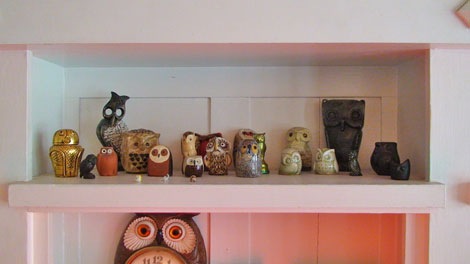
Apartment Therapy posted photos of Sam Grawe’s apartment yesterday as part of their 2008 home tour series. Sam is the Editor-in-Chief at the San Francisco based Dwell Magazine. If you are unfamiliar with Dwell, it is a magazine that focuses on modern architecture and design.
Sam has lots of goodies in his house. The place is filled with Danish modern furniture, Bertoia chairs and Scandinavian nic nacs. What did me in was the record covers and the owls. This is a man that loves owls! He has a slew of these Edvard Lindahl looking ceramic miniature birds of prey. Too be fair, it looks he holds no Owl biases. I see examples of Strigidae (Heck yea, I’m name dropping) as well as the barn yard variety. I actually know nothing about Owls. I picked all this up in a two minute search at Wikipedia. Anyways, I’m getting off track. To sum up, just check out the house tour.
No Tags
Share This
©2007 -Visit us at Grain Edit.com for more goodies. 
By: Rebecca,
on 1/18/2008
Blog:
OUPblog
(
Login to Add to MyJacketFlap)
JacketFlap tags:
A-Featured,
sunday,
singing,
rendition,
bowie,
glad,
heads,
surface,
trace,
Add a tag
Time may change me but I can’t trace time.
Sorry, I’ll stop singing now (be glad you can’t hear my off-key Bowie rendition.) I wanted to give all you wonderful OUP readers a heads-up that some surface changes will be taking place on Sunday night and the blog may be a bit wonky. Try and do your blog reading beforehand, or wait until Monday and let us know what you think of the greener OUPblog.
Share This





I love Engman's work! First saw her in an Uppercase magazine. Can't wait to read this. I love lots of details like in Mouk.